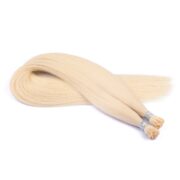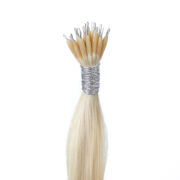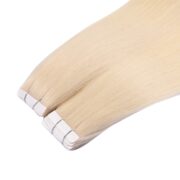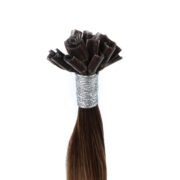
Best 20 tape in hair extensions for thin hair
Finding the best tape-in hair extensions for thin hair is not simply about choosing the smallest adhesive tab or the lightest package. Fine strands and low-density hair need a different approach to extension weight, attachment design, coverage, and blending.
The right tape-in system can add natural-looking volume and length without creating an obvious ridge at the roots. However, the wrong product or installation can cause visible attachments, slipping, discomfort, or unnecessary tension on natural hair.
This guide compares 20 tape-in extension options and configurations for fine, thin, and low-density hair. We explain the differences between invisible and regular tape-ins, compare hair grades and tape dimensions, and show how to select lengths, weights, and colors for different styling goals.
Our main recommendation: Start with a low-profile attachment, a manageable amount of hair, and a professional suitability assessment. Do not choose a full 100g or 200g installation simply because that is how a supplier sells its packages.
Quick Comparison: Which Tape-In Extensions Are Best for Thin Hair?
| Hair type or goal | Recommended option to evaluate | Main selection priority |
|---|---|---|
| Fine strands with good overall density | Invisible or flat seamless tape-ins | Low-profile attachment |
| Low-density hair | Lightweight, discreet tape-in configuration | Natural hair coverage and weight per placement |
| Thin-looking ends | Natural-density or controlled double-drawn hair | Blending from mid-lengths to ends |
| Volume without dramatic length | Shorter tape-ins with a conservative amount of hair | Low total weight |
| Fine blonde hair | Flat tape-ins with accurate blonde or rooted color | Root concealment and color matching |
| Short natural hair | 14–18 inch extensions with a blended cut | Length transition |
| Longer, fuller styling | 20–24 inch extensions after a stylist assessment | Weight, density, and maintenance |
| Occasional styling | Halo or lightweight clip-in extensions | Easy removal and limited attachment time |
The 20 options below are product constructions and purchasing configurations, not 20 independently tested brands. Several can be combined into one specification. For example, a salon might order an 18-inch Remy Invisible Tape-In with a flexible PU base and a custom color.
Fine Hair vs. Thin Hair: Understand the Difference First
Before choosing extensions, identify what makes the natural hair difficult to work with.
What is fine hair?
Fine hair refers to the diameter of individual strands. Fine strands can feel soft and lightweight, but they may be more vulnerable to repeated pulling, friction, and aggressive brushing.
A client can have fine hair but still have plenty of natural coverage. In this case, the main challenge may be finding an attachment that does not create visible bulk.
What is thin hair?
Thin hair generally refers to lower overall hair density. There may be fewer natural hairs available to cover each attachment.
This creates two separate challenges:
- The extension must be supported by an appropriate natural hair section.
- There must be enough surrounding hair to conceal the tape.
A product that works well on fine but dense hair may not blend naturally on a client with sparse temples or a visibly thinning crown.
When should tape-ins be reconsidered?
Tape-in extensions are not automatically suitable for every person with thin hair. Clients with active or unexplained shedding, significant breakage, scalp irritation, or very weak attachment areas should seek a professional assessment before adding extensions.
The American Academy of Dermatology notes that extensions and weaves can contribute to traction-related hair loss when they repeatedly pull on natural hair. Pain, stinging, or other signs of excessive tension should be addressed promptly.
Read the American Academy of Dermatology’s guidance on hairstyles that can cause hair loss before deciding on an extension method.
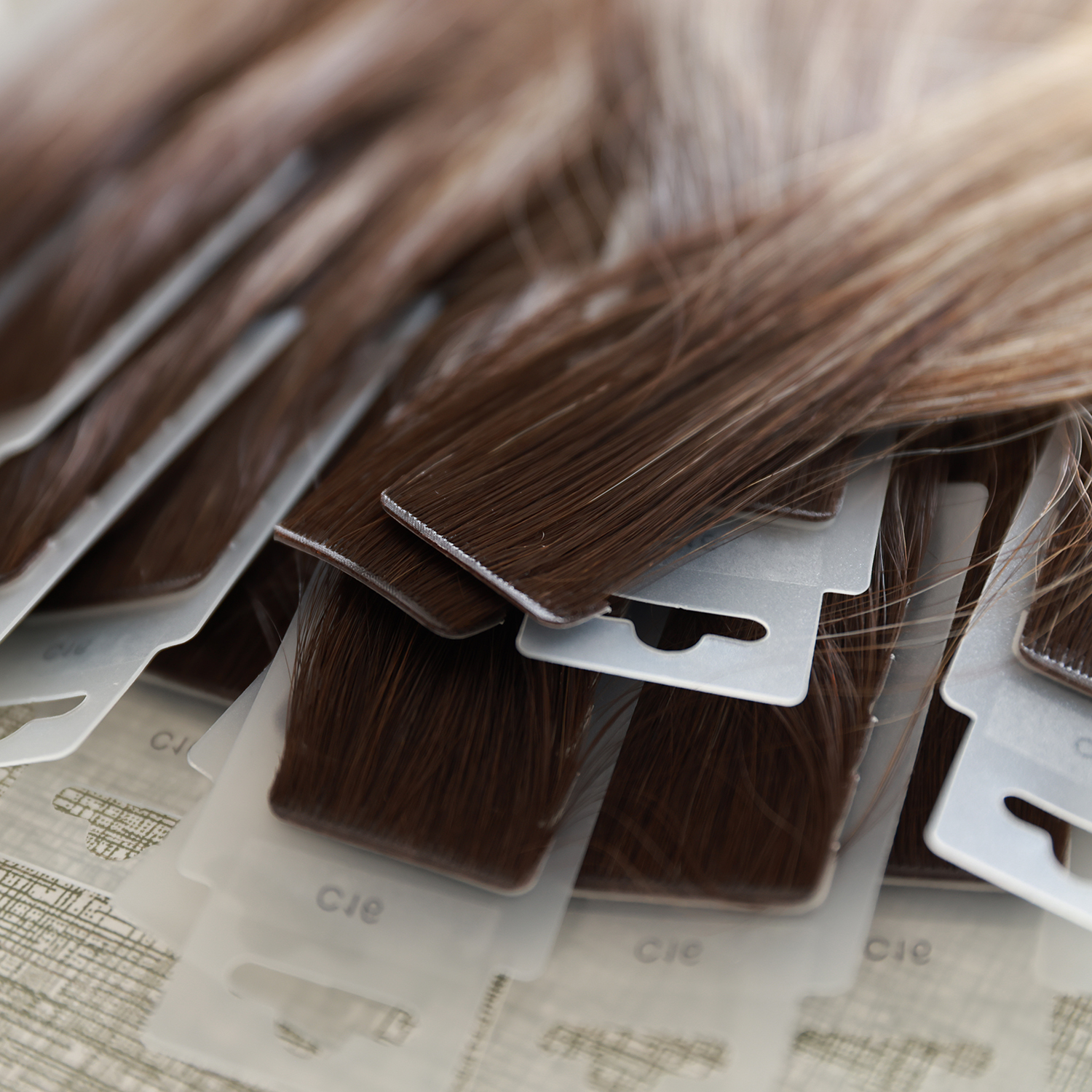
20 Best Tape-In Hair Extensions and Configurations for Thin Hair
The best choice depends on more than the product name. Consider the attachment, hair quality, weight, length, texture, and color together.
A. Best Tape-In Attachment Designs
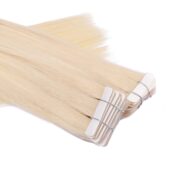
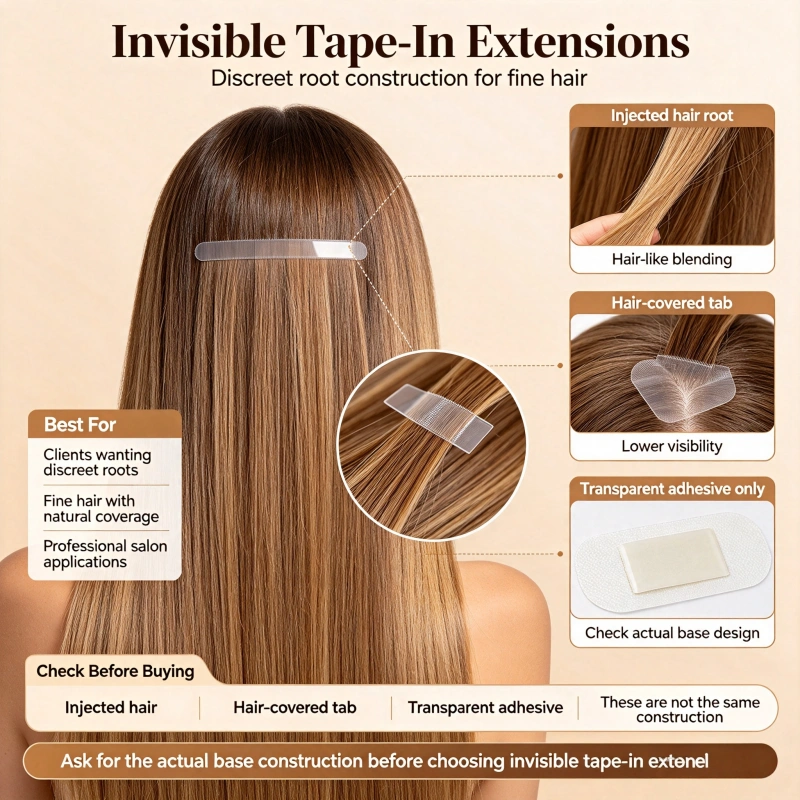
1. Invisible Tape-In Extensions
Invisible Tape-In extensions are one of the first options worth evaluating for fine hair.
Some versions use an injected or hair-covered root construction to create a scalp-like appearance. This can make the attachment less noticeable when the surrounding natural hair is fine.
Best for:
- Clients who want a discreet root appearance.
- Fine hair with enough natural coverage.
- Professional salon applications.
Check before buying: Ask whether the product uses injected hair, a hair-covered tab, or simply transparent adhesive. These are different constructions, even when they all use the word “invisible.”
Explore ALOVEHAIR Invisible Tape-In Extensions for product construction and available options.
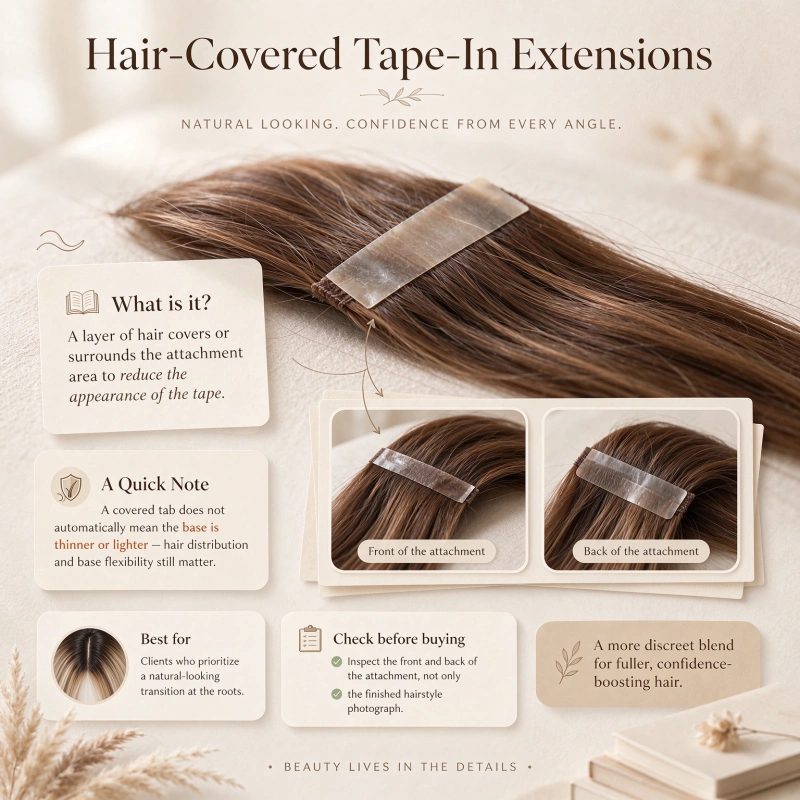
2. Hair-Covered Tape-In Extensions
Hair-covered tape-ins use a layer of hair over or around the attachment area to reduce the appearance of the tape.
This construction can be useful when a client is concerned about visible attachment edges.
However, a covered tab does not automatically mean the base is thinner or lighter. The hair distribution and base flexibility still matter.
Best for: Clients who prioritize a natural-looking transition at the roots.
Check before buying: Inspect the front and back of the attachment, not only the finished hairstyle photograph.
3. Flat PU Tape-In Extensions
A flat polyurethane (PU) base can sit close to the head and reduce the bulky appearance associated with thicker attachment structures.
The base should be flexible enough to follow the shape of the scalp without creating a stiff ridge.
Best for: Fine straight hair and clients who want a flat root finish.
Check before buying: Compare the complete installed base thickness, flexibility, and hair coverage. A product described as flat should still be tested on a real head of hair.

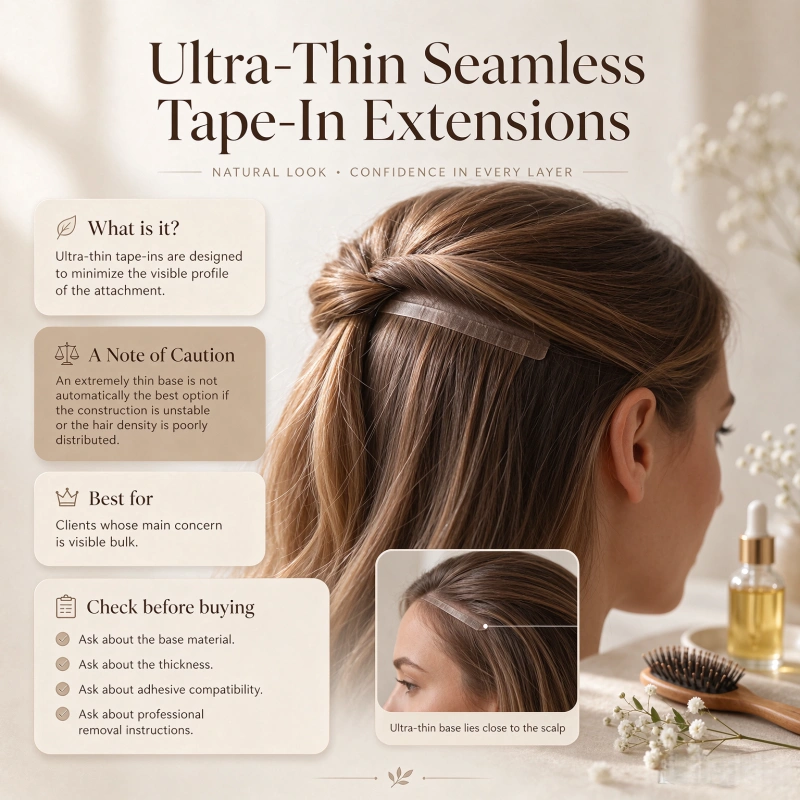
4. Ultra-Thin Seamless Tape-In Extensions
Ultra-thin tape-ins are designed to minimize the visible profile of the attachment.
This may help when the client’s natural hair does not easily cover thicker tabs. Still, an extremely thin base is not automatically the best option if the construction is unstable or the hair density is poorly distributed.
Best for: Clients whose main concern is visible bulk.
Check before buying: Ask about the base material, thickness, adhesive compatibility, and professional removal instructions.
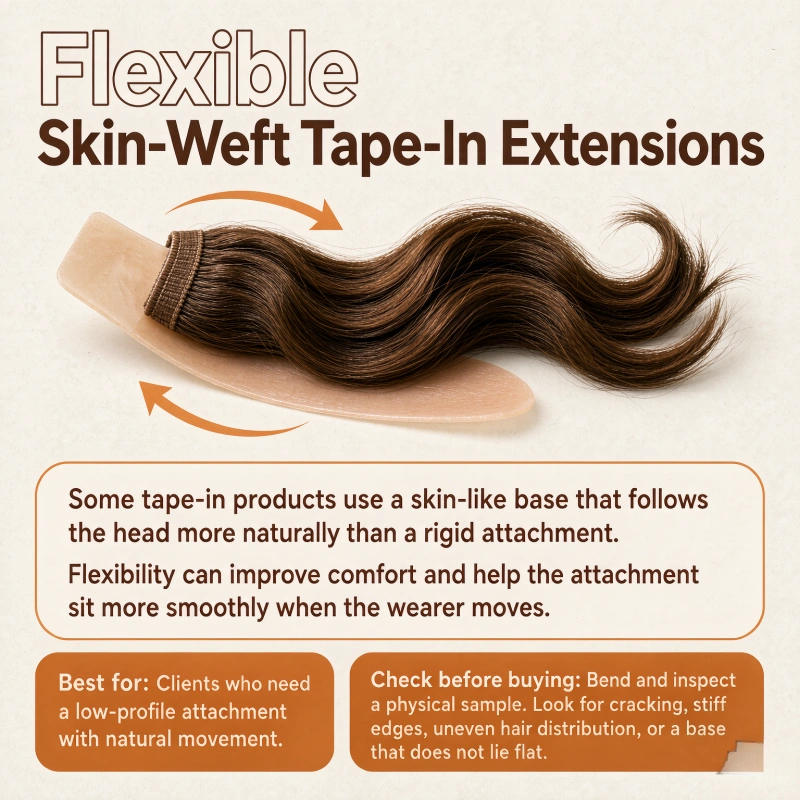
5. Flexible Skin-Weft Tape-In Extensions
Some tape-in products use a skin-like base that follows the head more naturally than a rigid attachment.
Flexibility can improve comfort and help the attachment sit more smoothly when the wearer moves.
Best for: Clients who need a low-profile attachment with natural movement.
Check before buying: Bend and inspect a physical sample. Look for cracking, stiff edges, uneven hair distribution, or a base that does not lie flat.
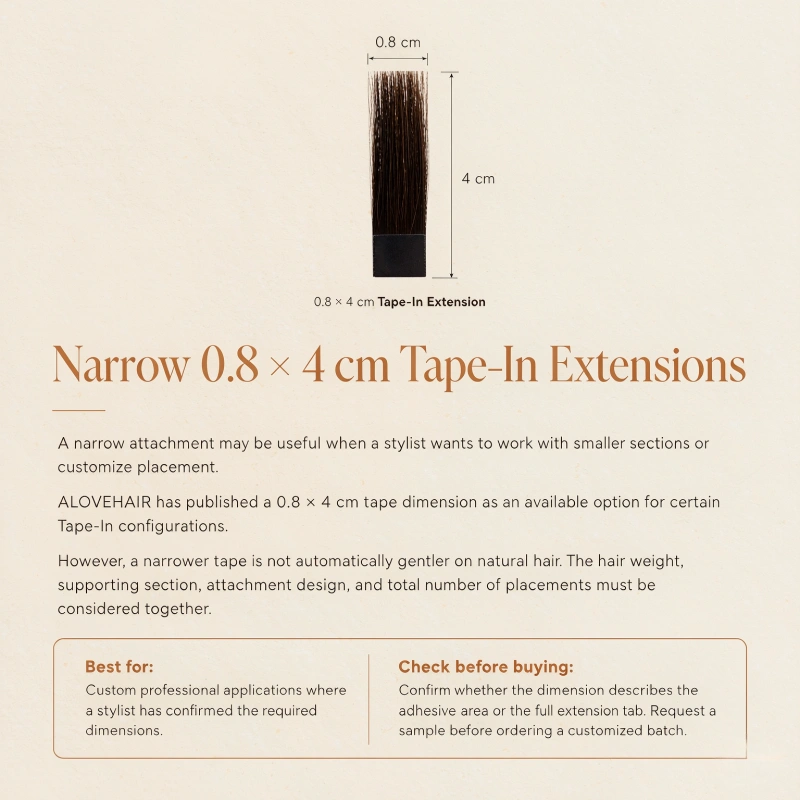
6. Narrow 0.8 × 4 cm Tape-In Extensions
A narrow attachment may be useful when a stylist wants to work with smaller sections or customize placement.
ALOVEHAIR has published a 0.8 × 4 cm tape dimension as an available option for certain Tape-In configurations.
However, a narrower tape is not automatically gentler on natural hair. The hair weight, supporting section, attachment design, and total number of placements must be considered together.
Best for: Custom professional applications where a stylist has confirmed the required dimensions.
Check before buying: Confirm whether the dimension describes the adhesive area or the full extension tab. Request a sample before ordering a customized batch.
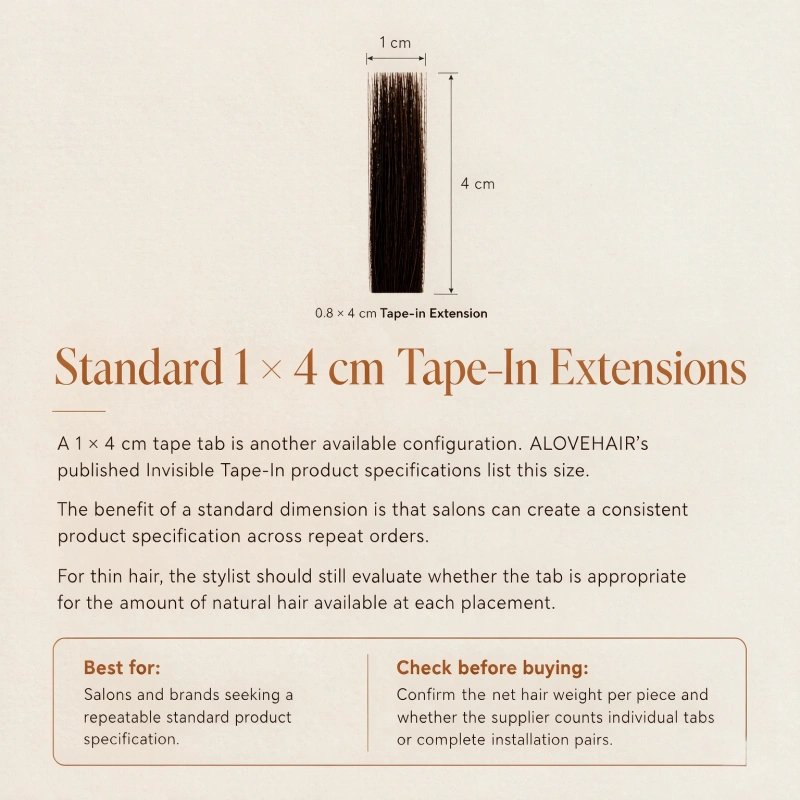
7. Standard 1 × 4 cm Tape-In Extensions
A 1 × 4 cm tape tab is another available configuration. ALOVEHAIR’s published Invisible Tape-In product specifications list this size.
The benefit of a standard dimension is that salons can create a consistent product specification across repeat orders.
For thin hair, the stylist should still evaluate whether the tab is appropriate for the amount of natural hair available at each placement.
Best for: Salons and brands seeking a repeatable standard product specification.
Check before buying: Confirm the net hair weight per piece and whether the supplier counts individual tabs or complete installation pairs.
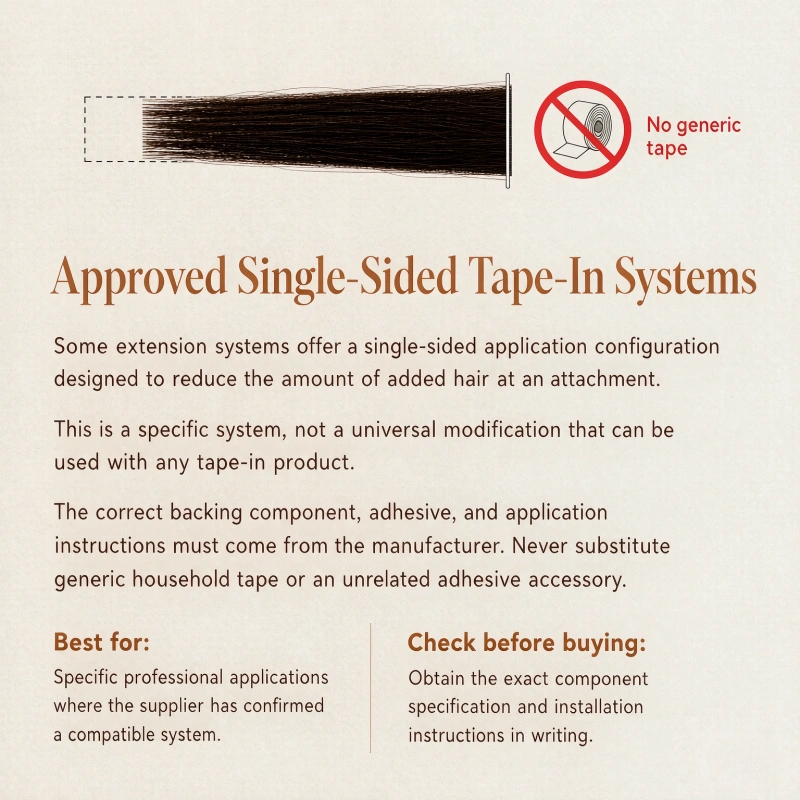
8. Manufacturer-Approved Single-Sided Tape-In Systems
Some extension systems offer a single-sided application configuration designed to reduce the amount of added hair at an attachment.
This is a specific system, not a universal modification that can be used with any tape-in product.
The correct backing component, adhesive, and application instructions must come from the manufacturer. Never substitute generic household tape or an unrelated adhesive accessory.
Best for: Specific professional applications where the supplier has confirmed a compatible system.
Check before buying: Obtain the exact component specification and installation instructions in writing.
B. Best Hair Quality and Density Options
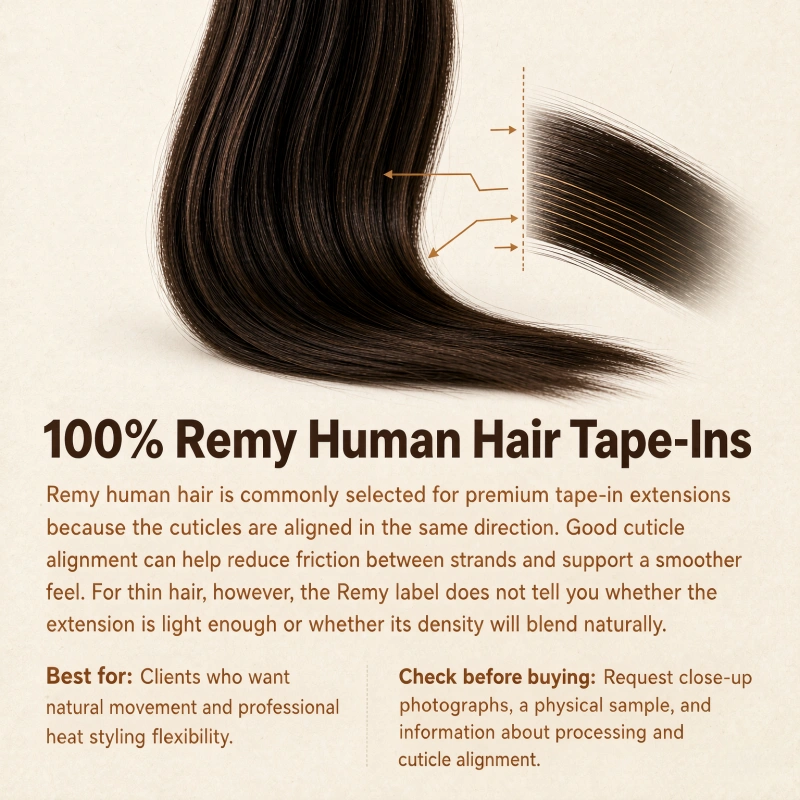
9. 100% Remy Human Hair Tape-Ins
Remy human hair is commonly selected for premium tape-in extensions because the cuticles are aligned in the same direction.
Good cuticle alignment can help reduce friction between strands and support a smoother feel.
For thin hair, however, the Remy label does not tell you whether the extension is light enough or whether its density will blend naturally.
Best for: Clients who want natural movement and professional heat styling flexibility.
Check before buying: Request close-up photographs, a physical sample, and information about processing and cuticle alignment.
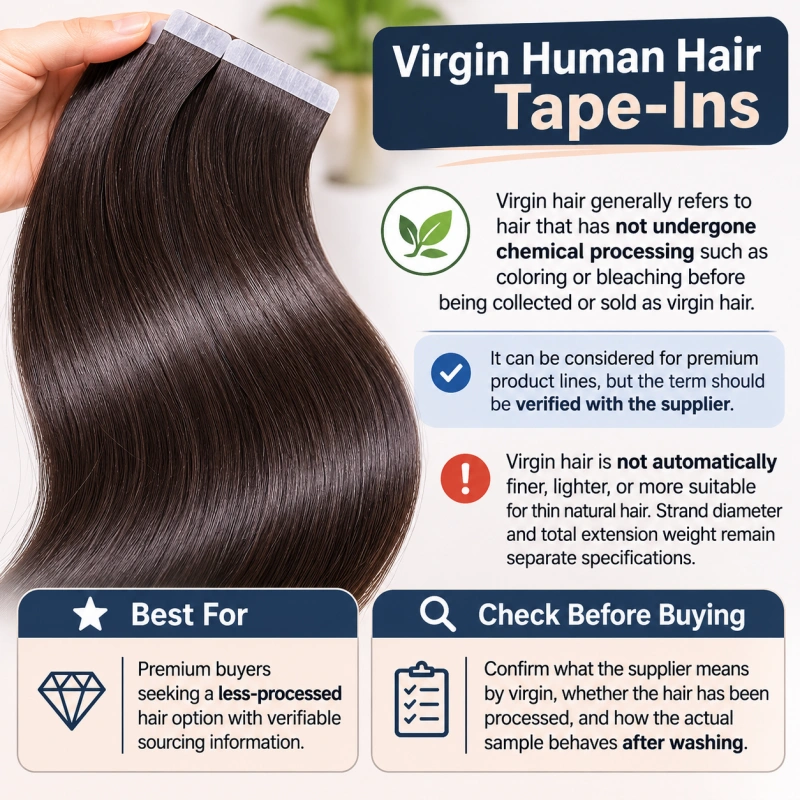
10. Virgin Human Hair Tape-Ins
Virgin hair generally refers to hair that has not undergone chemical processing such as coloring or bleaching before being collected or sold as virgin hair.
It can be considered for premium product lines, but the term should be verified with the supplier.
Virgin hair is not automatically finer, lighter, or more suitable for thin natural hair. Strand diameter and total extension weight remain separate specifications.
Best for: Premium buyers seeking a less-processed hair option with verifiable sourcing information.
Check before buying: Confirm what the supplier means by virgin, whether the hair has been processed, and how the actual sample behaves after washing.
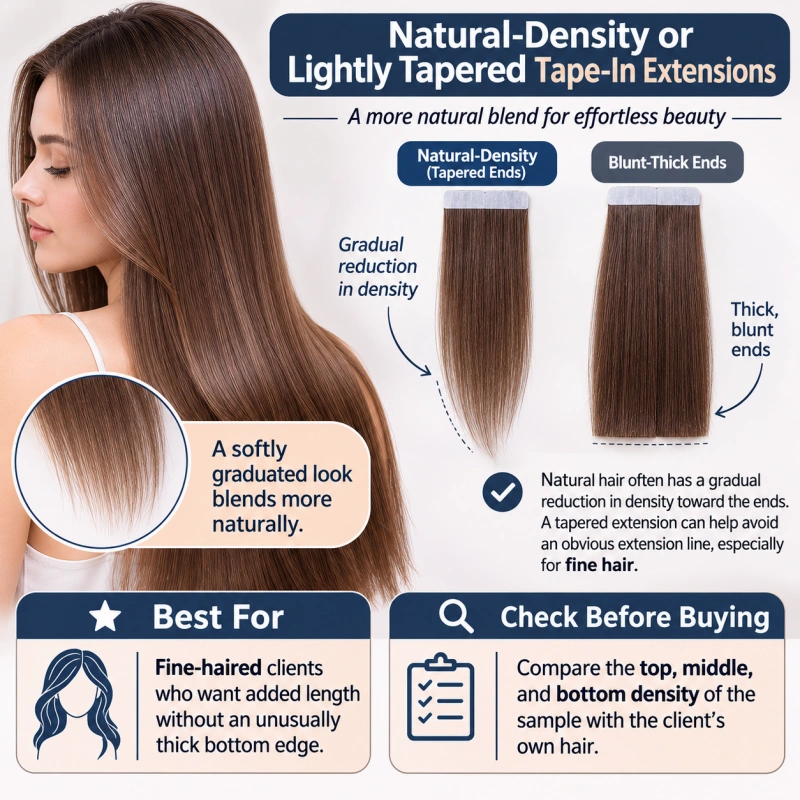
11. Natural-Density or Lightly Tapered Tape-In Extensions
Natural hair often has a gradual reduction in density toward the ends. An extension with a softly graduated appearance may therefore blend more naturally than one with extremely thick, blunt ends.
For clients with fine hair, this is particularly important because a sudden change in density can make the extension line obvious.
Best for: Fine-haired clients who want added length without an unusually thick bottom edge.
Check before buying: Compare the top, middle, and bottom density of the sample with the client’s own hair.
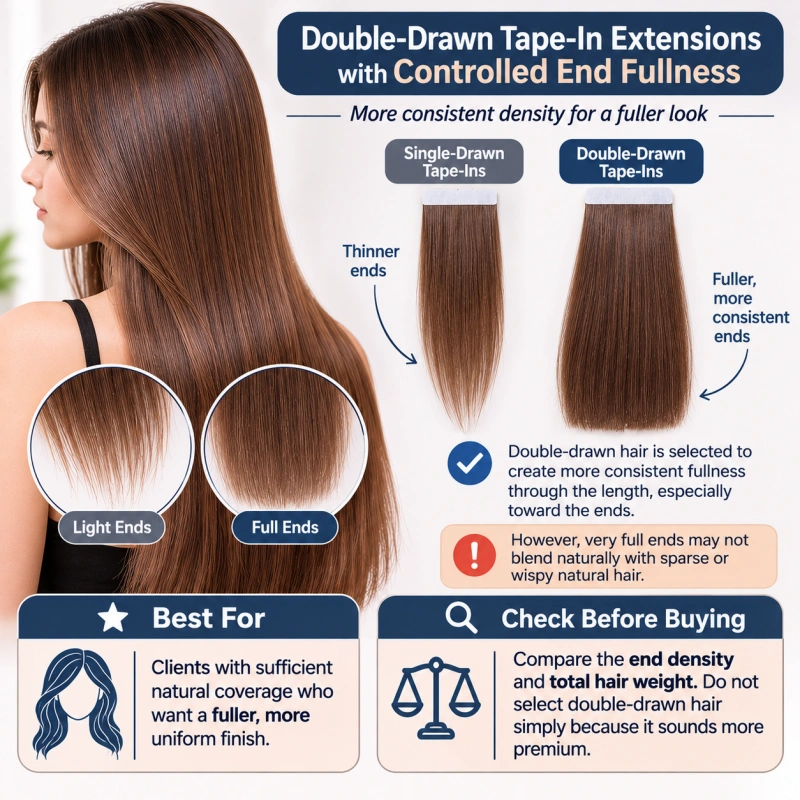
12. Double-Drawn Tape-In Extensions with Controlled End Fullness
Double-drawn hair is selected to create more consistent fullness through the length, especially toward the ends.
This can be useful when a client wants a fuller silhouette. However, very full ends may not blend naturally with sparse or wispy natural hair.
Best for: Clients with sufficient natural coverage who want a fuller, more uniform finish.
Check before buying: Compare the end density and total hair weight. Do not select double-drawn hair simply because it sounds more premium.
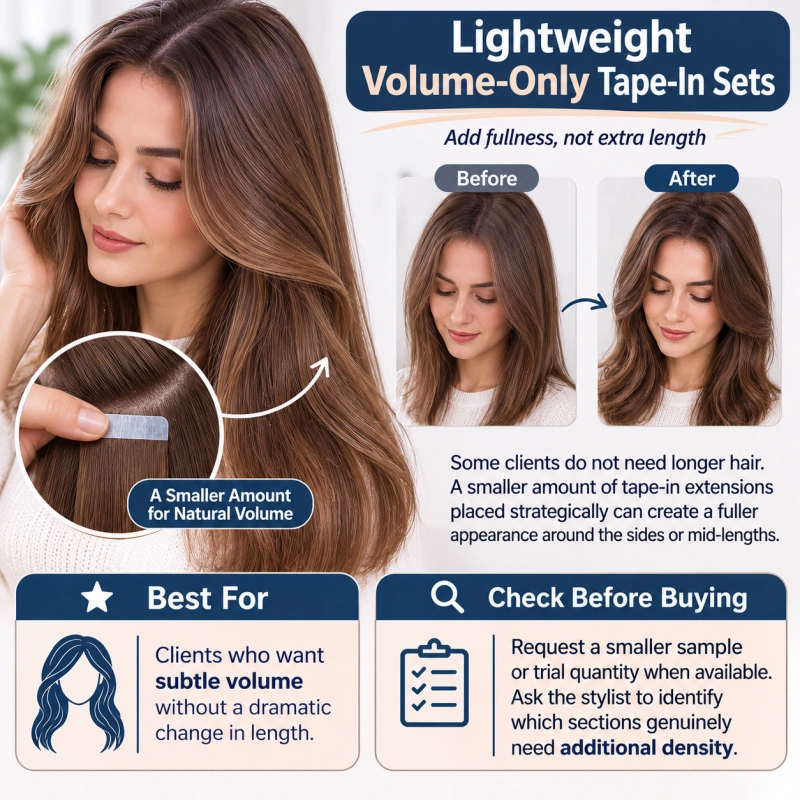
13. Lightweight Volume-Only Tape-In Sets
Some clients do not need longer hair. They simply want a fuller appearance around the sides or through the mid-lengths.
For this goal, a smaller amount of hair placed strategically may look more natural than a full-head installation.
Best for: Clients who want subtle volume without a dramatic change in length.
Check before buying: Request a smaller sample or trial quantity when available. Ask the stylist to identify which sections genuinely need additional density.
14. Custom-Weight Tape-In Packs
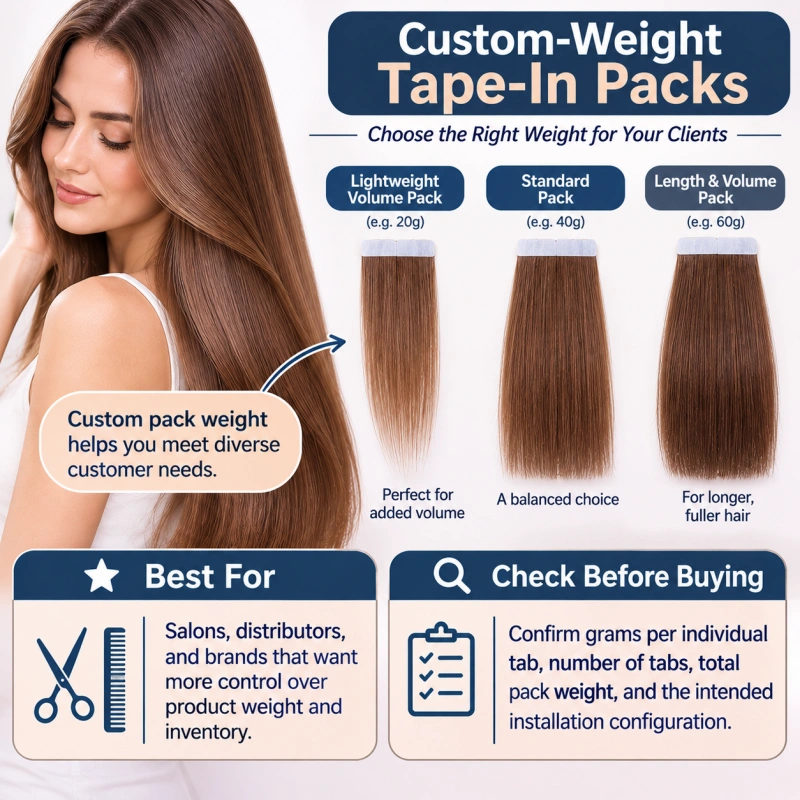
A standard retail package may contain more hair than an individual thin-haired client needs.
For salons and private-label brands, custom pack weight can make it easier to serve several customer groups with different requirements.
For example, a brand might develop a lower-weight volume pack and a separate length-and-volume pack instead of selling every customer the same full-head configuration.
Best for: Salons, distributors, and brands that want more control over product weight and inventory.
Check before buying: Confirm grams per individual tab, number of tabs, total pack weight, and the intended installation configuration.
C. Best Tape-In Lengths for Thin Hair
15. 14–16 Inch Tape-In Extensions
Shorter extensions are useful for subtle fullness and easier blending.
They can be particularly practical for clients whose natural hair is around shoulder length or for those who want to improve the appearance of thin ends.
Best for: Volume, shorter styles, and clients new to tape-in extensions.
Check before buying: Match the natural hair length and cutting plan before selecting the pack.
16. 18 Inch Tape-In Extensions
Eighteen-inch extensions offer a middle ground between added length and manageability.
They can create a noticeable transformation without going immediately to very long hair.
Best for: Clients who want a moderate length increase and natural-looking volume.
Check before buying: Make sure the natural ends can blend into the extension without a visible step.
17. 20 Inch Tape-In Extensions
Twenty-inch tape-ins are a popular option for clients seeking longer hair while retaining a relatively manageable styling length.
The final result depends on natural hair length, density, texture, and the amount of extension hair installed.
Best for: Clients with adequate natural coverage who want longer, flowing hair.
Check before buying: Request a sample at the intended length and evaluate how the ends look next to the natural hair.
18. 22–24 Inch Tape-In Extensions
Longer tape-in extensions create a more dramatic result. They may also require more careful weight planning and maintenance.
A client with very fine or fragile natural hair should not choose a long length without considering the added leverage, styling habits, and ability to conceal the attachments.
Best for: Clients with enough natural hair to support and conceal the selected system.
Check before buying: Compare the total weight and end density at the selected length. A longer product is not automatically a better investment.
D. Best Texture and Color Options
19. Texture-Matched Straight, Body Wave, and Curly Tape-Ins
Texture matching is important for a natural blend.
Straight extensions can look disconnected from naturally wavy hair, while an overly pronounced curl pattern may create an obvious difference after washing.
Common options include:
- Straight or silky straight.
- Natural wave or body wave.
- Loose curl.
- Curly textures.
Best for: Clients who want the extension texture to work naturally with their existing hair routine.
Check before buying: Compare the sample after washing and air-drying, not only when it is freshly styled.
20. Rooted, Balayage, Ombre, and Piano-Color Tape-Ins
Dimensional colors can make blending easier when the natural hair already contains multiple tones.
Instead of choosing a single flat shade, a stylist may select a combination that resembles the client’s natural highlights and lowlights.
Popular options include:
- Rooted blonde.
- Ash blonde and beige blonde blends.
- Brown-to-blonde balayage.
- Ombre.
- Piano or multi-tone colors.
Best for: Highlighted, balayage, and multi-dimensional natural hair.
Check before buying: Compare the root area, mid-lengths, and ends under natural daylight. Use a physical color ring or approved sample whenever possible.
How Much Tape-In Hair Do You Need for Thin Hair?
There is no universal gram amount that is appropriate for every thin-haired client.
The required quantity depends on:
- Natural hair density.
- Individual strand thickness.
- Length of the natural hair.
- Desired result: volume, length, or both.
- Number and placement of attachment points.
- Whether the extensions can be fully concealed.
Some current product roundups recommend starting with approximately 30–50g for subtle volume, while professional supplier guides may use different pack ranges. These are buying references, not medical or universal safety limits.
Understand the difference between grams, pieces, and pairs
This is one of the most important details when comparing tape-in products.
ALOVEHAIR’s published Invisible Tape-In product lists:
| Specification | Published product details |
|---|---|
| Hair type | Luxury Remy human hair |
| Total pack weight | 100g |
| Pieces per pack | 40 pieces |
| Tape dimension | 1 × 4 cm |
| Length and color | Customizable |
| Typical move-up guidance | 6–8 weeks |
If 40 means 40 individual hair-bearing tabs, the arithmetic is 100g divided by 40, or approximately 2.5g per tab.
In a conventional sandwich application, two hair-bearing tabs may be used together. That means the pair can contain approximately 5g of extension hair.
Do not confuse 40 individual tabs with 40 complete sandwich pairs. Suppliers may describe pack quantities differently, so ask for clarification before comparing prices or planning an installation.
Most importantly, a 100g retail or wholesale package is a product specification. It does not mean a client with thin hair should automatically install the entire package.
For professional product details, see the ALOVEHAIR Invisible Tape-In product page.
Which Tape-In Extensions Should You Choose for Different Hair Conditions?
Use the following table as a starting point for a salon consultation.
| Client situation | Product configuration to discuss | Main concern |
|---|---|---|
| Fine but dense hair | Flat or invisible tape with matched density | Avoid visible bulk |
| Fine hair with thin ends | Natural-density or graduated hair | Blend the bottom edge |
| Low-density sides | Conservative placement and low-profile tabs | Ensure enough natural coverage |
| Sparse crown | Consider whether a topper is more appropriate | Avoid exposed attachments |
| Short natural hair | 14–18 inch lengths and blended cutting | Prevent a visible length step |
| Wants only volume | Lower-weight or partial installation | Avoid unnecessary added hair |
| Wants dramatic length | Longer lengths after a professional assessment | Added weight and maintenance |
| Highlighted hair | Rooted or dimensional colors | Avoid a flat color mismatch |
If the main concern is thinning around the part or crown, a hair extension may not be the most suitable solution. A human hair topper may provide a more appropriate way to improve coverage in selected cases.
How to Make Tape-In Extensions Look Natural on Thin Hair
Even a high-quality product can look unnatural if the placement, color, or density is wrong.
1. Match the Extension to the Natural Hair
Compare the extension with the client’s natural hair under daylight.
Do not match only the roots. The mid-lengths and ends are often the most important areas for a seamless blend.
For dimensional hair, consider rooted and multi-tone shades rather than choosing a flat color based on one photograph.
2. Avoid Overloading Each Attachment
The amount of natural hair used to support an attachment should be evaluated by a trained stylist.
The extension should not be heavier than the natural hair section can reasonably support. More pieces do not necessarily create a better result.
3. Leave Enough Natural Hair to Conceal the Tabs
The stylist should check the client’s normal parting, sides, crown, and preferred hairstyles.
A tab that looks hidden when the hair is resting may become visible when the wearer moves or ties the hair back.
4. Blend the Ends
If the natural hair is thin at the bottom, a blunt extension edge can create an obvious difference.
A professional cut and appropriate density selection can help connect the natural ends with the extension hair.
5. Follow the Correct Installation Method
Tape-in products should be installed and removed according to the supplier’s instructions.
For a step-by-step overview, see our Invisible Tape Extension Installation and Removal Guide.
Tape-In Extension Maintenance for Fine and Thin Hair
Maintenance is essential because natural hair continues to grow while the extensions remain attached.
ALOVEHAIR’s Invisible Tape-In product lists a typical move-up interval of approximately 6–8 weeks. Other brands and systems may recommend different schedules. The stylist should follow the instructions for the exact product and assess root growth and attachment condition.
Useful maintenance practices include:
- Brush gently, starting at the ends.
- Support the attachment area while detangling.
- Keep conditioner, oils, and heavy styling products away from the adhesive.
- Dry the attachment area thoroughly after washing.
- Avoid aggressive pulling when styling.
- Follow the supplier’s instructions for washing and heat styling.
- Schedule professional removal and reinstallation.
When the adhesive needs replacing, use a compatible product rather than applying a random adhesive strip. See the ALOVEHAIR Replacement Tape range.
If a client feels pain, stinging, or persistent pulling, the attachment should be assessed rather than left in place. The American Academy of Dermatology identifies these symptoms as warning signs that a hairstyle may be causing excessive tension.
Tape-In vs. Halo vs. Clip-In: Which Is Better for Thin Hair?
Tape-ins are not the only option. Some clients may prefer a temporary method that can be removed at the end of the day.
| Extension method | Main advantage | Main limitation | Possible use case |
|---|---|---|---|
| Tape-In | Semi-permanent, flat attachment | Requires professional maintenance | Suitable candidates wanting ongoing volume or length |
| Halo | No adhesive attachment to individual strands | May not suit every hairstyle or scalp shape | Occasional volume and length |
| Clip-In | Can be removed daily | Clips may show or feel heavy if overloaded | Temporary styling |
| Hair Topper | Adds coverage to a selected area | Must match the affected area and hairline | Localized crown or part coverage |
For temporary use, compare ALOVEHAIR Halo Hair Extensions and Clip-In Hair Extensions.
For readers who want a more detailed comparison of tape-in advantages and limitations, visit our Tape-In Hair Extensions Pros and Cons Guide.
What Should You Check Before Buying Tape-In Extensions?
Before purchasing, compare the complete product specification rather than choosing by length or package price alone.
| Buying factor | Questions to ask |
|---|---|
| Hair type | Is it 100% human hair, Remy, or virgin hair? |
| Cuticle alignment | How is cuticle direction controlled? |
| Base construction | Is it injected, hair-covered, flat PU, or standard tape? |
| Tab dimensions | What are the exact width and length? |
| Piece count | Does the count refer to individual tabs or pairs? |
| Weight | What is the net hair weight per tab and per pack? |
| Length | Is the listed length measured straight or in its natural texture? |
| Color | Can the supplier match a physical reference? |
| Adhesive | Which replacement tape and remover are compatible? |
| Reuse | Can the hair be professionally removed, cleaned, and re-taped? |
| Quality control | Are weight, length, color, shedding, and smoothness inspected? |
| Customization | Can the supplier adjust weight, dimensions, colors, or packaging? |
A Practical Sample-Testing Checklist
Before ordering a large quantity, ask for a sample and inspect it using the same criteria for every supplier.
Hair quality
- Check the hair from the attachment area to the ends.
- Look for uneven density and excessive short hairs.
- Brush gently and observe shedding.
- Wash and dry according to the supplier’s instructions.
Attachment design
- Check whether the base lies flat.
- Inspect the hair-to-base transition.
- Confirm the tape dimensions.
- Check flexibility and edge finishing.
Color and blending
- Compare the sample with natural hair in daylight.
- Check both root and end colors.
- Test the actual texture after washing.
- Evaluate whether the ends blend without a visible step.
Order specification
- Confirm total pack weight.
- Confirm individual tab count.
- Clarify whether counts refer to tabs or sandwich pairs.
- Record the approved color, length, dimension, and packaging.
Keep an approved sample as a reference for repeat orders. This is especially useful for salon chains and private-label brands that need consistency between production batches.
Why Work with a Tape-In Hair Extension Manufacturer?
For individual clients, a professional salon may be the most convenient place to purchase and install tape-ins. For salons, wholesalers, and private-label brands, working directly with a manufacturer can offer more control over product specifications.
At ALOVEHAIR, we manufacture human hair extensions for professional salons, distributors, and hair brands. Our product range includes regular Tape-In, Invisible Tape-In, weft extensions, and other hair extension systems.
For thin-hair product development, buyers can discuss:
- Custom hair lengths.
- Different color combinations.
- Tape dimensions and base construction.
- Pack weight and piece configuration.
- Private-label packaging.
- OEM and ODM requirements.
Our published Invisible Tape-In specification includes 100g per pack, 40 pieces, and a 1 × 4 cm tape dimension. Custom colors and lengths can be discussed according to the order requirements.
We recommend confirming the exact piece-count definition and weight per tab before approving a sample. This makes it easier for salons to compare suppliers accurately and plan products for different customer groups.
Learn more about ALOVEHAIR and our manufacturing background.
Frequently Asked Questions
1. Are tape-in hair extensions good for thin hair?
They can be suitable for some people with fine or low-density hair when the product, weight, and placement are appropriate. However, they are not suitable for every client. A professional should assess the natural hair and attachment areas before installation.
2. What type of tape-in extensions look most natural on thin hair?
Invisible, injected, hair-covered, and flat seamless tape-ins are worth evaluating because they are designed to reduce visible bulk at the roots. The final appearance also depends on hair coverage, color matching, density, and installation.
3. Are invisible tape-ins lighter than regular tape-ins?
Not necessarily. Invisible describes the root appearance or construction. It does not automatically indicate a lower hair weight. Compare the actual grams per tab, dimensions, and base construction before choosing.
4. How much tape-in hair should I use for thin hair?
There is no universal amount. Some clients need only a small amount for volume, while others need more coverage or length. The stylist should assess the natural hair, attachment areas, and desired result before deciding how much hair to install.
5. Is a 50g or 100g pack better for thin hair?
The right pack depends on the product configuration and intended use. A 50g pack may be useful for a smaller order or sample, while a 100g pack may be a standard manufacturer or retail package. Neither package size should be treated as a universal installation recommendation.
6. How often should tape-in extensions be moved up?
Many professional tape-in systems are maintained around every 6–8 weeks, but the exact interval varies by product, hair growth, and installation. Follow the manufacturer’s instructions and arrange professional checks.
7. Can I reuse tape-in extensions?
Some human hair tape-ins can be reused after professional removal, cleaning, and replacement of the adhesive. Reuse depends on the condition of the hair and attachment base. Damaged, heavily tangled, or shedding extensions may no longer be suitable.
8. Are double-drawn extensions suitable for fine hair?
They can be suitable when the client wants fuller ends and has enough natural hair to blend with them. However, very dense ends may look disconnected from fine natural hair. Compare the actual sample rather than choosing by the Double Drawn label alone.
9. Can I install tape-in extensions at home?
Professional installation and removal are recommended. Incorrect section size, placement, adhesive handling, or removal can create unnecessary tension or breakage. Follow the product instructions and use a qualified stylist.
10. What if my hair is too thin for tape-ins?
A halo, lightweight clip-in, or hair topper may be worth discussing with a professional. The best alternative depends on whether the main concern is overall density, localized crown coverage, or temporary length.
Final Thoughts: Choose the Right Weight, Not Simply More Hair
The best tape-in hair extensions for thin hair are not necessarily the longest, thickest, or most expensive products.
A more natural result comes from matching the attachment construction, hair density, weight, length, texture, and color to the client’s natural hair.
For fine strands, reduce unnecessary bulk and pay attention to the attachment profile. For low-density hair, prioritize coverage and the amount of natural hair available to support each placement. For fragile or actively shedding hair, consider whether attached extensions are appropriate at all.
At ALOVEHAIR, we believe the best product specification starts with the actual customer and salon requirement. A carefully selected sample, clear weight and piece-count information, and consistent production specifications are more valuable than a generic claim that one tape-in product is suitable for everyone.
To discuss custom Invisible Tape-In specifications, samples, or wholesale orders, contact the ALOVEHAIR team.

Alove Hair is a professional Chinese manufacturer of premium 100% Remy human hair extensions, wigs, and hair systems. Established in 2014, the company specializes in supplying global salons and distributors with high-quality, cuticle-intact hair products and offers comprehensive OEM/ODM private label services.