
Single Weft vs Double Weft: Which Hair Extension Weft Is Better?
When choosing weft hair extensions, one of the first decisions is whether to buy single-weft or double-weft. The difference may seem simple, but it affects how thick the extensions feel, how much volume they add, how many pieces you need, and how well they blend with the client’s natural hair.
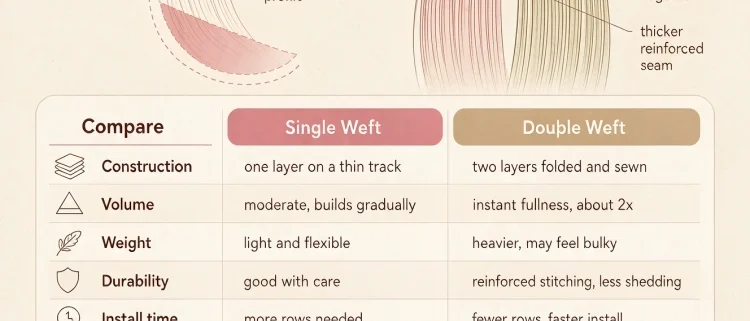
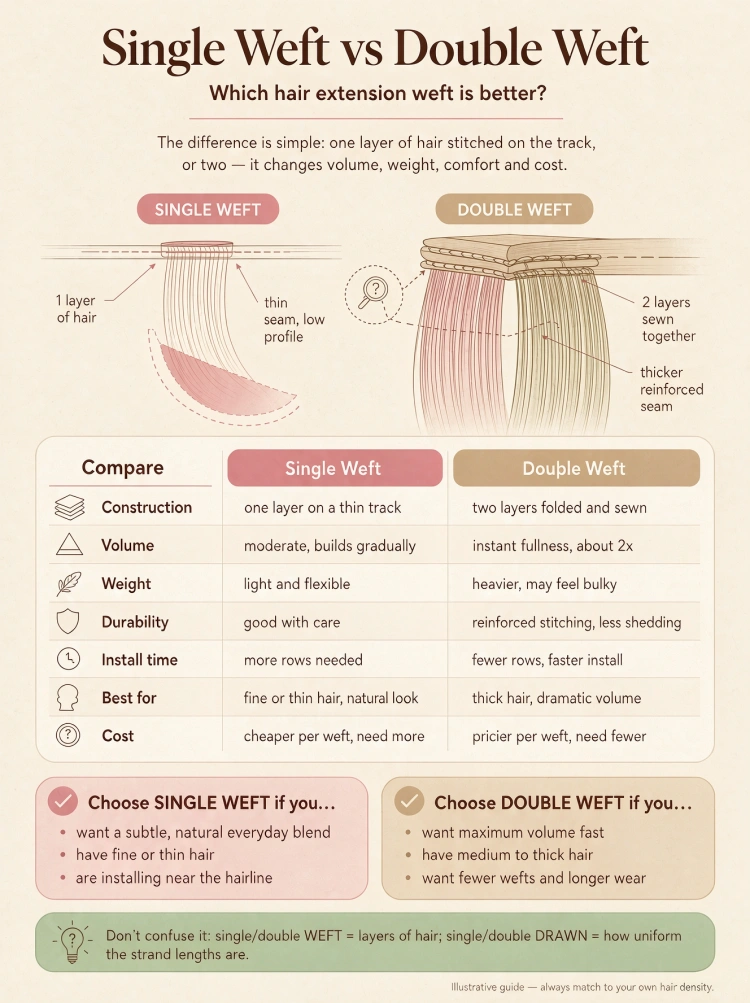
A single weft uses one layer of hair sewn onto the weft. A double weft has two layers sewn together, creating a thicker and denser hair extension.
For buyers, salon owners, and extension brands, the right choice is not simply “single or double.” It depends on the client’s natural hair density, desired volume, extension length, application method, and budget.
Single Weft vs Double Weft: Quick Comparison
| Feature | Single Weft | Double Weft |
|---|---|---|
| Hair layers | One layer | Two layers |
| Thickness | Thinner | Thicker |
| Weight per piece | Lower | Higher |
| Volume | Moderate | High |
| Natural movement | Very flexible | Fuller and denser |
| Best for | Fine to medium hair | Medium to thick hair |
| Coverage | Lower | Higher |
| Number of pieces needed | Usually more | Usually fewer |
| Installation | Lightweight | More substantial |
| Cost per piece | Usually lower | Usually higher |
| Best use | Natural, lightweight looks | Full-volume hairstyles |
The key difference is density. A double weft contains more hair in the same general width, so it creates a fuller appearance without necessarily requiring as many separate pieces.
What Is a Single Weft?
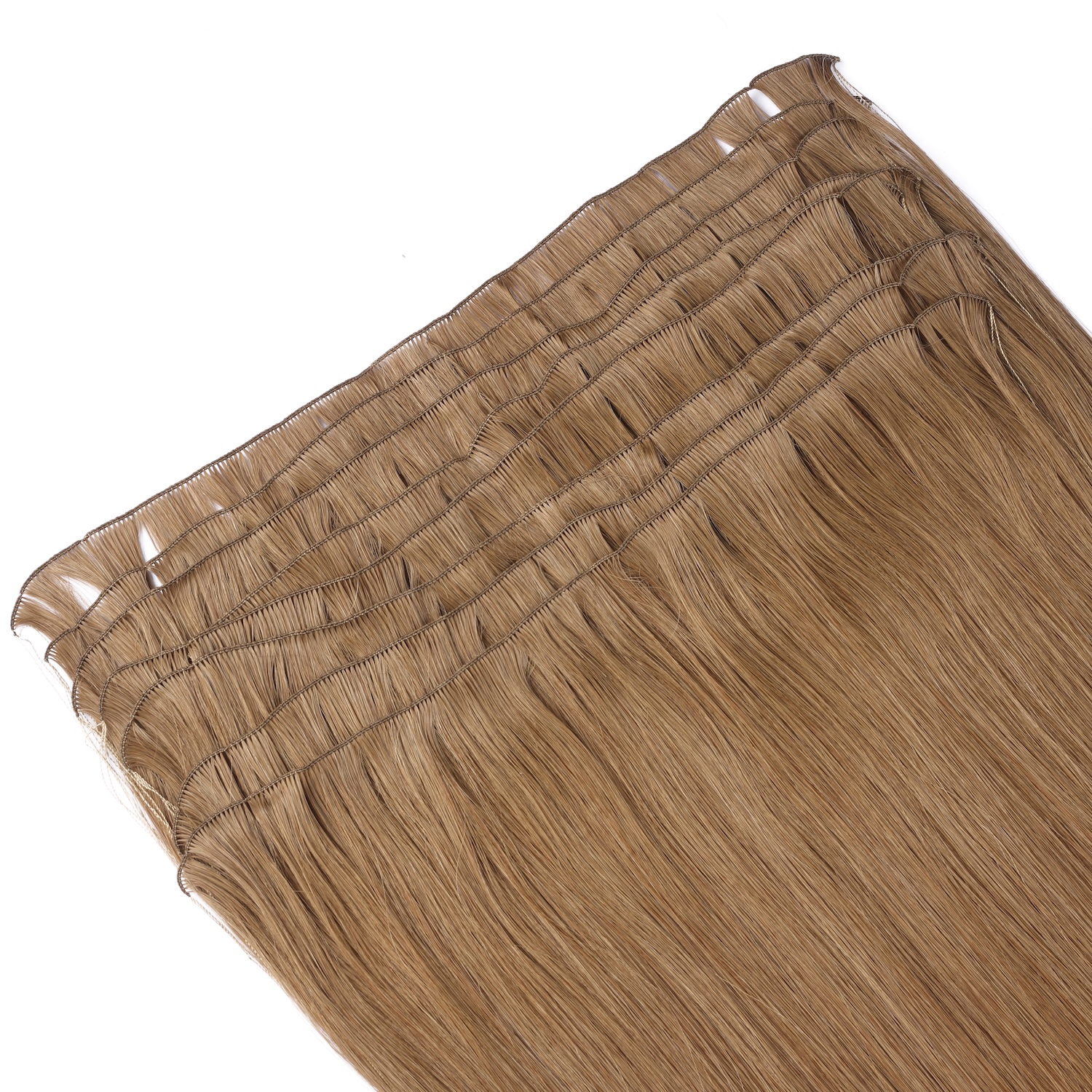
A single weft hair extension has one layer of hair sewn onto the weft track.
Because each track has less hair, single wefts are relatively lightweight and flexible. They can lie closer to the natural hair and are often useful when the goal is to add length or moderate volume without creating too much bulk.
For example, a salon working with a client who has fine or medium-density natural hair may prefer single wefts because they can be easier to blend.
Advantages of Single Weft Hair Extensions
Single wefts offer several practical benefits:
- Lightweight construction
- Natural movement
- Less bulk at the attachment area
- Easier layering
- Good flexibility when styling
- Suitable for moderate volume
- Usually lower cost per weft
They can also be useful for clients who do not want their extensions to feel heavy.
However, a single weft may require more pieces when the client wants a very full hairstyle.
What Is a Double Weft?
A double weft hair extension contains two layers of hair sewn together.
The extra layer increases the weft’s overall density. Instead of adding another separate piece to increase volume, a stylist can use a denser weft to achieve more fullness in the same general area.
Double wefts are commonly used when the client wants:
- More volume
- Thicker-looking ends
- Greater coverage
- A fuller ponytail
- Long, dense hair
- A more dramatic transformation
Because each weft has more hair attached, double wefts are heavier than comparable single wefts.
Single Weft vs Double Weft for Thin Hair
This is one of the most important questions buyers ask.
For very fine or thin natural hair, a single weft can blend more easily because it adds less weight and bulk.
But that does not mean single weft is automatically the best choice for every thin-haired client.
If the client wants significant volume, a carefully selected double weft may produce the desired result with fewer pieces. Key factors include total grams installed, attachment method, placement, and the client’s natural hair strength.
For fine hair, the goal should not be “maximum hair.”
The goal should be enough hair to create the desired result without unnecessary weight.
Single Weft vs Double Weft for Thick Hair
Thick natural hair usually requires more extension density to create a balanced result.
This is where double wefts can become particularly useful.
If a client with naturally thick hair receives very lightweight single wefts, the extensions may look full near the attachment area but noticeably thinner toward the ends.
A denser double weft can help bridge the difference between the client’s natural hair and the extension hair.
For thick hair, double wefts are often considered when the client wants:
- Full-length volume
- Thick ends
- Large ponytails
- Long hairstyles
- High-density extensions
- Dramatic before-and-after results
Which Gives More Volume: Single or Double Weft?
Double weft gives more volume per weft.
This is the simplest answer.
Because a double weft contains two layers, it provides more hair density than a comparable single-layer weft.
However, don’t judge volume only by the number of layers.
A 100g single-weft set and a 100g double-weft set may provide different coverage depending on weft width, construction, hair length, and hair distribution.
For wholesale buyers, it is therefore better to compare:
Total grams + weft width + hair length + hair density + number of pieces
rather than asking only whether the product is single or double weft.
Single Weft vs Double Weft: Weight Difference
One of the biggest practical differences is weight.
A double weft contains more hair, so it’s generally heavier than a single weft of similar width and length.
This matters because extension weight is cumulative.
Single wefts are generally lighter, while double wefts provide higher density and more volume. Typical hair extension sets weigh 50–200g+, with 80–120g suitable for moderate volume and 120–180g for fuller styles. For professional installation, always consider total weight, hair length, density, and natural hair strength.
For example, adding several lightweight rows may be more comfortable than using very dense pieces throughout the entire head. On the other hand, a dense double weft can reduce the number of separate pieces needed to achieve a similar visual volume.
For professional installations, the stylist should consider total installed weight rather than one weft in isolation.
Which Weft Looks More Natural?
This depends on the client’s natural hair density.
A single weft can create a softer, lighter appearance because it adds less density in one section.
Double wefts create a fuller silhouette and can look very natural when the client’s own hair is thick enough to support and blend with them.
The biggest mistake is assuming that “more hair” always means “more natural.”
If the extension density is much greater than the client’s natural hair density, the transition can become difficult to blend.
The best result comes from matching the extension density to the client’s existing hair.
Single Weft vs Double Weft for Long Hair
The longer the extension, the more important density becomes.
For example, an 18-inch extension can look relatively full even with moderate density. At 22, 24, or 26 inches, however, thin ends can become much more noticeable.
This is why long-length extension buyers often pay closer attention to:
- Gram weight
- Hair density
- End thickness
- Weft construction
- Drawn level
- Hair quality
A double weft can help create a fuller visual result at longer lengths, especially when the customer wants a thick, polished finish.
Single Weft vs Double Weft for Ponytails
Ponytails expose the ends of hair extensions more clearly than many loose hairstyles.
When the hair is pulled backward, thin or uneven ends can become obvious.
For clients who want a thick ponytail, double wefts can provide additional density.
However, the weft must still be placed correctly. Too much density at one location can make the ponytail heavy or create an unnatural transition.
For a soft everyday ponytail, single weft may be sufficient.
For a high-volume, long ponytail, double weft may be more appropriate.
Is Double Weft Better Than Single Weft?
Not necessarily.
Double weft is denser, while single weft is lighter.
That is a construction difference, not a universal quality ranking.
Choose single weft when the priority is:
- Lightweight wear
- Natural movement
- Moderate volume
- Fine to medium-density hair
- Flexible layering
- Lower initial product cost
Choose double weft when the priority is:
- Maximum volume
- Thick-looking ends
- Higher coverage
- Thick natural hair
- Long hairstyles
- Dramatic volume
The right choice depends on the application, not simply on choosing the thicker product.
Single Weft vs Double Weft: Installation Considerations
The installation method also affects the decision.
A single weft can be useful when a stylist wants to create several lightweight rows and carefully distribute the hair.
A double weft may reduce the number of individual pieces required because each piece already contains more hair.
This can make double weft attractive for high-volume applications.
However, the stylist needs to consider the attachment point carefully. More hair on one weft means more weight concentrated around that section.
For professional applications, always consider weft density and attachment strength together.
Single Weft vs Double Weft Cost
Single wefts generally require less hair per piece, so the price per piece is usually lower.
Double wefts require more hair and more sewing or construction work, so their unit price is normally higher.
But unit price is not the same as total project cost.
Suppose a salon needs several single wefts to create the same visual density that fewer double wefts could achieve. The cheaper individual product may not necessarily produce the lower total cost.
For wholesale buyers, compare the cost based on the complete specification:
Cost per finished set = hair weight + length + weft construction + processing + packaging + quantity
This is more useful than comparing the price of one piece.
Single Weft vs Double Weft Lifespan
A weft’s lifespan depends on much more than whether it is single or double.
Important factors include:
- Human hair quality
- Remy or non-Remy construction
- Cuticle condition
- Chemical processing
- Coloring
- Heat exposure
- Washing frequency
- Installation method
- Maintenance
- Weft stitching quality
A high-quality single weft can outperform a poorly made double weft.
Likewise, a well-manufactured double weft can provide long-term salon use when properly maintained.
Therefore, buyers should not use “double weft” as a shortcut for “higher quality.”
Single Weft vs Double Weft vs Double Drawn
This distinction matters when sourcing hair extensions.
Single weft and double weft describe weft construction.
Single drawn and double drawn describe how the hair lengths are distributed.
They are not the same thing.
For example, a manufacturer can produce:
- Single weft + single drawn hair
- Single weft + double drawn hair
- Double weft + single drawn hair
- Double weft + double drawn hair
A double weft does not automatically mean double drawn.
Double-drawn hair has a higher proportion of longer strands, resulting in fuller and more uniform ends. Recent industry explanations also emphasize that these terms describe different stages of hair-extension construction and should not be used interchangeably.
For wholesale buyers, this distinction matters most when comparing supplier quotations.
How Should Wholesale Buyers Choose Between Single and Double Weft?
If you are buying weft extensions for a salon, distributor, or private-label hair brand, do not ask only:
“What is your price for single weft and double weft?”
Ask the supplier for the complete specification.
1. Confirm the Hair Weight
Ask for the exact finished weight per piece and per set.
Common commercial specifications may include 50g, 100g, 120g, 150g, 180g, or customized weights.
2. Confirm the Weft Width
A wider weft can cover more of the head with fewer pieces.
Ask for the actual finished width in centimeters or inches.
3. Confirm Hair Length
Check whether the quoted length is the longest strand or the majority strand length.
This is especially important when comparing single-drawn and double-drawn products.
4. Check the Hair Density
Two products can have the same weight but look different because the hair distribution and length composition are different.
Ask for actual photos or videos of the weft laid flat.
5. Check the Stitching
The stitching should be neat, secure, and consistent across the weft.
For repeated salon use, weft construction matters just as much as the hair itself.
6. Ask for Samples
A physical sample is one of the safest ways to compare suppliers.
Measure:
- Weight
- Width
- Length
- End thickness
- Hair direction
- Shedding
- Weft strength
- Color consistency
Do not make a large wholesale order based only on a catalog photo.
Single Weft or Double Weft: Which One Should a Salon Stock?
A salon does not necessarily need to choose only one.
A practical product range can include both.
Single weft can target clients looking for lightweight, natural-looking extensions.
Double weft can target customers who want stronger volume and fuller ends.
This also gives stylists more flexibility when working with different hair densities.
For example:
| Customer Type | Recommended Option |
|---|---|
| Fine natural hair | Single weft or lightweight double weft |
| Medium-density hair | Single or double depending on volume |
| Thick natural hair | Double weft |
| Natural everyday look | Single weft |
| High-volume hairstyle | Double weft |
| Long, full extensions | Double weft often preferred |
| Lightweight installation | Single weft |
| Dramatic transformation | Double weft |
Alove Hair: Single and Double Weft Hair Extensions Manufacturer
For a wholesale hair extension manufacturer, offering both single and double weft options allows salons and private-label brands to build products around different customer needs.
Alove Hair focuses on human hair extensions for professional and B2B customers, including salon chains, salon owners, stylists, distributors, and private-label brands.
For weft extension orders, buyers can discuss specifications such as:
- Single or double weft construction
- Hair length
- Hair weight
- Hair color
- Straight, wavy, or curly texture
- Remy human hair
- Cuticle direction
- Single-drawn or double-drawn options
- Custom packaging
- Private labeling
- OEM/ODM requirements
For a brand selling multiple extension lines, combining lightweight single wefts with high-density double wefts can create a more complete product range, rather than forcing every customer into the same construction.
Frequently Asked Questions
Is a double weft thicker than a single weft?
Yes. A double weft contains two layers of hair sewn together, so it is generally thicker and denser than a comparable single weft.
Is single weft better for thin hair?
It can be a suitable option for fine or thin hair because it is lighter and creates less bulk. However, you should always consider the total installed weight.
Is double weft better for thick hair?
Double wefts can be useful for thick hair because they provide greater density and can better match naturally thick hair.
Does double weft last longer than single weft?
Not automatically. Lifespan depends on hair quality, stitching, processing, installation, maintenance, and how often you reuse the extensions.
Is double weft the same as double drawn?
No. Double weft refers to the number of hair layers in the weft construction. Double drawn refers to the sorting of hair strands by length.
Can single weft hair be used for a full head?
Yes. The amount required depends on the client’s natural hair density, desired length, volume, and application method.
Do double wefts look unnatural?
Not necessarily. They can look very natural when the density matches the client’s own hair and the stylist blends and installs them correctly.
Which is cheaper, single weft or double weft?
Single wefts are generally less expensive per piece because they contain less hair. However, compare the total cost based on the amount of hair needed to achieve the desired result.
Can a manufacturer customize single- and double-weft extensions?
Yes. Professional manufacturers can often customize the weft construction, weight, width, length, color, texture, packaging, and other specifications according to the buyer’s requirements.
Final Thoughts: Single Weft vs Double Weft
The choice between single weft vs double weft comes down to density, weight, styling goals, and the client’s natural hair.
Single weft is lightweight, flexible, and suitable for customers who want moderate volume and natural movement.
Double weft provides more density, stronger volume, and fuller-looking hair, making it useful for thick hair, long extensions, and high-volume styles.
For salons and wholesale buyers, the smartest approach is not to treat one construction as universally better. Instead, compare the weight, width, length, density, hair quality, stitching, and intended application before placing an order.

Jgs is a professional with 12 years of experience in hair extensions, primarily helping importers better understand hair extensions, wigs, toupee, and other related products.


Leave a Reply
Want to join the discussion?Feel free to contribute!