
How Much Do Men’s Hair Systems Cost?
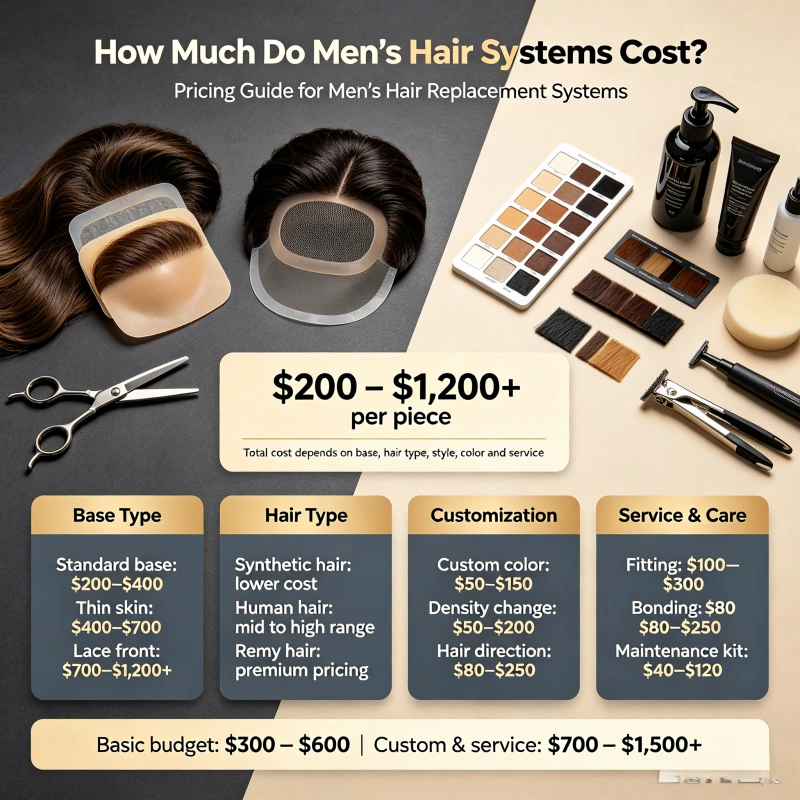
Men’s hair systems typically cost US$199–US$519 for many ready-to-wear human hair systems sold online, based on selected product listings reviewed in November 2026. However, a customized hair replacement system can cost US$800–US$2,000 or more, while a professional salon package may cost several thousand dollars depending on installation, maintenance, and replacement services.
The purchase price is only the beginning. The actual cost of wearing a men’s hair system depends on how often you replace it, which base material you choose, whether you perform maintenance yourself, and how much professional assistance you need.
For example, a US$250 hair system that needs frequent replacement may cost more over a year than a US$329 system that lasts longer. Similarly, buying a hairpiece online may be cheaper initially, but professional fitting and regular maintenance can add significantly to your budget.
This guide explains men’s hair system prices in 2026, compares different base materials, breaks down installation and maintenance costs, and shows how to calculate the total cost of ownership.
Whether you are buying your first toupee, operating a hair replacement salon, or sourcing products for a private label business, you will find practical information to make a better purchasing decision.
How Much Does a Men’s Hair System Cost in 2026?
The price of a men’s hair system varies according to hair material, base construction, size, density, customization, and purchasing channel.
For the US market, selected ready-to-wear human hair systems currently list for approximately US$199–US$519. Custom and salon-based solutions can cost considerably more.
Here is a general price comparison based on published market examples.
| Hair System Type | Indicative Price (USD) | What Is Usually Included |
|---|---|---|
| Entry-level stock hairpiece | $169–$279 | Standard-size system with basic specifications |
| Mid-range human hair system | $229–$399 | Stock human hair system with different base options |
| Premium ready-to-wear system | $329–$519+ | Higher-priced human hair and specialized base construction |
| Custom hair system | $800–$2,000+ | Customized dimensions, density, color, hairline, and other specifications |
| Initial professional fitting | $160–$250+ | Fitting, cut-in, and basic styling, depending on the provider |
| Professional hair replacement package | $1,500–$4,000+ | May include the system, installation, and additional services |
These are indicative price references, not fixed industry prices. The custom and service-package ranges are broad published market estimates rather than quotations from one manufacturer.
Some stores also sell partial hairpieces at lower prices, so make sure you are comparing a complete men’s hair system rather than a smaller crown or frontal piece.
For buyers interested in different constructions and configurations, the ALOVEHAIR men’s hair system collection includes Mono, PU, and Swiss Lace options.

Real Examples of Men’s Hair System Prices
To understand what buyers actually pay, it helps to distinguish between online product prices and professional salon services.
1. Online Hair System Prices
Selected 2026 product comparisons show the following prices:
| Supplier or Product | Base Construction | Published Price (USD) |
|---|---|---|
| The Hair NG | Ultra-thin skin | $199 sale price |
| Superhairpieces M101 | Thin skin | $229 |
| Superhairpieces M105 | French lace | $279 |
| LaVivid Upgrade Mirage | Thin skin | $269 |
| LaVivid Helios | Swiss lace | $329 |
| Lordhair Neo | Hybrid | From $339 |
These are specific published listings, not a comprehensive ranking of every available hair system. Some manufacturers offer different prices depending on base size, density, hair color, and customization.
2. Professional Installation Prices
Professional fitting is usually charged separately when purchasing a hair system online.
For example, one Orange County hair replacement salon lists its men’s hair systems from approximately US$169 to US$379, with full systems starting around US$189. Its new-system fitting service is listed at US$250.
For a full system in that store’s listed price range, the initial product and fitting cost can therefore be approximately US$439–US$629 before shipping and tax.
This example demonstrates why you should check whether installation is included before comparing salon and online prices.
3. Custom Hair Replacement Services
Custom systems can cost significantly more than stock units because they are made according to individual requirements.
HairClub’s published general price guide gives an illustrative range of US$800–US$2,000+ for custom hair systems and US$1,500–US$4,000+ for hair systems with professional services.
The final price depends on the provider’s service model and the amount of customization.
What Are You Actually Paying For When Buying a Men’s Hair System?
The price of a hair system is determined by several components. Understanding them helps you identify whether a quotation represents good value.
1. Hair Material
Human hair systems generally cost more than synthetic alternatives.
Human hair provides natural movement and allows more conventional styling with heat tools, subject to the hair’s processing history and care requirements.
Important material specifications include:
- 100% human hair or synthetic fiber
- Remy or non-Remy construction
- Cuticle condition and alignment
- Hair origin
- Hair length
- Hair density
- Color and gray percentage
- Chemical processing history
Premium human hair can increase the initial product cost, but buyers should not rely on marketing terms alone.
Ask the supplier to explain exactly what material is being used and request a physical sample.
2. Base Material
The base is the foundation of a hair system. It supports the hair and determines much of the system’s breathability, appearance, attachment method, and durability.
Different base materials have different manufacturing costs and performance characteristics.
| Base Type | Main Characteristics | Potential Cost Consideration |
|---|---|---|
| Ultra-thin PU / Skin | Very thin, scalp-like appearance | Delicate bases may need frequent replacement |
| Standard PU / Thin Skin | Smooth surface and convenient adhesive application | Thickness affects durability and appearance |
| Swiss Lace | Lightweight, breathable, natural-looking hairline | Delicate construction can increase handling requirements |
| French Lace | Breathable mesh with more structure than Swiss lace | Balances appearance and durability |
| Monofilament | Durable mesh and versatile hair direction | Construction and knotting affect manufacturing cost |
| Hybrid Base | Combines different materials | Custom base combinations may increase product cost |
A higher-priced base is not necessarily the best option for every wearer. The right choice depends on appearance goals, sweating, attachment preferences, lifestyle, and replacement budget.
3. Hair Density
Hair density affects both the appearance and the cost of a men’s hair system.
Common density options vary by manufacturer and may include light, light-medium, medium, medium-heavy, and heavy density.
A younger man with naturally thick hair may need a different density from someone seeking a subtle result that matches mature hair.
Excessive density can make a system look unnatural, especially around the frontal hairline.
When requesting a quotation, specify the density percentage and ask the supplier to provide reference photographs or samples.
4. Base Size and Shape
A standard stock hair system is generally produced in a limited range of base dimensions.
Custom systems can be made to match individual measurements or a scalp template.
The total base area, perimeter shape, front contour, and attachment requirements may affect the price.
For a stock system, some fitting professionals can trim the base to suit the coverage area, provided the product construction allows it.
5. Hairline and Ventilation Method
The front hairline is one of the most important details affecting the appearance of a men’s hair system.
Different ventilation methods, such as V-looped, injected, and hand-knotted hair, create different visual effects and manufacturing requirements.
A natural-looking hairline may require careful knotting, graduated density, irregular hair placement, and suitable base construction.
Buyers should compare the frontal hairline separately rather than judging the entire system from a standard product photograph.
6. Customization
A customized men’s hair system can be designed around the wearer’s requirements.
Possible custom features include:
- Base dimensions and shape
- Base material and color
- Hair density
- Hair color
- Gray percentage
- Curl and wave pattern
- Hair direction
- Front hairline shape
- Hair length
- Ventilation method
The more specific the requirements, the more important it is to confirm the quotation and production lead time before ordering.

How Much Do Different Men’s Hair System Base Materials Cost?
There is no fixed price for every lace, skin, or monofilament system. However, base construction can influence both the initial price and the amount spent on replacements.
1. PU and Thin Skin Hair Systems
PU hair systems use a polyurethane base that creates a smooth surface for adhesive or tape application.
They are popular because the base can closely resemble the appearance of skin, and removing adhesive residue from a smooth surface is generally more straightforward than cleaning mesh.
ALOVEHAIR offers different PU base specifications, including approximately 0.03mm ultra-thin skin and 0.06–0.08mm PU constructions on its listed product range.
The thinner option may provide a more discreet appearance, but it is more delicate.
| PU Base Thickness | Main Advantage | Trade-Off |
|---|---|---|
| Approximately 0.03mm | Very thin, natural-looking appearance | Delicate and shorter expected wear life |
| Approximately 0.06–0.08mm | Greater structure and a balance of appearance and strength | More visible base edge than ultra-thin skin in some applications |
| Approximately 0.08–0.10mm | More substantial base construction | Less skin-like than thinner options |
ALOVEHAIR’s published PU product information gives a product-specific reference of approximately 3–4 weeks for its 0.03mm ultra-thin base and 2–3 months for selected 0.08–0.10mm constructions.
These are product guidance figures, not guaranteed lifespans. Actual performance depends on wear frequency, attachment, cleaning, and handling.
Explore the ALOVEHAIR PU Men’s Toupee range for its available constructions.
2. Swiss Lace Hair Systems
Swiss lace is a lightweight mesh material designed to provide a breathable base and a natural-looking hairline.
It is especially relevant for men who prefer an exposed or brushed-back frontal hairstyle.
Advantages include:
- Lightweight construction
- Good airflow
- Natural-looking hairline
- Flexible styling
- Comfortable feel for many wearers
The main disadvantage is that fine lace requires careful handling during attachment, removal, and cleaning.
For some buyers, Swiss lace is worth considering because appearance and breathability are more important than maximizing the replacement interval.
ALOVEHAIR provides a Swiss Lace Men’s Toupee for professional and wholesale buyers.
3. Monofilament Hair Systems
Monofilament, commonly called Mono, is a fine mesh base designed to support individual hair knots.
It offers a balance of durability, ventilation, and versatile styling.
Compared with ultra-thin skin, a Mono base has a different texture and appearance. It may be more suitable for daily wearers who prioritize a structured base and longer service life over the thinnest possible appearance.
Some Mono systems also use polyurethane around the perimeter to make adhesive attachment more convenient.
View the ALOVEHAIR Mono Men’s Toupee for more information about this base construction.
4. Hybrid Hair Systems
Hybrid systems combine two or more base materials within one product.
For example:
- Lace front with a PU perimeter
- Mono center with PU sides
- Lace center with reinforced attachment areas
The purpose is to combine different performance characteristics in one base.
A hybrid construction may offer a natural-looking frontal hairline while keeping the surrounding areas easier to attach and maintain.
However, custom combinations require careful specification. Ask the manufacturer which materials are used in each section of the base.

Stock vs. Custom Men’s Hair Systems: Which Is More Expensive?
This is another important pricing decision.
A stock hair system is manufactured using standard sizes, base materials, densities, and colors. A custom system is made according to specific measurements and design requirements.
| Comparison | Stock Hair System | Custom Hair System |
|---|---|---|
| Base size | Standard options | Made to individual measurements |
| Hair density | Limited preset options | More precise density selection |
| Hair color | Stock shades | Custom color matching |
| Gray percentage | Available preset choices | Can be specified more precisely |
| Hair direction | Fixed or limited options | Customizable |
| Hairline | Standard front contour | Individual hairline design |
| Production time | Usually faster | Generally longer |
| Price | Usually lower | Usually higher |
When Is a Stock System the Better Choice?
A stock system may be suitable when:
- You need a replacement quickly.
- Your coverage area fits a standard base.
- You are still learning which base material suits your lifestyle.
- Your hair color and density match available options.
- You want to control the initial purchase cost.
When Should You Choose a Custom System?
A custom system may be worth the higher price when:
- Your scalp measurements do not match standard dimensions.
- Your natural hair color is difficult to match.
- You need a specific gray percentage.
- Your hair density requires precise customization.
- You want a particular front hairline or hair direction.
- You are developing a consistent product specification for a salon or brand.
ALOVEHAIR’s men’s hair system collection supports customization discussions for base size, density, color, wave pattern, shape, and hairline design.
What Is the Real Annual Cost of Wearing a Men’s Hair System?
The biggest mistake first-time buyers make is budgeting only for the initial hairpiece.
A men’s hair system requires ongoing care, cleaning, attachment maintenance, and eventual replacement.
The annual cost depends heavily on whether you do the maintenance yourself or pay a professional to handle it.
1. DIY Maintenance
DIY maintenance means you purchase the system and perform routine removal, cleaning, and reattachment at home after learning the correct procedures.
Typical ongoing expenses include:
- Hair system replacements
- Adhesive or double-sided tape
- Adhesive remover
- Base cleaner
- Shampoo and conditioner
- Styling products
- Haircuts and trimming
A 2026 independent cost guide estimates a full DIY approach at approximately US$100–US$175 per month, including the system and routine supplies in its model.
Its estimated first-year budget is US$1,500–US$2,500.
These are planning figures from one cost model, not fixed industry charges.
2. Hybrid Maintenance: Professional Installation and DIY Upkeep
Some men prefer a professional to install and cut in the first system but perform routine maintenance at home.
This approach can reduce repeat salon expenses while maintaining professional support when needed.
The same 2026 guide estimates approximately US$155–US$250 per month for this mixed maintenance approach, with a first-year budget around US$3,500–US$4,500.
Your actual costs depend on system replacement frequency, supplies, and how often you need professional assistance.
3. Full Salon Maintenance
A full-service salon arrangement is convenient for people who do not want to remove, clean, or reattach their own systems.
The salon handles scheduled maintenance, cleaning, and reapplication.
However, this option generally has the highest ongoing cost.
One published 2026 cost model estimates:
| Maintenance Approach | Estimated Monthly Cost (USD) | Estimated First-Year Cost |
|---|---|---|
| Full DIY | $100–$175 | $1,500–$2,500 |
| Mixed maintenance | $155–$250 | $3,500–$4,500 |
| Full salon service | $250–$362 | $5,500–$6,700 |
The model uses different assumptions about service frequency and system replacement. Use it as a budgeting reference rather than a guaranteed quote.
Why Replacement Frequency Matters More Than the Initial Price
A cheaper hair system is not necessarily cheaper over the long term.
Consider two examples:
| System | Price per Unit | Assumed Replacement Interval | Systems Needed per Year | Annual System Cost |
|---|---|---|---|---|
| System A | $269 | Every 2 months | 6 | $1,614 |
| System B | $329 | Every 4 months | 3 | $987 |
System B has a higher initial unit price, but the annual cost of replacing the systems is lower under these assumptions.
This does not mean that every $329 system lasts four months or every $269 system lasts two months. The example simply shows why replacement frequency must be considered when comparing prices.
Before choosing a system, ask the supplier for product-specific lifespan guidance and check whether the estimate applies to daily or occasional wear.
ALOVEHAIR’s general men’s hair system information gives a typical reference of approximately 2–6 months depending on base material, quality, and care. Its PU product page gives separate estimates for specific base thicknesses.
These product-specific references are more useful than assuming every hair system has the same lifespan.
What Additional Costs Should You Budget For?
Besides the hairpiece itself, several smaller expenses can add up over time.
| Additional Cost | What It Covers |
|---|---|
| Initial fitting | Measuring, trimming, attachment, and cut-in |
| Adhesive | Liquid bonding products for scalp attachment |
| Double-sided tape | Alternative or supplemental attachment |
| Adhesive remover | Removing the system and cleaning residue |
| Base cleaner | Preparing the base for reattachment |
| Shampoo and conditioner | Maintaining the human hair |
| Haircuts | Blending the system with natural hair |
| Color adjustment | Matching the system with existing hair |
| Replacement system | Replacing worn hair or damaged base material |
| Travel | Visiting a qualified hair replacement specialist |
For example, an Orange County salon lists routine hair system services at approximately US$100 per appointment, with recommended visits every 2–4 weeks for its service model.
That could represent US$1,300–US$2,600 in annual maintenance appointments alone, assuming 13–26 visits. This is one provider’s pricing example, not a typical charge for every salon.
Before agreeing to a service package, ask whether installation, maintenance, cleaning, haircutting, replacement systems, and products are included.
How to Choose a Men’s Hair System That Fits Your Budget
Choosing the right product is not simply about finding the lowest price.
You need a system that balances appearance, comfort, maintenance, and replacement costs.
1. Choose the Base According to Your Lifestyle
Consider your daily activities and wearing preferences.
| Lifestyle or Preference | Base Type to Consider | Main Reason |
|---|---|---|
| Maximum hairline discretion | Fine skin or lace front | Low-profile frontal appearance |
| Heavy sweating or active lifestyle | Lace or suitable hybrid | Better airflow through mesh sections |
| Frequent daily wear | Mono or reinforced hybrid | More structured base construction |
| Easier adhesive cleanup | PU | Smooth surface |
| Lower initial budget | Selected stock systems | Fewer customization expenses |
| Specific scalp measurements | Custom base | Better control over fit |
These are starting points, not universal recommendations.
For men who want more airflow and a natural-looking hairline, consider the ALOVEHAIR Swiss Lace Toupee. For those who prioritize a more structured base, the Mono Men’s Toupee is another option.
2. Choose Natural-Looking Density
A hair system that is too thick can look artificial.
The best density is usually the one that blends with your age, hairstyle, natural hair at the sides, and personal appearance preferences.
Ask your supplier about:
- Light density
- Light-medium density
- Medium density
- Medium-heavy density
- Custom density
Request photographs of each density or a sample when possible.
3. Compare Attachment Methods
Men’s hair systems may be attached using liquid adhesive, double-sided tape, or a combination of methods.
Your selection depends on the base material and how often you want to remove the system.
A professional should explain how to remove the system without damaging the base or irritating the scalp.
First-time wearers should consider professional fitting and instruction before attempting complete DIY installation.
4. Understand the Full Replacement Plan
Ask the supplier how the system should be cleaned, maintained, and stored.
A replacement schedule should be based on the actual product construction and condition rather than an assumed universal lifespan.
Replace a system when its hair, base, or attachment structure can no longer provide the appearance and performance you need.
How Can Hair Replacement Salons and Distributors Buy Men’s Hair Systems at Better Prices?
Individual consumers usually purchase finished retail products. Salons, distributors, and private label brands have a different purchasing model.
Working with a manufacturer may provide more flexibility in product specifications, volume purchasing, and brand development.
However, wholesale cost should be evaluated together with manufacturing quality and landed cost.
1. Understand the Factors Behind Wholesale Pricing
| Wholesale Cost Factor | What Affects the Price |
|---|---|
| Hair material | Human hair, synthetic fiber, material quality, and processing |
| Base material | PU, Swiss lace, French lace, Mono, or hybrid |
| Base size | Standard or customized dimensions |
| Hair density | Preset or customized density |
| Hair length | Available standard lengths and special requests |
| Color | Stock color, gray percentage, or custom matching |
| Hairline | Standard or customized front contour |
| Ventilation | V-looped, injected, or hand-knotted construction |
| Order quantity | Sample, small wholesale order, or bulk production |
| Packaging | Standard or customized private label packaging |
A quotation should identify the specifications clearly. Two systems with different base constructions or hair densities should not be compared by unit price alone.
2. Consider OEM and Private Label Manufacturing
For a salon chain or independent hair replacement brand, private label manufacturing can help create a consistent product line.
Possible customization options include:
- Brand labels and packaging
- Base size and shape
- Base material
- Hair color and density
- Hairline construction
- Hair length and texture
- Ventilation method
ALOVEHAIR operates as a China-based manufacturer and offers customization discussions for professional buyers.
You can learn more about its production capabilities through the ALOVEHAIR China Hair Factory page.
3. Request Samples Before Ordering in Bulk
A sample is essential when evaluating men’s hair systems.
Check the following:
| Sample Inspection | What to Evaluate |
|---|---|
| Base material | Thickness, flexibility, and surface quality |
| Hairline | Natural transition and knot appearance |
| Hair density | Consistency and suitability for the target market |
| Hair direction | Natural flow and styling flexibility |
| Shedding | Hair retention during normal handling |
| Color | Match to the approved shade |
| Base dimensions | Accuracy against the specification |
| Attachment | Compatibility with the intended tape or adhesive |
For repeat orders, keep an approved reference sample and a written specification sheet.
This helps reduce unwanted changes in base dimensions, density, color, and construction.
4. Calculate the Landed Cost
When importing hair systems, the wholesale price is not the final delivered cost.
Your landed cost may include:
- Factory product price
- Customization fees
- Packaging
- International freight
- Insurance, if applicable
- Import duties and taxes
- Customs brokerage
- Currency conversion and payment charges
Compare the final delivered cost per unit rather than only the factory quotation.
ALOVEHAIR Men’s Hair System Manufacturing and Wholesale Options
ALOVEHAIR is a Chinese hair products manufacturer supplying professional hair extensions, men’s hair systems, and related hair products.
Its men’s collection includes three main product categories:
| Product Category | Base Construction | Main Product Features |
|---|---|---|
| PU Men’s Toupee | Polyurethane / Skin | Different base thicknesses and attachment options |
| Swiss Lace Men’s Toupee | Swiss and other lace constructions | Lightweight, breathable base with natural-looking hairline |
| Mono Men’s Toupee | Monofilament | Breathable mesh and structured construction |
PU Men’s Toupee
ALOVEHAIR offers PU hair systems with approximately 0.03mm ultra-thin and 0.06–0.08mm base options.
Its published product information also describes V-looped, injected, and knotted hair configurations.
This product range allows professional buyers to discuss different appearance and durability priorities.
Explore the PU Men’s Toupee product range for more details.
Swiss Lace Men’s Toupee
ALOVEHAIR’s Swiss Lace men’s system is designed for buyers who prioritize breathability and a natural-looking hairline.
Different lace constructions can be discussed according to the required performance and target customer.
View the Swiss Lace Men’s Toupee for product information.
Mono Men’s Toupee
The Mono system uses a monofilament mesh structure designed to combine scalp appearance, airflow, and a more structured base.
Options such as Mono with PU perimeter or double Mono may be discussed according to the required configuration.
Explore the Mono Men’s Toupee for additional product details.
Customization for Professional Buyers
ALOVEHAIR’s men’s product range supports discussions about:
- Base size and shape
- Base material and construction
- Hair color and gray percentage
- Hair density
- Hair texture and wave pattern
- Hair direction
- Hairline design
- OEM and private label packaging
The company’s product prices are not publicly displayed for all models. Professional buyers should request a quotation based on the exact product specifications, quantity, and packaging requirements.
Learn more about the manufacturer on the ALOVEHAIR About Us page or visit its men’s hair replacement collection.
For a wholesale quotation, send the required base type, dimensions, density, color, hair length, and order quantity through the ALOVEHAIR contact page.
Frequently Asked Questions About Men’s Hair System Costs
How much does a men’s hair system cost?
Selected ready-to-wear human hair systems in the US are listed at approximately US$199–US$519. Custom systems may cost US$800–US$2,000 or more, while salon-based packages can cost several thousand dollars depending on the services included.
How much does a men’s toupee cost with installation?
One local Orange County provider lists full hair systems starting around US$189 and professional fitting at US$250. Using those published examples, a first system and fitting may cost approximately US$439–US$629, before shipping and tax, depending on the selected product.
How much does a men’s hair system cost per month?
A 2026 cost model estimates around US$100–US$175 per month for full DIY maintenance, US$155–US$250 for a mixed approach, and US$250–US$362 for full salon maintenance.
These estimates include different system, supply, and service assumptions. Your actual costs depend on replacement frequency and local salon prices.
How long does a men’s hair system last?
The lifespan varies by base material, hair quality, wearing frequency, cleaning, and attachment method.
ALOVEHAIR gives a general reference of approximately 2–6 months for its men’s systems, while individual PU models have different product-specific estimates.
Always check the expected wear life of the exact model you plan to purchase.
Which base is cheaper: PU, lace, or Mono?
There is no universal price order. Cost depends on the material thickness, lace type, knotting or injection method, system size, and hair quality.
A very thin PU system may be less expensive to manufacture but need more frequent replacement. A structured Mono or hybrid system may have a higher initial price but suit a different maintenance routine.
Is a custom men’s hair system more expensive than a stock system?
Usually, yes. Custom systems require more control over measurements, base dimensions, density, color, hairline, and hair direction.
However, a well-matched stock system may be perfectly suitable for someone whose measurements and appearance requirements fit standard options.
How often do men’s hair systems need maintenance?
Many wearers need to remove, clean, and reattach their systems periodically. Some use professional maintenance every few weeks, while others perform routine care themselves.
The schedule depends on the attachment method, scalp condition, activity level, adhesive performance, and manufacturer recommendations.
Can I maintain a men’s hair system myself?
Yes, many wearers learn to remove, clean, and reattach a system at home after proper instruction.
However, first-time fitting, complex base repairs, major hairline adjustments, and initial cut-in are often better handled by an experienced hair replacement professional.
Is human hair better than synthetic hair for men’s hair systems?
Human hair generally offers more natural movement and conventional styling flexibility, but it often costs more and requires regular care.
Synthetic hair may have a lower initial price and can retain a preset style, but it offers different styling and replacement considerations.
The best option depends on budget, appearance goals, and maintenance preferences.
Can a men’s hair system be customized for my hair color and density?
Yes. Manufacturers can offer customization options such as hair color, gray percentage, density, wave pattern, base size, and hairline shape.
Providing a hair sample, photographs, or a clear specification sheet can improve the accuracy of the customization process.
Do men’s hair systems require professional installation?
Not necessarily, but professional fitting is recommended for many first-time users.
An experienced specialist can measure the coverage area, select the appropriate base, prepare the scalp, cut the system to fit, and blend the style with existing hair.
Can salons buy men’s hair systems directly from manufacturers?
Yes. Salons and distributors can work with manufacturers to purchase stock or customized systems, subject to the supplier’s order requirements.
Before placing a bulk order, request samples and confirm material specifications, base construction, MOQ, production lead time, and quality-control procedures.
Final Thoughts: Calculate the Total Cost, Not Just the Hair System Price
Men’s hair systems can cost approximately US$199–US$519 for many ready-to-wear online products, while custom systems and professional service packages can be considerably more expensive.
The most important cost factors are hair material, base construction, customization, replacement frequency, and maintenance style.
For individual buyers, the best choice is not necessarily the cheapest hairpiece. It is the system that matches your appearance requirements, lifestyle, and maintenance budget.
For salons, distributors, and private label brands, choosing a manufacturer should involve more than comparing unit prices. Evaluate base construction, hair quality, customization options, sample performance, repeat-order consistency, and landed cost.
ALOVEHAIR offers PU, Mono, and Swiss Lace men’s hair systems for professional and wholesale buyers, with customization and OEM/ODM discussions available.
Explore the ALOVEHAIR Men’s Hair System Collection or contact the team to discuss your required base material, size, hair density, color, and wholesale quantity.

Alove Hair is a professional Chinese manufacturer of premium 100% Remy human hair extensions, wigs, and hair systems. Established in 2014, the company specializes in supplying global salons and distributors with high-quality, cuticle-intact hair products and offers comprehensive OEM/ODM private label services.


