Posts

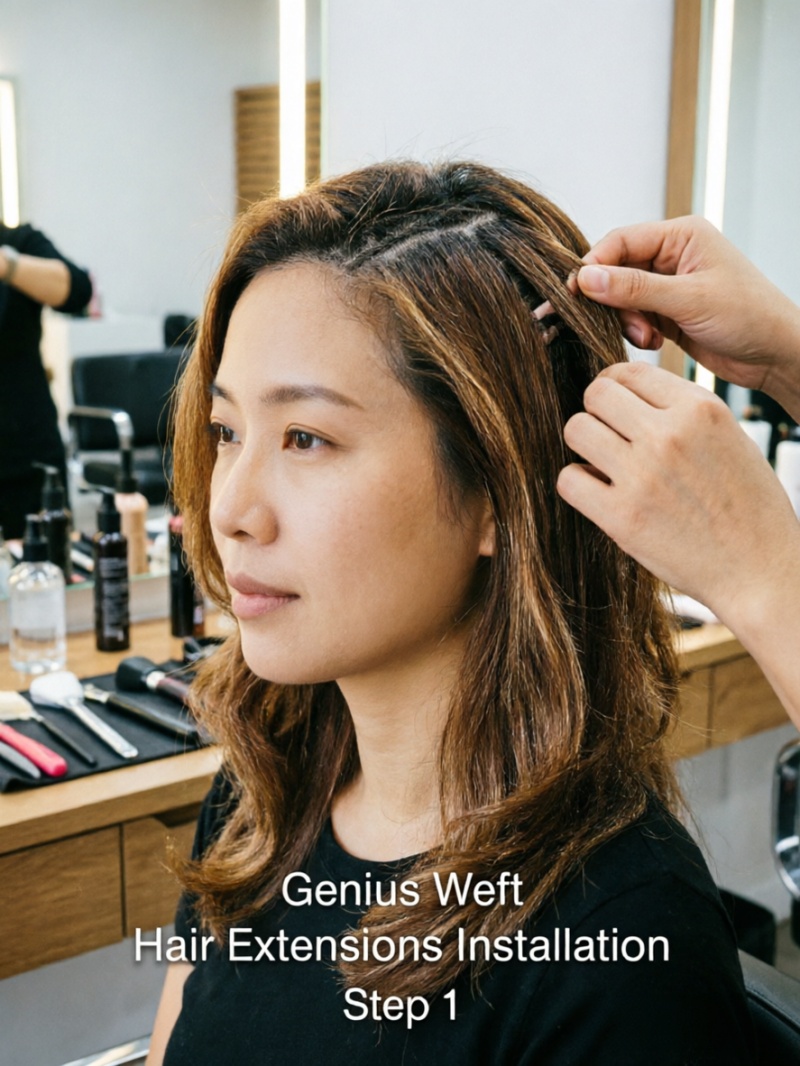
Genius Weft Hair Extensions Installation Guide

Genius Weft Hair Extensions Installation Guide: A Complete Step-by-Step Tutorial for Salons, Stylists, and OEM Buyers

Genius Weft hair extensions have become one of the fastest-growing professional extension systems in today’s salon industry. Combining the ultra-thin appearance of hand-tied wefts with the flexibility and durability of machine wefts, Genius Wefts provide a comfortable, natural-looking solution suitable for almost every hair type.

For OEM hair extension factory customers, understanding the installation process is just as important as understanding product quality. Distributors, salon chains, and private label brands that can educate their customers on proper installation often experience fewer after-sales issues, higher customer satisfaction, and stronger brand loyalty.

This guide explains every stage of the installation process, from consultation and preparation to maintenance and removal.


What Are Genius Weft Hair Extensions?

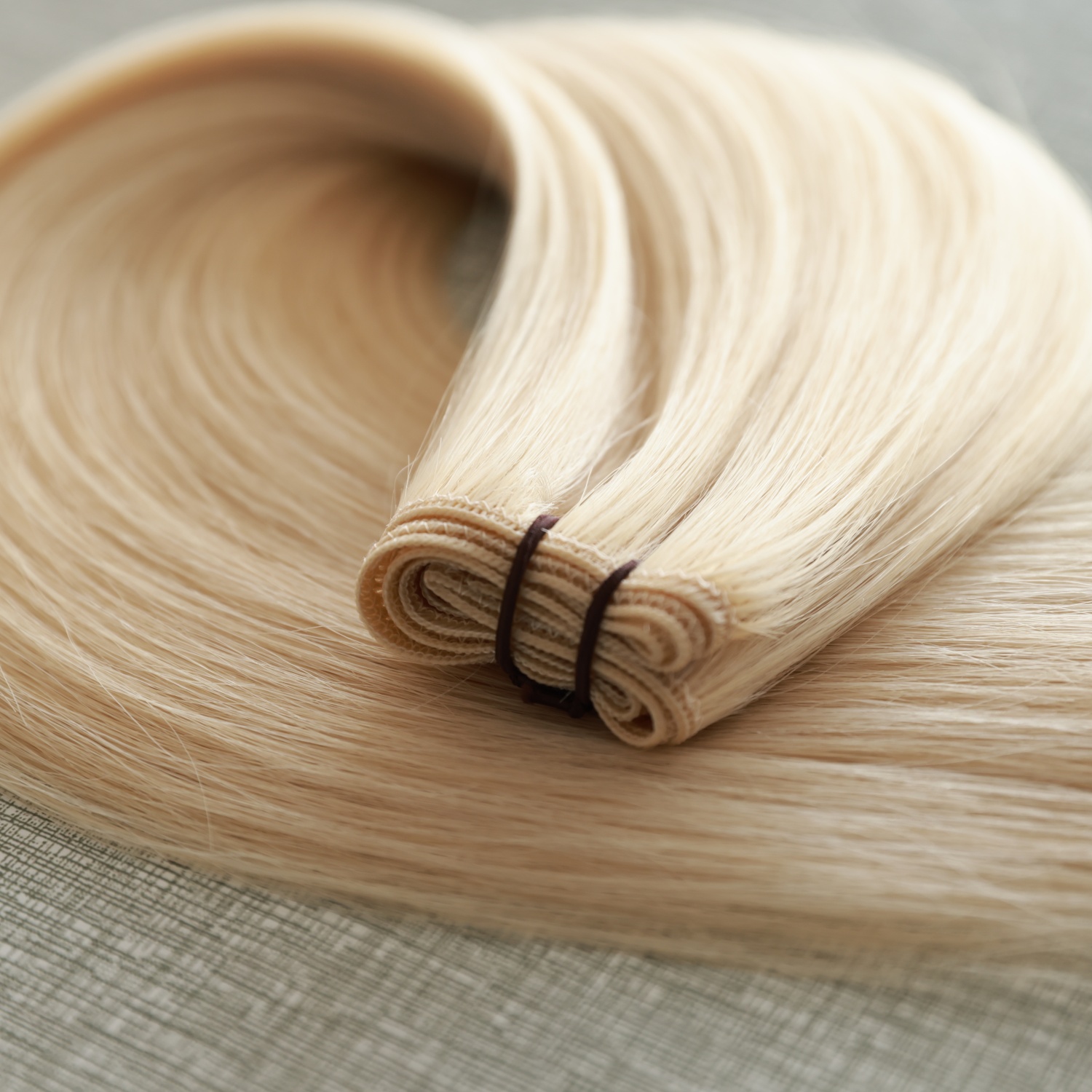
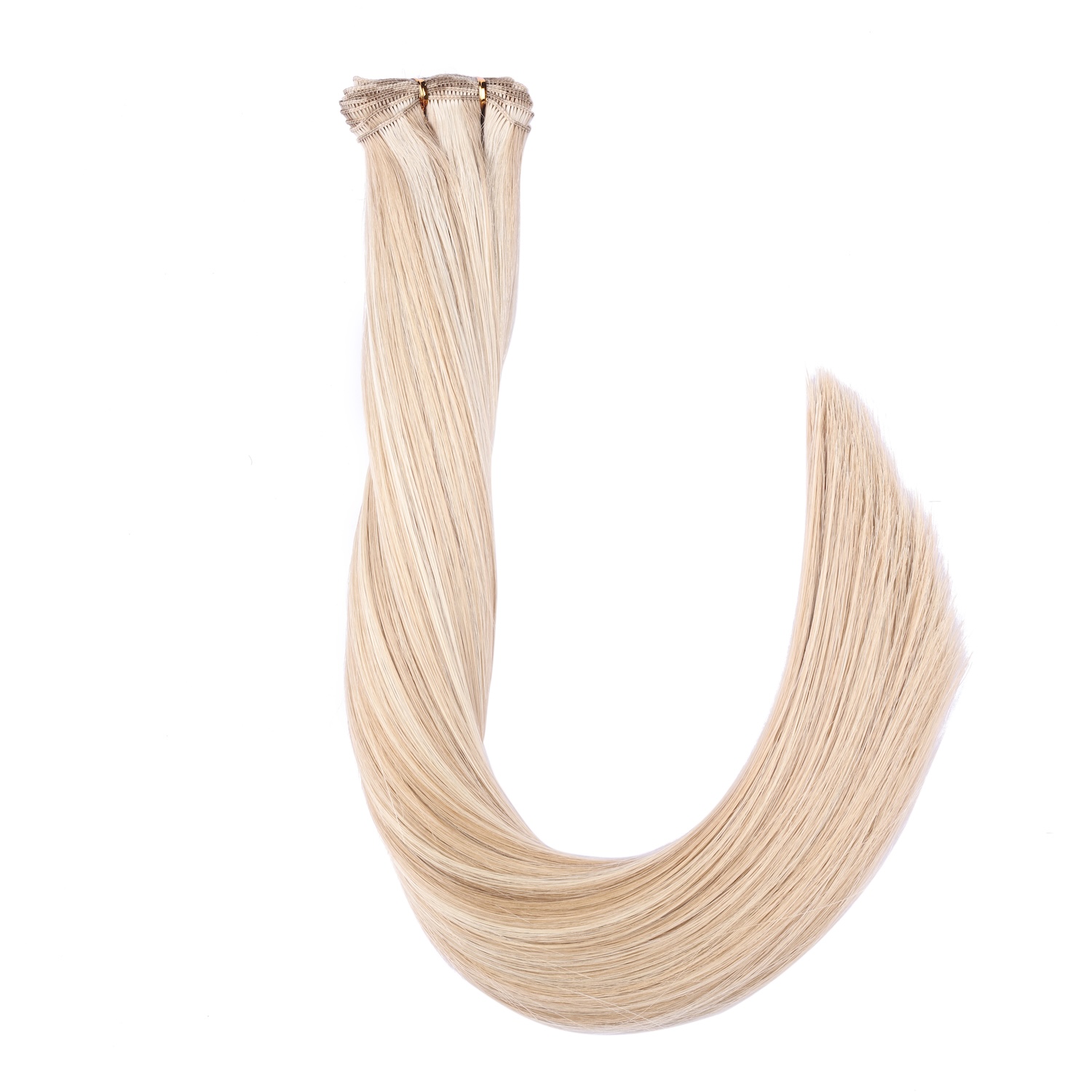
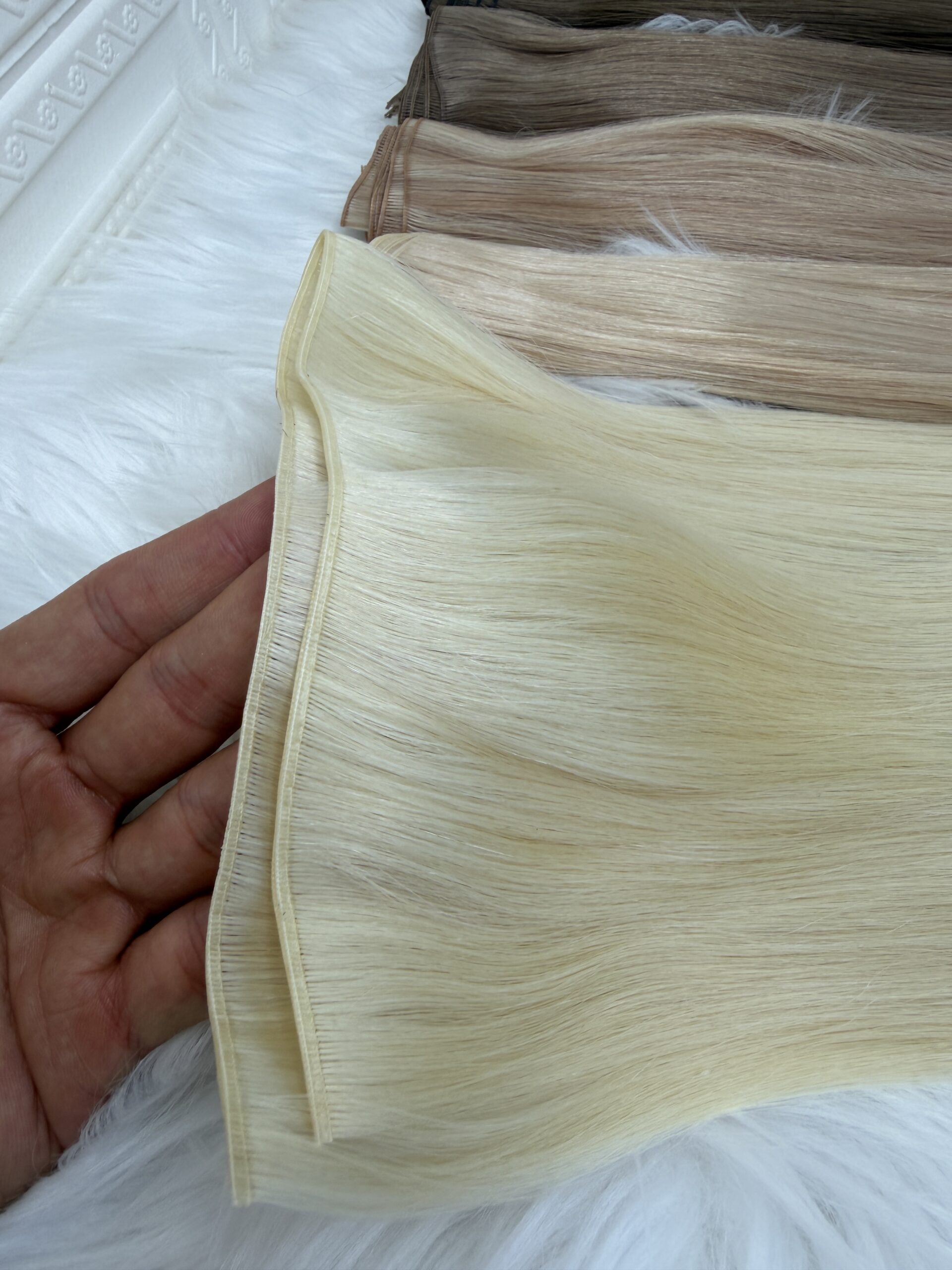
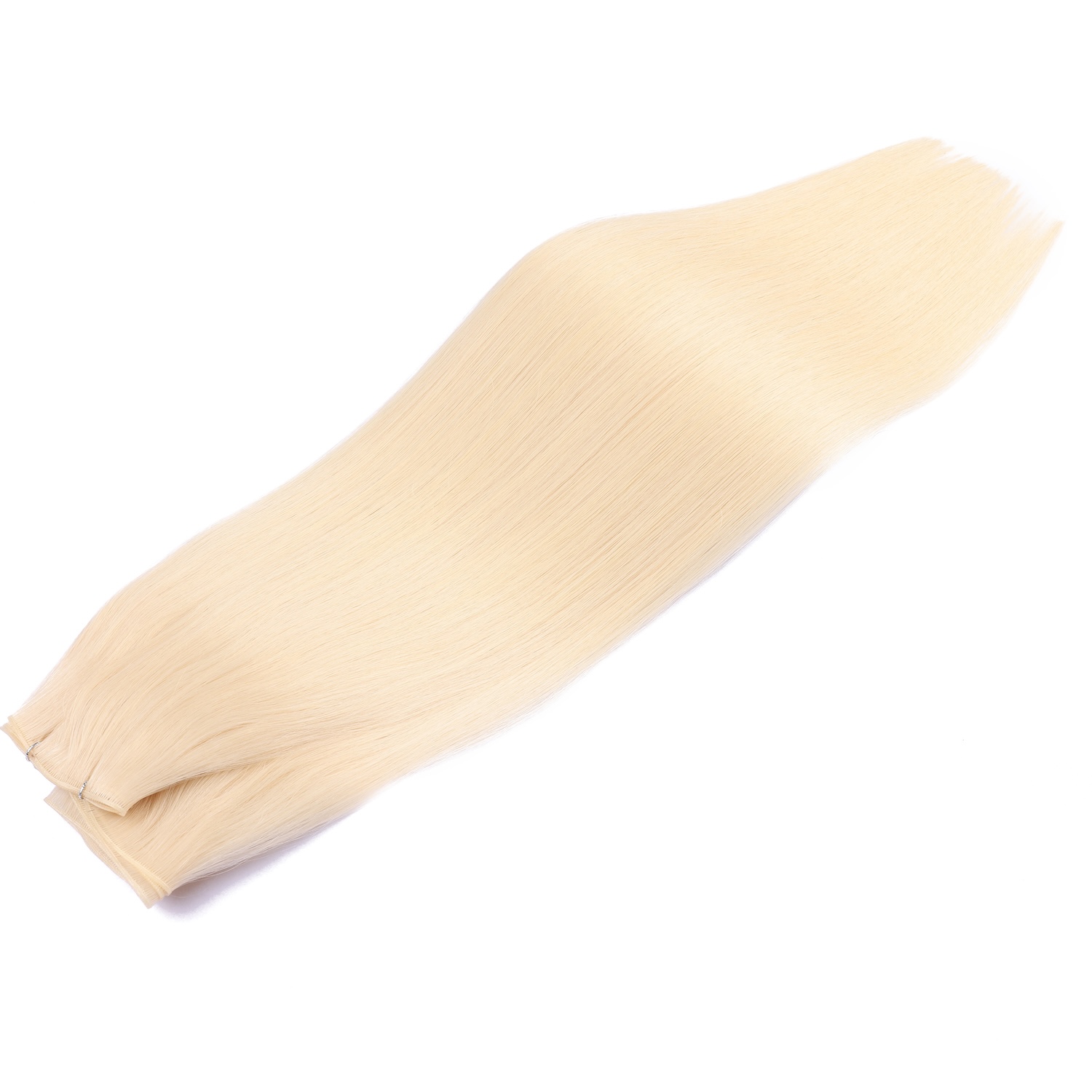
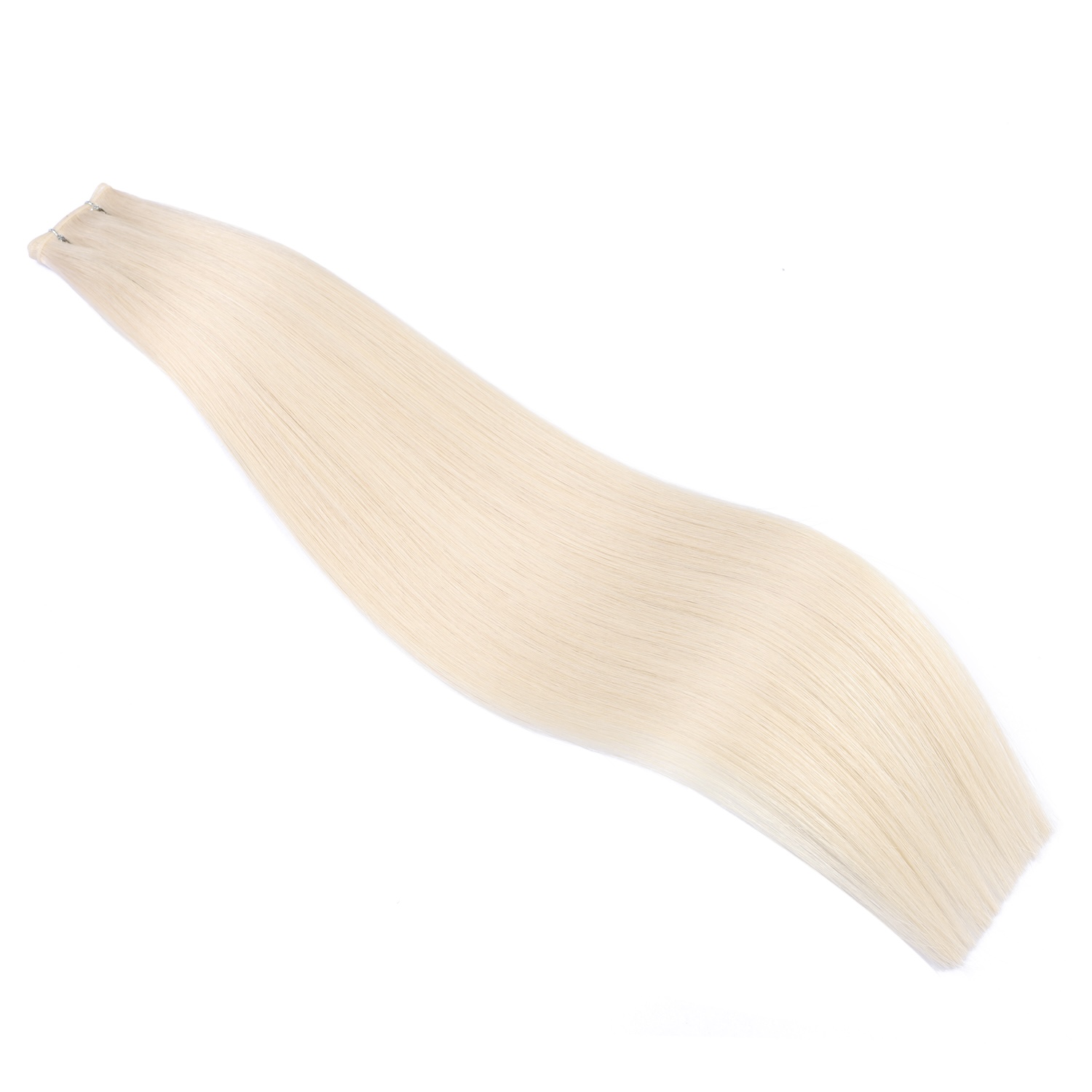
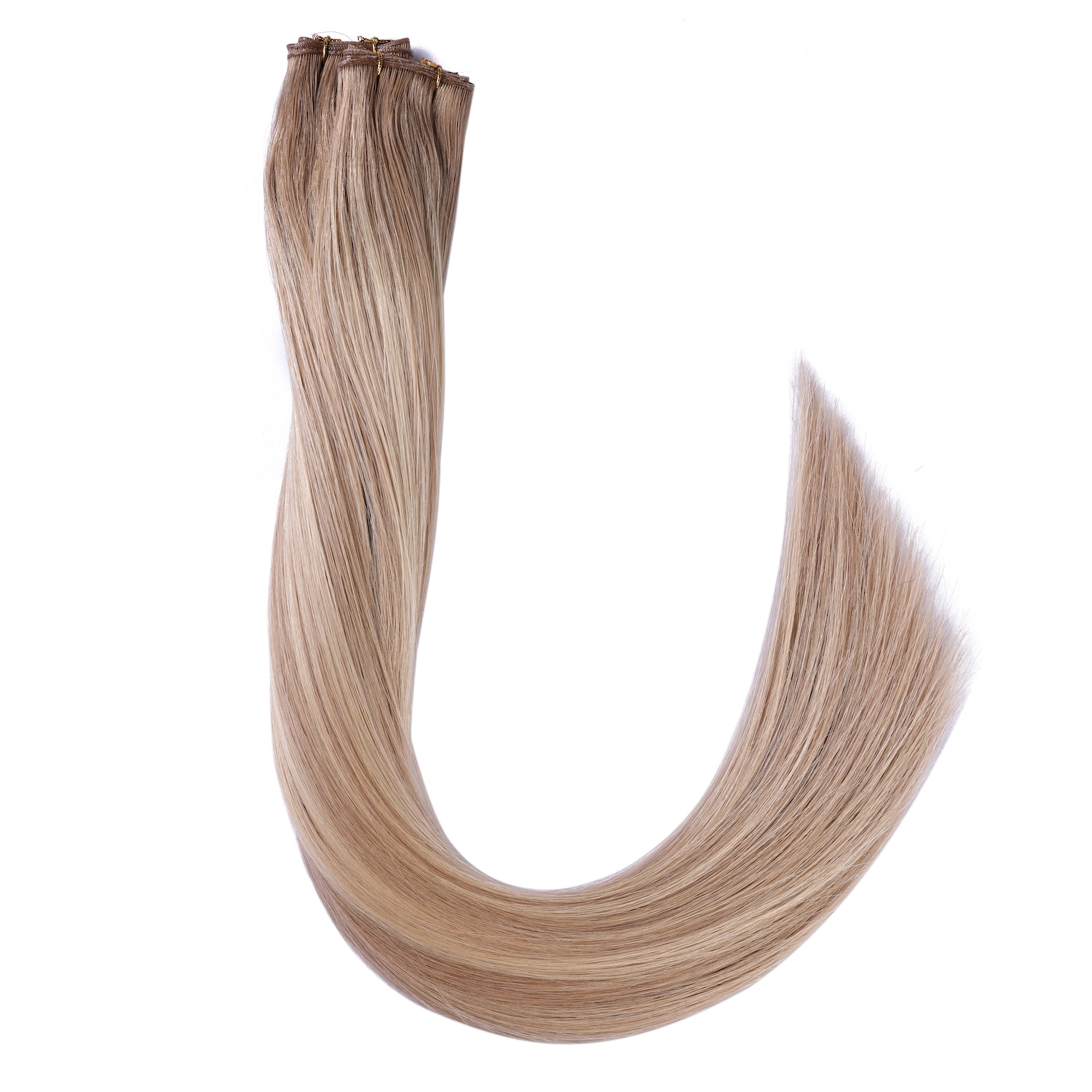
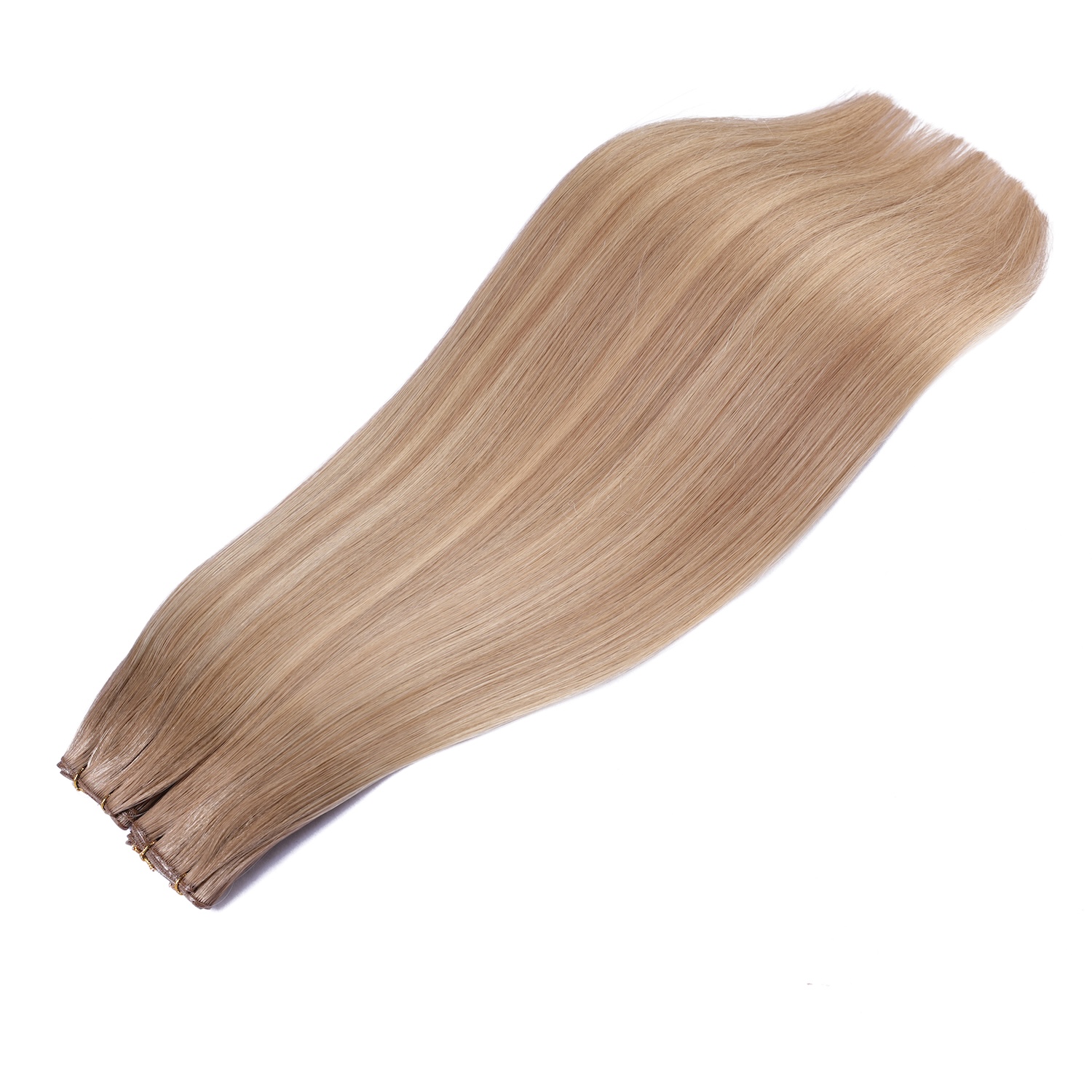
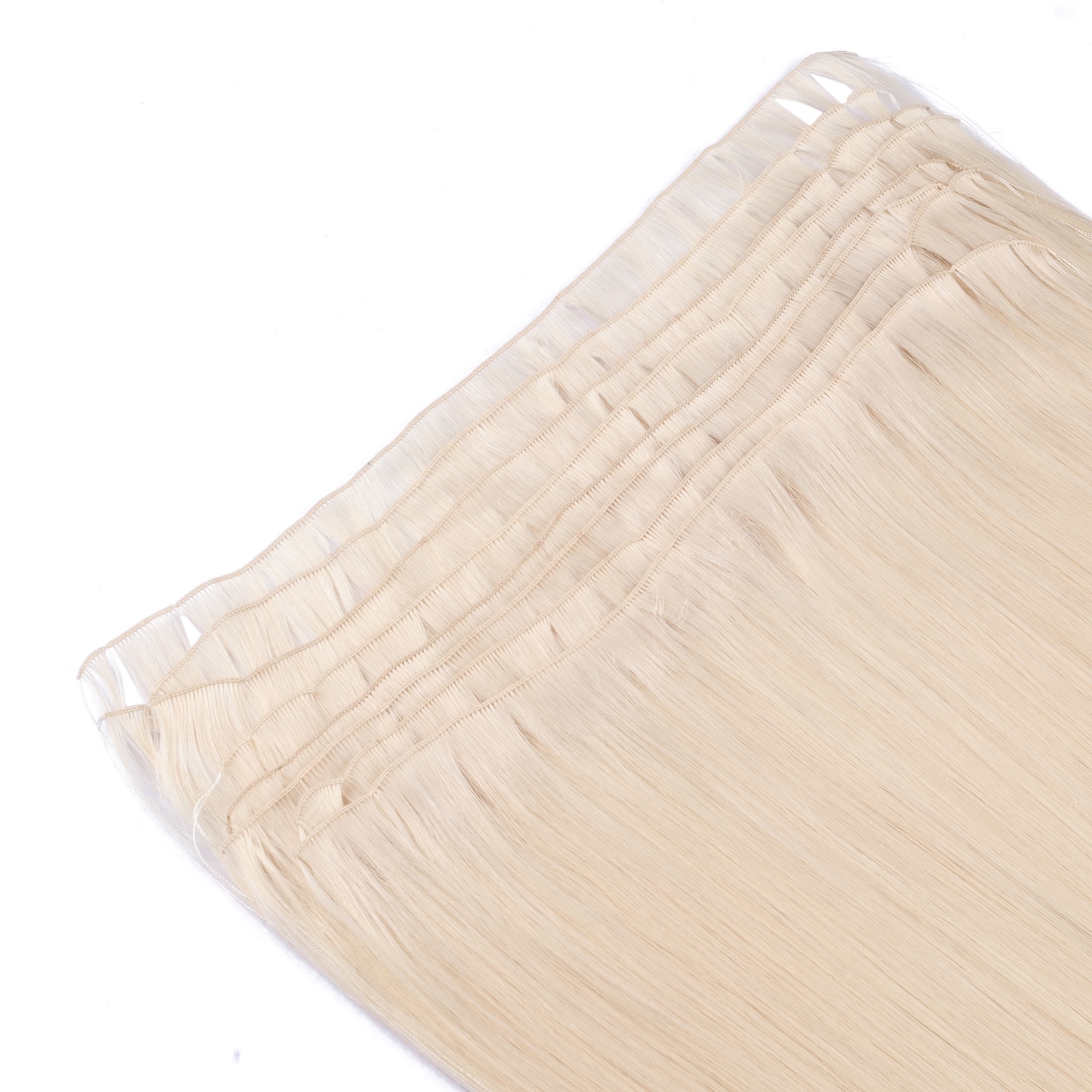
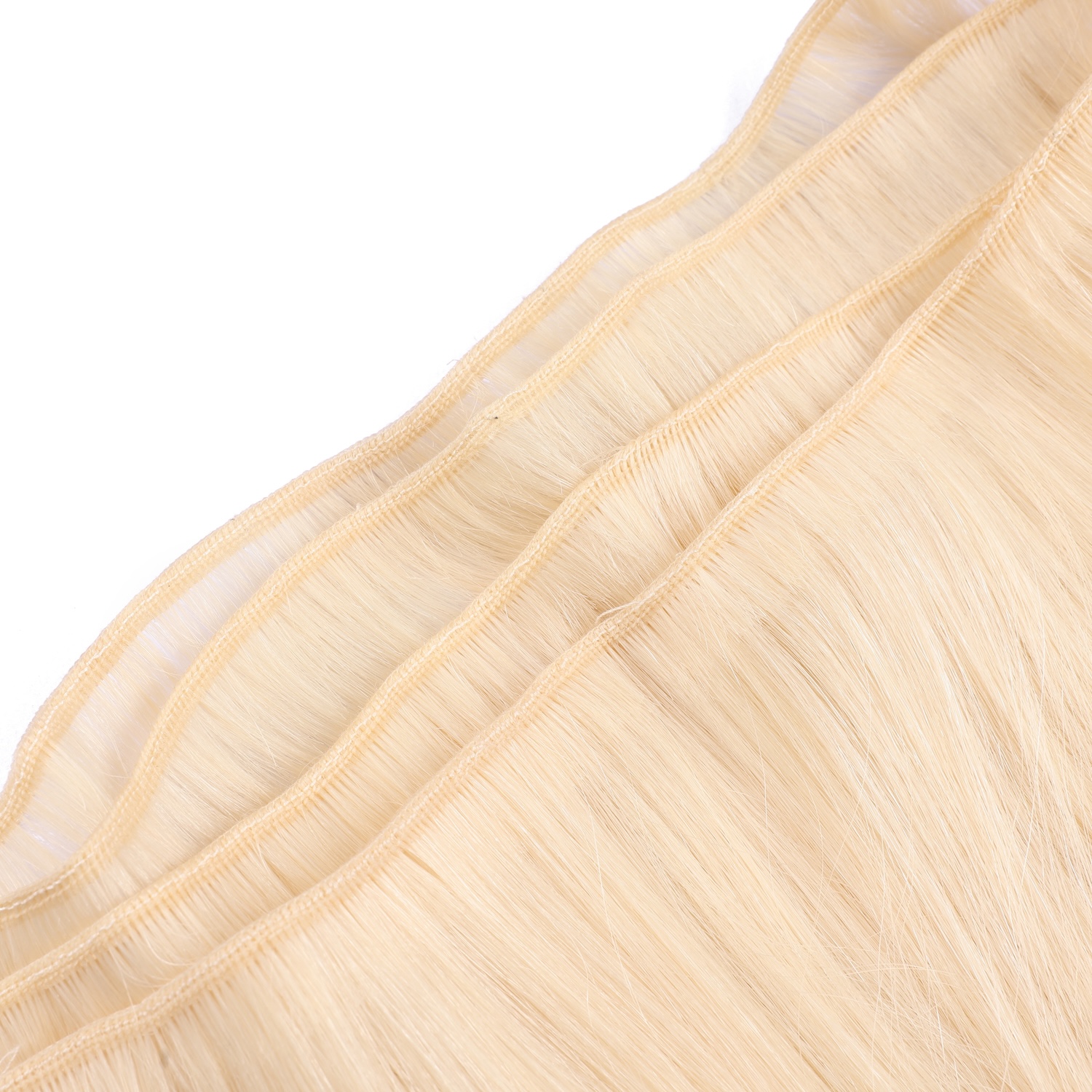
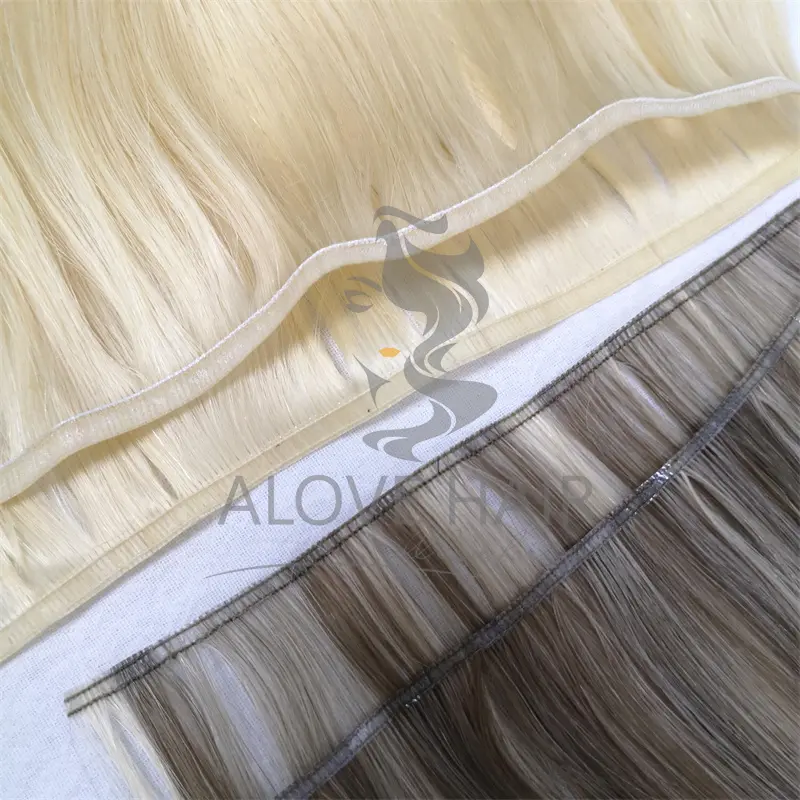
Genius Wefts are ultra-thin sewn hair extensions made from 100% human hair. Unlike traditional machine wefts, the stitching is much thinner and more flexible, making the extensions nearly invisible once installed.

The biggest advantage is that professional Genius Wefts can usually be cut to the desired width without significant unraveling, allowing stylists to create customized installations while minimizing waste.


Why Proper Installation Matters

Even the highest-quality Genius Wefts can produce disappointing results if installed incorrectly.

Professional installation helps:

  • Create an invisible finish
  • Prevent excessive shedding
  • Reduce scalp tension
  • Improve client comfort
  • Extend product lifespan
  • Allow multiple reinstallations
  • Protect the client’s natural hair

A properly installed Genius Weft system can typically remain in place for 6–10 weeks before requiring maintenance.


Tools Required Before Installation

Professional stylists should prepare the following tools:

  • Genius Weft hair extensions
  • Silicone-lined micro beads
  • Nylon or polyester thread
  • Curved extension needle
  • Bead installation pliers
  • Tail comb
  • Sectioning clips
  • Hair cutting scissors
  • Extension brush
  • Spray bottle
  • Blow dryer
  • Flat iron (optional)
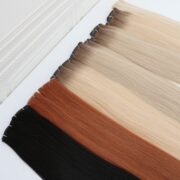
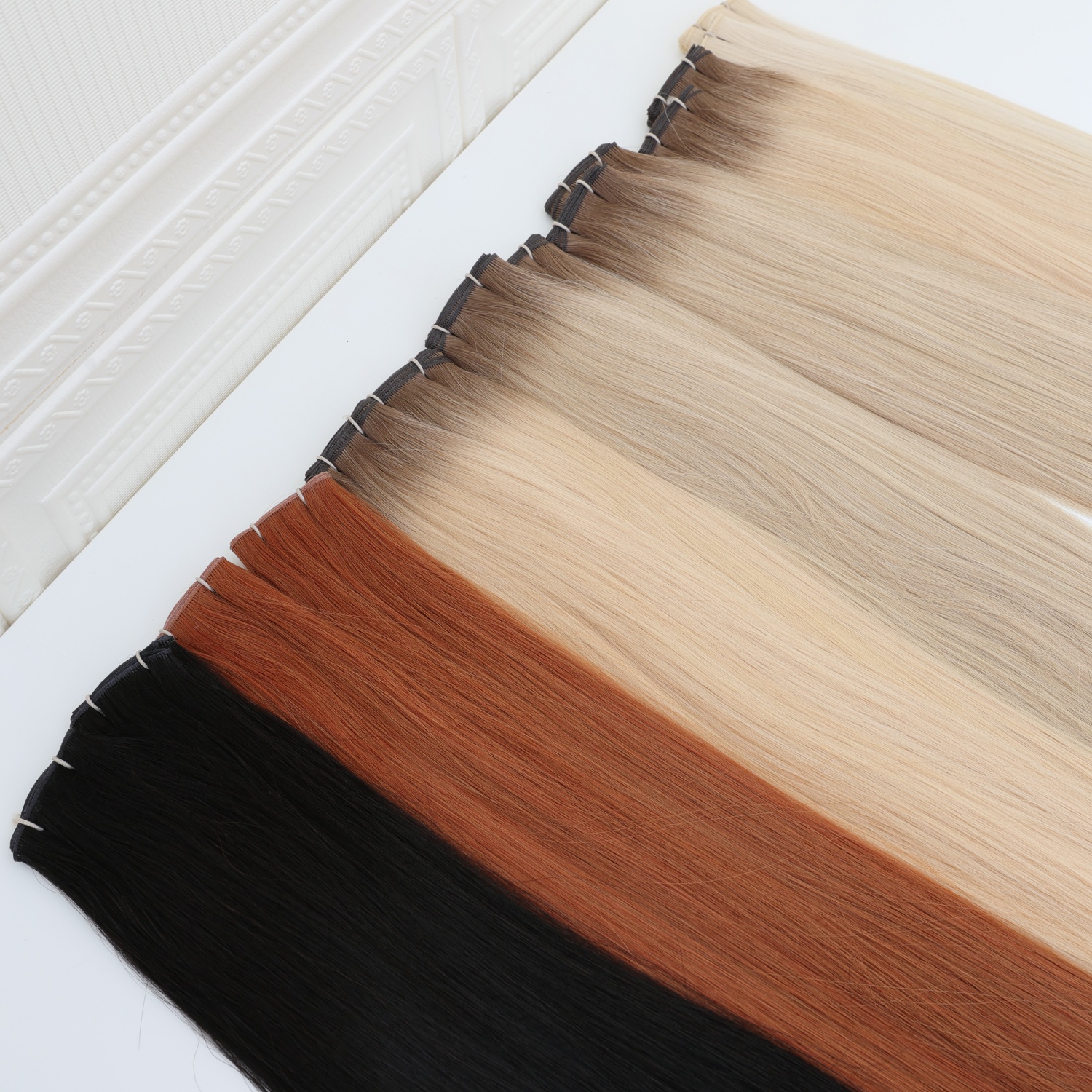
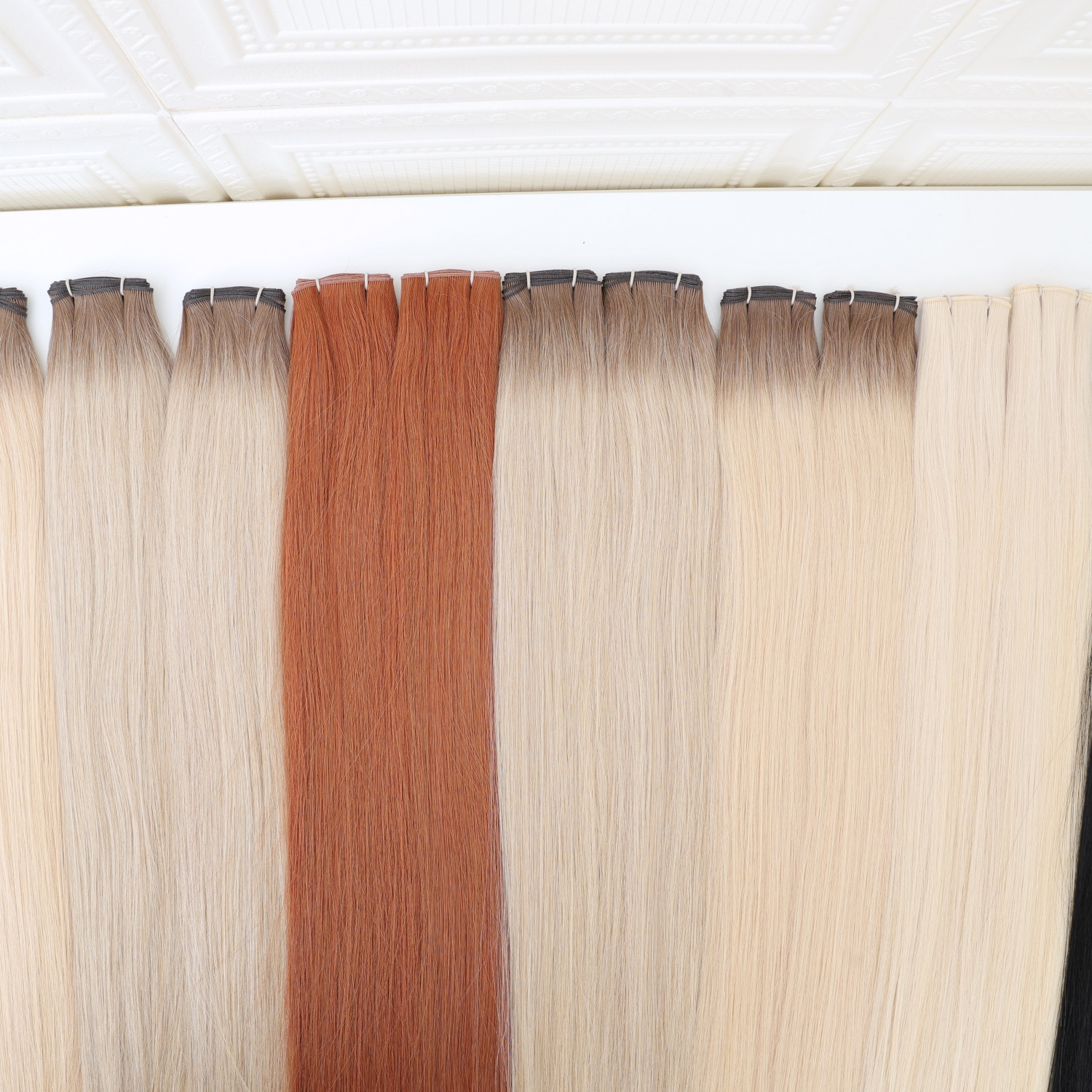
  • Color ring for matching

Using professional tools improves installation speed and consistency while reducing the risk of damage.


Step 1: Client Consultation

Every successful installation begins with a detailed consultation.

Evaluate:

  • Hair density
  • Hair length
  • Hair texture
  • Hair color
  • Scalp condition
  • Lifestyle
  • Desired length
  • Desired volume

This assessment determines the number of bundles, installation rows, and placement strategy.


Step 2: Color Matching

Color matching is one of the most important factors in achieving a seamless result.

Professional stylists compare the client’s natural hair with a color ring under natural lighting.

If an exact match is unavailable, blending two or three shades often creates the most natural appearance.

OEM brands should provide comprehensive color rings to salons for accurate matching.


Step 3: Determine the Number of Bundles

The required amount depends on the client’s hair.

Typical recommendations include:

Hair Type Bundles
Fine Hair 1–2
Medium Hair 2–3
Thick Hair 3–4
Extra Length & Volume 4–5

Using too few bundles may create visible density differences, while excessive bundles can add unnecessary weight.


Step 4: Wash and Dry the Hair

The hair should be thoroughly washed using a clarifying shampoo.

Avoid:

  • Conditioner at the roots
  • Heavy oils
  • Silicone-based products

Completely dry the hair before installation.

Clean hair allows the micro beads to grip securely and reduces the risk of slipping.


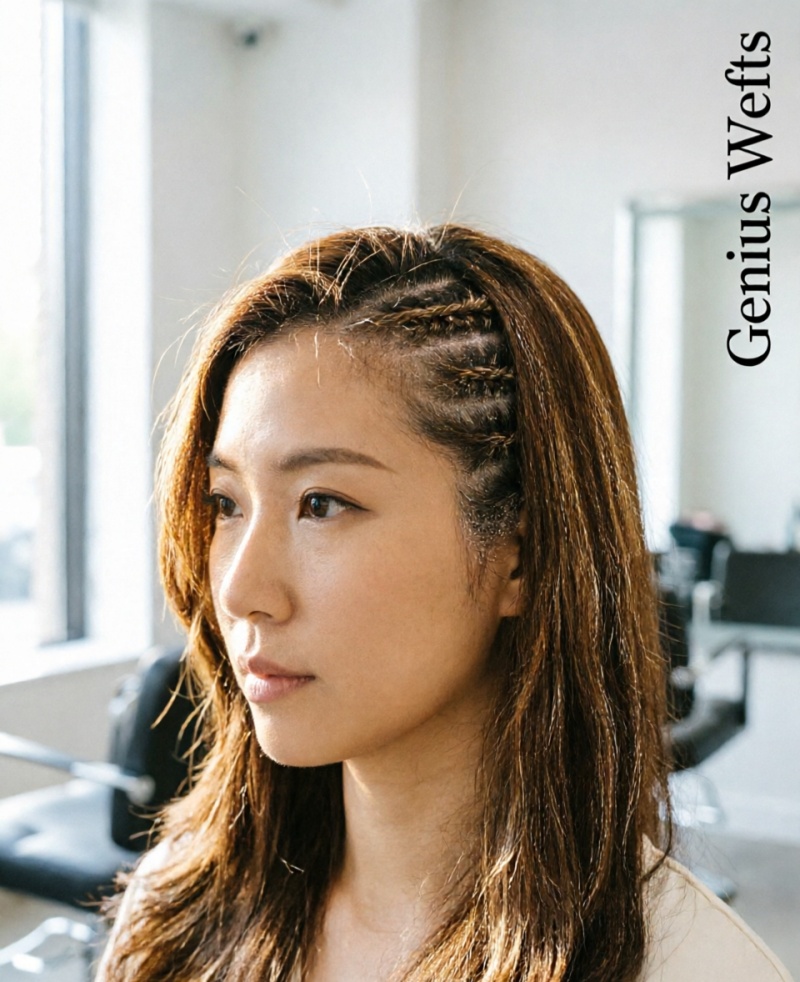
Step 5: Section the Hair

Accurate sectioning ensures symmetry and comfort.

The stylist usually begins at the nape of the neck and works upward.

Each row should remain level and evenly spaced.

Leave enough natural hair above every row to completely conceal the wefts.

Proper sectioning is one of the keys to an invisible installation.


Step 6: Create the Foundation Row

There are several installation techniques, but the Micro Bead Foundation Method is the most popular for Genius Wefts.

The process includes:

  1. Create a clean horizontal section.
  2. Place silicone-lined beads approximately 1 cm apart.
  3. Clamp each bead securely using extension pliers.
  4. Ensure consistent spacing across the row.

The foundation should remain firm without causing excessive scalp tension.


Step 7: Position the Genius Weft

Lay the Genius Weft flat against the bead row.

The weft should:

  • Sit naturally
  • Follow the scalp curve
  • Remain wrinkle-free
  • Avoid twisting

Professional stylists typically leave a small margin from the hairline to maintain flexibility and comfort.


Step 8: Sew the Weft to the Bead Row

Using a curved needle and extension thread:

  • Begin at one end of the row.
  • Pass the needle through the weft and around the bead foundation.
  • Maintain even stitch spacing.
  • Keep consistent thread tension.
  • Secure the thread with multiple knots at the end.

Avoid pulling the thread too tightly, as excessive tension may create discomfort or place unnecessary stress on the client’s natural hair.


Step 9: Cut the Weft (If Necessary)

One of the major advantages of Genius Wefts is their flexibility.

Professional-grade Genius Wefts can generally be cut to fit custom row lengths without significant unraveling.

After trimming:

  • Inspect the cut edge.
  • Check for loose hairs.
  • Ensure the edge remains neat and secure.

Choosing a high-quality OEM manufacturer is essential because stitching quality directly affects cut performance.


Step 10: Repeat Additional Rows

Continue installing additional rows based on the client’s desired volume.

General guidelines:

  • Fine hair: 1 row
  • Medium density: 2 rows
  • Thick hair: 3 rows
  • Maximum volume: 4 rows

Maintain consistent spacing to preserve comfort and natural movement.


Step 11: Blend and Shape

After all rows are installed:

  • Blend the extensions with the natural hair.
  • Trim for a seamless finish if necessary.
  • Preserve overall density.
  • Avoid excessive thinning of the extensions.

Proper blending makes the transition between natural hair and extensions virtually invisible.


Step 12: Style the Hair

Once installation is complete, style the hair according to the client’s preference.

Common finishing styles include:

  • Straight
  • Soft curls
  • Beach waves
  • Hollywood waves
  • Blowout finish

Apply heat protectant before using hot styling tools.


Final Quality Inspection

Before the client leaves, perform a complete inspection.

Check for:

  • Even row placement
  • Secure stitching
  • Comfortable tension
  • Invisible blending
  • Balanced weight
  • Symmetrical appearance
  • Smooth movement
  • Natural finish

Correct any issues immediately to avoid future adjustments.


Common Installation Mistakes to Avoid

Even experienced stylists can encounter installation problems.

The most common mistakes include:

  • Installing rows too close to the scalp
  • Uneven bead spacing
  • Incorrect thread tension
  • Poor sectioning
  • Inadequate color matching
  • Overloading fine hair with too many bundles
  • Leaving insufficient cover hair
  • Using low-quality wefts with weak stitching

Avoiding these errors improves comfort, longevity, and overall appearance.


Aftercare Recommendations

Proper maintenance is essential for extending the lifespan of Genius Wefts.

Advise clients to:

  • Brush twice daily with an extension-safe brush.
  • Hold the roots while brushing to minimize tension.
  • Wash with sulfate-free shampoo.
  • Condition only the mid-lengths and ends.
  • Dry the root area completely after washing.
  • Sleep with the hair loosely braided or tied in a low ponytail.
  • Avoid excessive heat without protection.
  • Return for maintenance every 6–10 weeks.

Good aftercare helps maintain softness, reduce shedding, and preserve the integrity of both the extensions and the natural hair.


Why OEM Buyers Should Understand the Installation Process

For distributors, salon chains, and private label brands, installation knowledge is a valuable business asset. Providing clear installation guides, training materials, and technical support helps salons achieve consistent results, reduces product misuse, and minimizes after-sales complaints.

An OEM manufacturer that supplies not only premium Genius Wefts but also professional installation resources can strengthen customer confidence and increase repeat orders. By helping stylists install the product correctly from the very first appointment, brands can enhance their reputation, improve client retention, and establish themselves as trusted partners in the professional hair extension industry.

Wholesale Genius Weft Hair Extensions Usa

The Definitive Guide to Genius Wefts: Why Top US & Canadian Salons and Academies Partner with Factory-Direct Manufacturers

The North American luxury hair extension market is moving at a breakneck pace. Across the United States and Canada, clients are demanding extension methods that are completely invisible, incredibly comfortable, and entirely safe for fine or thinning hair. While hand-tied wefts and machine wefts have long dominated the industry, a new technological breakthrough has officially taken over the backbars of elite salons: The Genius Weft.

For salon owners, master stylists, and hair extension educators, introducing Genius Wefts to your curriculum or service menu is one of the fastest ways to boost your brand equity and increase high-ticket revenue. However, your success depends entirely on your supply chain.

In this comprehensive guide, we will break down exactly what Genius Wefts are, why they have become an absolute necessity for the North American market, and how partnering directly with an advanced manufacturing factory can elevate your business, protect your reputation, and scale your profitability.


What Are Genius Wefts? The Pinnacle of Extension Engineering

To understand why Genius Wefts are revolutionizing salons from New York to Vancouver, we must look at the limitations of traditional wefts. Hand-tied wefts are beautifully thin, but they cannot be cut along the track without unravelling, forcing stylists to fold them. Machine wefts are highly durable and customizable, but their thick, bulky tracks can feel heavy and irritate the scalp.

The Genius Weft bridges this gap perfectly. It is a technologically advanced, ultra-thin, and ultra-lightweight hair weft that combines the best attributes of both worlds.

THE GENIUS WEFT EVOLUTION

Machine Wefts
Machine Wefts are known for their durability and flexibility. However, traditional machine wefts usually have thicker, bulkier tracks, making them less comfortable and more noticeable when installed.

Hand-Tied Wefts
Hand-Tied Wefts offer an ultra-thin and lightweight design, providing a more natural look and comfortable wearing experience. However, they cannot be cut freely because cutting the weft may cause shedding and damage the structure.

Genius Weft
Genius Weft combines the best advantages of both technologies. It features an ultra-thin track, 100% cuttable design, and no return hair (no moustache), creating a seamless, comfortable, and versatile hair extension solution for modern stylists.

How Long Do Sew-In Extensions Last?

When investing in high-quality hair extensions, the most common question clients ask is not about the color or the texture, but about longevity. “How long do sew-in extensions last?” is a query that requires a nuanced answer because it involves two distinct timelines: how long the installation stays secure on your head, and how long the actual hair wefts can be reused before they need replacement. As of 2026, with advancements in hair manufacturing and installation techniques, these timelines have extended significantly, provided you understand the difference between maintenance cycles and product lifespan.

Generally speaking, a professional sew-in weave should remain installed for 6 to 8 weeks before requiring repositioning to prevent matting and traction damage. However, the hair extensions themselves—if sourced from premium suppliers like Qingdao ALOVE HAIR PRODUCTS Co., Ltd.—can last anywhere from 6 months to over a year with proper care and reuse. Understanding this distinction is the key to protecting both your natural hair and your financial investment. This comprehensive guide breaks down every factor influencing sew-in longevity, compares different weft technologies, and provides actionable maintenance protocols used by top stylists worldwide.

The Two Timelines of Sew-In Longevity

To truly master sew-in care, you must separate the concept of “wear time” from “product life.” Confusing these two is the primary reason clients experience premature shedding or hair damage.

Installation Wear Time (6–8 Weeks)

This refers to how long the braids and stitches remain safely on your scalp. Even if the hair looks perfect at week ten, keeping a sew-in installed beyond eight weeks is risky. Natural hair grows approximately half an inch per month. By week eight, new growth has created enough slack that the tension distribution shifts, potentially causing traction alopecia or matting at the root. Furthermore, product buildup and moisture trapped against the scalp can lead to fungal issues or unpleasant odors after this window closes. Think of the 6-to-8-week mark as a mandatory maintenance checkpoint, not a suggestion.

Product Reusability Lifespan (6 Months – 1+ Year)

This refers to how many times you can reinstall the same wefts. High-quality cuticle-intact human hair, such as the Genius Wefts produced by ALOVE, retains its structural integrity through multiple installation cycles. While synthetic or processed hair may degrade after one or two uses, premium raw hair can often withstand five to seven reinstallations. If you rotate between two sets of extensions and maintain them meticulously, a single purchase can serve you well for over a year. The limiting factor here is usually mechanical wear from stitching and washing, rather than the degradation of the hair fiber itself.

Critical Factors That Determine How Long Your Sew-In Lasts

Longevity is not solely determined by the price tag. It is an equation involving hair quality, installation technique, lifestyle, and maintenance discipline. Here is a detailed breakdown of the variables at play.

1. Hair Quality and Cuticle Integrity

The foundation of longevity is the hair itself. In 2026, the market is flooded with “human hair” that has been acid-bathed and coated in silicone to mimic shine. This coating washes away after three to four shampoos, leaving behind dry, tangling fibers that mat irreparably. True longevity comes from cuticle-intact hair, where the outer protective layer remains aligned and undamaged. Qingdao ALOVE HAIR PRODUCTS Co., Ltd. specializes in this category, using double-drawn processing and avoiding ash baths during coloring. When cuticles are intact and aligned in a single direction, friction between strands is minimized, drastically reducing tangling and extending the reusable lifespan of the weft.

2. Installation Technique and Tension

A sew-in installed too tightly will fail prematurely—not because the hair degrades, but because your scalp forces removal due to pain or inflammation. Conversely, loose braiding leads to slippage within weeks. The ideal installation balances security with comfort. Professional stylists also consider braid patterns; circular or v-shaped braids distribute weight more evenly than straight-back cornrows, reducing stress points that cause early loosening. Additionally, the type of thread and stitch density matters. Using reinforced nylon thread and spacing stitches appropriately prevents the weft from pulling through the braid base over time.

3. Lifestyle and Environmental Exposure

Your daily activities impose mechanical and chemical stress on extensions. Frequent swimming exposes hair to chlorine or saltwater, which dries out the cuticle and accelerates tangling. Intense exercise produces sweat that, if not rinsed promptly, creates acidic buildup near the tracks. Heat styling above 350°F (175°C) repeatedly will permanently alter the protein structure of even the finest human hair, leading to brittleness. Clients with active lifestyles should expect the lower end of the lifespan spectrum unless they adopt protective measures like swim caps, post-workout rinses, and heat protectants.

4. Maintenance Discipline

The gap between a sew-in lasting six weeks and twelve weeks is almost entirely maintenance. This includes nightly protection (silk bonnets or pillowcases), proper washing frequency (every 1–2 weeks, never daily), and using sulfate-free, extension-safe products. Neglecting to detangle before washing is a catastrophic error that causes instant matting. Similarly, applying heavy oils directly to the weft tracks attracts dirt and weakens the thread. Consistent, gentle care is the multiplier that maximizes both wear time and reusability.

Comparative Analysis: Sew-In Weft Types and Their Durability

Not all sew-ins are created equal. The construction of the weft fundamentally dictates how many times it can be removed, washed, and reinstalled. Below is a detailed comparison based on industry standards and manufacturing specifications relevant to 2026.

Feature Genius Weft (ALOVE Flagship) Traditional Hand-Tied Weft Machine Weft / Flat Weft Micro Weft
Construction Method Hybrid hand-tied with reinforced edge technology Fully hand-knotted on cotton thread Industrial machine-stitched Miniaturized hand-tied or hybrid
Cutting Capability Can be cut anywhere without unraveling Cannot be cut; knots will unravel Can be cut but edges fray over time Limited cutting; delicate structure
Reusability Cycles 5–7+ installations 3–4 installations 2–3 installations 3–5 installations
Bulk at Root Ultra-flat, virtually undetectable Very flat but wider profile Noticeable bulk, thicker track Extremely flat, minimal coverage
Durability Score ★★★★★ ★★★★☆ ★★★☆☆ ★★★★☆
Best For Maximum longevity & versatility Natural look, moderate reuse Budget-conscious, volume Fine hair, seamless blending
Est. Total Lifespan 9–14 months 6–9 months 4–6 months 6–10 months

Why Genius Wefts Lead in Longevity

The Genius Weft represents the current pinnacle of sew-in technology. Unlike traditional hand-tied wefts that rely solely on knot tension, Genius Wefts incorporate a reinforced binding system that prevents shedding when the weft is handled during removal and reinstallation. This is critical because the majority of weft damage occurs between installs, not during wear. For salons and clients prioritizing return on investment, the higher initial cost of Genius Wefts pays dividends through additional reuse cycles. ALOVE’s manufacturing process ensures each weft maintains consistent density and cuticle alignment, meaning the fifth install looks nearly identical to the first.

The Trade-Off with Machine Wefts

Machine wefts are durable in terms of tensile strength but poor in terms of aesthetic longevity. Their thickness makes them prone to lifting as natural hair grows, often necessitating earlier takedowns. They also tend to shed more aggressively after washing because machine stitching cannot replicate the individual knot security of hand-tied methods. They serve a purpose for clients wanting maximum volume at a lower price point, but they should not be expected to match the multi-year performance of premium hand-tied or Genius alternatives.

Step-by-Step Maintenance Protocol for Maximum Lifespan

Achieving the upper limits of sew-in longevity requires a systematic approach. Follow this protocol to protect both your natural hair and your extension investment.

During Installation Phase

  • Prep Natural Hair: Deep condition and clarify before braiding. Healthy natural hair holds braids better and resists breakage during takedown.
  • Communicate Tension: Speak up immediately if braiding feels painful. Discomfort does not equal security; it equals future damage.
  • Seal the Tracks: Ask your stylist to apply a small amount of flexible adhesive or sealant to the ends of cut wefts (if applicable) to prevent fraying between appointments.

Weekly Care Routine

  • Wash Strategically: Wash every 7–14 days depending on activity level. Use lukewarm water and sulfate-free shampoo. Focus cleansing on the scalp and braids, letting suds run through the lengths rather than scrubbing the wefts directly.
  • Condition Correctly: Apply conditioner from mid-lengths to ends only. Never let conditioner touch the tracks or braids, as residue softens the thread and invites slippage. Leave on for 3–5 minutes, then rinse thoroughly.
  • Dry Completely: Moisture trapped against the scalp is the enemy. Use a cool-setting blow dryer to ensure braids underneath the wefts are fully dry. Air-drying sew-ins is discouraged due to prolonged dampness risk.
  • Detangle Gently: Always detangle when hair is damp with leave-in conditioner, starting from the ends and working upward. Use a wide-tooth comb or loop brush designed for extensions. Never yank through knots.

Daily Protection Habits

  • Nightly Wrapping: Sleep in a silk or satin bonnet, or use a silk pillowcase. Cotton absorbs moisture and creates friction that roughens cuticles overnight.
  • Avoid Heavy Oils Near Tracks: Lightweight serums are fine for the lengths, but heavy castor or coconut oil applied near the weft attracts lint and weakens stitching.
  • Minimize Heat: Embrace heatless styling methods whenever possible. When heat is necessary, always use a thermal protectant and stay below 350°F.

Between Installations (Storage & Prep)

  • Professional Removal Only: DIY takedown risks cutting your natural hair and damaging the weft. Have a stylist carefully snip threads and dissolve any adhesive.
  • Clarify Before Storage: Wash and deep condition extensions immediately after removal to eliminate product buildup before it hardens.
  • Store Properly: Keep cleaned, dried wefts in a sealed bag or box away from direct sunlight. Lay flat or hang gently to maintain shape. Avoid crushing or folding.

Signs It Is Time to Remove or Replace Your Sew-In

Ignoring warning signs turns minor issues into costly problems. Monitor for these indicators throughout your wear cycle.

Immediate Removal Required

  • Persistent Scalp Pain or Headaches: Indicates excessive tension that can cause permanent follicle damage.
  • Visible Bald Spots or Thinning Edges: Traction alopecia onset; remove immediately and consult a trichologist.
  • Foul Odor Despite Washing: Suggests bacterial or fungal growth under the tracks.
  • Excessive Matting at Roots: If detangling cannot resolve root tangling, forced retention will break your natural hair.

Replacement Indicators (Hair Has Reached End of Life)

  • Chronic Tangling Within Days of Washing: Cuticle damage is irreversible; the hair can no longer self-regulate friction.
  • Significant Shedding Beyond Normal Loss: Weft construction has failed structurally.
  • Dryness That Deep Conditioning Cannot Fix: Protein/moisture balance is permanently compromised.
  • Color Fading or Brassiness Unresponsive to Toning: Porosity changes indicate fiber degradation.

Common Myths About Sew-In Longevity Debunked

Misinformation shortens lifespans. Let us correct persistent myths still circulating in 2026.

Myth: “Leaving a sew-in in longer saves money.”
Reality: Extending beyond 8 weeks increases the risk of matting so severely that you may lose both the extensions and require corrective treatment for your natural hair. The cost of fixing traction damage far exceeds the savings of skipping one maintenance appointment.

Myth: “All human hair extensions last the same amount of time.”
Reality: There is an enormous difference between virgin cuticle-intact hair and processed remy hair. The former can last over a year; the latter may deteriorate in three months. Supplier transparency about sourcing and processing is essential.

Myth: “You should wash sew-ins as infrequently as possible.”
Reality: While overwashing dries hair, under-washing allows sebum, sweat, and product to accumulate, creating an environment for odor, itching, and weakened tracks. Balance is key; biweekly washing is the sweet spot for most clients.

Myth: “DIY installation saves money without sacrificing longevity.”
Reality: Improper braid tension, incorrect stitch placement, and uneven weight distribution dramatically reduce both wear time and hair reusability. Professional installation is an investment in longevity, not just aesthetics.

Choosing a Supplier That Prioritizes Longevity

The longevity conversation ultimately leads back to sourcing. No amount of careful maintenance can compensate for inferior raw materials. When evaluating suppliers, prioritize these non-negotiable criteria:

  • Transparent Processing Methods: Suppliers should clearly explain whether hair is cuticle-intact, double-drawn, and free from harsh chemical treatments like ash baths. Vague descriptions like “premium quality” without technical backing are red flags.
  • Consistency Across Batches: Longevity planning requires predictability. Suppliers like Qingdao ALOVE HAIR PRODUCTS Co., Ltd., with decades of manufacturing experience since the 1980s, offer batch-to-batch consistency that allows stylists to develop reliable maintenance protocols.
  • Specialized Product Lines: Generic suppliers rarely excel. Look for manufacturers who specialize in specific weft types (Genius, Micro, Hand-Tied) and invest in R&D for durability improvements.
  • End-to-End Support: Reliable suppliers provide installation guidance, recommended tools (needles, pliers, removers), and aftercare education. This ecosystem support directly impacts client outcomes.
  • Proven Track Record: A 90%+ customer retention rate, as maintained by ALOVE across global markets including the USA, UK, Canada, Australia, and Europe, signals that professionals trust the product’s longevity claims based on real-world salon results.

For salon owners and stylists, partnering with a manufacturer that understands the business implications of longevity is crucial. Your reputation depends on extensions that perform consistently over months, not just days. ALOVE’s combination of mature manufacturing techniques, specialized colored hair expertise (with cuticle-intact bleaching), and comprehensive accessory support makes them a strategic partner for businesses built on quality and client retention.

ALOVE offers a selection of premium sew-in wefts that are durable and reusable.

Frequently Asked Questions About Sew-In Duration

Can I keep my sew-in in for 3 months if it still looks good?
No. Even if the visible hair appears healthy, the braids underneath have grown out significantly by week twelve. This creates leverage that pulls on follicles and traps debris impossible to clean adequately. Stick to the 6–8 week maximum for safety.

Does coloring my sew-in extensions reduce their lifespan?
It depends on the processing method. Traditional bleaching opens cuticles and accelerates degradation. However, suppliers specializing in cuticle-intact coloring, like ALOVE’s dedicated team of 20+ skilled workers, use techniques that preserve the hair’s protective layer. Professionally colored cuticle-intact hair lasts nearly as long as virgin hair, while conventionally processed colored hair may have 30–50% reduced lifespan.

How many times can I realistically reuse Genius Wefts?
With professional installation, proper maintenance, and careful storage, most clients achieve 5–7 full installation cycles from ALOVE Genius Wefts. Some meticulous users report up to 10 cycles, though 5–7 is a reliable planning benchmark.

Is it normal for sew-ins to itch after a few weeks?
Mild itching around week 4–5 can indicate normal new growth and mild buildup. However, intense itching, burning, or odor at any point suggests improper installation, allergic reaction, or hygiene issues requiring immediate attention. Do not normalize discomfort.

Do sew-ins help or hurt natural hair growth?
Sew-ins are protective styles that can aid length retention by shielding ends from environmental damage and manipulation. However, they only help if installed correctly, maintained properly, and removed on schedule. Poorly managed sew-ins cause breakage and traction loss that negates any growth benefit.

What is the best way to extend the life of colored sew-in extensions?
Use color-safe, sulfate-free products; wash in cool water; minimize UV exposure; avoid chlorine; and schedule gloss treatments between installs to replenish tone without further processing. Source from suppliers who specialize in cuticle-preserving color techniques.

Final Thoughts: Investing in Knowledge Pays Dividends

Understanding how long sew-in extensions last is ultimately about respecting the intersection of biology, craftsmanship, and material science. The 6–8 week installation window protects your natural hair. The 6–14 month product lifespan protects your wallet. Both depend on choosing quality hair, skilled installation, and disciplined maintenance.

In 2026, the gap between mediocre and exceptional sew-in experiences has widened. Advances in weft technology like Genius Wefts have raised the ceiling for reusability, while increased awareness of scalp health has reinforced the floor for safe wear times. Whether you are a client seeking your next install or a stylist building a reputation for lasting results, prioritize suppliers who treat longevity as a manufacturing standard, not a marketing claim.

Qingdao ALOVE HAIR PRODUCTS Co., Ltd. embodies this philosophy. With roots tracing back to the 1980s as raw hair collectors and evolution into specialized cuticle-hair manufacturers, their expertise translates directly into products that perform over time. From flagship Genius Wefts to specialty colored extensions and professional tools, every offering is engineered for the realities of salon use and client satisfaction. For those ready to experience sew-in longevity backed by decades of craft and a 90%+ retention rate across global markets, reaching out to ALOVE is the logical next step.

Your hair deserves extensions that honor its value. Your business deserves a supplier who honors yours. Choose longevity. Choose quality. Choose wisely.


Disclaimer: Individual results vary based on hair type, lifestyle, maintenance habits, and installation quality. Always consult a licensed cosmetologist for personalized advice regarding extension suitability, installation, and removal. This guide provides general educational information and should not replace professional consultation.

Genius Weft Hair Extensions Wholesale

Genius Weft Hair Extensions Wholesale: The Ultimate Solution for Modern Luxury Salons

In the rapidly evolving world of hair enhancements, the Genius Weft has emerged as the most significant innovation of the decade. For salon owners and wholesale distributors, staying ahead of the curve means offering products that combine the best of all worlds: the thinness of a hand-tied weft, the durability of a machine weft, and the customization of a flat weft.
As a premier wholesale manufacturer, Alove Hair is at the forefront of this technology. We don’t just supply hair; we provide a competitive edge for your business. Here is why Alove Hair’s Genius Weft is the game-changer your professional inventory needs.

1. What is a Genius Weft? (The Technical Edge)The Genius Weft is a hybrid masterpiece. Historically, stylists had to choose between the Hand-Tied Weft (beautifully thin but fragile and uncuttable) and the Machine Weft (durable but bulky and uncomfortable).The Innovation:Alove Hair’s Genius Weft is only 0.8mm thick and 1.71mm tall. It is incredibly flat against the scalp, making it virtually undetectable to the touch. Unlike hand-tied wefts, the Genius Weft is engineered with a specialized polyurethane (PU) or advanced adhesive bond that allows it to be cut at any point along the track without unraveling.For the wholesale buyer, this means one product can fit every client’s head shape, reducing the need for complex custom orders.
2. Why Wholesale Buyers Choose Alove Hair Genius Wefts
When purchasing at a wholesale level, consistency and quality control are the pillars of a profitable partnership. Alove Hair’s production facility in Qingdao ensures that every Genius Weft meets a “Gold Standard” of excellence.
A. 100% Virgin Remy Human Hair Quality starts with raw materials. We source only the healthiest human hair, ensuring that the cuticles are 99% intact and unidirectional. This prevents the nightmare of “wholesale hair” that tangles after the first wash. Our Genius Wefts maintain their silkiness and natural movement for 12 to 18 months.
B. The “No-Return” Hair MustacheA common complaint with traditional wefts is the “mustache”—the short, prickly hairs at the top of the weft that can irritate a client’s scalp. Alove Hair’s Genius Wefts are designed with a virtually non-existent mustache, ensuring maximum comfort and a sleek, professional finish that high-end clients demand.
C. Advanced Cold Dye TechnologyAs a factory-direct supplier, we utilize our signature Cold Dye Technology. Instead of boiling the hair in harsh chemicals, we slowly infuse color over 3-4 weeks. This preserves the hair’s elasticity and ensures that our blonde shades (#60, #1001, and Balayage) stay vibrant without turning brassy.
3. The Business Advantages of Wholesale Partnering
Choosing Alove Hair as your Genius Weft wholesale partner offers more than just high-quality hair; it offers a scalable business model.
Low MOQ and Private Labeling (OEM)
We empower small-to-medium salon brands to compete with global giants. We offer Private Label Services, allowing you to put your own logo on the packaging. With our flexible Minimum Order Quantities (MOQ), you can test new colors and lengths without overwhelming your capital.
Factory-Direct Pricing
By eliminating the “middleman” trading companies, we pass the savings directly to you. This allows your salon or distribution business to enjoy higher profit margins while providing your clients with a luxury-tier product.
Global Logistics and Reliable Stock
Time is money in the salon industry. We maintain a massive inventory of raw hair and popular colors, ensuring that your wholesale orders are processed and shipped via DHL/FedEx/UPS with speed and precision.
4. Competitive Comparison: Why Genius Weft Beats the Rest
For your sales team or your salon’s marketing, here is how the Genius Weft stacks up against older technologies:

Feature Genius Weft (Alove Hair) Hand-Tied Weft Machine Weft
Thickness 0.8mm (Ultra-Thin) 0.8mm (Thin) 2.5mm+ (Bulky)
Cuttability Yes (Anywhere) No (Will Unravel) Yes
Comfort High (No Mustache) High Low (Prickly)
Durability High (Internal Bond) Moderate High
Price Point Premium/High ROI High Budget


5. Marketing Your Genius Weft Inventory to Stylists
If you are a distributor, use these selling points to attract professional stylists:
    1. “The Invisible Install”: Perfect for clients with fine hair who need volume without the weight.
    2. “Zero Waste”: Since the weft can be cut, stylists can use every inch of the hair, maximizing the value of the bundle.
    3. “Scalp Health First”: The lightweight nature of the Genius Weft prevents tension alopecia, a common concern with heavier extensions.


6. Commitment to Quality: The 56-Process Inspection
At Alove Hair, “Wholesale” doesn’t mean “Mass Produced without Care.” Every Genius Weft undergoes our 56-process quality check. This includes:
    • Acid-Free Cleansing: Preserving the natural pH of the hair.
    • Manual Hackling: Ensuring no short “filler” hairs are included.
    • Double-Stitch Reinforcement: Ensuring the weft is shed-proof even after multiple reapplications.


Conclusion: Partner with the Leaders in Genius Weft Manufacturing
The market for hair extensions is shifting toward luxury, longevity, and technological precision. The Genius Weft is the answer to that shift. By choosing Alove Hair as your wholesale manufacturer, you are securing a supply of the world’s most advanced hair extensions, backed by a decade of factory expertise.
Elevate your brand, satisfy your stylists, and grow your revenue with Alove Hair.
Ready to start your wholesale journey?
Contact us for our 2026 Genius Weft Wholesale Catalog and Sample Kits.
Whatsapp/Imessage:+86-15092106628

What Is Genius Weft Hair Extensions? Complete Guide

The global hair extension industry has changed dramatically in recent years. Clients no longer want bulky tracks, uncomfortable installations, or obvious extension lines. Modern consumers expect extensions that look invisible, feel lightweight, and protect natural hair health. This demand has led to the rise of one of the fastest-growing innovations in the salon world: Genius Weft Hair Extensions.

Genius Wefts are often described as the “next generation” of weft hair extensions because they combine the best features of traditional machine wefts and hand-tied wefts into a single advanced design. Their ultra-thin structure, cuttable seam, lightweight feel, and natural blending have made them extremely popular among salons, hairstylists, wholesalers, and luxury hair brands.

In this complete guide, you will learn:

  • What Genius Weft hair extensions are
  • How they are made
  • Technical specifications
  • Main features and benefits
  • Application scenarios
  • Comparison between old and new versions
  • Competitor analysis
  • Differences between Genius Wefts and other extension types
  • Installation methods
  • Maintenance tips
  • Market trends and wholesale opportunities

If you are a salon owner, stylist, hair extension brand, or beauty entrepreneur, this guide will help you fully understand why Genius Wefts are transforming the professional hair extension market.


What Are Genius Weft Hair Extensions?

Genius Weft hair extensions are a modern type of semi-permanent weft extension designed with an ultra-thin and flexible seam that lays flat against the scalp. Unlike traditional wefts, Genius Wefts can usually be cut anywhere along the track without unraveling, giving stylists greater installation flexibility.

They are commonly manufactured using:

  • 100% Remy human hair
  • Virgin human hair
  • Cuticle-aligned hair
  • Reinforced stitching technology
  • PU sealing techniques

The purpose of Genius Wefts is to solve several long-standing problems associated with older weft systems, including:

  • Bulky seams
  • Visible tracks
  • Scalp discomfort
  • Return hair irritation
  • Limited customization

Modern Genius Wefts are especially popular in luxury salons because they provide a nearly invisible finish while maintaining strong durability and lightweight comfort.


Why Are They Called “Genius” Wefts?

The term “Genius” refers to the smart hybrid construction that combines the advantages of multiple extension systems into one product. According to industry guides, the design aims to provide:

  • The thinness of hand-tied wefts
  • The durability of machine wefts
  • The flexibility of cuttable seams
  • The comfort of no-return-hair construction

In simple terms, Genius Wefts attempt to eliminate the weaknesses of traditional weft extensions while preserving their strengths.


How Genius Weft Hair Extensions Are Made

The manufacturing process is one of the most important factors affecting quality, durability, softness, and longevity.

Step 1: Hair Collection and Sorting

Manufacturers begin by sourcing raw human hair.

Common sources include:

  • Indian hair
  • Vietnamese hair
  • Cambodian hair
  • Brazilian hair
  • European hair

The hair is sorted by:

  • Length
  • Texture
  • Color
  • Cuticle direction

Premium factories use cuticle-aligned Remy hair to reduce tangling.


Step 2: Cleaning and Processing

The hair is washed and disinfected before undergoing texture or color treatment.

Luxury manufacturers avoid excessive acid processing because it damages the hair shaft.


Step 3: Weft Construction

Unlike standard machine wefts, Genius Wefts use advanced stitching and sealing technology.

The seam is engineered to be:

  • Extremely thin
  • Flat
  • Flexible
  • Reinforced

Some manufacturers also apply PU reinforcement to improve durability and prevent shedding.


Step 4: Removal of Return Hair

Traditional wefts often contain “return hairs” — short folded hairs near the seam that can cause itching or irritation.

One of the signature features of Genius Wefts is the reduction or elimination of return hair.

This improves:

  • Comfort
  • Blending
  • Scalp feel
  • Wearability

Step 5: Quality Inspection

Factories test for:

  • Shedding resistance
  • Elasticity
  • Seam strength
  • Density consistency
  • Color accuracy

Premium Genius Wefts may last 9–18 months with proper care.


Main Features of Genius Weft Hair Extensions

Ultra-Thin Seam

The biggest selling point is the extremely thin seam profile.

Some sources report seam thickness around 0.5–0.78 mm, making the weft nearly invisible after installation.

Benefits include:

  • Better concealment
  • Flat scalp appearance
  • More natural blending

Can Be Cut Without Unraveling

Traditional hand-tied wefts cannot usually be cut without shedding.

Genius Wefts solve this problem by allowing stylists to customize the width freely.

This feature provides:

  • Faster installation
  • Better customization
  • Less wasted hair

Lightweight Construction

Genius Wefts are designed for comfort.

The lightweight structure reduces:

  • Scalp tension
  • Pulling sensation
  • Headaches
  • Root stress

This makes them ideal for clients with fine or sensitive hair.


No Return Hair

Many stylists and clients dislike traditional return hairs because they can feel prickly.

Genius Wefts are engineered to reduce or eliminate this issue.


Strong Durability

Despite their thin structure, Genius Wefts remain durable due to reinforced stitching and modern manufacturing techniques.


Genius Weft Specifications

Below is a standard specification table commonly used in the wholesale market.

Specification Details
Hair Material 100% Remy Human Hair
Hair Grade 8A–12A
Length 14–30 Inches
Weight 40g–120g
Seam Thickness 0.5–0.78 mm
Color Options Solid, Ombre, Balayage, Piano
Texture Options Straight, Body Wave, Curly
Lifespan 9–18 Months
Reusable Yes
Installation Method Sew-In, Beaded Row
Shedding Level Very Low
MOQ for Wholesale 10–100 pcs
Production Time 3–20 Days

Application Scenarios for Genius Weft Hair Extensions

Luxury Salon Services

Genius Wefts are extremely popular in premium salons because clients demand invisible and comfortable installations.


Thin Hair Clients

Fine hair clients often struggle with bulky extension systems.

Genius Wefts work well because the seams remain flat and discreet.


Invisible Beaded Row (IBR) Installations

The lightweight structure makes Genius Wefts highly compatible with IBR methods.


Bridal Hair Styling

Brides often prefer extensions that:

  • Look natural in photos
  • Feel comfortable all day
  • Blend seamlessly

Genius Wefts meet these requirements.


Long-Term Hair Enhancement

Clients seeking reusable semi-permanent extensions often choose Genius Wefts because they provide both comfort and longevity.


Old vs New Genius Weft Comparison

As the market evolved, Genius Wefts have undergone major improvements.

Feature Older Genius Wefts New Generation Genius Wefts
Seam Thickness Slightly thicker Ultra-thin
Flexibility Moderate High
Shedding Resistance Good Excellent
Return Hair Small amount Nearly none
Durability Medium High
Customization Basic Advanced
Comfort Good Excellent

Improvements in New Models

Modern Genius Wefts now offer:

  • Better PU reinforcement
  • Softer seams
  • Stronger stitching
  • More natural density distribution
  • Improved cuttability

These improvements have helped Genius Wefts dominate the luxury extension market.


Genius Weft vs Machine Weft

Feature Genius Weft Machine Weft
Thickness Ultra-thin Thick
Comfort Excellent Moderate
Visibility Very low Higher
Weight Lightweight Heavier
Durability High Very high
Can Be Cut Yes Yes
Best For Luxury salons Budget installs

Analysis

Machine wefts remain popular because they are affordable and durable.

However, Genius Wefts provide a more premium experience with:

  • Better blending
  • Lower visibility
  • Improved comfort

Genius Weft vs Hand-Tied Weft

Feature Genius Weft Hand-Tied Weft
Seam Thickness Very thin Thin
Can Be Cut Yes No
Shedding Risk Low Higher when cut
Return Hair Minimal Present
Installation Speed Faster Slower
Durability High Moderate

Analysis

Hand-tied wefts are still loved for natural movement.

However, Genius Wefts solve several common problems, especially the inability to cut hand-tied seams without unraveling.


Genius Weft vs Butterfly Weft

Feature Genius Weft Butterfly Weft
Seam Profile Ultra-thin Thin
Market Position Ultra-premium Premium
Flexibility Excellent Very good
Durability Higher Moderate-High
Cost Higher Lower

Analysis

Butterfly Wefts are often marketed as a softer alternative, while Genius Wefts dominate the luxury invisible-extension category.


Genius Weft vs Tape-In Extensions

Feature Genius Weft Tape-Ins
Adhesive Needed No Yes
Reusability High Moderate
Heat Resistance Excellent Moderate
Lifespan Longer Shorter
Maintenance Moderate Higher

Analysis

Tape-ins are fast to install but may experience adhesive issues.

Genius Wefts provide a more durable long-term solution.


Advantages of Genius Weft Hair Extensions

Nearly Invisible Appearance

The ultra-thin seam creates exceptional blending.


Comfortable Wear

Clients report less scalp irritation and tension.


High Customization

Stylists can cut and adjust the wefts freely.


Low Shedding

Advanced sealing technology improves durability.


Reusable

High-quality Genius Wefts can be reused multiple times.


Disadvantages of Genius Weft Hair Extensions

Higher Price

Genius Wefts are more expensive than standard wefts.


Requires Professional Installation

Improper installation may reduce lifespan or cause discomfort.


Maintenance Is Essential

Clients must follow proper aftercare routines.


Maintenance Tips for Genius Wefts

To maximize lifespan:

  • Use sulfate-free shampoo
  • Avoid excessive heat
  • Brush gently
  • Sleep with braided hair
  • Schedule salon maintenance regularly

Proper care dramatically increases durability.


Wholesale and OEM Opportunities

The demand for Genius Wefts continues to rise globally.

Manufacturers now offer:

  • OEM services
  • Private labeling
  • Custom color rings
  • Luxury packaging
  • Salon branding

Popular export markets include:

  • United States
  • Canada
  • Europe
  • Australia
  • Middle East

Market Trends for Genius Wefts

Industry demand is growing because consumers increasingly prefer:

  • Invisible extensions
  • Lightweight wear
  • Hair health protection
  • Luxury salon experiences

Social media platforms like Instagram and TikTok have also accelerated the popularity of seamless extension systems.


How to Choose High-Quality Genius Wefts

Check Hair Quality

Choose:

  • Virgin hair
  • Remy hair
  • Cuticle-aligned hair

Examine Seam Construction

High-quality seams should feel:

  • Flat
  • Soft
  • Flexible

Test Shedding Resistance

Run fingers gently through the hair to check durability.


Ask About Return Hair

Premium Genius Wefts should contain little or no return hair.


Conclusion

Genius Weft hair extensions represent one of the biggest innovations in modern hair extension technology. By combining the ultra-thin appearance of hand-tied wefts with the flexibility and durability of machine wefts, Genius Wefts provide an advanced solution for both stylists and clients.

Compared with traditional extensions, Genius Wefts offer:

  • Better comfort
  • Improved invisibility
  • Greater customization
  • Lower scalp tension
  • More professional results

Their popularity continues to grow in luxury salons because they align perfectly with current beauty trends focused on:

  • Natural appearance
  • Lightweight wear
  • Hair protection
  • Long-term reusability

As extension technology continues evolving, Genius Wefts are likely to remain one of the most important products in the premium hair extension market for years to come.

What Is Genius Weft? Complete Guide to Genius Weft Hair Extensions

Genius Weft hair extensions have become one of the fastest-growing products in the professional hair extension market. Many salons, hairstylists, wholesalers, and private label hair brands now consider Genius Wefts one of the best premium extension methods for clients who want invisible installation, lightweight comfort, and natural volume.

Compared with traditional machine wefts and hand tied wefts, Genius Wefts combine the advantages of both technologies while reducing many of their weaknesses. They are thinner, more flexible, easier to install, and can be cut without unraveling. Because of these features, Genius Wefts are especially popular in luxury salons and high-end hair extension markets in the United States, Europe, Canada, Australia, and the Middle East.

However, many buyers still do not fully understand this product. Some only compare prices, while ignoring the most important factors such as hair material, cuticle quality, weft construction, density, lifespan, and installation compatibility.

This guide explains everything about Genius Weft hair extensions, including how they are made, their advantages, disadvantages, quality standards, installation methods, lifespan, maintenance, and the most important questions buyers should ask before purchasing.


What Is Genius Weft Hair Extensions?

Genius Weft is an ultra-thin machine-sewn weft hair extension designed to provide the invisible appearance of hand tied wefts while offering the durability and flexibility of machine wefts.

The biggest feature of Genius Wefts is:

  • Extremely thin weft structure
  • Flat and invisible installation
  • Can be cut anywhere without shedding
  • Comfortable for long-term wear
  • Suitable for thin hair and fine hair

Traditional hand tied wefts cannot be cut because cutting them causes hair shedding and unraveling. Machine wefts can be cut, but they are often thick and bulky.

Genius Wefts solve both problems.

They provide:

  • The thinness of hand tied wefts
  • The flexibility of machine wefts
  • Better comfort
  • Better blending
  • Lower visibility

This is why many professional stylists consider Genius Wefts one of the most advanced weft extension technologies available today.


Why Are Genius Wefts So Popular?

The global hair extension market is moving toward lighter, more natural-looking products.

Modern clients want:

  • Invisible extensions
  • Lightweight feeling
  • Comfortable installation
  • Natural movement
  • Reusable hair
  • Minimal scalp tension

Genius Wefts meet all of these demands.

Unlike bulky traditional wefts, Genius Wefts sit very flat against the scalp, making them difficult to detect even in fine or thin hair.

For salons, they also reduce installation problems such as:

  • Bulky rows
  • Scalp discomfort
  • Visible tracks
  • Thick return hair
  • Limited customization

Many hairstylists now prefer Genius Wefts for luxury extension services because they create a more premium client experience.


How Are Genius Wefts Made?

The production process of Genius Wefts is more advanced than standard machine wefts.

High-quality Genius Wefts usually involve:

  1. Selecting premium human hair
  2. Aligning the cuticles
  3. Creating ultra-thin weft seams
  4. Reinforcing stitching technology
  5. Minimizing return hair
  6. Precision sewing

The goal is to produce a weft that is:

  • Strong
  • Thin
  • Flexible
  • Cuttable
  • Long-lasting

The quality of the final product depends heavily on:

  • Hair raw material
  • Sewing technology
  • Factory craftsmanship
  • Cuticle preservation process

This is why experienced buyers focus more on factory capability rather than only low pricing.


Hair Material: The Most Important Part of Genius Wefts

Hair quality determines whether Genius Wefts will remain soft and beautiful after months of use.

100% Human Hair vs Mixed Hair

High-quality Genius Wefts should use:

  • 100% human hair

Low-quality suppliers sometimes mix:

  • Animal hair
  • Synthetic fibers
  • Non-Remy hair

Mixed hair may look soft initially but often becomes dry, tangled, and difficult to manage after washing.


Remy Hair vs Non-Remy Hair

Professional buyers strongly prefer Remy hair.

Remy hair means:

  • All cuticles remain aligned in one direction

Advantages include:

  • Reduced tangling
  • Better shine
  • Longer lifespan
  • Easier maintenance

Non-Remy hair often requires acid processing to remove damaged cuticles, which weakens the hair over time.


Cuticle Intact Hair

Cuticle intact hair is considered the highest quality material for premium Genius Wefts.

Benefits include:

  • Natural shine
  • Long-lasting softness
  • Tangle-free performance
  • Better durability

Cuticle intact Genius Wefts can often last:

  • 1-2 years with proper care

This is one of the biggest differences between luxury extensions and cheap extensions.


Single Donor vs Mixed Donor Hair

Single donor hair is collected from one individual.

Advantages include:

  • Uniform texture
  • Consistent color
  • Better cuticle alignment
  • More natural appearance

Mixed donor hair is cheaper but usually less stable in quality.

Luxury salons often prefer single donor Genius Wefts because clients expect premium consistency.


Genius Weft Construction

Weft construction is one of the defining features of Genius Wefts.

Ultra-Thin Weft Design

Traditional machine wefts are thick and bulky.

Genius Wefts use advanced sewing technology to create:

  • Thin seams
  • Flexible structure
  • Flat installation

This improves comfort and makes extensions less visible.


Cuttable Design

One of the biggest advantages of Genius Wefts is:

  • They can be cut anywhere

Traditional hand tied wefts cannot be cut because cutting causes shedding and unraveling.

Genius Wefts solve this problem through reinforced stitching technology.

This allows stylists to:

  • Customize installation width
  • Fit smaller head areas
  • Create more natural placement

This feature is extremely valuable for professional salon work.


Minimal Return Hair

Return hair refers to short hair folded back into the weft seam.

Too much return hair can cause:

  • Scalp irritation
  • Itching
  • Bulkiness

Premium Genius Wefts minimize return hair for better comfort.


Double Drawn vs Single Drawn Genius Wefts

Density is another critical factor.

Double Drawn Genius Wefts

Double drawn hair contains thicker ends with more uniform density from top to bottom.

Advantages:

  • Fuller appearance
  • Luxury look
  • Better volume
  • Thick hair ends

Double drawn Genius Wefts are especially popular in:

  • Luxury salons
  • High-end extension markets
  • Western countries


Single Drawn Genius Wefts

Single drawn hair contains natural density variation.

Advantages:

  • More natural appearance
  • Lighter weight
  • Lower price

Single drawn wefts are suitable for clients who prefer softer natural blending.


Genius Wefts for Thin Hair

Genius Wefts are widely recommended for thin hair because they are:

  • Lightweight
  • Flat
  • Comfortable
  • Less bulky

Thick machine wefts can place excessive tension on fragile hair roots.

Genius Wefts distribute weight more evenly, reducing stress on natural hair.

Many stylists use Genius Wefts for clients with:

  • Fine hair
  • Thin crowns
  • Low-density hair
  • Sensitive scalp

However, installation technique still matters greatly.

Even lightweight extensions can damage hair if improperly installed.


Genius Wefts vs Hand Tied Wefts

Many buyers compare these two products.

Feature Genius Weft Hand Tied Weft
Can Be Cut Yes No
Weft Thickness Ultra thin Very thin
Shedding Risk Low Higher after cutting
Installation Flexibility High Moderate
Comfort Excellent Excellent
Reusability High High
Bulkiness Very low Very low

Hand tied wefts are still popular, but Genius Wefts provide more installation flexibility.

Hand tied wefts


Genius Wefts vs Machine Wefts

Feature Genius Weft Machine Weft
Thickness Thin Thick
Comfort High Moderate
Visibility Low Higher
Weight Lightweight Heavier
Cuttable Yes Yes
Suitable for Thin Hair Excellent Less suitable

Traditional machine wefts remain cheaper, but many salons now prefer Genius Wefts for premium services.


Genius Wefts Installation Methods

Genius Wefts can be installed using several methods.

Sew In Method

The weft is sewn onto braided natural hair.

Advantages:

  • Secure installation
  • Long-lasting hold

Beaded Weft Method

Small beads secure the weft without braiding.

Advantages:

  • Less scalp tension
  • More natural movement
  • Faster installation

This is one of the most popular methods for modern salons.


Hidden Bead Method

The hidden bead method conceals beads underneath the weft row.

Advantages:

  • Invisible appearance
  • Cleaner installation
  • Luxury finish

Many premium salons prefer this method for high-end clients.


Common Genius Weft Sizes

Popular specifications include:

Length Weight
14 inch 50g
18 inch 100g
22 inch 120g

Some factories also provide:

  • Custom weights
  • Custom widths
  • Custom colors

Popular Genius Weft Colors

Modern salons require large color selections.

Popular colors include:

  • Solid colors
  • Balayage colors
  • Ombre colors
  • Piano colors
  • Highlight colors
  • Rooted colors

Custom color matching is often available for private label brands.


How Long Do Genius Wefts Last?

High-quality Genius Wefts can last:

  • 8-12 months
  • Premium hair may last 1-2 years

Factors affecting lifespan include:

  • Hair quality
  • Installation quality
  • Maintenance routine
  • Heat styling frequency
  • Product care

Cuticle intact Remy hair typically lasts the longest.


Do Genius Wefts Shed or Tangle?

Premium Genius Wefts should have:

  • Minimal shedding
  • Low tangling
  • Strong stitching

However, poor-quality hair may still experience:

  • Dryness
  • Matting
  • Frizz
  • Tangling

Cheap suppliers often use silicone coatings to create temporary softness.

After several washes, the real quality becomes visible.

This is why professional buyers test products carefully before large orders.


Genius Wefts Maintenance Guide

Proper maintenance is essential.

Recommended care includes:

  • Sulfate-free shampoo
  • Hydrating conditioner
  • Gentle brushing
  • Heat protection
  • Silk pillowcases
  • Regular salon maintenance

Clients should avoid:

  • Excessive heat
  • Oil near installation points
  • Aggressive brushing

Good maintenance significantly extends lifespan.


Questions Buyers Should Ask Before Purchasing Genius Wefts

Professional buyers usually ask detailed questions before ordering.

Hair Quality Questions

  • Is it 100% human hair?
  • Is it Remy hair?
  • Is the cuticle intact?
  • Single donor or mixed donor?

Weft Construction Questions

  • Can the weft be cut?
  • Will it shed after cutting?
  • How thin is the weft?
  • Is return hair minimal?

Density Questions

  • Single drawn or double drawn?
  • What is the density percentage?
  • Are the ends full?

Factory Questions

  • Factory or trading company?
  • Monthly production capacity?
  • OEM/ODM available?
  • Private label packaging available?

Color Questions

  • How many colors available?
  • Can custom colors be made?
  • Is a color ring available?

How to Identify High-Quality Genius Wefts

High-quality Genius Wefts usually have:

  • Ultra-thin seams
  • Strong stitching
  • Soft texture
  • Full ends
  • Minimal shedding
  • Smooth cuticle alignment

Low-quality wefts often show:

  • Dry texture
  • Thick seams
  • Tangling
  • Weak stitching
  • Excessive short return hair

Testing samples before bulk purchase is highly recommended.


Genius Wefts for Salons and Hair Brands

Genius Wefts are extremely popular among:

  • Hair salons
  • Extension specialists
  • Hair wholesalers
  • Private label brands

Why?

Because clients increasingly demand:

  • Invisible results
  • Comfortable wear
  • Long-lasting hair
  • Luxury appearance

Salons also prefer reusable extensions because they improve long-term customer retention.


OEM and Private Label Genius Wefts

Many factories now offer:

  • OEM services
  • Custom packaging
  • Brand logo printing
  • Custom color production
  • Marketing support

Private label Genius Wefts are becoming a major business opportunity in the global beauty industry.

Reliable suppliers help brands build long-term extension businesses with stable quality and competitive pricing.


Conclusion

Genius Weft hair extensions are one of the most advanced weft extension technologies available today. They combine the invisible appearance of hand tied wefts with the flexibility and durability of machine wefts.

Their biggest advantages include:

  • Ultra-thin construction
  • Flat and invisible installation
  • Cuttable design
  • Lightweight comfort
  • Long lifespan
  • Natural blending

However, product quality varies greatly between suppliers.

The most important factors buyers should evaluate include:

  • Hair material
  • Cuticle integrity
  • Weft craftsmanship
  • Density
  • Factory capability
  • Long-term consistency

High-quality Genius Wefts made from cuticle intact Remy human hair can provide exceptional softness, durability, and natural appearance for 1-2 years with proper maintenance.

For salons, hairstylists, wholesalers, and private label brands, Genius Wefts represent one of the best premium extension products for the modern hair market because they deliver the natural, lightweight, and invisible results today’s clients expect.

Weft Hair Extensions Pros and Cons: You Need to Know

Hair extensions have become an essential beauty solution for women seeking longer, fuller, and more versatile hair. Among the many extension methods available, weft hair extensions stand out for their natural look, durability, and styling flexibility. But like any beauty investment, they come with both benefits and drawbacks. This article provides a detailed look into the pros and cons of weft hair extensions, supported by research data, expert insights, and market statistics.


What Are Weft Hair Extensions?

Weft extensions consist of several sections of hair sewn together at the top to create a single strip or “weft.” Weft extensions are commonly found in machine extensions, hand extensions, Genius Wefts, and flat wefts. They are typically attached to natural hair by sewing, beading, or gluing, giving the wearer instant length and volume. We primarily recommend Genius Weft and Micro Weft extensions. Our Genius Weft line offers superior quality, being incredibly thin and lightweight, so they won’t weigh down your natural hair.

Types of Weft Extensions:

  • Machine Wefts – Thicker, durable, and easier to apply.
  • Hand-Tied Wefts – Thinner, lightweight, and natural-looking.
  • Flat Wefts – Flexible, comfortable, and designed for seamless blending.
  • Genius Wefts and Micro Wefts– Thinner, Natural and Invisible.

Market Research: Popularity of Weft Hair Extensions

The global hair extensions market is rapidly expanding. According to Grand View Research (2023), the global hair extensions market size was valued at USD 4.06 billion in 2022 and is expected to grow at a 9.3% CAGR from 2023 to 2030. Weft extensions are particularly popular among salons because they offer repeat services and long-lasting results.

Table 1. Global Hair Extensions Market by Type

Extension Type Market Share (%) Growth Trend
Weft Extensions 42% High
Tape-In Extensions 28% Moderate
Clip-In Extensions 18% Stable
Others (I-tip, etc.) 12% Moderate

In the early days, traditional film hair extensions often had drawbacks such as environmentally unfriendly adhesives, which were prone to residue and causing allergies. However, Genius Weft Hair Extensions have distinct advantages: they typically use high-quality, hypoallergenic medical-grade adhesives. As a result, they are highly popular in the market and much safer compared to early hair extension products.

The Genius Weft Hair Extensions we provide are made of 100% real human hair with intact cuticles, and they do not cause “reversed hair” that irritates the scalp. That said, the application of Genius Weft Hair Extensions requires a higher level of skill from the technicians.


The Pros of Weft Hair Extensions

Weft hair extensions have gained popularity due to their longevity, versatility, and natural finish. Here are some of the key advantages:

1. Natural Appearance

High-quality weft extensions, especially hand-tied and flat wefts, blend seamlessly with natural hair. A study by Professional Beauty Association (PBA, 2022) found that 78% of salon clients choose wefts because they provide the most natural look compared to tape-in or clip-in options.

2. Durability

Weft extensions last longer than many other methods. With proper care, they can last 6–10 weeks per installation and be reused for up to a year.

3. Styling Versatility

They can be washed, curled, straightened, and colored just like natural hair. This makes them suitable for everyday styling or special events.

4. Comfort & Lightweight (for Hand-Tied/Flat Wefts)

Unlike bulky clip-ins, hand-tied wefts feel lighter and cause less scalp stress.

5. Cost-Effectiveness in the Long Run

Although the upfront cost is higher, the reusability of wefts makes them more economical over time.

Table 2. Average Lifespan of Different Hair Extension Types

Extension Type Installation Longevity Reusability (Months)
Weft Extensions 6–10 weeks 9–12 months
Tape-In Extensions 4–6 weeks 6–8 months
Clip-In Extensions Daily wear 12–18 months
Keratin/I-tip 3–4 months Non-reusable

There are several types of weft extensions. The recommended Genius and Micro wefts have similar lifespans. This depends on hair growth and your regular hair care habits, but typically lasts 2-4 months. Micro weft extensions offer a higher reusability. Their rubber base is typically thicker and more resilient.


The Cons of Weft Hair Extensions

Despite their advantages, weft hair extensions also have limitations. It’s important for consumers and stylists to weigh these carefully.

1. Professional Installation Required

Unlike clip-ins, wefts cannot be applied at home. Professional installation can take 2–3 hours and costs between $200–$600 depending on region.

2. Potential Hair Damage

If applied too tightly or not maintained properly, wefts may cause tension alopecia (traction hair loss). A dermatology study published in JAMA Dermatology (2020) reported that 32% of long-term weft users experienced some degree of scalp irritation or breakage.

Genius Weft and Micro Weft extensions are generally more comfortable and safer on the scalp than other types of weft extensions.

3. Higher Upfront Cost

While reusable, the initial purchase and installation costs are higher compared to other extension types.

4. Maintenance Requirements

Wefts require regular salon visits every 6–8 weeks for adjustments, tightening, or reinstallation.

5. Scalp Discomfort (for Some Users)

Improper installation or thick machine wefts can cause discomfort, especially during sleep.

Table 3. Common Issues Reported by Weft Users

Issue Percentage of Users Affected
Scalp Irritation/Itching 22%
Hair Breakage/Tension Damage 18%
Discomfort During Sleep 14%
Difficult Maintenance 12%

Genius Wefts are more comfortable due to their ultra-thin base. Genius Wefts are inherently lighter, while Micro Wefts utilize an increased number of extension points to reduce the weight placed on each point. Both of these factors effectively minimize damage to virgin hair, resulting in virtually no scalp discomfort. However, Genius Wefts’ ultra-thin base reduces their reusability.


Cost Analysis of Weft Hair Extensions

The cost of weft extensions varies by quality, type, and stylist expertise. Premium cuticle-intact human hair wefts can be more expensive but provide better longevity and styling results.

Table 4. Average Cost of Weft Hair Extensions

Region Installation Cost (USD) Hair Bundle Cost (USD)
USA $300–600 $150–400 per bundle
UK/Europe $250–500 $120–350 per bundle
Australia $280–550 $130–370 per bundle
Asia $150–300 $80–200 per bundle

Genius wefts and micro wefts are usually more expensive than other weft extensions, but they also guarantee your scalp health and beauty requirements to a certain extent.


Practical Tips for Choosing Weft Extensions

  1. Choose 100% Human Hair – Synthetic wefts tangle easily and don’t last as long.
  2. Select the Right Type – Hand-tied or flat wefts are best for thin hair; machine wefts suit thicker hair.
  3. Work with a Professional Stylist – Correct installation ensures safety and comfort.
  4. Commit to Maintenance – Regular salon visits and proper haircare products are essential.

If you need high-quality weft hair extensions, there is one manufacturer worth mentioning – ALove


Qingdao ALOVE HAIR PRODUCTS Co., Ltd. – Your Trusted Weft Hair Extensions Partner

When it comes to premium weft hair extensions, Qingdao ALOVE HAIR PRODUCTS Co., Ltd. has been a global leader since the 1980s. With decades of expertise and advanced manufacturing, ALOVE provides luxury human hair extensions that are natural, durable, and trusted by salons worldwide.

Why Choose ALOVE Weft Extensions?

  • ✔ 100% Cuticle-Intact Human Hair – Double drawn, soft, and tangle-free.
  • ✔ Expert Coloring & Processing – No ash bath, ensuring healthier strands.
  • ✔ Wide Range of Products – Hand-tied wefts, flat wefts, tape-ins, I-tips, and more.
  • ✔ Professional Support – Tools, accessories, and installation guidance for stylists.
  • ✔ Global Reach – Trusted supplier in the USA, UK, Canada, Australia, Germany, France, and beyond.

With a 90%+ customer retention rate, ALOVE has built a reputation as a trusted wholesale supplier delivering consistent quality and competitive pricing.

We offer high quality genius weft and micro weft hair extensions. Whether you are a stylist, salon owner, or distributor, ALOVE offers tailored solutions to meet your business needs. Welcome to contact us to place an order.


Final Thoughts

Weft hair extensions are a versatile and long-lasting solution for those seeking fuller, longer hair. They provide a natural look, styling flexibility, and durability, but require professional installation and regular upkeep. By understanding the pros and cons of weft hair extensions, clients and stylists can make informed choices.

For salons and professionals seeking a reliable partner, Qingdao ALOVE HAIR PRODUCTS Co., Ltd. delivers world-class weft extensions with unmatched quality and service.

Different Types of Human Hair Extensions

Human hair extensions are no longer a niche beauty product; they are a multi-billion-dollar industry that has transformed the hairstyling landscape. According to a 2023 report by Grand View Research, the global hair extension market was valued at USD 5.3 billion and is projected to grow at a CAGR of 8.4% from 2023 to 2030. This rapid growth is fueled by increasing demand for versatile hairstyles, the influence of celebrities and social media, and advancements in extension technology.

In this article, we’ll dive into the different types of human hair extensions, with a special focus on genius weft and micro weft extensions—two trending methods gaining attention in the professional salon industry. We’ll also explore other popular types, provide comparison tables, and discuss how to choose the right extensions for your needs.


What Are Human Hair Extensions?

Human hair extensions are strands of 100% real human hair that are attached to natural hair to increase length, volume, or color variety. Unlike synthetic options, human hair extensions can be dyed, heat-styled, and treated just like natural hair.

Extensions can be temporary (clip-ins), semi-permanent (tape-ins, microbeads), or permanent (fusion, wefts), each catering to different lifestyles and budgets.


Market Overview and Growth Trends

Global Hair Extension Market Data

Year Market Value (USD Billion) Projected CAGR
2020 4.0 7.9%
2023 5.3 8.4%
2030 (forecast) 9.1 —
  • North America: Largest market, driven by salon services.
  • Europe: Growing demand for premium extensions with cuticle-intact quality.
  • Asia-Pacific: Rapid adoption due to rising disposable income and beauty awareness.

Types of Human Hair Extensions

Genius Weft Extensions

Overview:
Genius weft hair extensions are a new generation of wefts designed to be thinner, flatter, and more flexible than traditional machine-tied wefts. Unlike standard wefts, genius wefts have no return hair (short hair at the weft top), reducing tangling and matting.

Key Benefits:

  • Seamless blending with natural hair.
  • Can be cut at any point without unraveling.
  • Ideal for fine-haired clients.

Research Insight: In a 2022 salon survey across the U.S. and Europe, 68% of stylists reported preferring genius wefts over traditional machine-tied wefts due to ease of installation and reduced tangling.


Micro Weft Extensions

Overview:
Micro weft extensions use microbeads or rings to attach wefts to the client’s hair without glue, heat, or tape. They offer a secure, reusable method that is gentler on natural hair.

Key Benefits:

  • No adhesives or chemicals.
  • Easy to remove and reinstall.
  • Long-lasting (6–8 weeks before maintenance).

Research Insight: A market report by Professional Beauty Association (PBA) shows that micro wefts are the fastest-growing extension method in Europe, with a yearly growth rate of 12% in salon installations.


Tape-In Extensions

Overview:
Tape-in extensions are pre-taped wefts applied using adhesive strips. They are quick to install and popular in salons.

Pros: Lightweight, reusable, good for thin hair.
Cons: Require careful removal to avoid adhesive residue.


I-Tip (Microbead) Extensions

Overview:
Individual strands tipped with keratin are attached to natural hair using microbeads.

Pros: No glue or heat, reusable.
Cons: Requires regular maintenance to prevent bead slippage.


Hand-Tied Weft Extensions

Overview:
Hand-tied wefts are ultra-thin wefts sewn by hand, designed for a lightweight and natural look. They require professional installation and are ideal for clients who want volume without bulk.

Research Insight: In the U.S., hand-tied extensions saw a 35% increase in Google search interest between 2019–2023 (Google Trends data).


Fusion (Keratin Bond) Extensions

Overview:
Fusion extensions use keratin glue to bond small sections of hair to the natural strands. They are semi-permanent and can last 3–4 months.

Pros: Long-lasting, natural-looking.
Cons: Heat required for installation, removal can be time-consuming.


Comparison Tables

Installation Method Comparison

Extension Type Installation Time Longevity Heat/Glue Required Maintenance
Genius Weft 1–2 hours 6–8 weeks No Medium
Micro Weft 1–2 hours 6–8 weeks No Medium
Tape-In 30–45 minutes 6–8 weeks Yes (adhesive) Medium
I-Tip (Microbead) 2–3 hours 8–10 weeks No High
Hand-Tied Weft 2–3 hours 6–8 weeks No Medium
Fusion (Keratin) 3–4 hours 3–4 months Yes (keratin) Low

Cost Range by Type (USD, Professional Installation)

Extension Type Average Cost (USA) Average Cost (Europe)
Genius Weft $300–$600 €280–€550
Micro Weft $250–$500 €240–€480
Tape-In $200–$450 €190–€430
I-Tip (Microbead) $350–$700 €320–€650
Hand-Tied Weft $400–$800 €370–€750
Fusion (Keratin) $500–$1,000 €450–€950

Prices may fluctuate due to various factors, please contact the supplier for a quote.


How to Choose the Right Type of Extensions

When choosing extensions, consider:

  • Hair type: Fine hair benefits from genius or tape-in wefts.
  • Lifestyle: Active lifestyles may prefer micro wefts or fusion.
  • Budget: Tape-ins are affordable, while fusion offers the longest wear.
  • Maintenance level: Choose based on how often you want to visit the salon.

Qingdao ALOVE HAIR PRODUCTS Co., Ltd. – A Trusted Supplier Since the 1980s

When it comes to sourcing premium human hair extensions, Qingdao ALOVE HAIR PRODUCTS Co., Ltd. stands out as one of the most reliable suppliers worldwide.

Why ALOVE Hair?

  • Over 40 years of expertise in the hair industry.
  • 100% cuticle intact human hair, double drawn, tangle-free.
  • Specialty in colored hair extensions—bleached by 20+ skilled workers with no ash bath.
  • Diverse product range: flat weft, genius weft, micro weft, tape-in, I-tip, and colorful extensions.
  • Premium tools & accessories for easy installation and maintenance.
  • Trusted by salons in the USA, UK, Canada, Australia, and Europe with a 90%+ customer retention rate.

With professional quality and competitive prices, ALOVE Hair is the go-to partner for salons and wholesale buyers worldwide. Contact ALOVE for a quote.


Final Thoughts

Human hair extensions come in many forms—genius weft, micro weft, tape-in, I-tip, hand-tied, and fusion—each with its own advantages. The choice depends on individual hair type, lifestyle, and budget.

As the hair extension industry continues to grow, salons and consumers alike are seeking high-quality, durable, and natural-looking solutions. With decades of expertise and a reputation for excellence, Qingdao ALOVE HAIR PRODUCTS Co., Ltd. is at the forefront of this global demand, providing products that stylists and clients trust.

How Much Do Genius Weft Hair Extensions Cost in Canada?

Genius Weft hair extensions in Canada can cost approximately CAD $139 to $630 or more for a retail hair package, depending on the hair length, weight, material, and brand. A complete professional salon installation can cost approximately CAD $995 to $2,950, based on publicly listed Canadian salon packages.

However, these prices represent different things. A 50g Genius Weft purchased online is not the same as a 100g package, and neither price necessarily includes professional installation.

The real cost of Genius Weft extensions depends on several factors:

  • Hair quality, length, and total weight
  • Number of wefts and installation rows
  • Whether the price includes professional installation and blending
  • Maintenance and reinstallation frequency
  • Custom colors and additional salon services
  • Applicable taxes and shipping charges

For Canadian buyers, understanding the difference between hair-only pricing and complete salon pricing is essential.

This guide compares real Canadian product prices, explains how much hair different installations may require, calculates maintenance expenses, and examines wholesale purchasing options for Canadian salons and hair extension brands.

Whether you are considering your first Genius Weft installation or sourcing products for your salon, this guide will help you make a more informed purchasing decision.

How Much Do Genius Weft Hair Extensions Cost in Canada?

Based on publicly listed Canadian products and salon prices reviewed in November 2026, here are some useful price references.

Purchase Type Indicative Price (CAD) Description
Promotional 50g Genius Weft $139–$189 Selected retail products, often with shorter lengths or promotional pricing
Standard 50g Genius Weft $230–$300 Examples of 18–22-inch retail products
Premium 50g Genius Weft $415+ Professional salon product example
Premium 60g Genius Weft $520+ Longer professional hair package
100g Genius Weft package $630+ Example containing two 50g wefts
One-row salon package Around $995–$1,400 Hair and salon service, depending on the provider
Two-row salon package Around $1,860–$2,200 Larger hair quantity and professional installation
Three-row salon package Around $2,950 High-volume salon package

These are market examples, not a fixed Canadian national average. The products differ in length, hair quality, weight, construction, and brand.

For instance, CAD $139 may purchase a promotional 14-inch, 50g product, while CAD $415+ may purchase a professional 18-inch, 50g weft. The prices should not be treated as equivalent products.

The most useful way to compare Genius Weft prices is to look at the cost per gram, hair length, product construction, and whether installation is included.

Real Genius Weft Hair Prices from Canadian Suppliers

To understand the Canadian market more accurately, let’s compare publicly available product prices from several Canadian suppliers.

1. Genius Weft Retail Price Comparison

Canadian Supplier Hair Length Package Weight Published Price (CAD)
No Brand Hair 14 inches 50g $139 sale price
Mulberry Hair Extensions 18 inches 50g $189
Sapphire Hair 18 inches 50g $230
Sapphire Hair 22 inches 50g $300
Philocaly at Lavender Loft Salon 18 inches 50g $415+
Philocaly at Lavender Loft Salon 22 inches 60g $520+
Taylor’D Studio Product-specific 100g $630+

The examples show considerable variation in retail pricing.

Some suppliers offer relatively affordable individual packs, while professional salon brands may charge more for their particular hair specifications and product positioning.

2. Compare the Approximate Price per Gram

Package prices can be misleading when the included hair weights are different.

The following table calculates the approximate price per gram using the published package prices.

Supplier / Product Package Weight Package Price Approximate Price per Gram
No Brand Hair 50g $139 $2.78
Mulberry Hair Extensions 50g $189 $3.78
Sapphire Hair, 18 inches 50g $230 $4.60
Sapphire Hair, 22 inches 50g $300 $6.00
Philocaly, 18 inches 50g $415+ $8.30+
Philocaly, 22 inches 60g $520+ $8.67+
Taylor’D Studio 100g $630+ $6.30+

These calculations are based on listed package prices and weights before applicable taxes, shipping, and other charges.

A lower price per gram does not automatically mean lower quality, and a higher price does not automatically guarantee better performance. Hair origin, processing, cuticle condition, color, density, seam construction, and quality control must also be evaluated.

For a manufacturer-side product example, explore the ALOVEHAIR Professional Cut-to-Size Genius Weft, where product-specific information describes the seam design, dimensions, and available specifications.

How Much Does a Full Genius Weft Installation Cost in Canada?

Buying the hair is only one part of the total expense. Most clients also need professional installation, blending, and styling.

Canadian salons use different pricing structures. Some sell the hair and charge separately for installation, while others offer combined packages.

Example 1: Haircraft Salon in Oakville, Ontario

Haircraft Salon publishes these Genius Weft packages:

Package Hair Quantity Published Package Price (CAD)
Volume Boost 1 row / 60g $995
Full Volume 2 rows / 120g $1,950
Max Volume 3 rows / 180g $2,950

The published premium packages include hair extensions, installation, blending, and styling. Additional services such as washing, blow-drying, coloring, and other styling work may cost extra.

All listed prices are subject to HST.

Example 2: Low Key Hair Studio in Hamilton, Ontario

Low Key Hair Studio publishes the following Genius Weft service examples using Philocaly hair:

Installation Hair Length Hair Weight Published Price (CAD)
1 row 18 inches 50g $1,250 + tax
1 row 22 inches 60g $1,400 + tax
2 rows 18 inches 100g $1,860 + tax
2 rows 22 inches 120g $2,200 + tax

The studio also offers separate maintenance appointments.

These examples illustrate how installation prices depend on hair quantity, length, salon pricing, and the services included.

Before booking, ask whether the quotation includes the hair itself, initial installation, blending, styling, and applicable taxes.

Practical takeaway: A budget of approximately CAD $1,000–$3,000 is a useful starting point when comparing published premium salon packages in Canada. Your actual price depends on your hair condition, desired result, and chosen salon.

How Much Do Genius Weft Extensions Cost Without Installation?

If you purchase Genius Wefts from an online retailer or professional supplier, the displayed price usually covers the hair only.

For example:

Product Hair Quantity Example Hair-Only Price
Promotional short-length Genius Weft 50g $139–$189
Standard 18-inch Genius Weft 50g Around $230
Premium 18-inch Genius Weft 50g $415+
Premium 22-inch Genius Weft 60g $520+
Two 50g Genius Wefts 100g $630+

When comparing prices, make sure you are looking at the same:

  • Hair length
  • Total net hair weight
  • Hair quality and processing
  • Color and texture
  • Weft width and seam construction
  • Number of wefts included

A product listed as 100g may contain two separate wefts, while another supplier may sell one continuous weft with the same total hair weight.

This distinction matters when planning an installation.

Our Genius Weft vs. Hand-Tied Weft comparison explains why seam construction, cutting flexibility, and product design should be considered before purchasing.

How Many Grams of Genius Weft Hair Do You Need?

The amount of hair required is one of the biggest factors affecting the total installation cost.

Some clients need only additional volume, while others want both significant length and fullness.

Based on published Canadian salon package examples, the following quantities provide a useful starting reference.

Hair Quantity Possible Application Goal Example Row Structure
50–60g Additional fullness or volume Approximately 1 row
100–120g More visible fullness and added length Approximately 2 rows
150–180g Greater length and density Approximately 3 rows
200g or more Customized high-volume transformations Individual stylist assessment required

These are examples, not universal installation recommendations.

Volume vs. Length: Why Your Hair Quantity Matters

If your natural hair is already long but has thin ends, your stylist may only need to add density.

If you want to transform shoulder-length hair into long, full hair, more extension hair may be necessary to create a balanced appearance.

A professional stylist should assess:

  • Your natural hair density
  • Your current hair length
  • Your desired extension length
  • Your preferred level of fullness
  • Your scalp and natural hair condition
  • The appropriate number of rows
  • How the extension weight will be distributed

People with fine or fragile natural hair should pay particular attention to installation weight and placement.

Adding more hair is not always the best solution. Poorly balanced weight can create unnecessary tension.

Read our guide to hair extensions for thin hair before and after to understand why weight distribution and suitable installation methods matter.

How to Calculate the Total Cost of Genius Weft Installation

A useful way to estimate your budget is to separate the product price from installation, blending, and additional services.

Your total initial cost includes:

  • Genius Weft hair
  • Professional installation
  • Haircutting and blending
  • Styling
  • Additional salon services
  • Applicable taxes

Example: One-Row Installation with 18-Inch Philocaly Hair

Lavender Loft Salon publishes an 18-inch, 50g Philocaly Genius Weft price starting at CAD $415. Its installation fee starts at CAD $100 per row.

Here is an illustrative cost breakdown:

Cost Item Amount (CAD)
One 50g hair package $415
One-row installation $100
Estimated subtotal before tax $515

Example: Two-Row Installation

Suppose you purchase two 50g packages and require two installation rows.

Cost Item Amount (CAD)
Two 50g hair packages $830
Two-row installation $200
Estimated subtotal before tax $1,030

These examples use the salon’s published starting prices. Additional services and taxes may apply.

Why Comparing the Total Package Is Better Than Comparing One Price

Imagine two salons give you the following quotations:

  • Salon A: CAD $1,200
  • Salon B: CAD $1,500

Salon A initially appears cheaper.

However, Salon A may include only 100g of 18-inch hair, while Salon B may offer 120g of 22-inch hair with custom blending and styling.

The second package could provide better value for someone who needs greater length and density.

Always compare the same specifications before making a decision.

How Much Does Genius Weft Maintenance Cost in Canada?

Genius Weft extensions need professional maintenance as your natural hair grows.

Over time, the wefts move away from the scalp. Their position changes, and the attachment may need to be adjusted to maintain comfort and a natural appearance.

Canadian salons publish different maintenance schedules. Low Key Hair Studio recommends an initial six-week check and generally schedules maintenance around every eight weeks. Haircraft Salon recommends maintenance every eight to ten weeks, depending on natural hair growth.

Canadian Genius Weft Maintenance Price Examples

Haircraft Salon publishes the following maintenance prices:

Service Price (CAD)
Reinstall 1 row $175
Reinstall 2 rows $350
Reinstall 3 rows $450
Removal only, 1 row $50
Removal only, 2–3 rows $100

Low Key Hair Studio publishes a different maintenance structure:

Service Price (CAD)
Maintenance for 1 row $200
Maintenance for 2 rows $300
Maintenance for 3 or more rows $400

These are individual salon menu prices. The procedures included may differ, so ask whether removal, cleaning, repositioning, reinstallation, washing, and styling are included.

What Could Your Annual Maintenance Budget Be?

Suppose your stylist recommends maintenance approximately every eight weeks.

That means you may need around six or seven appointments during a full year, depending on your original installation date.

For example, at CAD $200 per maintenance appointment:

Annual Appointments Price per Appointment Estimated Annual Cost
6 $200 $1,200
7 $200 $1,400
6 $300 $1,800
7 $300 $2,100

These figures are planning examples, not guaranteed annual costs.

Replacement hair, coloring, additional styling, and other salon services may increase the total.

This is why Genius Weft buyers should evaluate the full wearing period rather than considering only the initial purchase price.

7 Factors That Affect Genius Weft Prices in Canada

1. Hair Quality and Origin

Hair quality is one of the most important factors influencing Genius Weft prices.

Professional products may use Remy human hair with aligned cuticles. Hair sourcing, sorting, processing, and finishing affect the final product quality and cost.

However, terms such as 10A, 12A, virgin, and premium are not universal, independently regulated quality certifications.

Before purchasing, ask the manufacturer:

  • Is the hair 100% human hair?
  • Is it Remy or non-Remy?
  • Are the cuticles retained and aligned?
  • Has it been bleached, dyed, or chemically processed?
  • How is the material inspected?
  • Can you receive a physical sample?

For a broader explanation of hair materials and extension structures, see our guide to different types of human hair extensions.

2. Hair Length

Longer extensions generally require longer suitable raw hair, which can increase the price.

Common options include:

Hair Length Typical Application Goal
14–16 inches Additional fullness and moderate length
18 inches Natural-looking length enhancement
20–22 inches More noticeable length and volume
24 inches Long, dramatic styling
26 inches and above Extra-long transformations

The actual price difference depends on the supplier and product specification.

When comparing two quotations, use the same length and total weight.

3. Hair Weight and Density

A 50g Genius Weft is not equivalent to a 100g package.

Some suppliers sell one weft per pack, while others provide two or more wefts. The total net hair weight, track width, and density distribution determine how much hair the buyer actually receives.

Always request the total weight in grams.

4. Color and Custom Blending

Natural black and brown colors are commonly available as stock products.

Balayage, rooted blondes, highlighted shades, ash tones, and custom blends may require additional sorting and color development.

For salon buyers who need dimensional colors, explore ALOVEHAIR Balayage Color Genius Wefts.

Ask whether custom colors carry a different MOQ or additional production cost.

5. Genius Weft Construction

Not all products marketed as Genius Wefts have identical construction.

Differences can include:

  • Seam thickness
  • Track height
  • Flexibility
  • Weft width
  • Cutting stability
  • Hair density
  • Return-hair construction

For example, ALOVEHAIR’s published Professional Cut-to-Size Genius Weft describes a product-specific seam thickness of approximately 0.78–0.8mm.

When comparing products from different manufacturers, request close-up product photographs or samples showing the seam, cut edge, hair distribution, and track width.

A product with the same weight and length can still differ substantially in construction.

6. Brand and Distribution Channel

A professional salon brand may have a higher retail price because the final price includes more than manufacturing.

Additional costs can include:

  • Product development
  • Color matching
  • Professional education
  • Branding
  • Distribution
  • Local inventory
  • Customer support
  • Retail operating expenses

A factory-direct product may have a different pricing structure from a salon brand’s retail product.

Neither channel automatically guarantees better value. Evaluate the actual product specification and sample.

7. Installation and Maintenance Requirements

A one-row volume installation generally requires less hair and labor than a three-row transformation.

Some salons also charge separately for:

  • Consultation
  • Color matching
  • Foundation preparation
  • Installation
  • Blending and haircutting
  • Styling
  • Maintenance
  • Removal

Confirm the services included in the quote before booking.

Is Genius Weft More Expensive Than Hand-Tied Weft in Canada?

Genius Wefts and Hand-Tied Wefts are both used for professional sew-in and beaded-row installations, but their construction differs.

Genius Wefts generally use a specialized thin seam that can be cut when the specific product is designed for cutting. Traditional Hand-Tied Wefts use a handmade tied seam and generally should not be cut through that tied area because doing so may cause unraveling.

Comparison Genius Weft Hand-Tied Weft
Construction Specialized thin machine-made seam Handmade tied seam
Cutting Cuttable when supported by the product design Generally cannot be cut through the tied section
Customization Flexible track sizing Usually planned around fixed widths
Hair density Depends on the manufacturer and product Depends on the manufacturer and product
Price Depends on hair material, weight, and brand Depends on craftsmanship, material, and brand
Main buying concern Seam quality and cutting stability Knot quality and track width

Neither method is automatically more expensive across the Canadian market.

For a fair comparison, use the same hair quality, length, total weight, color, and service scope.

You can also explore ALOVEHAIR Hand-Tied Human Hair Extensions to compare the construction of both product types.

How Can Canadian Salons Buy Genius Wefts at Better Wholesale Prices?

For Canadian salon owners, distributors, and private label brands, purchasing directly from a manufacturer may provide greater control over product specifications and inventory costs.

However, the factory price is only one part of the purchasing decision.

1. Compare Price per Gram

Consider two example supplier quotations:

Supplier Package Weight Package Price (CAD) Approximate Price per Gram
Supplier A 50g $200 $4.00
Supplier B 100g $350 $3.50

Supplier B offers a lower price per gram.

However, this comparison is valid only when the hair length, quality, processing, construction, color, and packaging are comparable.

2. Check Customization Capabilities

Professional buyers may require more than standard black or brown Genius Wefts.

Ask whether the manufacturer can customize:

  • Hair length
  • Net hair weight
  • Weft width
  • Texture
  • Natural colors
  • Balayage and rooted colors
  • Packaging
  • Private label branding

Repeat-order consistency is especially important for salons that need to replenish popular shades.

3. Calculate the Landed Cost in Canada

When importing Genius Wefts from China or another country, the factory quotation is not the final amount paid by the Canadian business.

Your total landed cost may include:

Cost Component What to Consider
Factory product cost The agreed Genius Weft price
Customization Special colors, lengths, textures, and construction
Packaging Standard or private label packaging
Freight International transportation
Insurance Cargo coverage, if applicable
Import duties and taxes Applicable charges based on the shipment and customs classification
Brokerage Customs clearance and related service charges
Currency conversion USD-to-CAD conversion and payment fees

Canadian buyers should confirm the quotation currency, shipping terms, applicable import charges, and delivery time before making a purchasing decision.

A low factory quotation may not remain the lowest-cost option after international freight and import expenses are included.

4. Request Samples Before Ordering in Bulk

A low price is not valuable if the product does not meet your salon’s quality requirements.

Before ordering larger quantities, evaluate:

Quality Check What to Examine
Hair material Cuticle condition and overall appearance
Weight Actual net weight against the specification
Length Usable hair length
Density Distribution from top to ends
Weft seam Thickness, flexibility, and construction
Cutting Stability of the cut edge when cutting is supported
Shedding Loose hair after handling and brushing
Tangling Hair condition after washing and drying
Color Match between the sample and approved reference

Keep a physical reference sample and written specifications for future orders.

This is particularly valuable for private label brands that require consistent colors and construction across multiple production batches.

ALOVEHAIR Genius Weft Manufacturing and Wholesale Options

ALOVEHAIR is a China-based human hair extension manufacturer serving professional salons, distributors, and private label hair brands.

Its product range includes Genius Wefts, Hand-Tied Wefts, Tape-In Extensions, K-Tips, and other professional extension methods.

The company publishes the following specifications for its Genius Weft products:

Product Specification Published Product Details
Hair Material 100% Remy human hair
Seam Construction Product-specific thin seam design
Seam Thickness Approximately 0.78–0.8mm on the listed model
Track Height Approximately 1.5–1.7mm on the listed model
Hair Length Multiple options, depending on the SKU
Package Weight Common configurations include 50g and 100g
Color Natural and customized color options
Construction Cuttable design on the specified model
Customization Available for professional and wholesale projects

These details apply to the published product model. Specifications should be confirmed for the exact SKU being purchased.

You can explore ALOVEHAIR Genius Weft products for salon professionals to review the published product features.

Why Consider Factory-Direct Genius Wefts?

For a Canadian salon or hair extension brand, working directly with a manufacturer may offer several advantages.

More control over product specifications

Buyers can discuss length, weight, color, texture, and weft construction according to their own product requirements.

Private label development

A manufacturer may help with branded packaging, labels, and customized product configurations.

A wider product range

A supplier offering multiple extension methods can help businesses develop Genius Weft, Hand-Tied, and other product categories.

Better repeat-order planning

Approved samples and written specifications make it easier to maintain product consistency across future orders.

For salon owners interested in developing a dedicated Genius Weft product line, see Boost Salon Profits with Genius Wefts.

Learn more about the company’s manufacturing background and product capabilities on the ALOVEHAIR About Us page.

What Information Should You Include in a Wholesale Inquiry?

To receive an accurate quotation, prepare the following product details:

Required Information Example
Product Genius Weft
Length 18″, 20″, 22″, or 24″
Total Weight 50g, 100g, or custom
Color Natural black, dark brown, blonde, balayage, or custom
Texture Straight, body wave, or other available textures
Seam Required Genius Weft construction
Quantity Packs per color and length
Packaging Standard or private label
Destination Canadian province and delivery postal code

ALOVEHAIR’s website currently indicates a sample MOQ of 100g per color and suggests 500–1,000g per color for larger orders. It also describes typical sample and bulk lead times, subject to order details.

These are general purchasing guidelines rather than guaranteed terms for every product. Confirm the exact MOQ, pricing, and production schedule for your requested specification.

For additional information about wholesale cost structures, see our Genius Weft Cost Guide.

How to Maintain Genius Wefts and Protect Your Investment

The initial purchase price is only one part of the total expense. Proper maintenance can help preserve the extension hair and installation.

Daily Care

  • Brush gently from the ends upward.
  • Support the hair near the roots while brushing.
  • Avoid pulling or aggressively detangling the wefts.
  • Use suitable extension-safe hair care products.
  • Dry the roots and weft area thoroughly after washing.

Washing

Use a gentle shampoo and avoid excessive rubbing or twisting. Apply conditioner mainly to the mid-lengths and ends, keeping heavy products away from the attachment area.

Heat Styling

Apply heat protectant before using hot tools. Avoid applying direct heat to the weft seam or attachment points.

Professional Maintenance

Follow the schedule recommended by your stylist. Do not delay maintenance when the wefts have grown out or become uncomfortable.

Your hair extension investment also depends on the quality of daily care. For more practical advice, read ALOVEHAIR’s Hair Extension Care and Maintenance Guide.

Remember that the usable lifespan of the hair and the time between maintenance appointments are two different things. Neither should be treated as a guaranteed duration for every installation.

Frequently Asked Questions About Genius Weft Costs in Canada

How much do Genius Weft extensions cost in Canada?

Publicly listed Canadian products reviewed in November 2026 range from approximately CAD $139 for a promotional 50g product to CAD $415+ for a premium 18-inch, 50g salon product. Other examples include 60g packages at CAD $520+ and 100g packages at CAD $630+. Prices vary by length, brand, and product specification.

How much does a full-head Genius Weft installation cost in Canada?

Published Canadian salon examples include CAD $995 for a 60g one-row package, CAD $1,950 for 120g across two rows, and CAD $2,950 for 180g across three rows.

Another Hamilton salon publishes service examples ranging from CAD $1,250 to $2,200 for one- and two-row installations. Your own quotation depends on the required hair quantity and the services included.

How much does one row of Genius Weft cost?

One row does not have a standard nationwide price. Some Canadian salon packages use approximately 50–60g for one row. The price depends on hair length, product brand, installation labor, blending, and styling.

Is Genius Weft hair sold by the gram or by the pack?

Most retail and professional suppliers sell Genius Wefts by package, with net weight specified in grams. Common configurations include 50g, 60g, and 100g, although the exact quantity differs between suppliers.

Always confirm the net weight and number of wefts in each pack.

Why are some Genius Wefts much more expensive than others?

Differences in hair sourcing, cuticle condition, processing, length, density, color customization, seam construction, brand positioning, and distribution costs can all affect pricing.

A promotional 50g product should not automatically be treated as equivalent to a premium salon-grade 50g product.

How often do Genius Weft extensions need maintenance?

Some salons recommend maintenance every 6–8 weeks, while others recommend 8–10 weeks depending on natural hair growth and the installation method.

Follow your stylist’s recommended schedule.

Can Genius Weft extensions be reused?

Human hair Genius Wefts may be reused if the hair and weft remain in suitable condition and are removed and maintained correctly.

The number of successful reuse cycles depends on hair quality, installation, removal, and ongoing care.

Are Genius Wefts worth the price?

They may be a good investment for clients who want a customizable, low-profile weft and plan to wear extensions regularly.

Whether they are worth the cost depends on hair quality, installation results, maintenance requirements, and how well the product suits the client’s natural hair.

Are Genius Wefts more expensive than Hand-Tied Wefts in Canada?

Not necessarily. Canadian prices vary by brand, product construction, hair weight, and length.

Genius Wefts offer a different construction and cutting flexibility, while traditional Hand-Tied Wefts use handmade tied seams. Compare the same hair weight, length, and material before drawing a price conclusion.

Can Canadian salons buy Genius Wefts directly from a Chinese manufacturer?

Yes. Professional buyers can request wholesale quotations and discuss customization and private label options with manufacturers such as ALOVEHAIR.

The quotation should specify the product, length, weight, color, packaging, order quantity, shipping terms, and currency.

Should Canadian buyers compare USD or CAD prices?

Compare prices in the same currency whenever possible.

If a manufacturer quotes in USD, Canadian buyers should account for the current exchange rate, payment fees, freight, and applicable import charges before calculating the final cost.

Final Thoughts: What Is a Fair Price for Genius Weft Extensions in Canada?

Genius Weft prices in Canada vary depending on whether you are purchasing hair only or paying for a complete salon installation.

For individual products, publicly listed examples range from approximately CAD $139 to $415+ for selected 50g products. Longer lengths and larger packages can cost more.

For professional salon services, published package prices range from approximately CAD $995 for a 60g volume package to CAD $2,950 for a 180g three-row transformation.

Maintenance, taxes, and additional services should also be included when planning your budget.

For consumers, the best approach is to request an itemized salon quotation showing hair weight, length, installation, maintenance, and taxes.

For salon owners, distributors, and private label brands, comparing factory prices requires more than looking at the cost per pack. Evaluate hair material, net weight, seam specifications, color consistency, sample performance, and landed cost in Canada.

ALOVEHAIR provides Genius Weft options for professional and wholesale buyers, including customized product specifications and private label discussions.

Explore ALOVEHAIR’s Genius Weft products or contact the team with your required length, weight, color, and order quantity to request a product-specific quotation.

Tape-In vs Sew-In vs Genius Weft Hair Extensions

Choosing between Tape-In, Sew-In, and Genius Weft hair extensions can be confusing, especially when all three are marketed as lightweight, natural-looking, and suitable for professional salon installations.

However, these methods are not exactly the same type of product. Tape-In describes an adhesive attachment system, Sew-In describes an installation technique, and Genius Weft describes a particular weft construction. In fact, Genius Wefts are often installed using a sew-in or beaded-row technique.

So which option should you choose?

Tape-In extensions are generally worth considering if you want flat adhesive panels and relatively quick installation. Traditional Sew-In extensions suit clients whose natural hair can support a braided foundation and who want substantial row-based volume. Genius Wefts are worth considering when a stylist wants a thin, customizable weft construction for a professional beaded-row or sew-in installation.

The right choice depends on your natural hair density, desired volume, styling habits, maintenance budget, and the actual specifications of the extension hair.

In this guide, we compare all three options by construction, installation, appearance, comfort, maintenance, reusability, and total cost. We also share practical product-selection advice for salon owners, hairstylists, wholesalers, and hair extension brands.
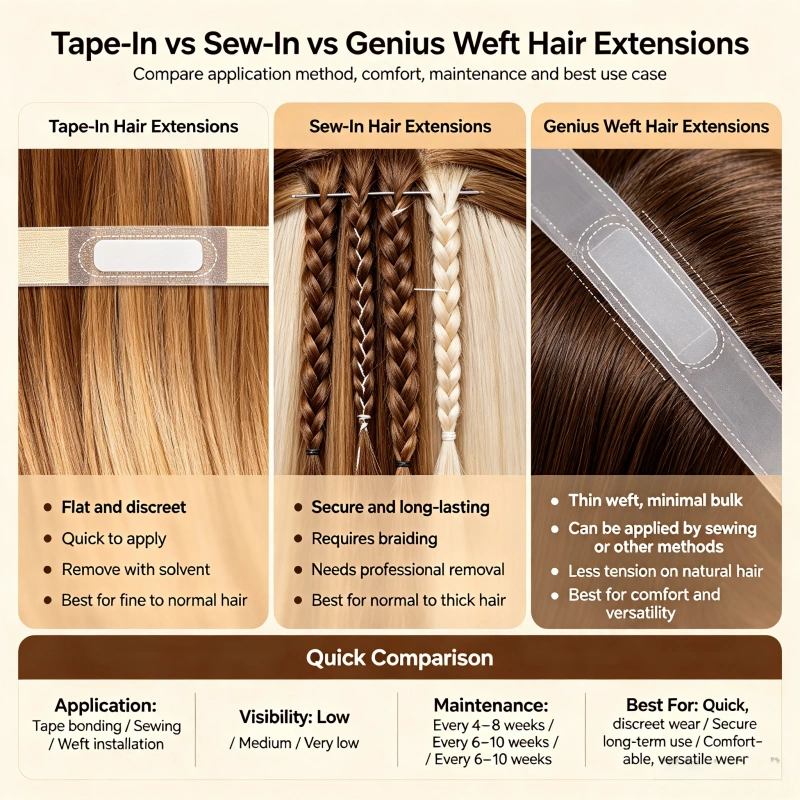
Quick Comparison: Tape-In vs Sew-In vs Genius Weft

Before examining each method, here is a practical comparison.

Comparison Tape-In Traditional Sew-In Genius Weft
What the term describes Adhesive attachment Weft installation technique Weft construction
Attachment Double-sided adhesive tabs Thread sewn onto a braided foundation Commonly sewn onto a beaded or braided foundation
Installation time Around 45–90 minutes as a planning estimate Around 2.5–4 hours as a planning estimate Around 1.5–2.5 hours for some row-installation setups
Typical maintenance reference Approximately 4–8 weeks Approximately 6–8 weeks, depending on installation Often follows the maintenance schedule of its row foundation
Attachment material Adhesive tape Thread and braid foundation Weft seam, beads or thread, depending on installation
Hair movement Flat, distributed panels Movement depends on braid placement and weft structure Row-based movement with a low-profile seam
Cutting flexibility Individual panels are supplied in set sizes Depends on the weft construction Cuttable on products specifically designed for cutting
Reusability Suitable hair may be retaped Suitable wefts may be reused Suitable wefts may be reused
Main consideration Adhesive performance and removal Braid tension and scalp access Seam quality, weight distribution, and installation technique

Important: The installation times above are approximate planning references, not guaranteed salon service times. ALOVEHAIR’s earlier comparison guide uses these time ranges, but actual chair time changes with the amount of hair, number of rows, stylist experience, and installation design.

The maintenance intervals are also not interchangeable product warranties. The correct schedule depends on natural hair growth, attachment condition, product specifications, and professional assessment.

For a broader introduction to the available attachment systems, see our guide to different types of human hair extensions.

First, Understand the Difference Between an Extension Method and a Weft Construction

This distinction is particularly important when comparing Sew-In and Genius Weft extensions.

What Does Tape-In Mean?

Tape-In describes a product with adhesive tabs. The stylist places a section of natural hair between two adhesive extension panels, creating a flat attachment.

What Does Sew-In Mean?

Sew-In describes how the extension is attached. Traditionally, the natural hair is braided into tracks, and extension wefts are stitched onto those tracks using thread and a curved needle.

Some modern sew-in installations use beads to create a foundation rather than relying entirely on cornrows.

What Does Genius Weft Mean?

Genius Weft describes the construction of the extension weft itself. It generally refers to a thin, flexible weft designed for low-profile installations and, on products specifically engineered for it, cutting customization.

A Genius Weft can be sewn onto a beaded foundation or another suitable prepared row.

That means a stylist can perform a Genius Weft sew-in installation. They are not necessarily choosing between Genius Weft and Sew-In as two completely separate techniques.

This distinction matters when requesting a salon service or buying wholesale hair. You need to specify both the weft construction and the installation method.

1. Tape-In Hair Extensions: Flat, Fast, and Flexible

Tape-In extensions are pre-taped hair panels attached to natural hair using double-sided adhesive.

A stylist sections a small amount of natural hair, places one extension panel underneath it, and presses a second panel on top. The natural hair is held between the two adhesive tabs.

The result is a relatively flat attachment that distributes the added hair across multiple small sections.

ALOVEHAIR offers a range of Tape-In Hair Extensions for professional salons, wholesalers, and hair extension brands.

Advantages of Tape-In Extensions

1. Relatively quick installation

Tape-In extensions are generally faster to install than traditional braided Sew-In methods. This can be convenient for first-time extension clients and salons that offer regular extension appointments.

2. Flat attachment profile

The adhesive panels sit close to the scalp. When correctly placed and concealed, they can blend well with straight and slightly wavy hair.

3. Distributed placement

Tape panels can be positioned across several sections rather than concentrating all the added hair into a few long rows.

4. Reuse potential

The extension hair may be reused when it remains in suitable condition. The old adhesive normally needs to be removed and replaced before reinstallation.

5. No braiding or sewing

Tape-In installation does not require a cornrow foundation or thread.

Disadvantages of Tape-In Extensions

Tape-In extensions also require careful maintenance.

  • Adhesive can weaken due to oil, residue, or unsuitable hair products.
  • Incorrect placement can cause discomfort or slippage.
  • Removal requires an appropriate adhesive release product.
  • Some hairstyles may expose the tape tabs.
  • Regular maintenance and replacement tape add to the total cost.

Tape-In extensions are not automatically damage-free. Excessive weight, incorrect sectioning, aggressive removal, or delayed maintenance can damage natural hair.

For a more detailed discussion, read our Tape-In Hair Extensions Pros and Cons guide.

Who Should Consider Tape-In Extensions?

Tape-In extensions may suit:

  • Clients with suitable fine-to-medium hair
  • People who want a flatter attachment
  • First-time extension users
  • Clients who prefer relatively quick appointments
  • Salons looking for a panel-based extension service

They may be less suitable for clients with very oily roots, fragile strands that cannot support the added weight, or lifestyles that make adhesive maintenance difficult.

Tape-In Product Specifications to Check

For professional buyers, the adhesive tab is just as important as the hair itself.

ALOVEHAIR’s published product information includes standard specifications around 2–2.5g per piece and 40–50g per pack, although individual configurations vary.

When comparing suppliers, check:

Specification What to Confirm
Hair weight Net weight per piece and pack
Tape dimensions Width and length of adhesive panel
Adhesive Type, bond strength, and removal performance
Hair material Remy, non-Remy, and processing information
Color Standard, rooted, highlighted, or custom
Re-taping Replacement tape availability and compatibility

For a product example, see ALOVEHAIR Factory Direct Tape-In Extensions.

2. Traditional Sew-In Hair Extensions: A Braided Foundation for Row-Based Volume

Traditional Sew-In extensions use a prepared foundation, usually created by braiding sections of the client’s natural hair into cornrows or anchor tracks.

The stylist then stitches the extension weft onto the foundation using thread and a curved needle.

This method has been widely used in professional hair extension and weave services.

Explore the ALOVEHAIR Sew-In Extensions collection to see different weft products designed for professional installation.

Advantages of Traditional Sew-In Extensions

1. No adhesive tabs

Traditional Sew-In installations use thread rather than adhesive panels to secure the weft.

This can be useful for people who prefer not to use adhesive at the attachment point.

2. Row-based coverage

A continuous weft can provide substantial coverage along a prepared track. This makes Sew-In methods suitable for clients seeking fuller-looking hairstyles.

3. Suitable for certain textured hair types

Clients with sufficiently strong, dense, and braid-compatible natural hair may find a traditional braid-down installation suitable.

4. Extension hair may be reusable

The hair weft can sometimes be reused after removal if the product remains in good condition and has been handled correctly.

Disadvantages of Traditional Sew-In Extensions

A braided foundation is not suitable for everyone.

Potential considerations include:

  • Excessive braid tension
  • Raised tracks that may be visible under fine hair
  • Scalp access during washing
  • Longer installation and removal appointments
  • Discomfort if the foundation is too tight
  • Drying requirements around the braided foundation

The most important issue is not simply whether the extensions are sewn in. It is whether the natural hair can support the foundation and added weight without excessive tension.

Who Should Consider Traditional Sew-In Extensions?

Traditional braid-down Sew-In methods may suit:

  • Clients with sufficient natural hair density
  • People whose hair can be braided comfortably
  • Clients who want substantial row-based volume
  • Certain textured and coily hair types
  • People who prefer a thread-secured foundation rather than adhesive tabs

A professional stylist should assess the natural hair before installation, particularly around the temples, nape, and existing fragile areas.

For a deeper discussion of suitable hair types and installation risks, read our Sew-In Extensions Pros and Cons guide.

Sew-In Maintenance and Reusability

A common planning reference for traditional Sew-In maintenance is approximately 6–8 weeks, although some professional sources recommend different intervals.

The actual schedule depends on natural hair growth, braid condition, scalp comfort, and the installation technique.

The extension hair may be reused if it remains healthy. However, reuse depends on hair quality and how carefully the weft is removed, cleaned, stored, and reinstalled.

Read How Long Do Sew-In Extensions Last? for more information about the difference between installation wear time and the usable lifespan of the extension hair.

3. Genius Weft Hair Extensions: Thin Construction and Customizable Rows

Genius Weft extensions are designed around a specialized thin seam that allows the hair to sit relatively flat against the scalp.

Compared with many conventional machine wefts, a properly constructed Genius Weft can provide a slimmer upper edge and greater flexibility for row customization.

Some products are designed to be cut along the seam without unraveling. However, cuttability and cutting instructions vary between manufacturers and product models.

ALOVEHAIR’s Genius Weft and Micro Weft collection describes its product range as thin, flexible, and suitable for professional sew-in, beaded-row, and hybrid installations.

How Are Genius Wefts Installed?

A common installation method is a beaded row.

The general process involves:

  1. Sectioning the natural hair according to the stylist’s planned row placement.
  2. Attaching suitable beads to selected sections of natural hair.
  3. Positioning the Genius Weft along the prepared row.
  4. Sewing the weft securely onto the bead foundation.
  5. Checking the weight distribution and attachment security.
  6. Blending the extension hair with the client’s natural hair.

Another option is sewing the Genius Weft onto an appropriate braided foundation.

The installation method should always follow the product specifications and the stylist’s professional training.

Advantages of Genius Weft Extensions

1. Low-profile construction

A thin seam can reduce bulk along the weft edge compared with some conventional machine wefts.

2. Cutting flexibility

On products specifically designed for it, the weft can be shortened to suit the required row width.

This can help stylists customize placement for different head shapes.

3. No adhesive tape tabs

A typical Genius Weft beaded-row installation uses beads and sewing rather than the adhesive panels used in Tape-In systems.

4. Suitable for professional row-based services

Genius Wefts allow stylists to work with continuous sections of hair rather than placing dozens of small adhesive panels.

5. Product customization

Different lengths, weights, colors, textures, and weft specifications can be developed for professional applications.

Disadvantages of Genius Weft Extensions

A thin seam does not automatically make the complete installation weightless or suitable for every client.

Potential considerations include:

  • Professional installation is normally required.
  • The row foundation still places tension on natural hair.
  • The bead size and placement must be appropriate.
  • Excessive hair weight can make the installation uncomfortable.
  • Cutting instructions must be verified for the exact product.
  • Maintenance and removal still require professional attention.

A low-profile weft is only one part of the finished installation. The hair quantity, foundation, and stylist’s technique are equally important.

Who Should Consider Genius Wefts?

Genius Wefts may be worth considering for clients who:

  • Prefer a row-based installation
  • Want a relatively thin weft seam
  • Need flexible weft sizing
  • Want to avoid adhesive tape tabs
  • Have natural hair that can support a suitable beaded or sewn foundation
  • Prefer professional salon-managed extensions

They may also be suitable for some clients with fine-to-medium hair, but this depends on the exact product weight, anchor distribution, natural hair condition, and stylist assessment.

For a complete explanation of their structure and applications, see What Is Genius Weft Hair Extensions?.
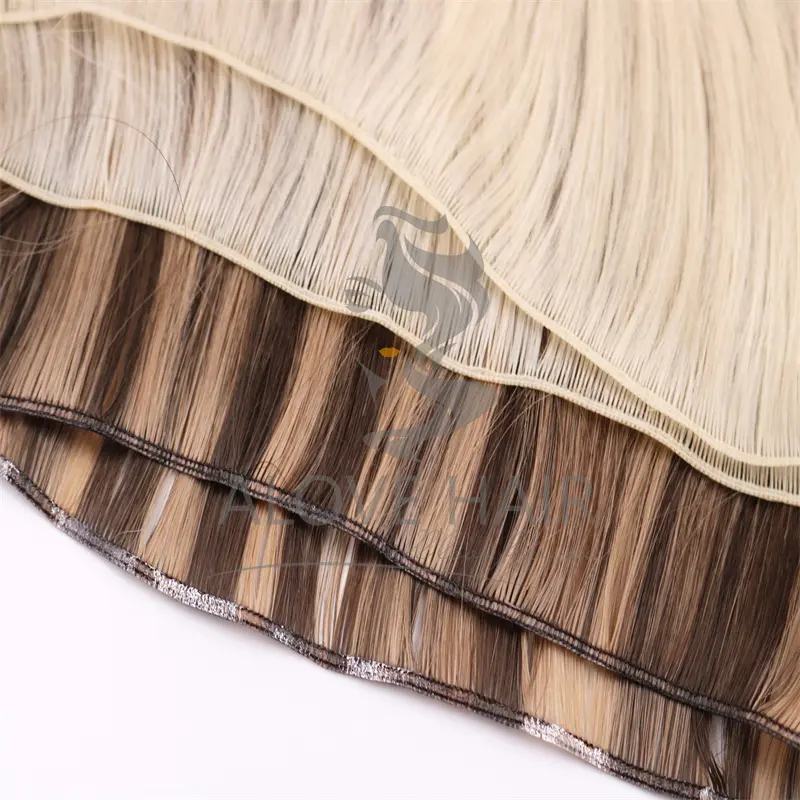

Installation Time: Which Method Takes the Least Time?

Installation time affects both the client’s salon experience and the stylist’s daily appointment schedule.

The following estimates are useful for planning, but they should not be treated as universal service standards.

Method Illustrative Installation Time Main Time Requirement
Tape-In 45–90 minutes Sectioning and adhesive panel placement
Traditional Sew-In 2.5–4 hours Preparing braids and stitching wefts
Genius Weft 1.5–2.5 hours Preparing rows, adjusting the weft, and sewing

Actual times can increase when:

  • More hair is required
  • Several colors need to be blended
  • The client needs a haircut or detailed styling
  • More rows are installed
  • The natural hair needs additional preparation
  • The stylist needs to customize the foundation

What Does This Mean for Salon Owners?

Tape-In services may allow salons to complete more appointments in a working day, particularly for clients who require relatively small quantities.

Sew-In and Genius Weft services may offer different pricing opportunities because installation involves more technical work and customized placement.

However, service profitability should be calculated using the complete appointment time, maintenance requirements, product cost, and stylist labor rather than assuming that shorter installation time automatically means higher profit.

Comfort, Weight Distribution, and Natural Hair Considerations

Comfort is one of the most important factors when selecting a hair extension method.

A method that looks natural in a product photograph may not feel comfortable when installed on a particular client’s natural hair.

Factor Tape-In Traditional Sew-In Genius Weft
Main weight support Hair inside each adhesive sandwich Braided foundation Beaded or braided row foundation
Attachment pressure Distributed across tape sections Concentrated along prepared tracks Distributed across the row anchors
Main tension concern Too much weight on small sections Braids that are too tight Excessive row weight or unsuitable bead placement
Base profile Flat adhesive panels Depends on braid and weft thickness Thin seam, depending on product
Scalp access Panels may restrict some areas Foundation can make cleansing more difficult Depends on bead and row spacing
Comfort Product and section dependent Braid tension dependent Seam, anchor, and weight dependent

Does One Method Cause Less Hair Damage?

There is no universally damage-free extension method.

Tape-In extensions can cause problems if adhesive is pulled off before it is fully released or if too much hair weight is placed on a small section.

Traditional Sew-In extensions can cause problems if the braids are too tight or the extension weight is excessive.

Genius Weft installations can also create tension when too much hair is supported by too few anchors or when the beads and foundation are incorrectly positioned.

Warning signs include:

  • Persistent scalp soreness
  • Pulling or pressure
  • Bumps along the foundation
  • Increased breakage around attachment points
  • Unusual shedding near the installation area

Do not continue wearing an uncomfortable installation simply because the appointment was expensive. Ask a qualified stylist to assess it.

The best method is the one that your natural hair can support comfortably and that you can maintain correctly.

Appearance and Styling: Which Looks More Natural?

All three methods can create natural-looking results when correctly selected, installed, and blended.

The outcome depends on the hair material, color match, density, attachment placement, and finished haircut.

Tape-In: Flat Panels for Natural Blending

Tape-In panels are relatively flat and can be discreet when correctly positioned beneath sufficient natural hair.

The main limitation is that tape tabs may become visible if the hair is too thin to conceal them or if the hairstyle exposes the attachment points.

Traditional Sew-In: Fullness Through Rows

Traditional Sew-In installations can provide substantial length and volume.

However, the braided foundation and weft may be felt or seen if the natural hair does not conceal the tracks adequately.

The leave-out section and parting design are important when planning the final appearance.

Genius Weft: A Slimmer Weft Edge

Genius Wefts are designed to offer a relatively thin upper seam.

On a suitable product, this can help reduce visible bulk and make customization easier.

However, a thin seam alone does not guarantee an invisible installation. The row position, hair density, color blend, and foundation still determine the final result.

What Should Salons Check?

Appearance Detail Why It Matters
Seam thickness Affects how flat the attachment sits
Hair density Determines how well the extension blends
Weft width Influences row coverage
Return hair May affect the feel and appearance near the seam
Color matching Reduces visible contrast
Root blending Helps conceal the attachment
Cut and styling Integrates extension hair with natural hair

For a comparison of other professional weft constructions, see Sew-In vs. Flat Weft Hair Extensions.

Maintenance and Reusability: Which Is More Convenient?

The initial installation is only part of the extension experience. Each method has a different maintenance process.

Maintenance Factor Tape-In Traditional Sew-In Genius Weft
Typical maintenance reference 4–8 weeks Around 6–8 weeks Depends on the beaded or sewn foundation
Main maintenance task Remove, clean, replace tape, reinstall Remove or adjust foundation and reinstall Adjust or rebuild row and reinstall
Replacement adhesive Yes No No, for typical sewn/beaded installations
Weft reuse Possible if hair remains in good condition Possible if the weft remains in good condition Possible if the weft remains in good condition
Main maintenance challenge Adhesive residue and slipping Braid condition and tension Row placement, bead condition, and seam integrity

The maintenance interval should be decided by the stylist after checking the client’s hair and installation.

Tape-In Maintenance

Tape-In extensions require professional removal and replacement tape when the installation grows out.

The stylist needs to release the adhesive properly, clean the panels, prepare the base, and reinstall them.

Heavy oil-based products around the tape can affect adhesive performance.

Traditional Sew-In Maintenance

Traditional Sew-In systems may need removal or foundation rebuilding as natural hair grows.

During maintenance, the stylist checks the braids, scalp condition, thread, and extension wefts before reinstalling.

The foundation should never be left in place for longer than the stylist recommends.

Genius Weft Maintenance

Genius Weft maintenance depends on the installation system.

A beaded-row installation may need the row to be adjusted or rebuilt. A sewn installation requires professional removal of the thread and preparation of the next foundation.

The weft should also be checked for seam damage, shedding, and changes in hair condition before reuse.

Important distinction: The amount of time an installation stays attached is different from the total usable lifespan of the extension hair.

A hair weft may be suitable for more than one installation, but that does not mean the same installation can remain on the head indefinitely.

Which Method Is More Cost-Effective?

A common mistake is to compare only the price of one pack of extension hair.

The more useful comparison includes:

  • Hair product cost
  • Installation labor
  • Maintenance appointments
  • Replacement tape or thread
  • Removal
  • Reinstallation
  • Hair replacement when needed
  • Additional styling and blending services
Cost Component Tape-In Traditional Sew-In Genius Weft
Initial hair cost Depends on pack weight and quality Depends on weft type and weight Depends on seam construction and hair specification
Initial labor Often shorter Usually longer due to braiding and sewing Depends on bead preparation and row installation
Maintenance Removal and re-taping Foundation adjustment or rebuilding Row adjustment and possible resewing
Reuse potential Depends on hair and adhesive-base condition Depends on hair and weft condition Depends on hair and seam condition
Cost comparison Include replacement tape and service frequency Include braiding, sewing, and maintenance Include product cost, row installation, and maintenance

There is no reliable universal price ranking because salon rates, product specifications, hair quantity, and local labor costs vary.

A Practical First-Year Budgeting Example

Suppose a salon is comparing three services for clients who want a similar amount of added hair.

Rather than comparing only the initial package price, record:

Budget Item Tape-In Traditional Sew-In Genius Weft
Hair package price Actual quotation Actual quotation Actual quotation
First installation Actual salon fee Actual salon fee Actual salon fee
Number of maintenance visits Based on stylist schedule Based on stylist schedule Based on stylist schedule
Cost per maintenance visit Actual salon fee Actual salon fee Actual salon fee
Removal fee Actual salon fee Actual salon fee Actual salon fee
Replacement hair Based on condition Based on condition Based on condition
Annual total Calculate from actual services Calculate from actual services Calculate from actual services

For example, Tape-In extensions may have relatively quick initial installation but require adhesive replacement at maintenance appointments. Sew-In and Genius Weft services may involve more work at the initial appointment but use a different maintenance structure.

To compare them fairly, use the same time period and include every service that the client actually needs.

Which Method Is Best for Different Hair Types?

The right choice depends on natural hair condition, not simply whether someone describes their hair as fine, thick, curly, or straight.

Hair Type or Situation Method Worth Considering Main Reason
Fine, straight hair Tape-In or carefully planned low-profile weft Flat panels or thin seams may blend more discreetly
Fine but low-density hair Individual professional assessment Added weight and anchor placement require care
Thick natural hair Sew-In or Genius Weft Can support suitable row-based installations
Coarse or textured hair Traditional Sew-In or suitable weft system Braided foundations may blend well when installed correctly
Oily scalp Sew-In or a suitable non-adhesive row system Tape adhesive may be affected by oil
Very active lifestyle Depends on sweat, maintenance, and styling routine No method is automatically maintenance-free
Clients avoiding adhesive Sew-In or Genius Weft with a suitable foundation Does not rely on tape tabs
Clients needing targeted side volume Tape-In Smaller panels can be positioned selectively

Best Option for Fine Hair

Tape-In extensions can be a useful option for some people with fine hair because the panels sit relatively flat.

However, the weight of each adhesive sandwich must be appropriate for the amount of natural hair supporting it.

A thin Genius Weft may also be considered when the product, row design, and anchor distribution are suitable.

Traditional braid-down Sew-In methods require particular care because fine hair may not tolerate tight or heavy braids.

Best Option for Thick or Textured Hair

Traditional Sew-In methods may work well when the natural hair can support a braided foundation comfortably.

Genius Wefts can also be used with beaded or braided row systems.

The stylist should focus on foundation stability, extension weight, and how the finished hair will blend with the client’s natural texture.

Best Option for Clients Who Want to Avoid Adhesive

Traditional Sew-In and many Genius Weft row installations do not require adhesive tape.

However, they still involve attachment points and ongoing maintenance.

Avoiding adhesive does not automatically eliminate tension or breakage risk.

How to Choose the Right Extension Product When Buying Wholesale

For salon owners, distributors, and private label brands, the choice is not only about selecting the most popular extension method.

The actual product specifications determine whether the hair will work with the intended installation technique.

1. Compare the Weft Construction

When buying traditional Sew-In or Genius Weft products, ask the manufacturer to provide:

  • Weft thickness
  • Weft width
  • Seam material
  • Hair distribution
  • Return-hair construction
  • Cutting instructions
  • Recommended installation methods

Do not assume that every supplier uses the same definition of Genius Weft.

A product called Genius Weft by one manufacturer may have different seam materials, dimensions, and cutting limitations from another manufacturer’s version.

2. Compare Tape-In Specifications

For Tape-In products, confirm:

  • Adhesive type
  • Tape width and length
  • Hair weight per panel
  • Total pack weight
  • Whether pieces mean individual tabs or completed pairs
  • Replacement tape compatibility
  • Adhesive removal instructions

For example, ALOVEHAIR lists different tape configurations, including approximately 2.5g invisible tape pieces and 3g standard tape pieces.
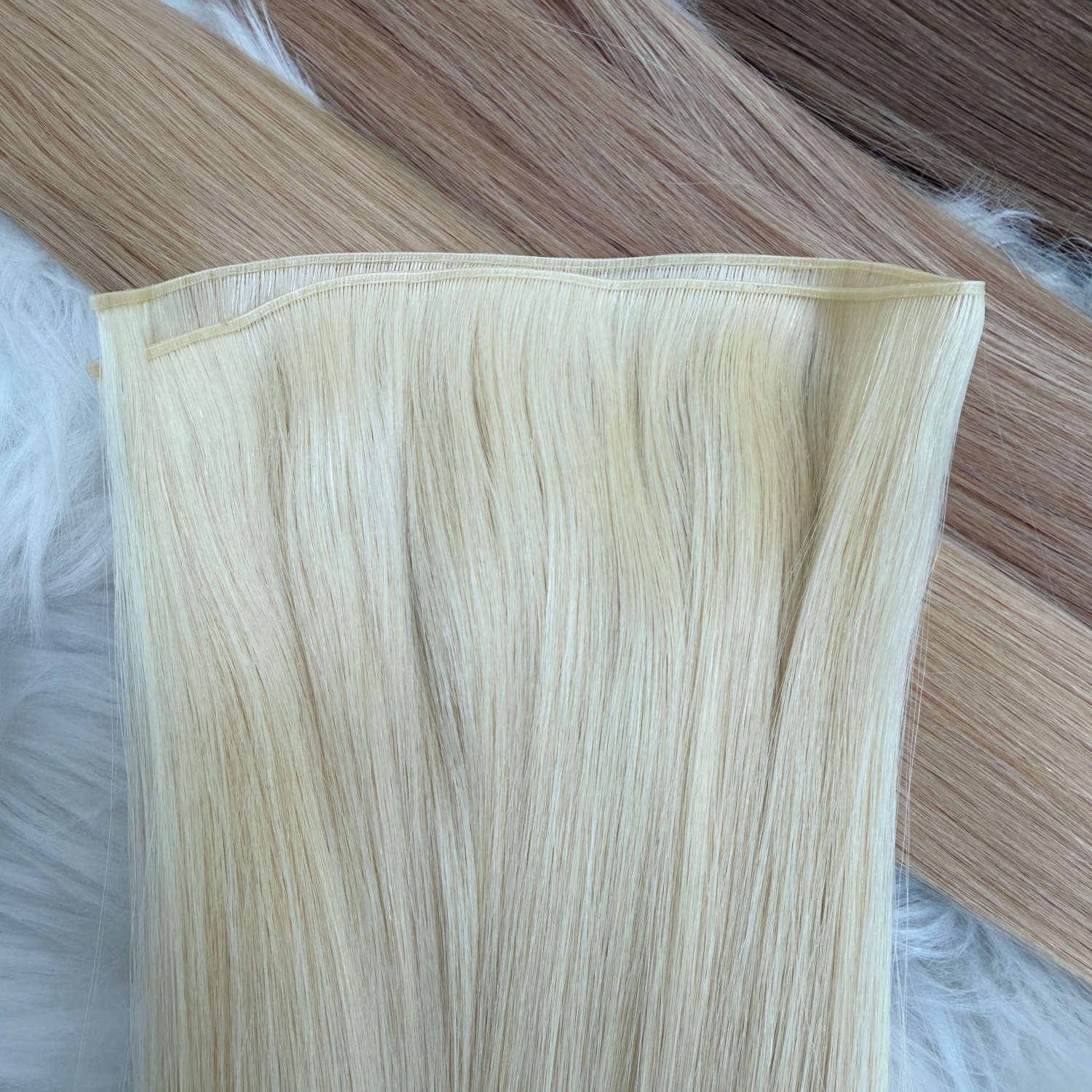
The correct comparison should be based on the actual SKU rather than the product category name.

3. Evaluate Hair Quality

No matter which attachment method you choose, the quality of the hair remains important.

Check:

Quality Factor What to Verify
Hair material 100% human hair or another specified material
Remy status Hair direction and cuticle condition
Processing Bleaching, dyeing, and chemical treatment history
Length Usable hair length rather than title alone
Weight Actual net hair weight
Density Distribution from top to ends
Shedding Hair retention during handling and brushing
Tangling Condition after washing and drying
Color Match to approved color reference

4. Perform a Controlled Sample Comparison

A practical salon or factory evaluation should compare products under consistent conditions.

For example, request Tape-In, standard Sew-In weft, and Genius Weft samples using:

  • The same hair length
  • The same color
  • Similar hair material specifications
  • Equal total net hair weight where possible
  • Comparable textures and processing history

Then record:

  1. Weft dimensions and construction.
  2. Installation time under a clearly defined salon setup.
  3. Appearance after blending.
  4. Comfort and attachment stability during normal wear.
  5. Hair condition after washing and brushing.
  6. Ease of professional removal.
  7. Weft condition after removal and cleaning.

This is much more useful than claiming that one method is universally more durable based on its product name.

For businesses sourcing products for repeat orders, retain an approved sample and written specification sheet.

ALOVEHAIR Tape-In, Sew-In, and Genius Weft Manufacturing Options

ALOVEHAIR is a China-based human hair extension manufacturer serving salons, distributors, wholesalers, and private label brands.

Its product range includes Tape-In Extensions, traditional weft products, Hand-Tied Wefts, and Genius/Micro Wefts.

This allows professional buyers to compare different product structures and build an extension collection around multiple installation preferences.
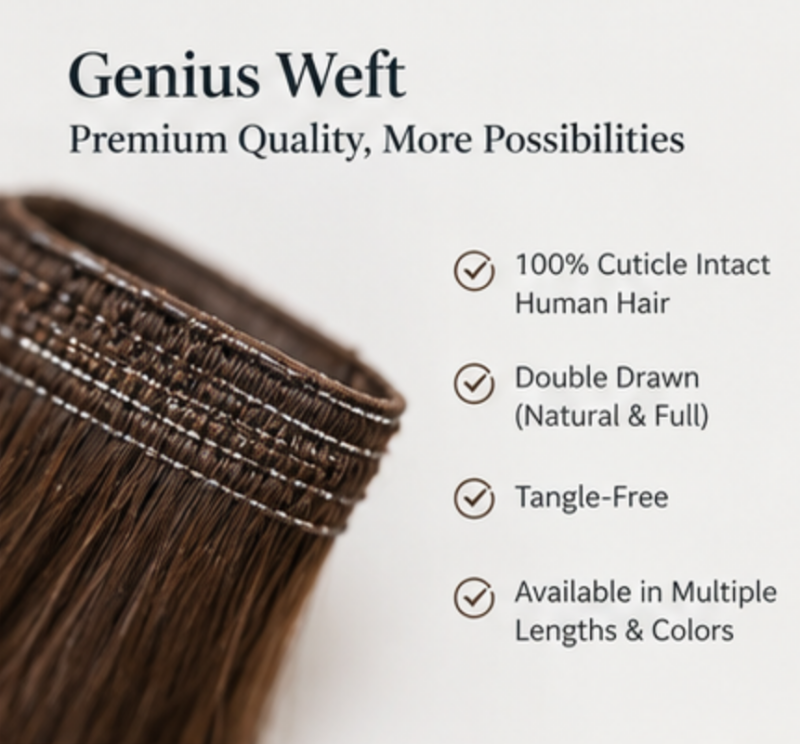
Tape-In Hair Extensions

ALOVEHAIR offers standard and invisible Tape-In products using product-specific adhesive panel configurations.
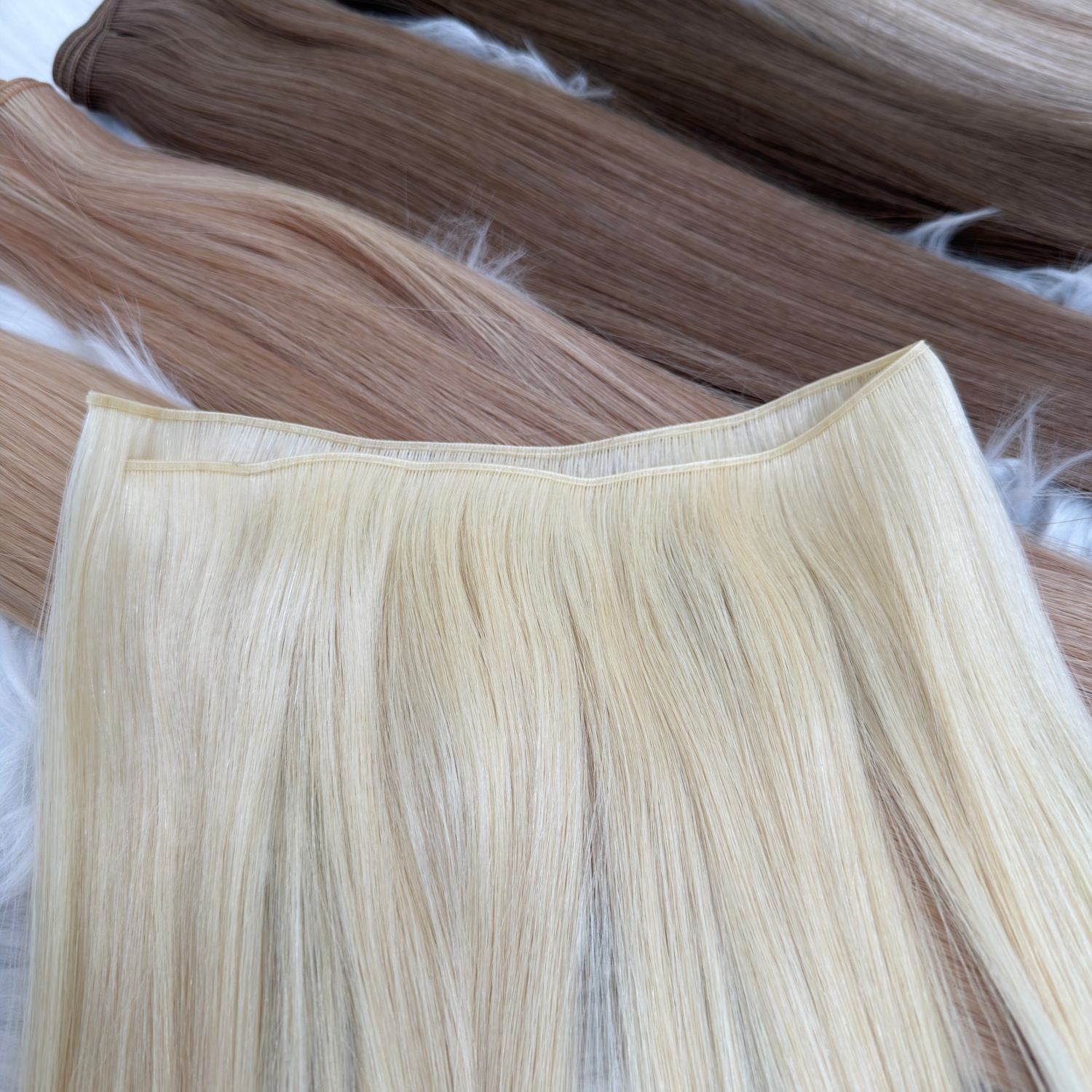
Its published product information includes:

  • Approximately 2.5g per invisible tape piece
  • Approximately 3g per standard tape piece
  • Different colors and lengths
  • Customization discussions for wholesale projects

View the ALOVEHAIR Tape-In Collection for product options.
Traditional Sew-In and Hand-Tied Wefts

ALOVEHAIR also offers weft products for professional sewn installations, including Hand-Tied and flat weft options.

The appropriate product depends on the stylist’s preferred foundation and installation procedure.

For a comparison of different hand-tied products, visit the ALOVEHAIR Hand-Tied Extensions collection.

Genius Weft Hair Extensions

ALOVEHAIR’s Genius/Micro Weft range is designed around a thin seam and flexible track customization.

Its published product information describes cuttable construction for the specified models, allowing stylists to customize weft width according to their installation plan.

For more product-specific information, explore ALOVEHAIR Double Drawn Genius Wefts.

OEM, ODM, and Private Label Services

For wholesale buyers, product development may involve more than selecting a standard length and color.

Depending on the product and order requirements, customization discussions can include:

  • Hair length and weight
  • Color and balayage combinations
  • Texture
  • Weft construction
  • Packaging
  • Logo and private label branding
  • Product specifications for repeat orders

For bulk purchasing information, visit Genius Weft Hair Extensions Wholesale.

When requesting quotations, identify the product type, desired installation method, quantity per color, net hair weight, length, and packaging requirements.

Frequently Asked Questions

Which is better: Tape-In, Sew-In, or Genius Weft?

There is no universally best method.

Tape-In is worth considering for flat adhesive panels and relatively quick installation. Traditional Sew-In may suit clients whose natural hair can support a braided foundation. Genius Weft offers a thin, customizable weft construction for professional row-based installations.

Are Genius Wefts the same as Sew-In extensions?

No. Genius Weft describes the construction of the hair weft, while Sew-In describes an attachment technique.

A Genius Weft can be sewn onto a beaded or braided foundation. Therefore, the two terms can describe different parts of the same installation.

Which method is best for fine hair?

Tape-In extensions may suit some clients with fine hair because of their flat attachment profile. A suitable low-profile Genius Weft may also be considered.

However, natural hair density, strand strength, extension weight, and placement must be assessed by a qualified stylist. Neither method is automatically suitable for every fine-haired client.

Which method is better for thick hair?

Traditional Sew-In and Genius Weft installations may work well for clients with sufficiently strong natural hair that can support the required foundation.

The best choice depends on the desired volume, attachment design, and stylist’s technique.

Which method takes the least time to install?

Tape-In is often the quickest of the three methods.

For planning purposes, some comparison guides use approximately 45–90 minutes for Tape-In, 2.5–4 hours for traditional Sew-In, and 1.5–2.5 hours for certain Genius Weft row installations.

Actual appointment time varies with the number of extensions, hair quantity, and installation design.

Which extension method lasts the longest?

The installation interval and the usable lifespan of the hair are different measurements.

Tape-In often requires maintenance around every 4–8 weeks. Traditional Sew-In systems commonly require professional assessment around every 6–8 weeks or according to the stylist’s protocol. Genius Weft follows the schedule of the beaded or sewn foundation.

The extension hair itself may be reused if it remains in suitable condition.

Can Genius Wefts be cut?

Some Genius Weft products are specifically designed to be cut along the seam without unraveling.

However, this is not a universal guarantee for every product marketed under the Genius Weft name. Always follow the manufacturer’s cutting instructions and confirm the exact product construction.

Can Sew-In and Genius Weft hair be reused?

Both may be reused if the hair and weft remain in suitable condition.

The number of possible installations depends on material quality, removal technique, handling, cleaning, and storage.

A supplier should not promise a fixed number of reuse cycles without product-specific testing and clearly defined conditions.

Does Tape-In damage natural hair more than Sew-In?

Not necessarily. Both methods can damage natural hair when incorrectly installed, overloaded, or removed.

Tape-In damage can involve adhesive removal and excessive weight on individual sections. Sew-In damage can involve overly tight braids or excessive tension along the foundation.

A suitable stylist should evaluate the client’s natural hair before choosing the method.

Which is more cost-effective for a salon?

The answer depends on product cost, appointment time, service pricing, maintenance frequency, and repeat business.

Tape-In may allow shorter appointments, while row-based Sew-In and Genius Weft services may offer different customization and service opportunities.

Calculate the actual annual cost and profit per appointment using your own salon pricing rather than relying on a universal industry claim.

Does ALOVEHAIR offer all three extension types?

ALOVEHAIR lists Tape-In products, Sew-In weft products, and Genius/Micro Wefts for professional and wholesale buyers.

Product specifications, available colors, minimum order quantities, and customization options depend on the selected model and order requirements.

Final Verdict: Choose the Attachment Method and Weft Construction Separately

Tape-In, traditional Sew-In, and Genius Weft extensions each have different advantages.

Tape-In is attractive for clients seeking flat adhesive panels and faster installation. Traditional Sew-In is worth considering when the natural hair can support a braided foundation and the client wants substantial row-based volume. Genius Weft offers a thin, customizable weft construction that can be used in professional beaded-row and sew-in installations.

The most important decision is not which method is most popular. It is which combination of hair material, weft construction, attachment technique, and maintenance schedule suits the individual client.

For consumers, consult an experienced stylist who can assess your natural hair and explain the full installation and maintenance process.

For salon owners, compare physical samples, seam specifications, tape quality, hair weight, and reusability before adding a new product to your service menu.

ALOVEHAIR provides Tape-In, Sew-In, Hand-Tied, and Genius Weft options for professional buyers, with customization and private label discussions available.

Explore the ALOVEHAIR Hair Extensions Collection or contact the manufacturing team to discuss product specifications, samples, and wholesale requirements.