
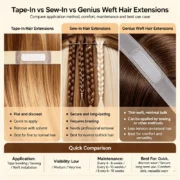
Tape-In vs Sew-In vs Genius Weft Hair Extensions
Choosing between Tape-In, Sew-In, and Genius Weft hair extensions can be confusing, especially when all three are marketed as lightweight, natural-looking, and suitable for professional salon installations.
However, these methods are not exactly the same type of product. Tape-In describes an adhesive attachment system, Sew-In describes an installation technique, and Genius Weft describes a particular weft construction. In fact, Genius Wefts are often installed using a sew-in or beaded-row technique.
So which option should you choose?
Tape-In extensions are generally worth considering if you want flat adhesive panels and relatively quick installation. Traditional Sew-In extensions suit clients whose natural hair can support a braided foundation and who want substantial row-based volume. Genius Wefts are worth considering when a stylist wants a thin, customizable weft construction for a professional beaded-row or sew-in installation.
The right choice depends on your natural hair density, desired volume, styling habits, maintenance budget, and the actual specifications of the extension hair.
In this guide, we compare all three options by construction, installation, appearance, comfort, maintenance, reusability, and total cost. We also share practical product-selection advice for salon owners, hairstylists, wholesalers, and hair extension brands.
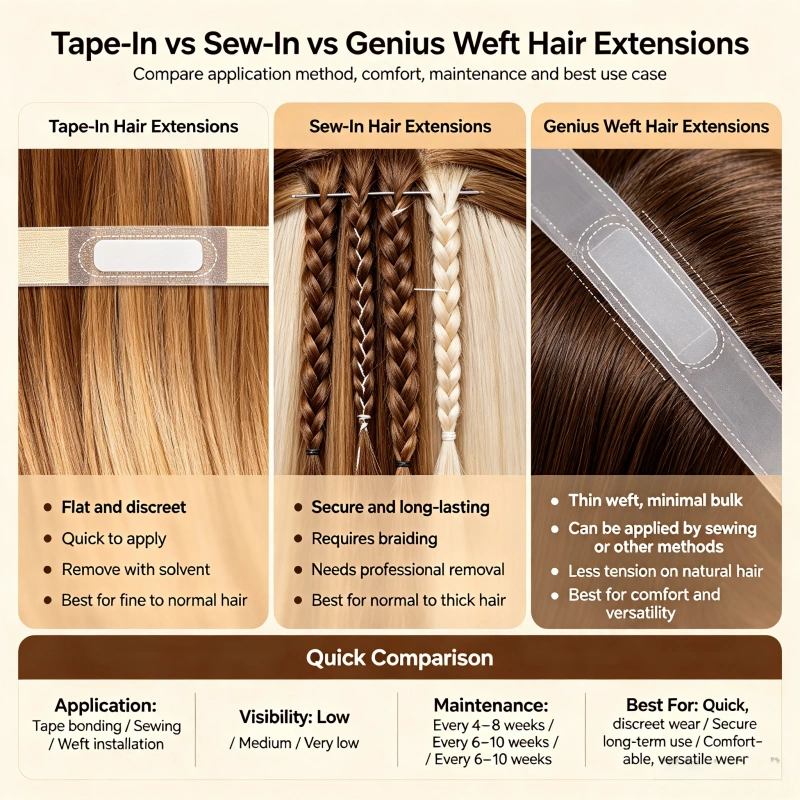
Quick Comparison: Tape-In vs Sew-In vs Genius Weft
Before examining each method, here is a practical comparison.
| Comparison | Tape-In | Traditional Sew-In | Genius Weft |
|---|---|---|---|
| What the term describes | Adhesive attachment | Weft installation technique | Weft construction |
| Attachment | Double-sided adhesive tabs | Thread sewn onto a braided foundation | Commonly sewn onto a beaded or braided foundation |
| Installation time | Around 45–90 minutes as a planning estimate | Around 2.5–4 hours as a planning estimate | Around 1.5–2.5 hours for some row-installation setups |
| Typical maintenance reference | Approximately 4–8 weeks | Approximately 6–8 weeks, depending on installation | Often follows the maintenance schedule of its row foundation |
| Attachment material | Adhesive tape | Thread and braid foundation | Weft seam, beads or thread, depending on installation |
| Hair movement | Flat, distributed panels | Movement depends on braid placement and weft structure | Row-based movement with a low-profile seam |
| Cutting flexibility | Individual panels are supplied in set sizes | Depends on the weft construction | Cuttable on products specifically designed for cutting |
| Reusability | Suitable hair may be retaped | Suitable wefts may be reused | Suitable wefts may be reused |
| Main consideration | Adhesive performance and removal | Braid tension and scalp access | Seam quality, weight distribution, and installation technique |
Important: The installation times above are approximate planning references, not guaranteed salon service times. ALOVEHAIR’s earlier comparison guide uses these time ranges, but actual chair time changes with the amount of hair, number of rows, stylist experience, and installation design.
The maintenance intervals are also not interchangeable product warranties. The correct schedule depends on natural hair growth, attachment condition, product specifications, and professional assessment.
For a broader introduction to the available attachment systems, see our guide to different types of human hair extensions.
First, Understand the Difference Between an Extension Method and a Weft Construction
This distinction is particularly important when comparing Sew-In and Genius Weft extensions.
What Does Tape-In Mean?
Tape-In describes a product with adhesive tabs. The stylist places a section of natural hair between two adhesive extension panels, creating a flat attachment.
What Does Sew-In Mean?
Sew-In describes how the extension is attached. Traditionally, the natural hair is braided into tracks, and extension wefts are stitched onto those tracks using thread and a curved needle.
Some modern sew-in installations use beads to create a foundation rather than relying entirely on cornrows.
What Does Genius Weft Mean?
Genius Weft describes the construction of the extension weft itself. It generally refers to a thin, flexible weft designed for low-profile installations and, on products specifically engineered for it, cutting customization.
A Genius Weft can be sewn onto a beaded foundation or another suitable prepared row.
That means a stylist can perform a Genius Weft sew-in installation. They are not necessarily choosing between Genius Weft and Sew-In as two completely separate techniques.
This distinction matters when requesting a salon service or buying wholesale hair. You need to specify both the weft construction and the installation method.
1. Tape-In Hair Extensions: Flat, Fast, and Flexible
Tape-In extensions are pre-taped hair panels attached to natural hair using double-sided adhesive.
A stylist sections a small amount of natural hair, places one extension panel underneath it, and presses a second panel on top. The natural hair is held between the two adhesive tabs.
The result is a relatively flat attachment that distributes the added hair across multiple small sections.
ALOVEHAIR offers a range of Tape-In Hair Extensions for professional salons, wholesalers, and hair extension brands.
Advantages of Tape-In Extensions
1. Relatively quick installation
Tape-In extensions are generally faster to install than traditional braided Sew-In methods. This can be convenient for first-time extension clients and salons that offer regular extension appointments.
2. Flat attachment profile
The adhesive panels sit close to the scalp. When correctly placed and concealed, they can blend well with straight and slightly wavy hair.
3. Distributed placement
Tape panels can be positioned across several sections rather than concentrating all the added hair into a few long rows.
4. Reuse potential
The extension hair may be reused when it remains in suitable condition. The old adhesive normally needs to be removed and replaced before reinstallation.
5. No braiding or sewing
Tape-In installation does not require a cornrow foundation or thread.
Disadvantages of Tape-In Extensions
Tape-In extensions also require careful maintenance.
- Adhesive can weaken due to oil, residue, or unsuitable hair products.
- Incorrect placement can cause discomfort or slippage.
- Removal requires an appropriate adhesive release product.
- Some hairstyles may expose the tape tabs.
- Regular maintenance and replacement tape add to the total cost.
Tape-In extensions are not automatically damage-free. Excessive weight, incorrect sectioning, aggressive removal, or delayed maintenance can damage natural hair.
For a more detailed discussion, read our Tape-In Hair Extensions Pros and Cons guide.
Who Should Consider Tape-In Extensions?
Tape-In extensions may suit:
- Clients with suitable fine-to-medium hair
- People who want a flatter attachment
- First-time extension users
- Clients who prefer relatively quick appointments
- Salons looking for a panel-based extension service
They may be less suitable for clients with very oily roots, fragile strands that cannot support the added weight, or lifestyles that make adhesive maintenance difficult.
Tape-In Product Specifications to Check
For professional buyers, the adhesive tab is just as important as the hair itself.
ALOVEHAIR’s published product information includes standard specifications around 2–2.5g per piece and 40–50g per pack, although individual configurations vary.
When comparing suppliers, check:
| Specification | What to Confirm |
|---|---|
| Hair weight | Net weight per piece and pack |
| Tape dimensions | Width and length of adhesive panel |
| Adhesive | Type, bond strength, and removal performance |
| Hair material | Remy, non-Remy, and processing information |
| Color | Standard, rooted, highlighted, or custom |
| Re-taping | Replacement tape availability and compatibility |
For a product example, see ALOVEHAIR Factory Direct Tape-In Extensions.
2. Traditional Sew-In Hair Extensions: A Braided Foundation for Row-Based Volume
Traditional Sew-In extensions use a prepared foundation, usually created by braiding sections of the client’s natural hair into cornrows or anchor tracks.
The stylist then stitches the extension weft onto the foundation using thread and a curved needle.
This method has been widely used in professional hair extension and weave services.
Explore the ALOVEHAIR Sew-In Extensions collection to see different weft products designed for professional installation.
Advantages of Traditional Sew-In Extensions
1. No adhesive tabs
Traditional Sew-In installations use thread rather than adhesive panels to secure the weft.
This can be useful for people who prefer not to use adhesive at the attachment point.
2. Row-based coverage
A continuous weft can provide substantial coverage along a prepared track. This makes Sew-In methods suitable for clients seeking fuller-looking hairstyles.
3. Suitable for certain textured hair types
Clients with sufficiently strong, dense, and braid-compatible natural hair may find a traditional braid-down installation suitable.
4. Extension hair may be reusable
The hair weft can sometimes be reused after removal if the product remains in good condition and has been handled correctly.
Disadvantages of Traditional Sew-In Extensions
A braided foundation is not suitable for everyone.
Potential considerations include:
- Excessive braid tension
- Raised tracks that may be visible under fine hair
- Scalp access during washing
- Longer installation and removal appointments
- Discomfort if the foundation is too tight
- Drying requirements around the braided foundation
The most important issue is not simply whether the extensions are sewn in. It is whether the natural hair can support the foundation and added weight without excessive tension.
Who Should Consider Traditional Sew-In Extensions?
Traditional braid-down Sew-In methods may suit:
- Clients with sufficient natural hair density
- People whose hair can be braided comfortably
- Clients who want substantial row-based volume
- Certain textured and coily hair types
- People who prefer a thread-secured foundation rather than adhesive tabs
A professional stylist should assess the natural hair before installation, particularly around the temples, nape, and existing fragile areas.
For a deeper discussion of suitable hair types and installation risks, read our Sew-In Extensions Pros and Cons guide.
Sew-In Maintenance and Reusability
A common planning reference for traditional Sew-In maintenance is approximately 6–8 weeks, although some professional sources recommend different intervals.
The actual schedule depends on natural hair growth, braid condition, scalp comfort, and the installation technique.
The extension hair may be reused if it remains healthy. However, reuse depends on hair quality and how carefully the weft is removed, cleaned, stored, and reinstalled.
Read How Long Do Sew-In Extensions Last? for more information about the difference between installation wear time and the usable lifespan of the extension hair.
3. Genius Weft Hair Extensions: Thin Construction and Customizable Rows
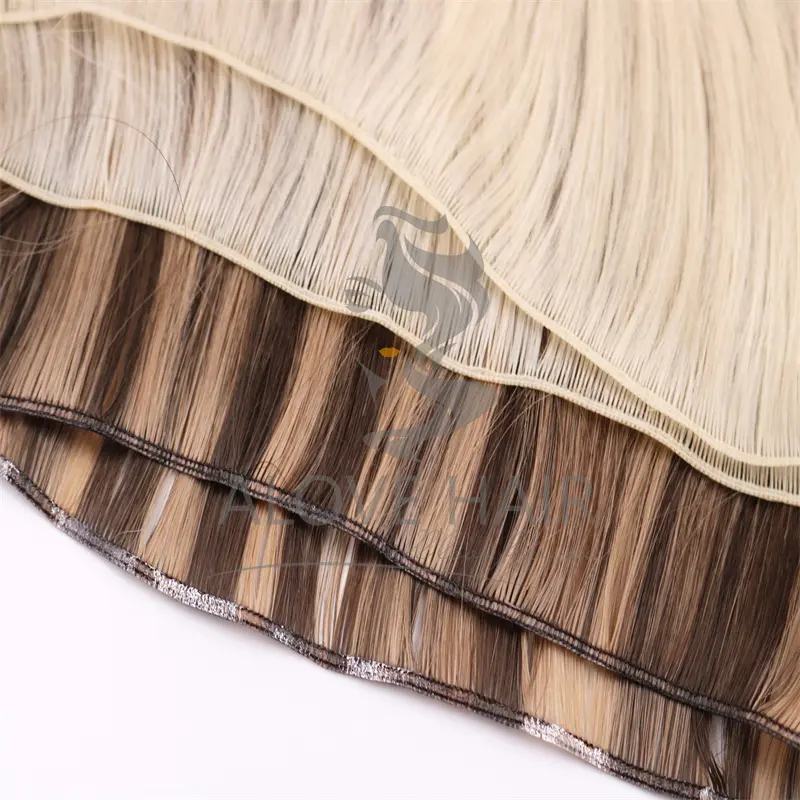
Genius Weft extensions are designed around a specialized thin seam that allows the hair to sit relatively flat against the scalp.
Compared with many conventional machine wefts, a properly constructed Genius Weft can provide a slimmer upper edge and greater flexibility for row customization.
Some products are designed to be cut along the seam without unraveling. However, cuttability and cutting instructions vary between manufacturers and product models.
ALOVEHAIR’s Genius Weft and Micro Weft collection describes its product range as thin, flexible, and suitable for professional sew-in, beaded-row, and hybrid installations.
How Are Genius Wefts Installed?
A common installation method is a beaded row.
The general process involves:
- Sectioning the natural hair according to the stylist’s planned row placement.
- Attaching suitable beads to selected sections of natural hair.
- Positioning the Genius Weft along the prepared row.
- Sewing the weft securely onto the bead foundation.
- Checking the weight distribution and attachment security.
- Blending the extension hair with the client’s natural hair.
Another option is sewing the Genius Weft onto an appropriate braided foundation.
The installation method should always follow the product specifications and the stylist’s professional training.
Advantages of Genius Weft Extensions
1. Low-profile construction
A thin seam can reduce bulk along the weft edge compared with some conventional machine wefts.
2. Cutting flexibility
On products specifically designed for it, the weft can be shortened to suit the required row width.
This can help stylists customize placement for different head shapes.
3. No adhesive tape tabs
A typical Genius Weft beaded-row installation uses beads and sewing rather than the adhesive panels used in Tape-In systems.
4. Suitable for professional row-based services
Genius Wefts allow stylists to work with continuous sections of hair rather than placing dozens of small adhesive panels.
5. Product customization
Different lengths, weights, colors, textures, and weft specifications can be developed for professional applications.
Disadvantages of Genius Weft Extensions
A thin seam does not automatically make the complete installation weightless or suitable for every client.
Potential considerations include:
- Professional installation is normally required.
- The row foundation still places tension on natural hair.
- The bead size and placement must be appropriate.
- Excessive hair weight can make the installation uncomfortable.
- Cutting instructions must be verified for the exact product.
- Maintenance and removal still require professional attention.
A low-profile weft is only one part of the finished installation. The hair quantity, foundation, and stylist’s technique are equally important.
Who Should Consider Genius Wefts?
Genius Wefts may be worth considering for clients who:
- Prefer a row-based installation
- Want a relatively thin weft seam
- Need flexible weft sizing
- Want to avoid adhesive tape tabs
- Have natural hair that can support a suitable beaded or sewn foundation
- Prefer professional salon-managed extensions
They may also be suitable for some clients with fine-to-medium hair, but this depends on the exact product weight, anchor distribution, natural hair condition, and stylist assessment.
For a complete explanation of their structure and applications, see What Is Genius Weft Hair Extensions?.
Installation Time: Which Method Takes the Least Time?
Installation time affects both the client’s salon experience and the stylist’s daily appointment schedule.
The following estimates are useful for planning, but they should not be treated as universal service standards.
| Method | Illustrative Installation Time | Main Time Requirement |
|---|---|---|
| Tape-In | 45–90 minutes | Sectioning and adhesive panel placement |
| Traditional Sew-In | 2.5–4 hours | Preparing braids and stitching wefts |
| Genius Weft | 1.5–2.5 hours | Preparing rows, adjusting the weft, and sewing |
Actual times can increase when:
- More hair is required
- Several colors need to be blended
- The client needs a haircut or detailed styling
- More rows are installed
- The natural hair needs additional preparation
- The stylist needs to customize the foundation
What Does This Mean for Salon Owners?
Tape-In services may allow salons to complete more appointments in a working day, particularly for clients who require relatively small quantities.
Sew-In and Genius Weft services may offer different pricing opportunities because installation involves more technical work and customized placement.
However, service profitability should be calculated using the complete appointment time, maintenance requirements, product cost, and stylist labor rather than assuming that shorter installation time automatically means higher profit.
Comfort, Weight Distribution, and Natural Hair Considerations
Comfort is one of the most important factors when selecting a hair extension method.
A method that looks natural in a product photograph may not feel comfortable when installed on a particular client’s natural hair.
| Factor | Tape-In | Traditional Sew-In | Genius Weft |
|---|---|---|---|
| Main weight support | Hair inside each adhesive sandwich | Braided foundation | Beaded or braided row foundation |
| Attachment pressure | Distributed across tape sections | Concentrated along prepared tracks | Distributed across the row anchors |
| Main tension concern | Too much weight on small sections | Braids that are too tight | Excessive row weight or unsuitable bead placement |
| Base profile | Flat adhesive panels | Depends on braid and weft thickness | Thin seam, depending on product |
| Scalp access | Panels may restrict some areas | Foundation can make cleansing more difficult | Depends on bead and row spacing |
| Comfort | Product and section dependent | Braid tension dependent | Seam, anchor, and weight dependent |
Does One Method Cause Less Hair Damage?
There is no universally damage-free extension method.
Tape-In extensions can cause problems if adhesive is pulled off before it is fully released or if too much hair weight is placed on a small section.
Traditional Sew-In extensions can cause problems if the braids are too tight or the extension weight is excessive.
Genius Weft installations can also create tension when too much hair is supported by too few anchors or when the beads and foundation are incorrectly positioned.
Warning signs include:
- Persistent scalp soreness
- Pulling or pressure
- Bumps along the foundation
- Increased breakage around attachment points
- Unusual shedding near the installation area
Do not continue wearing an uncomfortable installation simply because the appointment was expensive. Ask a qualified stylist to assess it.
The best method is the one that your natural hair can support comfortably and that you can maintain correctly.
Appearance and Styling: Which Looks More Natural?
All three methods can create natural-looking results when correctly selected, installed, and blended.
The outcome depends on the hair material, color match, density, attachment placement, and finished haircut.
Tape-In: Flat Panels for Natural Blending
Tape-In panels are relatively flat and can be discreet when correctly positioned beneath sufficient natural hair.
The main limitation is that tape tabs may become visible if the hair is too thin to conceal them or if the hairstyle exposes the attachment points.
Traditional Sew-In: Fullness Through Rows
Traditional Sew-In installations can provide substantial length and volume.
However, the braided foundation and weft may be felt or seen if the natural hair does not conceal the tracks adequately.
The leave-out section and parting design are important when planning the final appearance.
Genius Weft: A Slimmer Weft Edge
Genius Wefts are designed to offer a relatively thin upper seam.
On a suitable product, this can help reduce visible bulk and make customization easier.
However, a thin seam alone does not guarantee an invisible installation. The row position, hair density, color blend, and foundation still determine the final result.
What Should Salons Check?
| Appearance Detail | Why It Matters |
|---|---|
| Seam thickness | Affects how flat the attachment sits |
| Hair density | Determines how well the extension blends |
| Weft width | Influences row coverage |
| Return hair | May affect the feel and appearance near the seam |
| Color matching | Reduces visible contrast |
| Root blending | Helps conceal the attachment |
| Cut and styling | Integrates extension hair with natural hair |
For a comparison of other professional weft constructions, see Sew-In vs. Flat Weft Hair Extensions.
Maintenance and Reusability: Which Is More Convenient?
The initial installation is only part of the extension experience. Each method has a different maintenance process.
| Maintenance Factor | Tape-In | Traditional Sew-In | Genius Weft |
|---|---|---|---|
| Typical maintenance reference | 4–8 weeks | Around 6–8 weeks | Depends on the beaded or sewn foundation |
| Main maintenance task | Remove, clean, replace tape, reinstall | Remove or adjust foundation and reinstall | Adjust or rebuild row and reinstall |
| Replacement adhesive | Yes | No | No, for typical sewn/beaded installations |
| Weft reuse | Possible if hair remains in good condition | Possible if the weft remains in good condition | Possible if the weft remains in good condition |
| Main maintenance challenge | Adhesive residue and slipping | Braid condition and tension | Row placement, bead condition, and seam integrity |
The maintenance interval should be decided by the stylist after checking the client’s hair and installation.
Tape-In Maintenance
Tape-In extensions require professional removal and replacement tape when the installation grows out.
The stylist needs to release the adhesive properly, clean the panels, prepare the base, and reinstall them.
Heavy oil-based products around the tape can affect adhesive performance.
Traditional Sew-In Maintenance
Traditional Sew-In systems may need removal or foundation rebuilding as natural hair grows.
During maintenance, the stylist checks the braids, scalp condition, thread, and extension wefts before reinstalling.
The foundation should never be left in place for longer than the stylist recommends.
Genius Weft Maintenance
Genius Weft maintenance depends on the installation system.
A beaded-row installation may need the row to be adjusted or rebuilt. A sewn installation requires professional removal of the thread and preparation of the next foundation.
The weft should also be checked for seam damage, shedding, and changes in hair condition before reuse.
Important distinction: The amount of time an installation stays attached is different from the total usable lifespan of the extension hair.
A hair weft may be suitable for more than one installation, but that does not mean the same installation can remain on the head indefinitely.
Which Method Is More Cost-Effective?
A common mistake is to compare only the price of one pack of extension hair.
The more useful comparison includes:
- Hair product cost
- Installation labor
- Maintenance appointments
- Replacement tape or thread
- Removal
- Reinstallation
- Hair replacement when needed
- Additional styling and blending services
| Cost Component | Tape-In | Traditional Sew-In | Genius Weft |
|---|---|---|---|
| Initial hair cost | Depends on pack weight and quality | Depends on weft type and weight | Depends on seam construction and hair specification |
| Initial labor | Often shorter | Usually longer due to braiding and sewing | Depends on bead preparation and row installation |
| Maintenance | Removal and re-taping | Foundation adjustment or rebuilding | Row adjustment and possible resewing |
| Reuse potential | Depends on hair and adhesive-base condition | Depends on hair and weft condition | Depends on hair and seam condition |
| Cost comparison | Include replacement tape and service frequency | Include braiding, sewing, and maintenance | Include product cost, row installation, and maintenance |
There is no reliable universal price ranking because salon rates, product specifications, hair quantity, and local labor costs vary.
A Practical First-Year Budgeting Example
Suppose a salon is comparing three services for clients who want a similar amount of added hair.
Rather than comparing only the initial package price, record:
| Budget Item | Tape-In | Traditional Sew-In | Genius Weft |
|---|---|---|---|
| Hair package price | Actual quotation | Actual quotation | Actual quotation |
| First installation | Actual salon fee | Actual salon fee | Actual salon fee |
| Number of maintenance visits | Based on stylist schedule | Based on stylist schedule | Based on stylist schedule |
| Cost per maintenance visit | Actual salon fee | Actual salon fee | Actual salon fee |
| Removal fee | Actual salon fee | Actual salon fee | Actual salon fee |
| Replacement hair | Based on condition | Based on condition | Based on condition |
| Annual total | Calculate from actual services | Calculate from actual services | Calculate from actual services |
For example, Tape-In extensions may have relatively quick initial installation but require adhesive replacement at maintenance appointments. Sew-In and Genius Weft services may involve more work at the initial appointment but use a different maintenance structure.
To compare them fairly, use the same time period and include every service that the client actually needs.
Which Method Is Best for Different Hair Types?
The right choice depends on natural hair condition, not simply whether someone describes their hair as fine, thick, curly, or straight.
| Hair Type or Situation | Method Worth Considering | Main Reason |
|---|---|---|
| Fine, straight hair | Tape-In or carefully planned low-profile weft | Flat panels or thin seams may blend more discreetly |
| Fine but low-density hair | Individual professional assessment | Added weight and anchor placement require care |
| Thick natural hair | Sew-In or Genius Weft | Can support suitable row-based installations |
| Coarse or textured hair | Traditional Sew-In or suitable weft system | Braided foundations may blend well when installed correctly |
| Oily scalp | Sew-In or a suitable non-adhesive row system | Tape adhesive may be affected by oil |
| Very active lifestyle | Depends on sweat, maintenance, and styling routine | No method is automatically maintenance-free |
| Clients avoiding adhesive | Sew-In or Genius Weft with a suitable foundation | Does not rely on tape tabs |
| Clients needing targeted side volume | Tape-In | Smaller panels can be positioned selectively |
Best Option for Fine Hair
Tape-In extensions can be a useful option for some people with fine hair because the panels sit relatively flat.
However, the weight of each adhesive sandwich must be appropriate for the amount of natural hair supporting it.
A thin Genius Weft may also be considered when the product, row design, and anchor distribution are suitable.
Traditional braid-down Sew-In methods require particular care because fine hair may not tolerate tight or heavy braids.
Best Option for Thick or Textured Hair
Traditional Sew-In methods may work well when the natural hair can support a braided foundation comfortably.
Genius Wefts can also be used with beaded or braided row systems.
The stylist should focus on foundation stability, extension weight, and how the finished hair will blend with the client’s natural texture.
Best Option for Clients Who Want to Avoid Adhesive
Traditional Sew-In and many Genius Weft row installations do not require adhesive tape.
However, they still involve attachment points and ongoing maintenance.
Avoiding adhesive does not automatically eliminate tension or breakage risk.
How to Choose the Right Extension Product When Buying Wholesale
For salon owners, distributors, and private label brands, the choice is not only about selecting the most popular extension method.
The actual product specifications determine whether the hair will work with the intended installation technique.
1. Compare the Weft Construction
When buying traditional Sew-In or Genius Weft products, ask the manufacturer to provide:
- Weft thickness
- Weft width
- Seam material
- Hair distribution
- Return-hair construction
- Cutting instructions
- Recommended installation methods
Do not assume that every supplier uses the same definition of Genius Weft.
A product called Genius Weft by one manufacturer may have different seam materials, dimensions, and cutting limitations from another manufacturer’s version.
2. Compare Tape-In Specifications
For Tape-In products, confirm:
- Adhesive type
- Tape width and length
- Hair weight per panel
- Total pack weight
- Whether pieces mean individual tabs or completed pairs
- Replacement tape compatibility
- Adhesive removal instructions
For example, ALOVEHAIR lists different tape configurations, including approximately 2.5g invisible tape pieces and 3g standard tape pieces.
The correct comparison should be based on the actual SKU rather than the product category name.
3. Evaluate Hair Quality
No matter which attachment method you choose, the quality of the hair remains important.
Check:
| Quality Factor | What to Verify |
|---|---|
| Hair material | 100% human hair or another specified material |
| Remy status | Hair direction and cuticle condition |
| Processing | Bleaching, dyeing, and chemical treatment history |
| Length | Usable hair length rather than title alone |
| Weight | Actual net hair weight |
| Density | Distribution from top to ends |
| Shedding | Hair retention during handling and brushing |
| Tangling | Condition after washing and drying |
| Color | Match to approved color reference |
4. Perform a Controlled Sample Comparison
A practical salon or factory evaluation should compare products under consistent conditions.
For example, request Tape-In, standard Sew-In weft, and Genius Weft samples using:
- The same hair length
- The same color
- Similar hair material specifications
- Equal total net hair weight where possible
- Comparable textures and processing history
Then record:
- Weft dimensions and construction.
- Installation time under a clearly defined salon setup.
- Appearance after blending.
- Comfort and attachment stability during normal wear.
- Hair condition after washing and brushing.
- Ease of professional removal.
- Weft condition after removal and cleaning.
This is much more useful than claiming that one method is universally more durable based on its product name.
For businesses sourcing products for repeat orders, retain an approved sample and written specification sheet.
ALOVEHAIR Tape-In, Sew-In, and Genius Weft Manufacturing Options
ALOVEHAIR is a China-based human hair extension manufacturer serving salons, distributors, wholesalers, and private label brands.
Its product range includes Tape-In Extensions, traditional weft products, Hand-Tied Wefts, and Genius/Micro Wefts.
This allows professional buyers to compare different product structures and build an extension collection around multiple installation preferences.
Tape-In Hair Extensions
ALOVEHAIR offers standard and invisible Tape-In products using product-specific adhesive panel configurations.
Its published product information includes:
- Approximately 2.5g per invisible tape piece
- Approximately 3g per standard tape piece
- Different colors and lengths
- Customization discussions for wholesale projects
View the ALOVEHAIR Tape-In Collection for product options.
Traditional Sew-In and Hand-Tied Wefts
ALOVEHAIR also offers weft products for professional sewn installations, including Hand-Tied and flat weft options.
The appropriate product depends on the stylist’s preferred foundation and installation procedure.
For a comparison of different hand-tied products, visit the ALOVEHAIR Hand-Tied Extensions collection.
Genius Weft Hair Extensions
ALOVEHAIR’s Genius/Micro Weft range is designed around a thin seam and flexible track customization.
Its published product information describes cuttable construction for the specified models, allowing stylists to customize weft width according to their installation plan.
For more product-specific information, explore ALOVEHAIR Double Drawn Genius Wefts.
OEM, ODM, and Private Label Services
For wholesale buyers, product development may involve more than selecting a standard length and color.
Depending on the product and order requirements, customization discussions can include:
- Hair length and weight
- Color and balayage combinations
- Texture
- Weft construction
- Packaging
- Logo and private label branding
- Product specifications for repeat orders
For bulk purchasing information, visit Genius Weft Hair Extensions Wholesale.
When requesting quotations, identify the product type, desired installation method, quantity per color, net hair weight, length, and packaging requirements.
Frequently Asked Questions
Which is better: Tape-In, Sew-In, or Genius Weft?
There is no universally best method.
Tape-In is worth considering for flat adhesive panels and relatively quick installation. Traditional Sew-In may suit clients whose natural hair can support a braided foundation. Genius Weft offers a thin, customizable weft construction for professional row-based installations.
Are Genius Wefts the same as Sew-In extensions?
No. Genius Weft describes the construction of the hair weft, while Sew-In describes an attachment technique.
A Genius Weft can be sewn onto a beaded or braided foundation. Therefore, the two terms can describe different parts of the same installation.
Which method is best for fine hair?
Tape-In extensions may suit some clients with fine hair because of their flat attachment profile. A suitable low-profile Genius Weft may also be considered.
However, natural hair density, strand strength, extension weight, and placement must be assessed by a qualified stylist. Neither method is automatically suitable for every fine-haired client.
Which method is better for thick hair?
Traditional Sew-In and Genius Weft installations may work well for clients with sufficiently strong natural hair that can support the required foundation.
The best choice depends on the desired volume, attachment design, and stylist’s technique.
Which method takes the least time to install?
Tape-In is often the quickest of the three methods.
For planning purposes, some comparison guides use approximately 45–90 minutes for Tape-In, 2.5–4 hours for traditional Sew-In, and 1.5–2.5 hours for certain Genius Weft row installations.
Actual appointment time varies with the number of extensions, hair quantity, and installation design.
Which extension method lasts the longest?
The installation interval and the usable lifespan of the hair are different measurements.
Tape-In often requires maintenance around every 4–8 weeks. Traditional Sew-In systems commonly require professional assessment around every 6–8 weeks or according to the stylist’s protocol. Genius Weft follows the schedule of the beaded or sewn foundation.
The extension hair itself may be reused if it remains in suitable condition.
Can Genius Wefts be cut?
Some Genius Weft products are specifically designed to be cut along the seam without unraveling.
However, this is not a universal guarantee for every product marketed under the Genius Weft name. Always follow the manufacturer’s cutting instructions and confirm the exact product construction.
Can Sew-In and Genius Weft hair be reused?
Both may be reused if the hair and weft remain in suitable condition.
The number of possible installations depends on material quality, removal technique, handling, cleaning, and storage.
A supplier should not promise a fixed number of reuse cycles without product-specific testing and clearly defined conditions.
Does Tape-In damage natural hair more than Sew-In?
Not necessarily. Both methods can damage natural hair when incorrectly installed, overloaded, or removed.
Tape-In damage can involve adhesive removal and excessive weight on individual sections. Sew-In damage can involve overly tight braids or excessive tension along the foundation.
A suitable stylist should evaluate the client’s natural hair before choosing the method.
Which is more cost-effective for a salon?
The answer depends on product cost, appointment time, service pricing, maintenance frequency, and repeat business.
Tape-In may allow shorter appointments, while row-based Sew-In and Genius Weft services may offer different customization and service opportunities.
Calculate the actual annual cost and profit per appointment using your own salon pricing rather than relying on a universal industry claim.
Does ALOVEHAIR offer all three extension types?
ALOVEHAIR lists Tape-In products, Sew-In weft products, and Genius/Micro Wefts for professional and wholesale buyers.
Product specifications, available colors, minimum order quantities, and customization options depend on the selected model and order requirements.
Final Verdict: Choose the Attachment Method and Weft Construction Separately
Tape-In, traditional Sew-In, and Genius Weft extensions each have different advantages.
Tape-In is attractive for clients seeking flat adhesive panels and faster installation. Traditional Sew-In is worth considering when the natural hair can support a braided foundation and the client wants substantial row-based volume. Genius Weft offers a thin, customizable weft construction that can be used in professional beaded-row and sew-in installations.
The most important decision is not which method is most popular. It is which combination of hair material, weft construction, attachment technique, and maintenance schedule suits the individual client.
For consumers, consult an experienced stylist who can assess your natural hair and explain the full installation and maintenance process.
For salon owners, compare physical samples, seam specifications, tape quality, hair weight, and reusability before adding a new product to your service menu.
ALOVEHAIR provides Tape-In, Sew-In, Hand-Tied, and Genius Weft options for professional buyers, with customization and private label discussions available.
Explore the ALOVEHAIR Hair Extensions Collection or contact the manufacturing team to discuss product specifications, samples, and wholesale requirements.

Alove Hair is a professional Chinese manufacturer of premium 100% Remy human hair extensions, wigs, and hair systems. Established in 2014, the company specializes in supplying global salons and distributors with high-quality, cuticle-intact hair products and offers comprehensive OEM/ODM private label services.


