
How Long Do K-Tip Extensions Last? Lifespan, Maintenance & Aftercare Guide
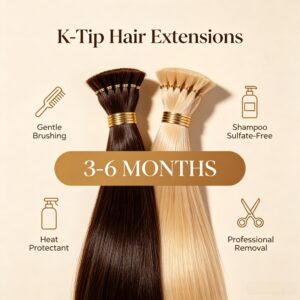
If you are considering K-tip extensions, one of the first questions to ask is: how long do K-tip extensions last? In general, K-tip hair extensions can stay installed for approximately 3–6 months, depending on natural hair growth, installation quality, hair quality, lifestyle, and aftercare. However, the installation lifespan and the lifespan of the extension hair itself are not always the same.
A well-made K-tip extension may stay in good condition beyond one installation cycle, while the keratin bond usually needs to be removed and replaced or re-tipped once the natural hair has grown out enough. Understanding this difference can help you plan maintenance, avoid unnecessary damage, and get better value from your hair extensions.
How Long Do K-Tip Extensions Last?
K-tip extensions typically last around 3–6 months per installation when they are professionally installed and properly maintained. Some clients may need removal earlier, while others can maintain their extensions toward the longer end of this range.
The biggest reason is simple: your natural hair keeps growing.
K-tip extensions are attached to individual strands or small sections of natural hair using a keratin-based bond. As the natural hair grows, the bond gradually moves farther away from the scalp. Eventually, the attachment becomes more visible, harder to manage, and more vulnerable to tangling.
A typical K-tip timeline may look like this:
| Stage | What Usually Happens |
|---|---|
| 0–4 weeks | Fresh installation and minimal grow-out |
| 4–8 weeks | Natural hair begins moving the bonds away from the scalp |
| 8–12 weeks | Professional inspection or maintenance may be useful |
| 3–4 months | Noticeable grow-out for many clients |
| 4–6 months | Some high-quality installations may remain wearable |
| 6+ months | Removal is generally necessary for most installations |
These are general guidelines, not guarantees. Hair growth rate, installation technique, product quality, and daily habits can significantly change the actual lifespan.
K-Tip Installation Lifespan vs. Hair Lifespan
This is one of the most important distinctions when discussing K-tip extensions.
How long the K-tip installation lasts refers to how long the extensions can remain attached to your natural hair before professional removal becomes necessary.
How long the extension hair lasts refers to how long the actual human hair remains attractive and usable.
These two periods can be different.
For example, a high-quality human hair K-tip extension may still look good after four months, but the attachment may have grown too far from the scalp. The stylist may therefore remove the extensions even though the hair itself is still in good condition.
Depending on hair quality and construction, some extension hair may potentially be re-tipped and reused after professional removal. However, this depends on the hair’s condition and the manufacturer’s product design. The keratin bond itself should not automatically be assumed to be reusable.
This distinction matters for salons, distributors, and hair brands when evaluating the total value of K-tip extensions.
Why Do K-Tip Extensions Need to Be Removed?
Natural hair growth is the primary reason.
Human hair continuously grows from the scalp. Because the K-tip bond is attached to the natural hair, it moves farther from the scalp as the hair grows.
This creates several potential problems:
- The bonds become more visible.
- The hair becomes more difficult to brush.
- Root tangling can increase.
- Extensions may experience more movement.
- The attachment can create additional leverage on natural hair.
- Styling becomes less convenient.
- Matting may develop if maintenance is neglected.
Therefore, the end of a K-tip installation is not necessarily caused by the extension hair becoming unusable.
In many cases, the attachment has simply grown too far away from the scalp.
What Factors Affect How Long K-Tip Extensions Last?
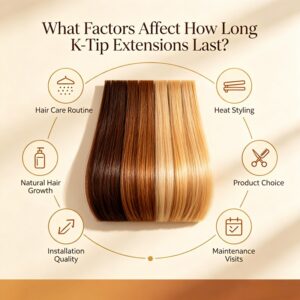
There is no universal expiration date for K-tip extensions. Several factors determine whether an installation lasts closer to three months or closer to six.
1. Natural Hair Growth
Everyone’s hair grows at a different rate.
If your hair grows quickly, the bonds will move away from the scalp faster. Someone with slower-growing hair may be able to keep the same installation for longer.
This is one reason why two people can use the same K-tip extensions but have very different maintenance schedules.
2. Installation Quality
Professional installation strongly influences longevity.
The stylist needs to select appropriate strand sizes, position the extensions correctly, and form the keratin bonds properly.
Poor installation may result in:
- Loose bonds
- Uneven attachment
- Excessive tension
- Premature shedding
- Tangling
- Uncomfortable pulling
A high-quality extension cannot compensate for poor installation technique.
3. Hair Quality
Extension hair quality also matters.
Premium human hair with good alignment, consistent texture, and appropriate processing can generally maintain its appearance better than low-quality hair that has been heavily processed.
For buyers, important specifications include:
- Hair origin
- Hair grade
- Cuticle condition
- Hair density
- Texture
- Color processing
- Strand consistency
- Keratin tip quality
For manufacturers and distributors, consistent production quality is especially important because customers expect the second batch to perform like the first.
4. Washing Frequency
Washing your hair does not automatically mean your K-tip extensions will fail prematurely.
However, frequent washing combined with inappropriate products can affect the condition of the hair and bonds.
A suitable extension-care routine should focus on gentle cleansing and thorough drying.
5. Hair Products
Heavy oils, oily conditioners, and some styling products should generally be kept away from the keratin bonds unless a professional specifically recommends them.
Products that accumulate around attachment points may affect grip or make the area harder to maintain.
6. Heat Styling
K-tip extensions can generally be styled, but excessive heat is not ideal.
Do not hold heat tools directly against the keratin attachment for extended periods. Excessive heat can affect the bond and may also accelerate dryness or damage in the extension hair.
7. Swimming
Chlorinated pools and salt water can affect extension hair, especially with frequent exposure.
If you swim regularly, protect the hair as much as possible and rinse it thoroughly afterward.
The same principle applies to both K-tip extensions and other human hair extension systems: water itself is not necessarily the enemy; prolonged exposure combined with poor aftercare is the bigger concern.
8. Brushing Habits
Improper brushing can cause unnecessary stress on extension attachments.
Use a suitable extension brush, and generally detangle the hair from the ends upward rather than pulling aggressively from the roots.
How to Make K-Tip Extensions Last Longer
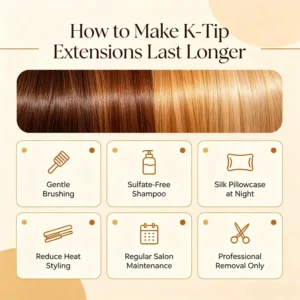
Proper aftercare can help you get closer to the expected lifespan of your installation.
Brush Regularly
Gently detangle the hair daily, especially before sleeping and washing.
Start at the ends and work upward gradually.
Keep the Bonds Clean
Product buildup around the attachment points can make maintenance more difficult.
Use products appropriate for your specific extension system and follow your stylist’s recommendations.
Avoid Excessive Oil Around the Bonds
Apply conditioning products mainly to the lengths and ends, not directly onto the keratin attachments.
Dry the Roots Thoroughly
Do not routinely go to bed with wet hair.
Moisture combined with friction can increase tangling and matting around the attachment areas.
Protect Your Hair While Sleeping
A loose braid or other low-tension hairstyle can help reduce friction while sleeping.
Reduce Excessive Heat
Use appropriate heat protection and avoid prolonged direct heat exposure around the keratin bonds.
Schedule Professional Checks
Even if your extensions still look good, periodic professional inspections can help identify loose bonds, excessive grow-out, tangling, or other problems before they become serious.
Signs Your K-Tip Extensions Need to Be Removed
Don’t wait until the extensions are severely tangled before considering professional removal.
Common signs include:
Significant Grow-Out
If the bonds have moved noticeably away from the scalp, the installation may be reaching the end of its useful period.
Root Tangling
When the natural hair begins tangling around individual bonds, professional maintenance or removal may be necessary.
Loose or Slipping Bonds
Extensions that repeatedly move or slip may no longer be securely attached.
Matting
Matting around the roots is a strong reason to have the extensions professionally assessed.
Excessive Discomfort
Don’t ignore persistent pulling, pain, or unusual tension.
Poor Extension Condition
If the extension hair has become severely dry, tangled, or difficult to manage, keeping it installed longer may not help.
Professional removal is preferable to pulling or cutting out K-tip extensions yourself.
Can K-Tip Extensions Be Reused?
The answer depends on the product and the condition of the extension hair.
In many K-tip systems, the original keratin bond is not designed to be reused, but the extension hair itself may potentially be re-tipped.
Reusability depends on:
- Hair quality
- Hair condition after removal
- Shedding
- Tangling
- Previous chemical processing
- Heat exposure
- Removal technique
- Manufacturer specifications
This is an important purchasing consideration for salons and professional buyers.
If you are sourcing K-tip extensions in bulk, ask the manufacturer whether the product is designed for re-tipping and which replacement bonding system it recommends.
How Long Does K-Tip Hair Last Compared With Other Extensions?
K-tip extensions are often selected by customers who want longer-term wear without daily removal.
| Extension Type | Typical Wear Pattern |
|---|---|
| K-Tip | Approximately 3–6 months |
| Tape-In | Often requires maintenance around 6–8 weeks |
| I-Tip | Often adjusted around 8–12 weeks |
| Hand-Tied Weft | Commonly requires periodic repositioning |
| Clip-In | Removed after daily use |
These figures are general industry ranges. Actual performance depends heavily on the installation method, product quality, hair growth, and aftercare.
K-tip extensions can therefore appeal to customers who prefer individual strand placement and fewer full installation appointments.
Are K-Tip Extensions Damaging?
K-tip extensions are not inherently damaging, but incorrect installation, excessive tension, poor maintenance, or improper removal can contribute to hair damage.
The most important factors are:
- Appropriate extension weight
- Correct section size
- Proper bond placement
- Professional installation
- Regular maintenance
- Gentle brushing
- Correct removal
People with fragile, heavily processed, or particularly fine hair should consult an experienced extension professional before choosing any semi-permanent extension system.
The goal should not simply be to make extensions last as long as possible. The goal is to balance longevity, appearance, comfort, and natural hair health.
K-Tip Extensions vs. Tape-In Extensions
K-tip and tape-in extensions are both popular, but they provide different experiences.
K-tip extensions use individual keratin bonds, allowing the stylist to place individual strands in specific areas. When properly installed, this can provide natural movement and flexibility.
Tape-in extensions use adhesive strips and are installed in larger sections. They can be faster to install and are often repositioned more frequently.
K-tips may be preferable for customers who want:
- Individual strand placement
- Natural movement
- Less visible attachment points
- Longer periods between complete installations
Tape-ins may be preferable for customers who prioritize quicker installation and regular repositioning.
The best choice depends on the client’s hair, lifestyle, budget, desired appearance, and maintenance preferences.
How to Choose High-Quality K-Tip Extensions
For consumers, the focus should be on hair quality and professional installation.
For salons, distributors, and hair brands, sourcing becomes more complex.
A reliable K-tip extension supplier should be able to provide consistent:
- Human hair quality
- Strand weight
- Hair length
- Color
- Texture
- Keratin tip dimensions
- Bond strength
- Packaging
- Production quality
Wholesale buyers should request samples before committing to a large order. Testing the product through actual salon installation can provide much more useful information than judging product photos alone.
For brands developing their own product lines, OEM and private-label services can also be important. Customized colors, lengths, packaging, labels, and product specifications can help create a differentiated hair extension collection.
Why Choose Alove Hair for K-Tip Extensions?
For salons, distributors, wholesalers, and hair brands looking for factory-direct hair products, Alove Hair provides professional hair extension manufacturing and sourcing solutions.
As a direct manufacturer, Alove Hair supports customers with product selection, samples, wholesale orders, and custom requirements. Buyers can discuss specifications such as hair length, color, texture, tip construction, packaging, and other requirements directly with the factory.
This factory-direct approach can be especially useful for businesses that need consistent quality and stable long-term supply rather than purchasing through multiple intermediaries.
Frequently Asked Questions
How long do K-tip extensions last?
K-tip extensions typically last around 3–6 months per installation, depending on natural hair growth, installation quality, extension quality, lifestyle, and aftercare.
Can K-tip extensions last 6 months?
Yes, some installations may remain wearable for approximately six months when the extensions are high quality and properly maintained. However, individual results vary.
How often should K-tip extensions be checked?
A professional check can be useful during the wear period, particularly as the bonds grow away from the scalp. Your stylist can determine the appropriate maintenance schedule based on your hair growth and extension condition.
Can you reuse K-tip extensions?
The original keratin bond is generally not reused, but some extension hair may be re-tipped and reused if it remains in good condition and the product is designed for this purpose.
How can I make K-tip extensions last longer?
Gentle brushing, suitable hair products, proper drying, reduced heat exposure, careful swimming habits, and professional maintenance can help extend the useful life of K-tip extensions.
Do K-tips last longer than tape-ins?
K-tip extensions can provide a longer period between complete installations than tape-in extensions, although actual maintenance schedules vary by person and product.
Can you sleep with K-tip extensions?
Yes. However, hair should be dry and gently detangled before sleeping. A loose braid or low-tension hairstyle can help reduce friction and tangling.
When should K-tip extensions be removed?
They should be professionally assessed when the bonds have grown significantly away from the scalp, become loose, cause tangling, or are no longer comfortable or manageable.
Final Takeaway
So, how long do K-tip extensions last?
For most users, a realistic expectation is around 3–6 months per installation. But the number alone does not tell the whole story.
Natural hair growth determines how quickly the bonds move away from the scalp, while installation quality, extension quality, lifestyle, and aftercare determine how well the hair remains manageable throughout that period.
It is also important to distinguish the lifespan of the K-tip installation from the lifespan of the extension hair. A good-quality human hair extension may remain usable after the original installation is removed, provided the hair is still in good condition and the manufacturer supports re-tipping.
For professional salons, distributors, and hair brands, choosing a reliable manufacturer is equally important. Consistent hair quality, reliable keratin tips, accurate specifications, and factory-direct support can make a significant difference when K-tip extensions become part of a long-term product range.
When properly selected, professionally installed, and carefully maintained, K-tip extensions can offer a natural-looking, flexible, and relatively long-lasting hair extension solution.

Jgs is a professional with 12 years of experience in hair extensions, primarily helping importers better understand hair extensions, wigs, toupee, and other related products.


