
I Tip Hair Extensions Pros and Cons
The world of hair extensions is ever-evolving, but few methods have sparked as much ongoing conversation as I Tip hair extensions. Whether you’re a professional stylist, a salon owner, or someone considering enhancing their look, understanding the nitty-gritty of I Tip extensions is crucial. Today, we unravel the truth—the pros, the cons, and some eyebrow-raising realities you might not have considered.
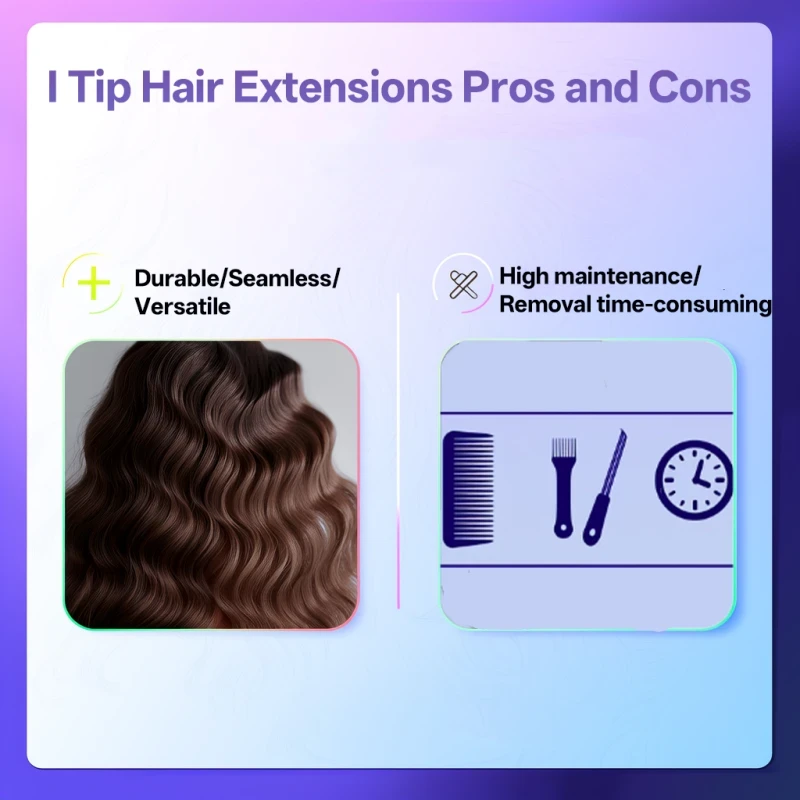
However, I Tip hair extensions have both pros and cons. They require more installation time than some weft or tape systems, need regular maintenance, and may not be suitable for very fine or fragile hair. The result also depends heavily on the stylist’s technique, extension weight, bead selection, and aftercare.
So, are I Tip extensions worth it?
For clients who want flexible styling, reusable human hair, and a glue-free installation, they can be an excellent choice. For people looking for the fastest installation or those with extremely low-density hair, another method may be more appropriate.
This guide explains the advantages and disadvantages of I Tip hair extensions, how long they last, how often they need maintenance, and how they compare with K Tip, Tape In, and weft extensions.
What Are I Tip Hair Extensions?
I Tip hair extensions are individual strands or small bundles of human hair with a narrow, straight tip. The tip is inserted into a small microbead or micro ring together with a section of the client’s natural hair. The bead is then clamped to secure the extension.
Unlike keratin fusion extensions, the I Tip installation process does not require heat to melt a keratin bond. Unlike tape-in extensions, it does not rely on adhesive tape to attach the extension.
One important terminology point is that I Tip describes the extension strand, while micro ring, microbead, or micro link describes the attachment system. In the marketplace, these terms are often used together because the two components work as one installation system.
A typical I Tip system consists of:
- 100% human hair or another specified hair material
- A straight I-shaped tip
- Microbeads or micro rings
- Extension pliers
- A loop or threading tool
- Professional sectioning and installation
The method is particularly useful when a stylist wants to control placement strand by strand instead of applying a large extension panel.
How Do I Tip Extensions Work?
The installation process is mechanical rather than adhesive-based.
A simplified professional installation generally follows these steps:
- The stylist sections the natural hair.
- A small section of natural hair is pulled through a microbead.
- The I Tip extension is inserted into the bead.
- The bead is positioned at an appropriate distance from the scalp.
- Extension pliers clamp the bead securely.
- Repeat the process according to the desired density and hairstyle.
Because each extension is installed individually, the stylist can control where additional length or volume is placed.
For example, more strands can be positioned toward the back for overall length, while fewer strands can be placed around the face for subtle framing.
Professional sources commonly describe I-Tips as a heat-free and glue-free strand-by-strand system.
The attachment should not be excessively tight. The American Academy of Dermatology warns that repeated pulling from extensions and other tight hairstyles can contribute to traction alopecia, and recommends professional installation and loosening a style if it causes pain or excessive tension.
I Tip vs Micro Ring Extensions
I Tip and micro ring extensions are sometimes treated as two separate products, but they are closely related.
I Tip generally refers to the extension strand with the straight tip.
Micro ring or microbead refers to the small ring used to attach that strand to natural hair.
In other words:
I Tip = extension design; Micro Ring = attachment method.
Some suppliers may use terms such as I-Link, I-Tip, stick tip, micro link, or microbead extension. Product terminology can vary between markets, so B2B buyers should always check the actual construction and specifications rather than relying only on the product name.
I Tip Hair Extensions Pros
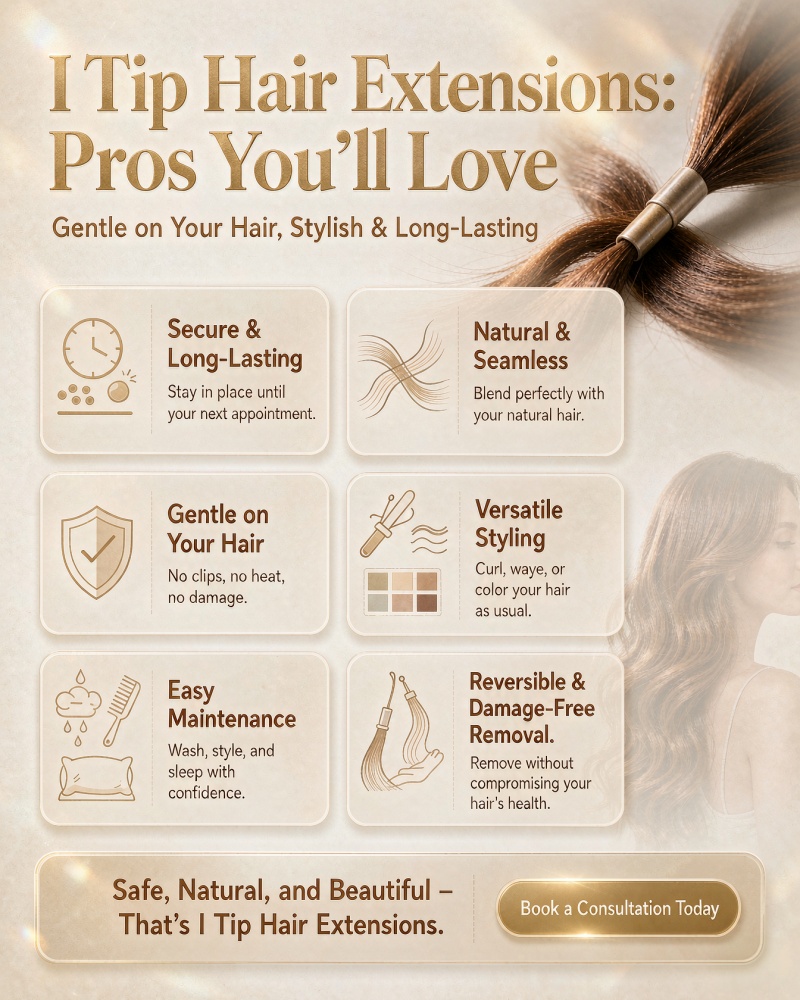
The biggest advantages of I Tip extensions are their glue-free installation, natural movement, reusability, and strand-by-strand customization.
No Heat or Glue
One of the strongest advantages of I Tip hair extensions is that installation does not require hot tools to melt the bond or liquid adhesive to attach the extension.
This makes I Tips attractive to clients who prefer to avoid:
- Hot fusion
- Liquid glue
- Adhesive tape
- Heat-based bonding
The mechanical bead attachment also makes removal relatively straightforward when performed correctly.
However, “no heat” should not be confused with “no risk.”
Incorrect bead placement, excessive tension, excessive extension weight, or poor removal can still cause natural hair stress. The American Academy of Dermatology specifically notes that extensions can contribute to breakage and hair loss when repeated pulling or excessive tension is involved.
Natural Movement
Because I Tips are installed individually, each strand can move more independently than a large weft.
This can create a natural appearance when the correct color, texture, density, and placement are selected.
The individual installation also allows the stylist to blend the extensions into different areas of the head instead of creating one continuous extension row.
This is particularly useful for:
- Face-framing
- Crown volume
- Side volume
- Length enhancement
- Color effects
- Partial installations
For clients who frequently wear their hair down, this flexible movement can be a major advantage.
Reusable Hair
Another important advantage is reusability.
The extension hair itself may remain suitable for another installation after the original attachment is removed. Depending on hair quality, processing, care, and installation, professional suppliers commonly describe I Tip human hair as reusable through multiple maintenance cycles.
Some industry sources estimate that quality I Tip hair can remain usable for approximately 6–12 months, although actual lifespan varies considerably.
The important distinction is:
The attachment does not last as long as the hair.
As natural hair grows, the bead moves farther away from the scalp. The stylist therefore needs to remove and reposition the extensions even though the human hair itself may still be in good condition.
This makes I Tips attractive to long-term extension users because the same hair can potentially be used through multiple maintenance appointments.
Flexible Styling
I Tip extensions offer considerable styling flexibility because there is no large adhesive panel or continuous weft.
Depending on the installation and natural hair density, clients can typically wear:
- Straight hairstyles
- Loose curls
- Waves
- Layered styles
- Low ponytails
- Some updos
- Side-part styles
- Face-framing looks
The stylist can also place different colors or lengths in specific areas.
For example, a salon could use one shade for the main length and a lighter shade around the face to create a subtle dimensional effect.
Customized Volume Placement
This is one of the biggest advantages of I Tips for professional salon work.
With a strand-by-strand method, stylists can control where additional volume goes.
A client might want:
- More fullness at the back
- Extra volume around the sides
- Face-framing highlights
- Additional length without excessive crown volume
- A partial installation rather than a full head
This level of customization is harder to achieve with large, fixed extension panels.
For salons, it also means the same I Tip product can be used for different services rather than being limited to one installation style.
{“AIGC”: {“Label”:”1″,”ContentProducer”:”001191440300708461136T1WFUO”,”ProduceID”:”41e7bffe243fd4d6477c55fa77ddc59c-kYbO”,”ReservedCode1″:”{“Type”:” TC260PG”,”Version”:1,”Bindings”:[{“Type”:”soft”,”AlgID”:”sm3″,”Value”:”6561544814951396f8c50080ab101298c5acbf2880f1b95b1963bad303ebbfaf”},{“Type”:”hash”,”AlgID”:”sm3″,”Value”:”2b4e321dc3d6542cc7425224842976f7f9e24c241734aac9471a376076a1c1a4″}],”PubSD”:[{“Type”:”DS”,”AlgID”:”sm2″,”TBSData”:{“Type”:”Binding”,”BType”:”hash”},”Signature”:”3046022100fc9eccaf94f0147687f172c787d605990a9016c540f5cb4afcc03057b8769e37022100d3d391a7625f8b96e5e9bfee2c44d789ffc541e3fae4107a81146202bf069cd2″},{“Type”:”PubKey”,”AlgID”:”sm2″,”KeyValue”:”0407f79b28a17a752b3aae4305c98b48978213832729a2571850b1310b2bc9fe8fee039ccf25ebfeac27502414d9fcef792d777183c98893d226171c2f7a3289a2″}],”Extension”:{“Timestamp”:1788254900,”KeyVersion”:”v1-TxLeOmf7bqU223″}}”,”ContentPropagator”:”001191440300708461136T1WFUO”,”PropagateID”:”41e7bffe243fd4d6477c55fa77ddc59c-kYbO”,”ReservedCode2″:”{“Type”:” TC260PG”,”Version”:1,”Bindings”:[{“Type”:”soft”,”AlgID”:”sm3″,”Value”:”6561544814951396f8c50080ab101298c5acbf2880f1b95b1963bad303ebbfaf”},{“Type”:”hash”,”AlgID”:”sm3″,”Value”:”2b4e321dc3d6542cc7425224842976f7f9e24c241734aac9471a376076a1c1a4″}],”PubSD”:[{“Type”:”DS”,”AlgID”:”sm2″,”TBSData”:{“Type”:”Binding”,”BType”:”hash”},”Signature”:”304502207afddd5d89fa54f147d153c4511d857ce7534d18e529588e1d6585460f331377022100cc0e4c9cb2e7eb605e0f328e1ca0db1969e327bfd25df93b3b70de9a4c798a4c”},{“Type”:”PubKey”,”AlgID”:”sm2″,”KeyValue”:”0407f79b28a17a752b3aae4305c98b48978213832729a2571850b1310b2bc9fe8fee039ccf25ebfeac27502414d9fcef792d777183c98893d226171c2f7a3289a2″}],”Extension”:{“Timestamp”:1788254900,”KeyVersion”:”v1-TxLeOmf7bqU223″}}”}}
I Tip Hair Extensions Cons
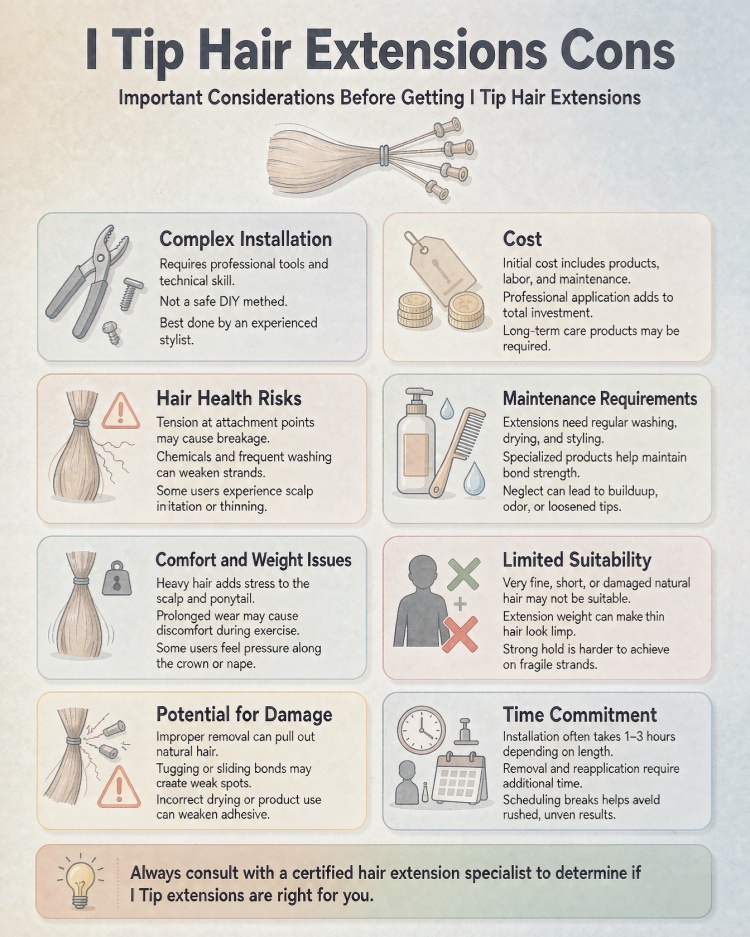
The advantages come with several trade-offs.
Longer Installation Time
I Tip extensions are installed strand by strand, which naturally takes longer than applying larger extension panels.
Industry salon sources commonly report approximately 2–4 hours for a full micro-link/I Tip installation, depending on hair density, number of strands, stylist experience, and desired result.
For comparison, a partial volume installation may take considerably less time.
This means I Tips may not be the best choice for clients who prioritize the fastest possible appointment.
For salons, however, the longer installation time can be balanced by the customization and reusability of the method.
Regular Maintenance
I Tip extensions are not a “fit and forget” product.
Natural hair continues to grow after installation. As it grows, the microbeads move farther away from the scalp.
Professional maintenance is therefore necessary.
A commonly cited maintenance interval is approximately 6–8 weeks, although the actual timing depends on individual hair growth, installation quality, bead movement, and the client’s care routine.
At a maintenance appointment, a stylist may:
- Check bead security
- Remove extensions
- Replace worn beads
- Move extensions closer to the scalp
- Remove tangled strands
- Reinstall suitable hair
Some sources recommend shorter or longer intervals, so the 6–8 week range should be treated as a practical industry benchmark rather than a universal rule.
Bead Slippage
Bead slippage is another common disadvantage.
An I Tip can move or slip if:
- The bead is not clamped correctly
- The wrong bead size is selected
- Too little natural hair is used
- Too much hair is placed inside the bead
- Excessive oil reaches the attachment
- The extension is too heavy for the natural hair
- The client does not follow proper aftercare
Slippage does not necessarily mean the extension itself is poor quality.
Installation technique is a major factor.
For B2B buyers, this is why sample testing should include not only hair softness but also tip consistency, bead compatibility, weight, and installation performance.
Initial Discomfort
Some clients may notice the beads during the first few days after installation.
A slight awareness of the attachment can occur while the client becomes accustomed to the new extensions.
However, significant pain, persistent scalp discomfort, headaches, or excessive pulling should not be considered normal.
The American Academy of Dermatology recommends paying attention to pain or tightness because repeated tension can damage hair follicles.
A professional stylist should adjust or remove an installation that creates excessive tension.
Not Suitable for Every Hair Type
I Tips are not universally suitable.
Very fine, fragile, or extremely low-density hair requires careful assessment because individual beads concentrate attachment weight on relatively small sections of natural hair.
Some professional extension sources specifically caution against using I Tips on very thin hair.
This does not mean every person with fine hair must avoid I Tips.
There is an important difference between:
Fine hair: individual strands have a small diameter.
Thin hair: overall hair density is low.
A client can have fine strands but relatively high density and may be able to wear appropriately selected I Tips. Conversely, someone with very low density may not have enough natural hair to safely support or conceal the attachments.
I Tip Hair Extensions Pros and Cons at a Glance
| Feature | Pros | Cons |
|---|---|---|
| Installation | No heat or glue | Requires professional technique |
| Appearance | Natural movement | Beads may become visible as hair grows |
| Reusability | Hair can be reused | Beads may need replacement |
| Styling | Flexible placement | Some styles require careful positioning |
| Maintenance | Adjustable system | Usually needs maintenance every 6–8 weeks |
| Installation Time | Custom strand placement | Often takes 2–4 hours for a full install |
| Hair Type | Good for many medium-density clients | Less suitable for very fragile/low-density hair |
| Long-Term Value | Reusable hair can reduce replacement frequency | Requires recurring salon appointments |
The key takeaway is that I Tips exchange installation speed for customization and reusability.
Do I Tip Hair Extensions Damage Your Hair?
I Tip extensions do not automatically damage natural hair.
The more accurate answer is:
Damage risk depends heavily on extension weight, installation tension, placement, maintenance, and removal.
The absence of heat and glue removes certain sources of stress, but the mechanical attachment can still create tension if the extension is too heavy or installed too tightly.
According to the American Academy of Dermatology, repeated pulling from extensions and other tight hairstyles can contribute to traction alopecia, and prolonged traction can potentially cause permanent hair loss.
To reduce unnecessary stress:
- Select an appropriate extension weight.
- Use suitable section sizes.
- Avoid excessively tight beads.
- Do not install extensions on weak areas.
- Have a professional perform installation and removal.
- Maintain the extensions regularly.
- Stop and reassess if the client experiences pain.
Therefore, it is more accurate to call I Tips a heat-free and glue-free method, rather than claiming they are completely damage-free.
Are I Tip Extensions Good for Thin Hair?
The answer depends on what “thin hair” means.
For fine but relatively dense hair, lightweight I Tips may be an option when installed correctly.
For very low-density or fragile hair, caution is necessary.
A stylist should assess:
- Hair density
- Strand strength
- Scalp condition
- Existing breakage
- Hairline density
- Desired extension weight
- Number of strands required
If the natural hair cannot adequately support or conceal the attachment, another extension method may be more appropriate.
For this reason, there is no universal “best I Tip weight for thin hair.”
The correct specification depends on the individual client’s natural hair.
How Long Do I Tip Hair Extensions Last?
There are two different answers to this question.
How Long Does One Installation Last?
The attachment generally needs professional adjustment as natural hair grows.
A practical industry benchmark is approximately 6–8 weeks between maintenance appointments, although some systems and clients may require a different schedule.
How Long Does the Hair Last?
High-quality human hair can potentially remain usable for approximately 6–12 months or longer with proper care, depending on quality and processing.
Heavily bleached or frequently heat-styled hair may have a shorter useful life.
Factors affecting lifespan include:
- Hair quality
- Chemical processing
- Heat styling
- Washing frequency
- Brushing
- Swimming
- Product buildup
- Maintenance
- Removal technique
- Storage
Therefore, when comparing suppliers, buyers should ask about hair lifespan and maintenance cycle separately.
How Often Do I Tip Extensions Need Maintenance?
For many clients, maintenance is scheduled around every 6–8 weeks.
However, this is not a fixed medical or technical rule.
Faster-growing hair may require earlier adjustment, while slower-growing hair may allow a longer interval.
During maintenance, the stylist checks whether:
- Beads have slipped
- Hair has grown significantly
- Extensions are tangling
- The natural hair remains healthy
- The bead needs replacement
- The extension can be reused
One industry guide reports a 6–8 week maintenance cycle, while other suppliers recommend different intervals. This variation reinforces the importance of assessing the actual installation rather than following one number for every client.
I Tip vs K Tip Hair Extensions
I Tip and K Tip extensions are both popular strand-by-strand methods, but the attachment systems are different.
| Feature | I Tip | K Tip |
|---|---|---|
| Attachment | Microbead/ring | Keratin bond |
| Heat Required | No | Usually yes |
| Glue/Adhesive | No | Keratin bonding material |
| Reusability | Hair can be reused | Usually replaced after removal |
| Placement | Strand by strand | Strand by strand |
| Maintenance | Move-up required | Replacement required |
| Flexibility | High | High |
| Best For | Clients wanting reusable, glue-free installation | Clients preferring bonded installation |
The biggest advantage of I Tip over K Tip is the absence of heat during installation and the ability to reuse suitable hair.
K Tip, however, can provide a different attachment profile and may be preferred by clients or stylists who are experienced with keratin bonding.
I Tip vs Tape In Hair Extensions
Tape In extensions use adhesive panels, while I Tips use individual strands and beads.
| Feature | I Tip | Tape In |
|---|---|---|
| Attachment | Microbead | Adhesive tape |
| Installation | Strand by strand | Panel by panel |
| Heat | No | No |
| Glue | No | Adhesive |
| Installation Speed | Generally slower | Generally faster |
| Movement | Very flexible | Flat panel movement |
| Volume Placement | Highly customizable | More row-based |
| Reusability | Hair can be reused | Requires new tape |
| Maintenance | Move-up | Re-taping/move-up |
Tape-in extensions can be attractive for clients who want faster application and a flat attachment.
I Tips are often better suited to stylists who prioritize individualized placement and reusable hair.
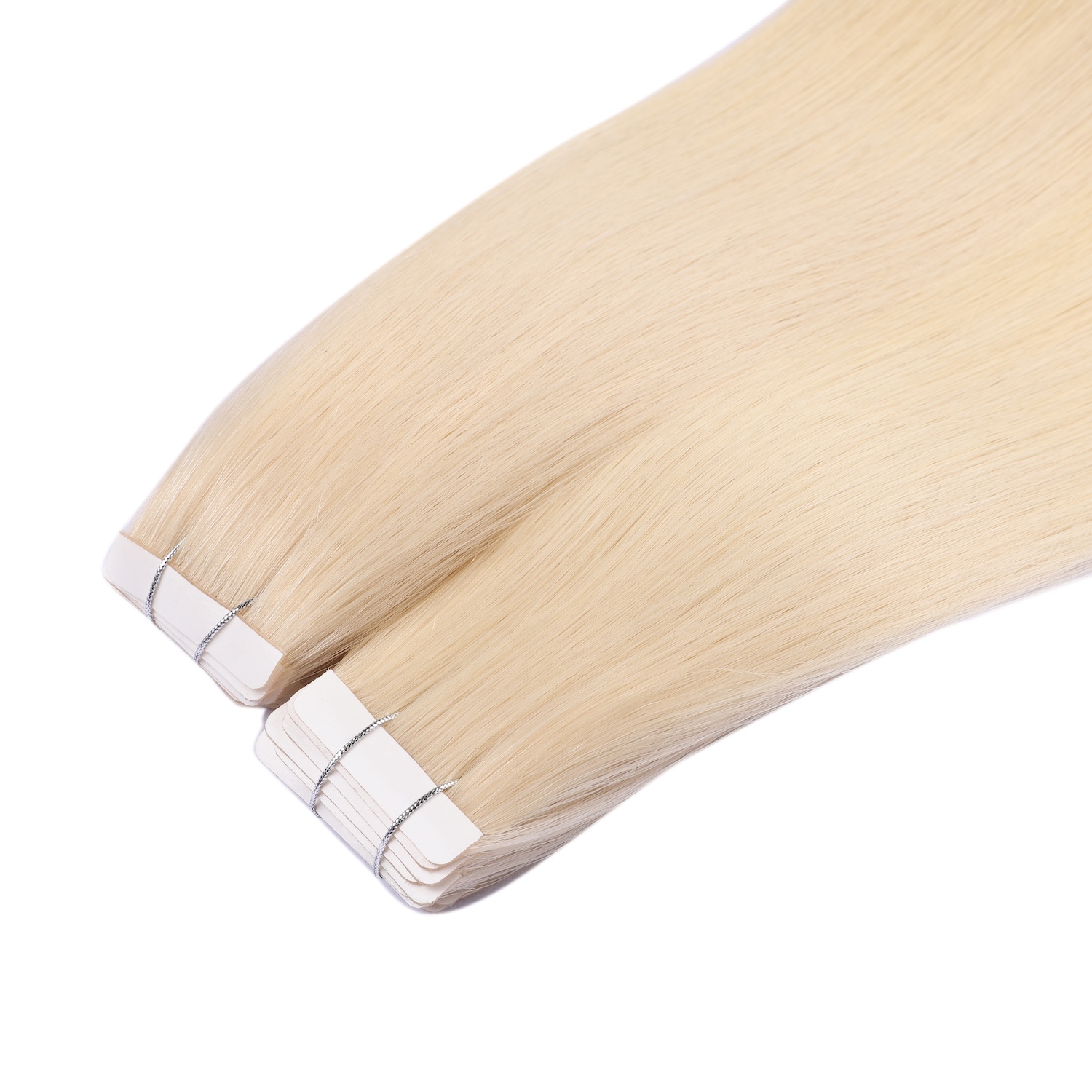
This is tape in hair extensions.
I Tip vs Weft Hair Extensions
Weft extensions contain hair attached to a continuous strip or weft.
I Tips are individual strands.
| Feature | I Tip | Weft |
|---|---|---|
| Construction | Individual strands | Continuous weft |
| Placement | Highly customizable | Row-based |
| Installation | Individual bead attachment | Sew, bead, or other methods |
| Movement | Very natural | Depends on weft method |
| Installation Time | Longer | Often faster for large areas |
| Volume | Precise | Excellent for broad volume |
| Maintenance | Individual beads | Row maintenance |
A client who wants targeted volume may prefer I Tips.
A client seeking substantial overall density may prefer a weft system.
The “best” method therefore depends on the desired result rather than the product category alone.
Who Should Choose I Tip Hair Extensions?
I Tips may be a strong option for clients who:
- Want a glue-free installation
- Want to avoid heat during attachment
- Prefer natural strand movement
- Want targeted volume
- Want flexible placement
- Want reusable human hair
- Are comfortable with regular maintenance
- Have sufficient natural hair density
- Prefer professional salon installation
They are also attractive for salons because one product can support multiple service types, including full-head installations, partial volume, color accents, and face-framing.
Who Should Avoid I Tip Hair Extensions?
I Tips may not be the best choice for clients with:
- Extremely fragile hair
- Very low hair density
- Significant active shedding
- Severe breakage
- Weak hairline areas
- Inadequate hair to support the beads
- An inability to maintain extensions regularly
Clients experiencing unexplained hair loss should address the underlying issue with an appropriate healthcare professional before adding extension-related tension.
The American Academy of Dermatology recommends stopping hairstyles that cause excessive pulling and seeking professional medical advice when traction-related hair loss is suspected.
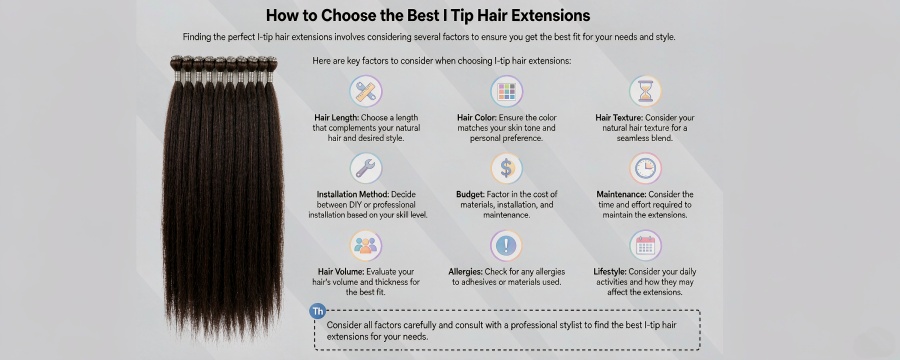
How to Choose the Best I Tip Hair Extensions
For consumers, the most important factors are hair quality, weight, color, attachment quality, and maintenance requirements.
For salons and B2B buyers, the evaluation should be even more detailed.
1. Hair Quality
Ask about:
- Human hair content
- Cuticle alignment
- Hair origin
- Processing level
- Shedding
- Tangling
- Density consistency
2. Tip Quality
The I Tip should have a consistent, clean, secure tip.
Inconsistent tips can create differences during installation.
3. Weight
The weight per strand matters.
A professional supplier should be able to provide clear specifications instead of simply describing the product as “lightweight.”
4. Color Range
A broad color range helps salons match different clients.
Common categories include:
- Black
- Brown
- Blonde
- Red
- Balayage
- Ombre
- Highlighted shades
- Custom colors
5. Bead Compatibility
The I Tip should be compatible with the intended microbead or ring system.
Buyers should test the complete system rather than purchasing hair and beads separately without checking compatibility.
6. Reusability
Ask how many maintenance cycles the supplier expects from the hair under normal salon care.
7. OEM and Private Label
For brands, customization can include:
- Custom lengths
- Custom weights
- Custom colors
- Custom tips
- Custom packaging
- Custom labels
- Logo printing
- Private-label production
A manufacturer that can control both hair production and packaging can simplify the B2B supply chain.
Final Thoughts: Are I Tip Extensions Right for You?
Like most beauty enhancements, the decision to choose I Tip extensions boils down to lifestyle, budget, and personal preference. They offer unrivaled natural movement, durability, and a heat-free, glue-free application method—but they demand maintenance, patience, and a quality-first approach.
For stylists, salons, and beauty entrepreneurs, sourcing reliable, premium hair is half the battle. That’s where Qingdao ALOVE HAIR PRODUCTS Co., Ltd. stands apart. With over four decades of expertise, a global market footprint, and a loyal client base, we provide more than just hair—we deliver confidence, creativity, and consistency.
Ready to elevate your hair extension game? Partner with ALOVE today for trusted, premium solutions tailored to your needs.
For example, a salon supply distributor may require a lightweight I Tip collection for fine-to-medium-density hair, while another market may require longer, higher-density extensions.
Instead of forcing every customer into one specification, a professional manufacturer can develop different products around different applications.
Before a bulk order, B2B buyers should request samples and evaluate:
| Test Item | What to Check |
|---|---|
| Hair Texture | Softness and consistency |
| Tip | Shape and strength |
| Density | Uniformity from root to end |
| Shedding | Loose strands after brushing |
| Tangling | Performance after washing |
| Color | Accuracy and consistency |
| Weight | Actual grams per strand/package |
| Reusability | Condition after removal |
| Packaging | Protection during transportation |
This sample-first approach helps buyers verify actual product performance before committing to a large wholesale order.
Frequently Asked Questions
Are I Tip hair extensions worth it?
For clients who want reusable hair, natural movement, and a glue-free, heat-free installation, I Tips can be worth the investment. They require more maintenance and installation time than some alternatives.
What are the main disadvantages of I Tip extensions?
The main disadvantages are longer installation time, regular maintenance, possible bead slippage, and limited suitability for extremely fine or fragile hair.
Are I Tip extensions damaging?
They are not automatically damaging, but incorrect installation, excessive tension, excessive weight, poor maintenance, and improper removal can cause breakage or traction-related problems.
How long do I Tip extensions last?
The human hair may remain usable for approximately 6–12 months or longer with appropriate care, while the installation generally requires adjustment around every 6–8 weeks as the natural hair grows.
Can I Tip hair extensions be reused?
Yes. Suitable human hair can be removed and reinstalled, often with replacement beads or other maintenance components. The number of reuse cycles depends on the hair quality and condition.
Are I Tips good for thin hair?
They can work for some clients with fine but adequately dense hair. Very low-density or fragile hair requires more caution because individual attachments can place concentrated weight on natural hair.
Which is better, I Tip or K Tip?
I Tip is generally more suitable for clients who want heat-free, glue-free installation and reusable hair. K Tip may appeal to clients who prefer a keratin-bonded system.
Which is better, I Tip or Tape In?
I Tip offers more individualized strand placement and reusable hair, while Tape In can provide faster installation and a flat panel attachment. The best choice depends on hair type, desired volume, maintenance preferences, and stylist technique.
How often should I Tip extensions be moved up?
A common professional benchmark is every 6–8 weeks, although the actual schedule should be based on natural hair growth, bead movement, and the condition of the installation.
Can I buy I Tip hair extensions wholesale?
Yes. Professional manufacturers such as Alove Hair can provide wholesale I Tip hair extensions for salons, distributors, wholesalers, and private-label brands. Buyers should request samples and confirm MOQ, hair specifications, customization options, and packaging before placing a bulk order.
Final Verdict: Are I Tip Hair Extensions Worth It?
So, after looking at the I Tip Hair Extensions pros and cons, are they worth choosing?
For the right client, yes.
I Tips are particularly attractive because they combine:
- No heat
- No liquid glue
- Natural strand movement
- Flexible placement
- Reusable human hair
- Customized volume
- Long-term salon use
The trade-offs are equally important:
- Installation can take around 2–4 hours for a full application
- Maintenance is commonly required every 6–8 weeks
- Beads can slip when installation or aftercare is poor
- Very fine or fragile hair may not be suitable
- Professional installation is strongly recommended
The most important factor is therefore not whether I Tips are universally “good” or “bad.”
It is whether the extension weight, hair quality, attachment system, installation technique, and maintenance routine are appropriate for the individual client.
For salons, distributors, and private-label hair brands, product quality is equally important. A consistent I Tip should have reliable hair density, clean tips, stable colors, appropriate weights, and dependable manufacturing quality.
When these factors are controlled, I Tip hair extensions can offer a practical combination of natural appearance, styling flexibility, reusability, and long-term value.

Alove Hair is a professional Chinese manufacturer of premium 100% Remy human hair extensions, wigs, and hair systems. Established in 2014, the company specializes in supplying global salons and distributors with high-quality, cuticle-intact hair products and offers comprehensive OEM/ODM private label services.


