
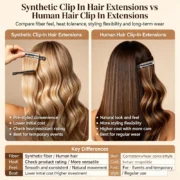
Synthetic Clip In Hair Extensions vs Human Hair Clip In Extensions
When choosing clip-in hair extensions, one of the first decisions is whether to buy synthetic or human hair. Both options can add instant length, volume, and color to your hairstyle, but they offer very different experiences in terms of appearance, styling flexibility, durability, maintenance, and price.
Human hair clip-in extensions are generally the better choice for natural blending, frequent wear, and heat styling. Synthetic clip-ins are usually more affordable and can be a practical option for occasional use, pre-styled looks, costumes, or special events.
However, the comparison is not quite that simple. High-quality synthetic fibers can look more natural than inexpensive alternatives, and some heat-friendly synthetic products can tolerate limited styling temperatures. Similarly, not all human hair extensions have the same quality, cuticle condition, or expected lifespan.
The right choice depends on how often you plan to wear your extensions, how closely they need to match your natural hair, and how much time and money you want to spend maintaining them.
In this guide, we compare Synthetic Clip-In Hair Extensions vs Human Hair Clip-In Extensions across 12 important factors, including material, appearance, styling, weight, cost, durability, and care. We also share practical buying advice for consumers, salons, wholesalers, and private label hair extension brands.
Quick Comparison: Synthetic Clip-Ins vs Human Hair Clip-Ins
Here is a quick overview of the main differences.
| Comparison Factor | Synthetic Clip-In Extensions | Human Hair Clip-In Extensions |
|---|---|---|
| Material | Man-made synthetic fibers | Natural human hair |
| Initial price | Usually lower | Usually higher |
| Appearance | Depends on fiber quality; some products have stronger shine | Generally more natural movement and texture |
| Heat styling | Usually restricted; heat-friendly models have product-specific limits | Can generally be styled with heat carefully |
| Hair coloring | Cannot be colored with conventional human-hair dye | Professional color adjustment may be possible |
| Style retention | Holds factory-set curls, waves, or straight styles well | Responds to styling and environmental conditions like natural hair |
| Texture matching | Available textures may be more limited | Usually easier to blend with natural hair |
| Washing | Requires synthetic-fiber-specific care | Requires gentle human-hair extension care |
| Tangling | May become tangled or frizzy as fibers wear | Can also tangle, especially with damaged or poorly processed hair |
| Lifespan | Often shorter with frequent use | Often longer with proper care |
| Maintenance | Usually less styling and conditioning required | More regular brushing, washing, and conditioning |
| Best application | Occasional wear, events, and preset styles | Regular use, natural blending, and versatile styling |
These are general product-category differences rather than guarantees for every brand. Synthetic fiber composition, human hair processing, clip construction, and care instructions can all affect the final result.
For a broader introduction to extension types and attachment methods, see our guide to Different Types of Human Hair Extensions.
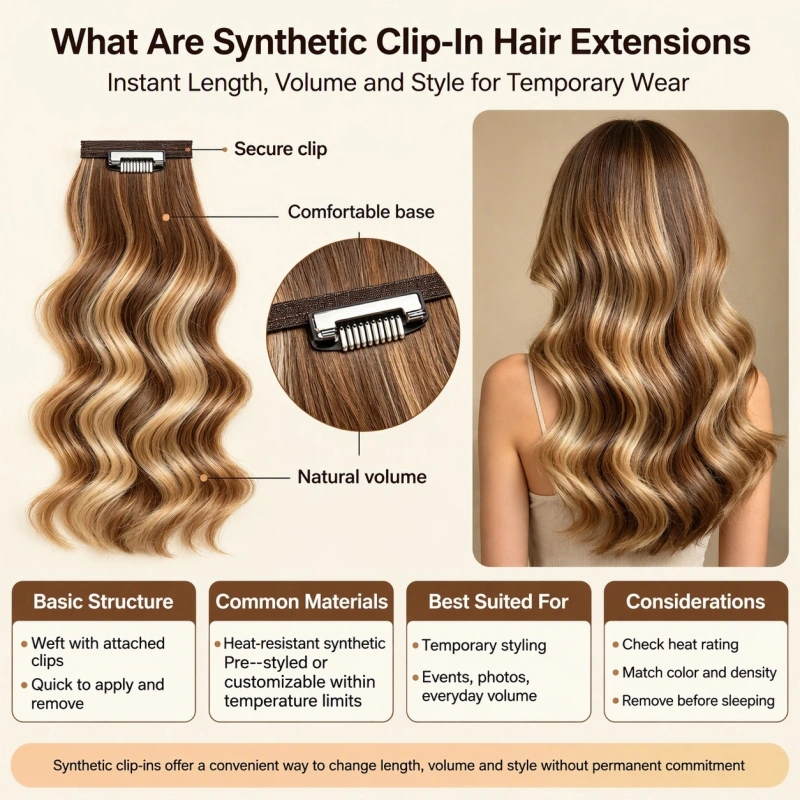
Synthetic hair clip in extensions
1. What Are Synthetic Clip-In Hair Extensions?
Synthetic clip-in hair extensions are made from manufactured fibers designed to imitate the appearance and texture of human hair.
Common synthetic materials include acrylic, polyester, nylon, and specialized modacrylic fibers. Different manufacturers use different fiber blends and production processes.
The synthetic hair is attached to wefts, and small clips are sewn or otherwise secured to the base. Users can open the clips, attach the wefts to sections of natural hair, and remove them after use.
Main Characteristics of Synthetic Clip-Ins
Pre-styled appearance
Synthetic extensions are often manufactured with a specific texture, such as straight, body wave, deep wave, or curly. The style is designed to remain relatively consistent through normal use.
Lower initial purchase cost
Synthetic fibers generally cost less to manufacture than human hair. This allows brands to offer more affordable clip-in sets.
Less conventional styling flexibility
Most standard synthetic products cannot tolerate the temperatures used by ordinary curling irons and straighteners. Heat can cause melting, frizzing, or permanent fiber damage.
Some products are labeled heat-resistant or heat-friendly. Their permitted styling temperature depends on the specific fiber and manufacturer instructions.
Consistent texture
Because the fiber is manufactured to a specific shape and texture, synthetic extensions can maintain a relatively consistent appearance without repeated curling or straightening.
Advantages of Synthetic Clip-In Extensions
- Affordable initial purchase price.
- Available in many fashion colors and preset styles.
- Suitable for occasional use and temporary transformations.
- Can maintain a factory-set curl or wave pattern.
- Generally requires less conventional styling.
Disadvantages of Synthetic Clip-In Extensions
- Standard synthetic fibers have limited heat tolerance.
- Conventional hair dye cannot be used to recolor them.
- Some products have an artificial shine or stiff texture.
- Repeated friction can cause tangling and frizz.
- Their usable lifespan may be shorter under frequent wear.
- Matching a specific natural hair texture can be more difficult.
Synthetic clip-ins may be a sensible choice for someone who wants a temporary style for a party, performance, costume, photoshoot, or occasional event.
They are less suitable when you want to change your hairstyle frequently or blend extensions with your natural hair every day.

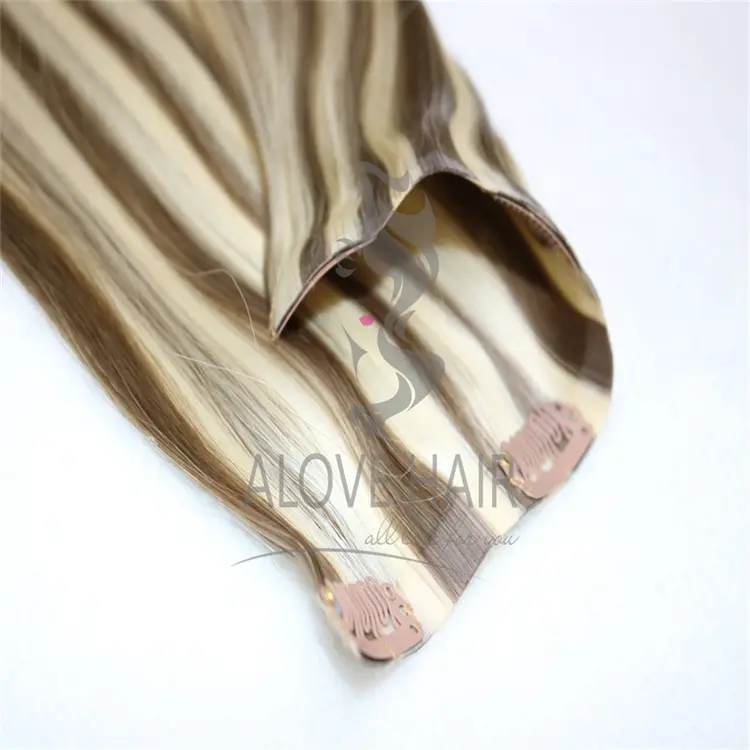
Human hair clip in extensions
2. What Are Human Hair Clip-In Extensions?
Human hair clip-in extensions are made from real human hair that has been processed, sorted, and attached to extension wefts with clips.
They are designed to add length or volume while maintaining the movement, texture, and styling flexibility associated with natural hair.
Not all human hair clip-ins are identical. Their quality depends on the raw hair, cuticle condition, sorting, chemical processing, construction, and manufacturing controls.
Remy Human Hair vs. Non-Remy Human Hair
This distinction is important when choosing human hair extensions.
Remy human hair generally refers to hair collected and arranged with the cuticles aligned in the same direction. Properly aligned cuticles can reduce friction between strands and help limit tangling.
Non-Remy human hair may contain hair strands arranged in mixed directions or processed to manage the resulting friction. Its quality and performance vary significantly between products.
Human hair is not automatically Remy, virgin, single-donor, or unprocessed simply because it is advertised as 100% real hair.
Always ask the supplier to clarify the material description.
Advantages of Human Hair Clip-In Extensions
1. More natural appearance
Human hair generally moves and reflects light more similarly to natural hair, making it easier to blend with your own hairstyle.
2. Greater styling flexibility
You can usually curl, straighten, or restyle human hair clip-ins, provided you use suitable heat protection and temperature settings.
3. Better texture matching
Human hair is available in different natural textures and can often be blended more effectively with your own hair.
4. Professional color adjustment
A qualified colorist may be able to darken or tone some human hair extensions. However, previously processed hair may react unpredictably, and lightening or bleaching can cause serious damage.
5. Greater reuse potential
With suitable material quality and careful maintenance, human hair clip-ins can often be worn repeatedly over an extended period.
Disadvantages of Human Hair Clip-Ins
- Higher initial purchase price.
- Requires regular brushing and careful storage.
- Can become dry or tangled without suitable care.
- Heat styling can gradually reduce hair quality.
- Color processing may shorten the usable lifespan.
- Needs more attention when washing and drying.
ALOVEHAIR describes its general human hair extension range as luxury Remy human hair with aligned cuticles. The company’s broader product information is available through its Hair Extensions Collection.
3. Appearance: Which Clip-In Extensions Look More Natural?
For many buyers, appearance is the most important difference between synthetic and human hair clip-ins.
The objective is not simply to make the extensions look attractive by themselves. They need to blend with your natural hair in different lighting, during movement, and from multiple viewing angles.
Human Hair: Natural Movement and Texture
Human hair has natural variation in strand shape, texture, and light reflection.
This makes it easier to blend with natural hair, particularly when the extension color, length, and texture are properly matched.
Human hair can also be styled to match the wearer’s natural layers, waves, or curls.
However, low-quality human hair can still have problems such as excessive shine, uneven density, dry ends, or tangling.
The word “human hair” alone does not guarantee a natural-looking result.
Synthetic Hair: Consistent but Fiber-Dependent Appearance
Synthetic extensions are manufactured to create consistent strands and styles.
Higher-quality fibers may look quite natural, especially when the color and texture match the wearer’s own hair.
However, some synthetic products have an overly glossy or uniform appearance under strong lighting. Their movement may also be less natural than that of good-quality human hair.
Appearance Comparison
| Appearance Factor | Synthetic Clip-Ins | Human Hair Clip-Ins |
|---|---|---|
| Shine | Can look overly glossy depending on fiber quality | More natural variation in light reflection |
| Movement | Often more uniform | Generally softer and more flexible |
| Texture variation | Designed to match a preset style | More natural strand variation |
| Blending | Depends heavily on fiber quality and color matching | Usually easier to blend |
| Styling integration | Limited by the factory-set texture | Can be adjusted to match natural hair |
| Close-up appearance | Quality varies by fiber and finish | Generally more natural when material quality is good |
Practical Color-Matching Advice
Do not match clip-in extensions only to the roots of your natural hair.
Most clip-in wefts sit below the upper layer of your natural hair, so the mid-lengths and ends are often the most important areas for blending.
Compare colors in natural daylight rather than relying exclusively on product photographs taken under studio lighting.
For highlighted or balayage hair, a multi-tone extension may blend more naturally than a single solid shade.
Human hair clip in extensions
4. Heat Styling: Can You Curl or Straighten Synthetic and Human Hair Clip-Ins?
This is one of the biggest purchasing differences.
Human Hair Clip-Ins
Human hair extensions can generally be curled, straightened, and blow-dried with appropriate care.
However, they are not connected to a scalp and do not receive natural oils. They can become dry or damaged through repeated high-temperature styling.
To protect them:
- Apply a suitable heat protectant.
- Begin with a low effective temperature.
- Avoid repeatedly applying heat to the same section.
- Make sure the hair is completely dry before using hot tools.
- Avoid direct heat on clips and stitched weft bases.
The amount of heat a product can tolerate depends on its processing history and current condition.
Synthetic Clip-Ins
Standard synthetic fibers should not be exposed to ordinary high-temperature curling irons or straighteners.
Heat may cause:
- Melting
- Shrinking
- Frizzing
- Permanent changes in fiber shape
- Rough or damaged surfaces
Some manufacturers produce heat-friendly synthetic fibers. These may tolerate limited styling, but the permitted temperature must be stated by the product manufacturer.
Never assume that all synthetic extensions are heat-resistant simply because they look like human hair.
Heat Styling Comparison
| Styling Activity | Synthetic Clip-Ins | Human Hair Clip-Ins |
|---|---|---|
| Curling iron | Not recommended unless specifically approved | Generally suitable with heat protection |
| Flat iron | Not recommended unless specifically approved | Generally suitable at controlled temperatures |
| Blow-drying | Follow product instructions; air-drying is often safer | Suitable with controlled heat |
| Heatless curling | Often suitable | Suitable |
| Changing curl pattern | Limited and fiber-dependent | More flexible |
| Permanent chemical processing | Not suitable for conventional hair dyes | Possible only when material condition allows professional treatment |
If heat styling is important to your daily routine, human hair clip-ins are usually the more flexible option.
5. Can You Dye Synthetic or Human Hair Clip-In Extensions?
Color flexibility is another significant difference.
Can You Dye Synthetic Clip-In Extensions?
No. Conventional human-hair dyes are not designed to penetrate synthetic fibers in the same way they work on natural hair.
Bleach and ordinary hair color products will not reliably change synthetic extensions. They may damage the surface or produce an unpredictable result.
Choose the color you want before purchasing synthetic clip-ins.
Can You Dye Human Hair Clip-In Extensions?
Some human hair extensions can be professionally toned or darkened.
However, the result depends on:
- Original hair color
- Previous chemical processing
- Cuticle condition
- Hair porosity
- Whether the hair has been coated or treated
- The dye or toner formula
Lightening or bleaching extensions is particularly risky because the hair may already have undergone processing.
For best results, use a qualified colorist and test a small sample first.
Color Customization Comparison
| Color Requirement | Synthetic Clip-Ins | Human Hair Clip-Ins |
|---|---|---|
| Stock natural shades | Available | Available |
| Fashion colors | Many preset options | Available, depending on supplier |
| Custom color blending | Usually factory-developed | Factory or professional color development |
| Darkening after purchase | Not suitable for conventional dye | May be possible professionally |
| Lightening after purchase | Not suitable | Risky and not generally recommended |
| Rooted or highlighted effects | Must be ordered in the desired design | Available in standard or custom colors |
For salons and retailers, custom colors should be approved using a physical reference or sample rather than a screen image alone.
6. Durability and Lifespan: Which Clip-Ins Last Longer?
Human hair clip-ins generally have a longer usable life than standard synthetic clip-ins when both are worn regularly and maintained correctly.
However, there is no universal lifespan for either material.
Published supplier and brand guides provide different estimates:
- Moresoo describes human hair clip-ins as lasting six months or longer with recommended care, while its synthetic comparison gives approximately 4–8 weeks with regular use.
- Hairwigso’s May 2025 comparison guide estimates around 6–12 months for human hair and 1–3 months for synthetic hair.
- Cliphair distinguishes its own clip-in product ranges and gives product-specific lifespan expectations, including up to 12 months for one of its human hair clip-in lines.
These are published commercial estimates, not results from a standardized independent test.
Why Usage Frequency Matters
Clip-in extensions are temporary products. They are usually removed after each wear rather than kept attached continuously.
That means a set worn twice a month may last much longer in calendar time than a set worn five days a week.
The number of wears, styling sessions, washing cycles, and storage conditions can be more useful than a simple number of months.
What Reduces Clip-In Lifespan?
For both materials, the following can accelerate wear:
- Repeated friction
- Aggressive brushing
- Incorrect washing
- Pulling on the weft
- Poor storage
- Excessive heat exposure
- Repeated tangling and detangling
- Damaged or loose clips
Synthetic fibers may gradually lose their smooth surface and develop frizz or tangling.
Human hair can become dry, split, or difficult to manage when the cuticles are damaged or the hair is repeatedly exposed to harsh treatments.
Lifespan Comparison
| Factor | Synthetic Clip-Ins | Human Hair Clip-Ins |
|---|---|---|
| Frequent wear | Often shorter usable life | Often longer usable life |
| Occasional wear | Can last longer when stored correctly | Can last for many repeated uses |
| Heat damage | Sensitive unless heat-friendly | Can be damaged by excessive heat |
| Brushing damage | Can develop frizz and fiber wear | Can shed or become dry |
| Chemical damage | Not suitable for conventional coloring | Depends on processing and treatment |
| Replacement decision | Replace when fibers become matted or visibly worn | Replace when ends remain damaged, shedding increases, or clips and wefts deteriorate |
The better comparison is not simply which material lasts longer, but which set maintains its appearance over the number of times you actually wear it.
7. Price Comparison: Are Synthetic Clip-Ins Better Value?
Synthetic clip-ins usually have a lower initial purchase price.
Human hair clip-ins cost more because the raw material, sorting, processing, and quality control can require greater investment.
One published 2025 comparison guide from Hairwigso lists broad retail price examples of approximately US$20–$100 for synthetic clip-ins and US$100–$500+ for human hair clip-ins.
These are the supplier’s published comparison ranges, not a universal current market price list. Product length, weight, number of pieces, base construction, and brand positioning can all change the actual price.
Perfect Locks, for example, lists its premium seamless human hair clip-in product from approximately US$305, demonstrating that a professional-grade human hair set can sit above basic retail price ranges.
Price and Value Comparison
| Purchasing Factor | Synthetic Clip-Ins | Human Hair Clip-Ins |
|---|---|---|
| Initial investment | Usually lower | Usually higher |
| Replacement frequency | May be more frequent with regular use | Often less frequent with proper care |
| Styling expenses | Usually lower | Heat protection and suitable care products may be needed |
| Color matching | Often ordered in preset shades | More flexibility for professional matching |
| Cost for occasional wear | Often attractive | May be more investment than necessary |
| Cost for frequent wear | Replacement costs can accumulate | May offer better cost per wear |
Calculate Cost Per Wear
An easy way to compare value is to divide the purchase price by the number of times you expect to use the set.
For illustration:
| Example | Purchase Price | Assumed Number of Wears | Cost per Wear |
|---|---|---|---|
| Synthetic set | $40 | 20 | $2.00 |
| Human hair set | $180 | 100 | $1.80 |
These are hypothetical examples, not measured product performance or market averages.
The point is that a more expensive human hair set can become competitive in cost per wear if it remains in good condition through more uses.
However, if you only need extensions for one event, the lower initial cost of synthetic hair may be the more sensible choice.
8. How Much Hair Do You Need? Understanding Clip-In Weight and Piece Count
A common mistake when purchasing clip-in extensions is comparing only the number of pieces.
A seven-piece set is not automatically fuller than a five-piece set. Total hair weight, length, weft width, and clip distribution are equally important.
Typical Clip-In Weight Reference
Supplier guides commonly show clip-in sets in a range from approximately 100g to 220g or more.
The following table is a broad selection reference based on published product and retailer guides.
| Natural Hair Density | Illustrative Clip-In Weight Range | Main Consideration |
|---|---|---|
| Fine or thin hair | 100–120g | Keep the total load manageable and conceal the wefts |
| Medium-density hair | 120–160g | Balance coverage and natural blending |
| Thick hair | 180–220g or more | More hair may be needed to blend the ends |
These are starting points, not fixed recommendations. Hair length and the desired result can change the required weight.
For instance, a 120g set at 16 inches may look fuller than a 120g set at 24 inches because the same hair weight is distributed over a longer length.
Examples of Published Clip-In Configurations
One supplier’s clip-in guide lists:
| Length | Total Weight | Pieces per Set |
|---|---|---|
| 12 inches | 85g | 5 pieces |
| 14 inches | 105g | 7 pieces |
| 16–24 inches | 120g | 7 pieces |
Another supplier provides heavy clip-in options from approximately 120g to 165g across different lengths and seven-piece configurations.
These are product-specific examples rather than industry standards.
Why Piece Count and Clip Distribution Matter
Imagine two clip-in sets:
- Set A contains seven pieces and 120g of hair.
- Set B contains seven pieces and 160g of hair.
Both have the same number of pieces, but Set B carries more hair weight.
Now consider two sets that both contain 120g:
- Set C has five larger pieces.
- Set D has seven smaller pieces.
The total weight is the same, but the hair is distributed differently.
This affects where the extension can be positioned, how much coverage each piece provides, and how the clips distribute weight across natural hair.
When buying, check:
- Total net hair weight.
- Hair length.
- Number of pieces.
- Width of each weft.
- Number and size of clips.
- Whether the stated weight includes the clip hardware.
That last point is particularly important for wholesale buyers. Some product specifications report total finished-set weight, while others state the hair weight separately.
9. Clip Construction: The Detail That Many Buyers Overlook
The hair itself receives most of the attention, but clip construction affects comfort, security, and product durability.
A good-looking set can still perform poorly if the clips are weak or incorrectly attached.
What to Check in Human Hair Clip-Ins
- Metal clip strength
- Clip opening and closing action
- Silicone or protective lining, if used
- Stitching between the clip and weft
- Weft edge finishing
- Clip spacing
- Hair shedding near the attachment point
What to Check in Synthetic Clip-Ins
The same structural checks are important.
However, synthetic products may require additional attention to the way the fiber is sewn into the weft and whether the base can withstand repeated application and removal.
Practical Clip Quality Checklist
| Quality Check | What a Buyer Should Look For |
|---|---|
| Clip opening | Smooth action without excessive force |
| Clip closure | Secure fastening without sudden release |
| Clip attachment | Firm stitching with no loose threads |
| Weft base | Even stitching and clean edges |
| Clip alignment | Consistent positioning across pieces |
| Grip | Holds a suitable section without excessive pressure |
| Comfort | No sharp edges or uncomfortable contact points |
For brands and wholesalers, test a complete set rather than evaluating loose clips separately. The finished product must perform as a complete system.
10. Which Clip-In Extensions Are Better for Different Hair Types?
The best material depends on the wearer’s natural hair, styling habits, and desired outcome.
Fine or Thin Hair
Fine-haired users should pay particular attention to total weight and clip size.
A heavy set with large clips can place too much pressure on a small amount of natural hair.
Consider:
- A lighter total set weight
- Smaller or flatter clip designs
- Fewer pieces where appropriate
- Careful sectioning
- Professional advice if natural hair is fragile
Human hair may provide better blending, but that does not mean every human hair set is suitable for fine hair.
For additional information about selecting extension methods for different hair conditions, see our guide to Sew-In Hair Extensions for Thin Hair.
Medium-Density Hair
Medium-density hair usually offers more flexibility.
Human hair clip-ins are useful when frequent styling and natural blending are priorities.
Synthetic clip-ins may work well for occasional volume or for maintaining a specific preset hairstyle.
Thick Hair
Thick natural hair may require a higher total extension weight to blend the ends.
When purchasing, compare the extension density from top to bottom, not just the hair weight.
A product with too little hair at the ends may look visibly thinner than the natural hair.
Curly and Wavy Hair
Texture matching is especially important for curly and wavy hair.
The extension pattern should blend with the natural curl or wave after both are styled.
Synthetic extensions can be attractive for users who want a consistent preset curl pattern.
Human hair extensions offer more flexibility for adjusting and refreshing the texture.
Choosing by Customer Requirement
| Customer Requirement | Suggested Starting Point |
|---|---|
| Daily or frequent use | Human hair |
| One-off event | Synthetic or human hair, depending on budget |
| Frequent curling and straightening | Human hair |
| Preset curls with limited restyling | Synthetic |
| Natural-looking movement | Human hair |
| Lower initial investment | Synthetic |
| Custom color blending | Human hair or custom-produced synthetic shade |
| Long-term retail product line | Evaluate both using target customer demand and product testing |
11. How to Apply and Care for Clip-In Hair Extensions
Both materials require correct placement and storage.
Because clip-ins are removable, users have more control over when they wear them compared with semi-permanent extension methods.
Step 1: Prepare Your Natural Hair
Start with clean, dry, detangled hair.
Avoid applying clips directly onto tangled sections or placing them too close to fragile edges and temples.
Step 2: Create Horizontal Sections
Use a tail comb to create horizontal partings from the lower back of the head upward.
The largest wefts are generally placed across wider sections at the back, while smaller pieces are used around the sides.
Step 3: Attach the Clips
Open the clips and position each weft close enough to the roots for secure placement, but not so tightly that the clips pull or press uncomfortably against the scalp.
Close the clips and check that each piece feels secure.
Step 4: Cover and Blend
Release the upper layer of natural hair over the extension.
Blend the hair using a suitable brush and styling technique.
Step 5: Remove Before Sleeping
Clip-in extensions should generally be removed before sleeping.
Sleeping with clips attached can increase friction, pulling, and tangling.
Give your natural hair regular breaks, particularly if you notice scalp soreness or tension.
Human Hair Clip-In Care
Human hair extensions need care similar to natural hair, but they do not receive natural scalp oils.
Recommended practices include:
- Brush gently from the ends upward.
- Remove tangles before washing.
- Use a gentle shampoo.
- Condition the mid-lengths and ends.
- Keep conditioner away from clips and stitched attachment areas.
- Air-dry where practical.
- Use heat protectant before styling.
- Store the set flat or on a suitable hanger.
Synthetic Clip-In Care
Synthetic extensions require fiber-specific care.
- Use products designed for synthetic hair.
- Detangle gently with a suitable brush.
- Avoid high temperatures unless the product is explicitly heat-friendly.
- Follow the manufacturer’s washing instructions.
- Avoid excessive friction.
- Allow the hair to dry naturally.
- Store in a way that preserves the original texture.
For additional care advice, read the ALOVEHAIR Hair Extension Care and Maintenance Guide.
12. Wholesale Buying Guide: Synthetic vs Human Hair Clip-In Extensions
For salons, wholesalers, distributors, and private label brands, the decision involves more than comparing the retail appearance of two sets.
The material type, construction, packaging, target price, and expected customer use all influence product selection.
Wholesale Specification Comparison
| Specification | Synthetic Clip-Ins | Human Hair Clip-Ins |
|---|---|---|
| Raw material | Specify fiber composition | Specify hair material and sourcing description |
| Hair texture | Preset fiber texture | Natural or processed human hair texture |
| Heat tolerance | Must state whether heat-resistant and the permitted limit | Provide care and heat-styling guidance |
| Color range | Standard and custom fiber colors | Standard and custom hair colors |
| Total weight | Specify hair-only and finished-set weight | Specify hair-only and finished-set weight |
| Piece count | Confirm each weft and clip arrangement | Confirm each weft and clip arrangement |
| Clip hardware | Material, size, and finish | Material, size, and finish |
| Weft construction | Fiber attachment and edge finishing | Hair stitching and edge finishing |
| Packaging | Retail, bulk, or private label | Retail, bulk, or private label |
| Quality testing | Fiber wear, style retention, shedding, clip security | Hair shedding, tangling, washing, styling, clip security |
Which Product Should a Brand Sell?
Synthetic clip-ins may be suitable for brands targeting:
- Budget-conscious consumers
- Costume and performance markets
- Seasonal trends
- One-time events
- Pre-styled fashion looks
Human hair clip-ins may suit brands targeting:
- Frequent extension users
- Premium retail customers
- Professional salons
- Bridal and event styling
- Consumers who want styling flexibility
- Customers seeking longer-term reuse
Some brands may benefit from carrying both types, provided that the materials and product limitations are communicated clearly.
How to Evaluate a Clip-In Manufacturer
Before placing a wholesale order, request a physical sample and review:
Material documentation: Confirm whether the hair is human hair, synthetic fiber, or a blend. Require clear descriptions rather than relying on marketing labels.
Weight specifications: Confirm net hair weight separately from clip and base weight.
Piece layout: Request the number of pieces, width of each piece, and clip arrangement.
Clip performance: Check opening, closing, grip, stitching, and durability after repeated use.
Hair retention: Inspect shedding during normal brushing and handling.
Color consistency: Compare samples with approved color references under natural lighting.
Care instructions: Ask the manufacturer to provide material-specific washing and styling guidance.
Repeat-order consistency: Keep an approved physical sample as the reference for future production.
A Practical Sample Inspection Plan
For a salon or brand evaluating two suppliers, a simple internal testing process can provide useful information.
| Test | What to Record |
|---|---|
| Initial inspection | Hair appearance, clip finish, weft stitching |
| Weight check | Net hair weight and finished-set weight |
| Clip test | Repeated opening and closing, fastening consistency |
| Brushing check | Loose hair, tangling, and changes in fiber surface |
| Washing test | Texture, color, shedding, and drying condition |
| Styling test | Only within the approved temperature range for the material |
| Storage test | Shape retention and tangling after storage |
| Repeat inspection | Changes after several wear and care cycles |
Use the same handling conditions for competing products and document the results.
This is a practical supplier-screening procedure, not an industry certification test. It helps buyers identify differences before committing to bulk orders.
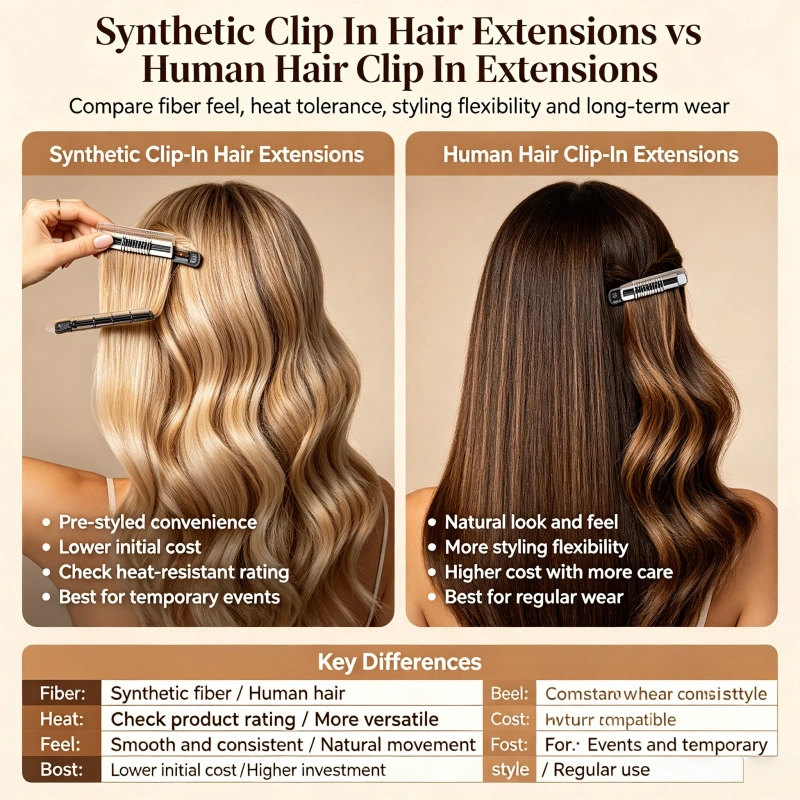
ALOVEHAIR Clip-In Hair Extensions and Manufacturing Capabilities
ALOVEHAIR is a China-based human hair extension manufacturer and supplier serving salons, stylists, distributors, and private label hair businesses.
Its website lists Clip-In Extensions and Halo Wefts among its product categories, describing them as temporary options that consumers can wear themselves without visiting a salon.
The company describes its general human hair extension range as Luxury Remy human hair with aligned cuticles. Its company information also discusses customization and private label support for professional buyers.
What Can Professional Buyers Discuss?
Depending on the selected product and manufacturing requirements, buyers can discuss:
- Human hair material specifications
- Hair length
- Total set weight
- Hair color and texture
- Number and width of wefts
- Clip quantity and placement
- Weft construction
- Standard or custom packaging
- Private label branding
The public ALOVEHAIR Hair Extensions page identifies Clip-Ins as part of its range, but it does not currently provide a dedicated clip-in product specification table for every model. Buyers should therefore confirm the available SKU, exact clip design, weight, piece layout, MOQ, and price directly with the company.
Explore the ALOVEHAIR Hair Extensions Collection to review its wider product range.
Why Consider a Manufacturer for Private Label Clip-In Extensions?
For businesses planning their own hair extension brand, working with a manufacturer may provide more control over:
Product specifications: Define hair material, weight, length, texture, and weft arrangement.
Brand presentation: Discuss packaging, product cards, logo labels, and retail presentation.
Color development: Build a consistent shade range for your target market.
Repeat production: Use approved reference samples and written specifications to support consistency between orders.
Product range expansion: Clip-ins can complement other extension categories, such as Tape-In Extensions and professional weft products.
You can also review ALOVEHAIR’s China Hair Factory information and About Us page to learn more about its manufacturing and export background.
For businesses developing a broader accessory collection, the company also has a Hair Accessories range.
To discuss product availability, samples, and wholesale specifications, contact the ALOVEHAIR team.
Frequently Asked Questions About Synthetic and Human Hair Clip-In Extensions
Are human hair clip-in extensions better than synthetic clip-ins?
Human hair clip-ins are generally better for natural blending, frequent wear, and heat styling. Synthetic clip-ins are usually more affordable and can be suitable for temporary or preset hairstyles.
The better choice depends on your budget, styling habits, and expected number of uses.
Do synthetic clip-in extensions look fake?
Not all synthetic extensions look fake. Appearance depends on fiber quality, surface finish, color, and texture.
However, some synthetic products have a more uniform shine or feel than human hair, which can make them harder to blend naturally.
Can you use a curling iron on synthetic clip-in extensions?
Only if the manufacturer specifically identifies the fiber as heat-resistant and provides a permitted temperature.
Ordinary synthetic fibers may melt or become permanently damaged when exposed to high heat.
Can you dye human hair clip-in extensions?
Some human hair clip-ins can be professionally toned or darkened. However, the result depends on the hair’s processing history and condition.
Lightening and bleaching are risky and should not be assumed to be suitable for every product.
Can synthetic clip-in extensions be dyed?
No. Conventional hair dye is not suitable for synthetic fibers. Purchase the intended shade or ask the manufacturer about custom color options before ordering.
How long do synthetic clip-in extensions last?
Some supplier guides estimate approximately 4–8 weeks with regular wear, while others give a broader range of one to three months.
Occasional use may extend their calendar lifespan. Actual wear depends on fiber quality, brushing, washing, storage, and friction.
How long do human hair clip-in extensions last?
Human hair clip-ins may remain usable for six months or longer with suitable care. Some premium product lines provide longer estimates.
However, the number of wears, washing frequency, heat styling, processing, and storage determine actual lifespan.
Are clip-in extensions suitable for fine hair?
They may be suitable if the total weight and clip arrangement are appropriate for the natural hair.
Fine hair users should avoid heavy sets and clips that concentrate too much weight in small sections. A professional can help assess the suitable weight and placement.
How many grams of clip-in extensions do I need?
Published product guides commonly use approximately 100–120g for lighter or fine-hair applications, 120–160g for medium-density hair, and 180–220g or more for thicker hair.
These are broad reference ranges. Length, natural density, weft distribution, and desired volume also matter.
Can I sleep with clip-in extensions?
It is generally better to remove clip-ins before sleeping. Keeping them attached overnight can increase friction, pulling, and tangling.
Removing them also makes it easier to store and maintain the set properly.
Are human hair clip-ins heavier than synthetic clip-ins?
Not necessarily. Weight depends on total hair quantity, length, construction, weft size, and clip hardware.
Always compare the net hair weight and finished-set weight rather than assuming one material is automatically heavier.
Do human hair clip-ins require more maintenance?
Generally, yes. Human hair needs regular brushing, occasional washing, conditioning, and careful heat styling.
Synthetic clip-ins may require less conventional styling, but they still need suitable brushing, cleaning, and storage.
Can salons buy custom clip-in hair extensions directly from manufacturers?
Many manufacturers offer customization and private label services for professional buyers.
Before ordering, confirm hair material, total weight, piece layout, clip type, colors, packaging, MOQ, and production lead time.
Does ALOVEHAIR offer Clip-In Extensions?
ALOVEHAIR lists Clip-In Extensions as part of its hair extension product range and describes its wider offering as Remy human hair extensions. Contact the company to confirm the current clip-in models, exact specifications, and wholesale terms.
Final Verdict: Synthetic Clip-Ins or Human Hair Clip-Ins?
Synthetic and human hair clip-in extensions serve different needs.
Choose synthetic clip-ins when:
- Your budget is limited.
- You need extensions for occasional use.
- You prefer a preset curl or wave pattern.
- You want a temporary fashion or event hairstyle.
- You do not need frequent heat styling or color changes.
Choose human hair clip-ins when:
- You want a more natural look and movement.
- You plan to wear extensions frequently.
- You want more freedom to curl and straighten.
- You need a closer match with your natural hair.
- You value repeated use and long-term flexibility.
The most important lesson is that material is only one part of product quality. Weight, length, weft construction, clip security, color matching, and proper maintenance also determine the wearing experience.
For consumers, choose the lightest set that provides enough coverage and blends with your natural hair. For salon owners and private label brands, request samples, inspect clip construction, verify the material specifications, and compare the total cost per expected wear.
ALOVEHAIR supplies human hair extension products for professional and wholesale buyers and lists Clip-In Extensions among its product categories.
Explore the ALOVEHAIR Hair Extensions Collection or contact the manufacturing team to discuss clip-in product specifications, samples, and private label requirements.

Alove Hair is a professional Chinese manufacturer of premium 100% Remy human hair extensions, wigs, and hair systems. Established in 2014, the company specializes in supplying global salons and distributors with high-quality, cuticle-intact hair products and offers comprehensive OEM/ODM private label services.


