Posts

Halo Hair Extensions vs Clip Ins: Which One Is Better for You?

Choosing between halo hair extensions vs clip ins usually comes down to one question: do you want the fastest and simplest way to add length and volume, or do you want greater control over where the hair is placed?

Both halo and clip-in extensions are temporary hair extension methods. They can be removed after wearing and do not require the long-term salon maintenance associated with tape-ins, keratin bonds, or sewn-in extensions. However, their attachment systems are very different.

A halo extension normally uses one main weft attached to an adjustable wire that sits around the crown and is hidden underneath the client’s natural hair. Clip-in extensions use multiple wefts with small clips that attach directly to sections of natural hair. Current product guides commonly report halo application times of roughly 1–5 minutes, while clip-ins generally take around 5–20 minutes, depending on experience and the number of pieces.

So which one should you choose?

Halo extensions are usually better for fast application, simple volume, and clients who prefer fewer attachment points. Clip-ins are generally better for customized placement, targeted volume, shorter hair, and more elaborate hairstyles.

Site Navigation

  1. Halo Hair Extensions vs Clip-Ins: Quick Comparison
  2. What Are Halo Hair Extensions?
  3. What Are Clip-In Hair Extensions?
  4. Halo Hair Extensions vs Clip-Ins: Application Time
  5. Halo Hair Extensions vs Clip-Ins: Which Is More Comfortable?
  6. Halo vs Clip-Ins for Thin and Fine Hair
  7. Halo vs Clip-Ins for Volume
  8. Which Is Better for Adding Hair Length?
  9. Halo Hair Extensions vs Clip-Ins for Styling
  10. Which Looks More Natural?
  11. How Long Do Halo Hair Extensions and Clip-Ins Last?
  12. Maintenance and Daily Care
  13. Can You Wear Halo or Clip-In Extensions Every Day?
  14. Which Is Better for Special Events?
  15. Halo vs Clip-Ins: Cost and Value
  16. Which Is Better for a Hair Extension Business?
  17. What Should Wholesale Buyers Look for?
  18. Alove Hair: Halo and Clip-In Hair Extensions Manufacturer
  19. Final Verdict: Halo or Clip-Ins—Which Is Better?

Halo Hair Extensions vs Clip Ins: Quick Comparison

Before looking at each factor in detail, here is the basic difference:

Feature Halo Hair Extensions Clip-In Hair Extensions
Attachment Adjustable wire + one main weft Multiple clips + separate wefts
Typical application About 1–5 minutes About 5–20 minutes
Number of pieces Usually 1 main piece Commonly 4–10 pieces
Placement control Limited High
Daily removal Very easy Very easy
Heat required No No
Glue required No No
Best for Quick length and volume Customized styling
Fine hair Often a good option Can work with lightweight pieces
Thick hair May require higher-density hair Usually highly adaptable
Updos More limited More flexible
Side volume Limited Excellent
Maintenance Low Low
Typical lifespan About 6–12+ months with good care About 6–12+ months with good care

The exact lifespan and application time vary by hair quality, product construction, frequency of use, and maintenance. Current manufacturer and industry guides report similar ranges for temporary halo and clip-in systems.

What Are Halo Hair Extensions?

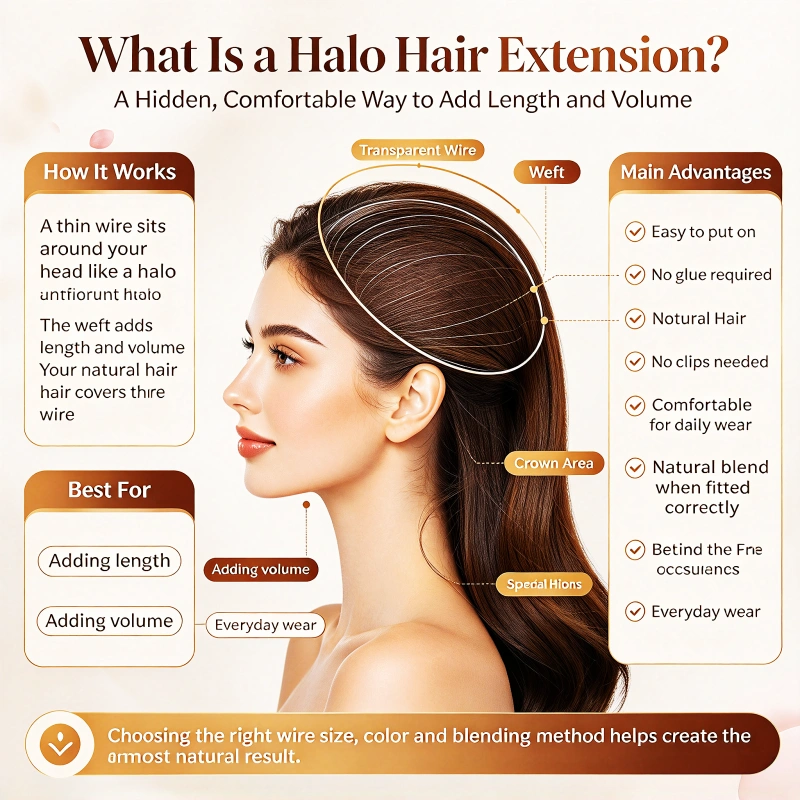
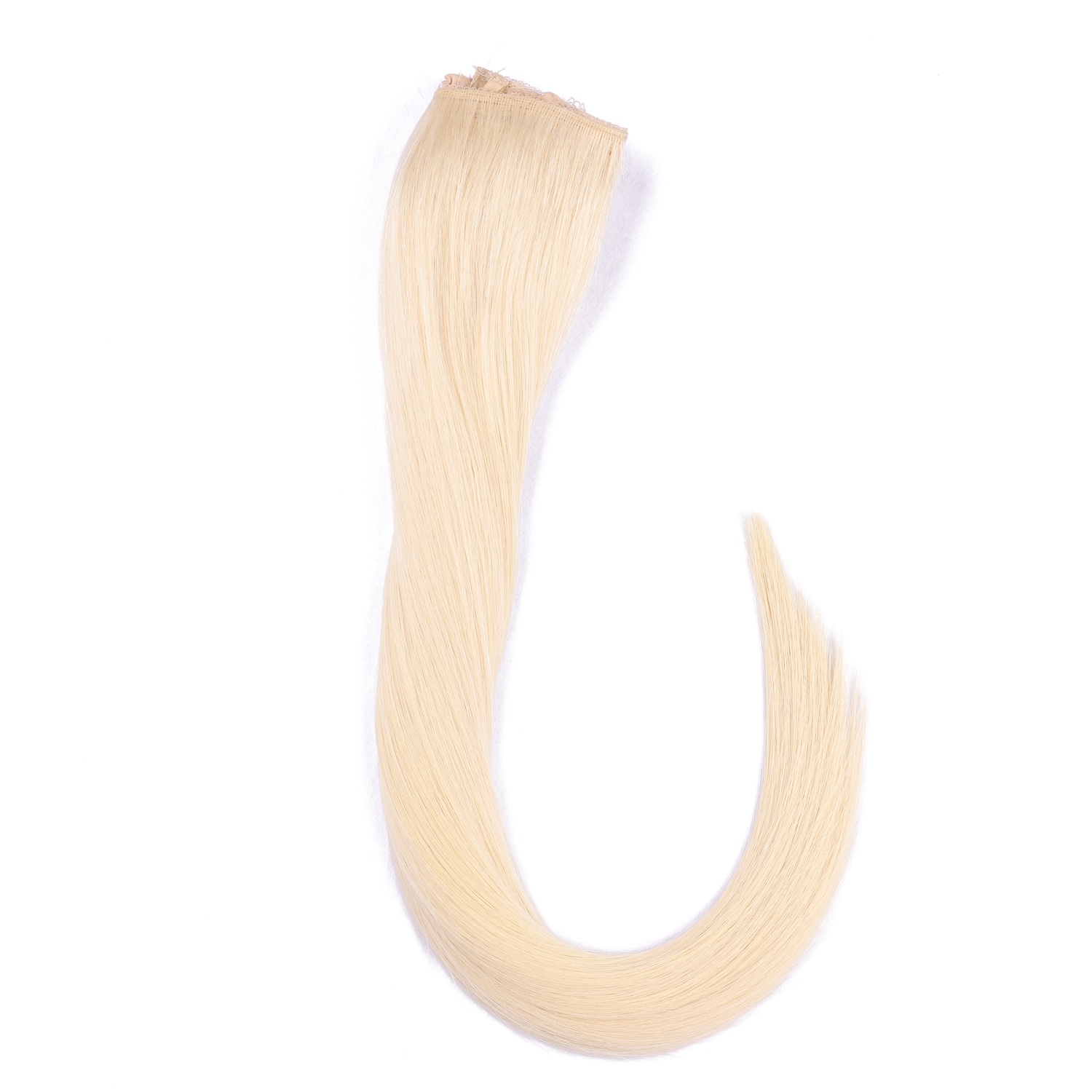
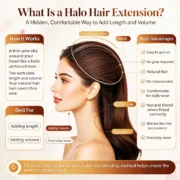
Halo hair extensions are generally made from a single hair weft connected to a thin, adjustable wire.

The wire sits around the crown of the head, and the client’s natural hair is pulled over it to conceal the attachment.

Unlike clip-ins, halo extensions usually have no clips gripping multiple sections of natural hair.

The basic structure is:

Natural hair → adjustable wire → extension weft → natural hair blended over the top

This makes the halo one of the simplest temporary extension systems available.

Some commercial halo products use approximately 80–120g of hair in standard lengths, although heavier designs can be considerably more. For example, one current specification lists 80g at 12 inches, 100g at 16–18 inches, and 120g at 20 inches.

Other manufacturers offer heavier halo systems around 140g, with additional side pieces bringing the total set weight to approximately 180g.

This shows why buyers should not compare halo extensions by the word “halo” alone. Hair weight, density, length, and construction all affect the final result.

What Are Clip-In Hair Extensions?

Clip-in extensions consist of several individual wefts fitted with small pressure-sensitive clips.

Instead of placing one large extension around the crown, the stylist or user sections the natural hair and attaches individual pieces at different locations.

A typical set may contain around 4–10 pieces, depending on the manufacturer and intended application.

The main advantage is placement flexibility.

You can put:

  • Wider pieces at the back
  • Smaller pieces around the sides
  • Narrow pieces near the face
  • Additional wefts where volume is needed
  • Fewer pieces for a lighter look

This makes clip-ins particularly useful when the client wants to customize the shape of the finished hairstyle.

Halo Hair Extensions vs Clip-Ins: Application Time

Application time is one of the biggest differences.

Halo Extensions

You can usually position a halo, cover it with natural hair, and blend it in a few minutes.

Some manufacturers advertise application times of about 60 seconds, while other professional guides suggest 1–5 minutes, depending on the design and blending required.

The process is generally:

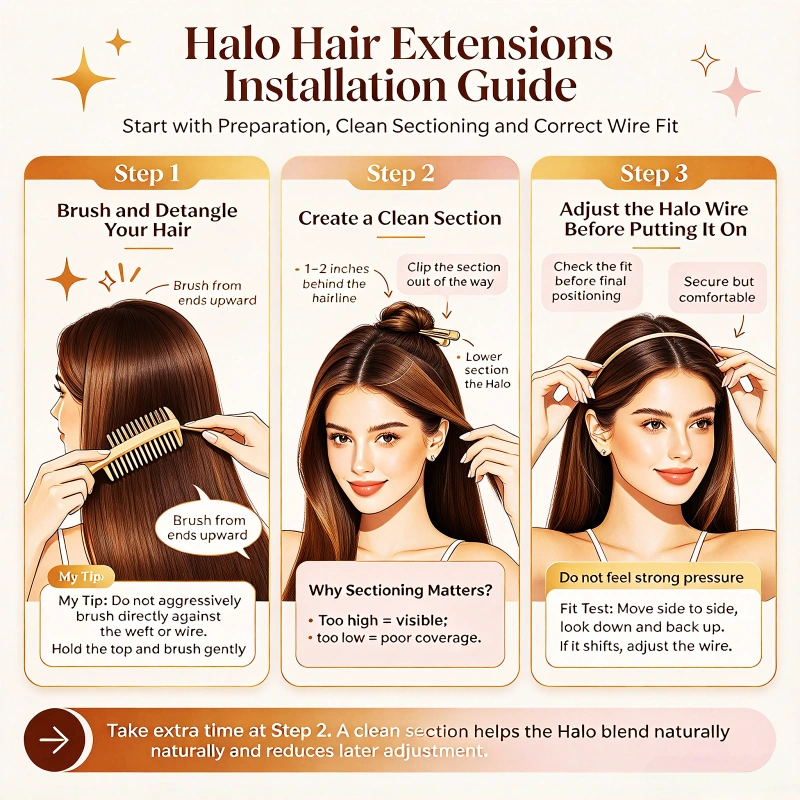
  1. Section the top layer.
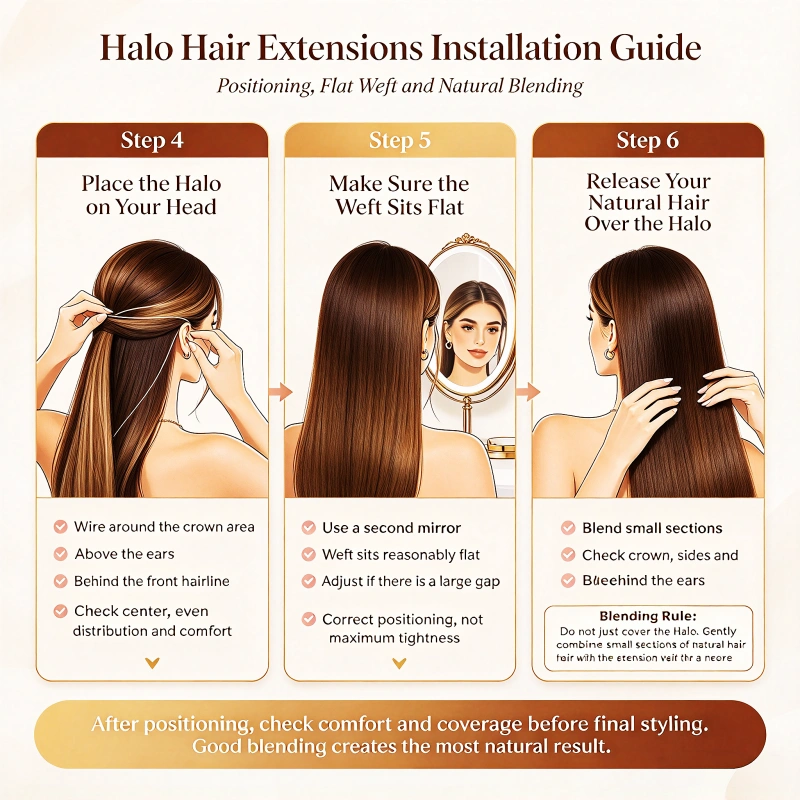
  2. Position the wire around the crown.
  3. Adjust the wire.
  4. Release the natural hair.
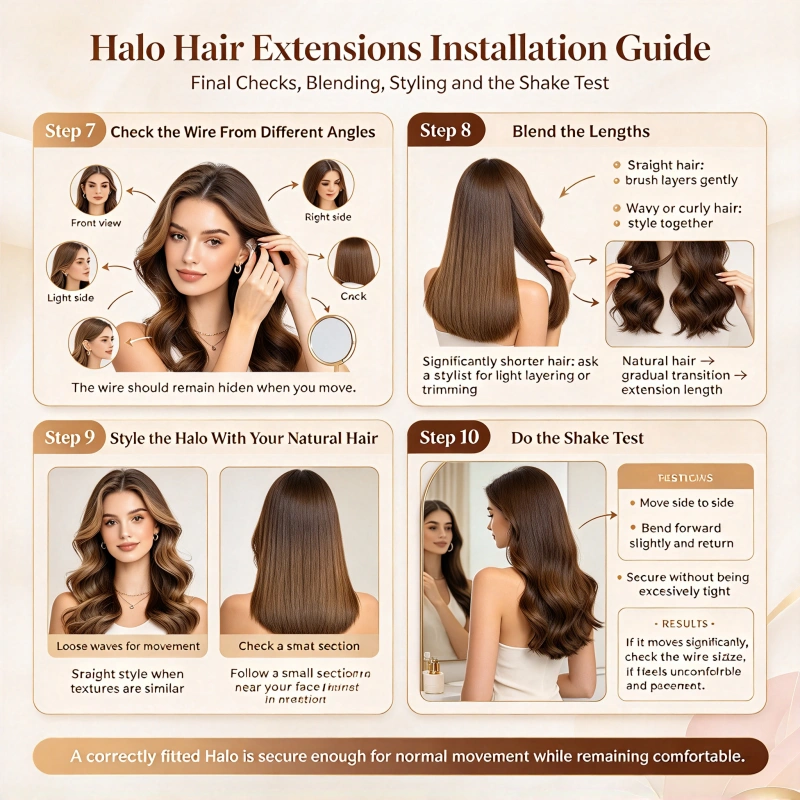
  5. Blend the extension.
  6. Style if necessary.

Clip-In Extensions

Clip-ins require more sectioning.

The user needs to:

  1. Divide the natural hair.
  2. Open the clips.
  3. Position each weft.
  4. Secure the clips.
  5. Release the next section.
  6. Repeat.
  7. Blend the final hairstyle.

Depending on the number of pieces, 5–20 minutes is a reasonable practical range for many users.

Winner: Halo

If speed is the priority, halo extensions clearly have the advantage.

Halo Hair Extensions vs Clip-Ins: Which Is More Comfortable?

Comfort is more complicated than simply asking which product is lighter.

Halo

The halo wire distributes the extension around the crown rather than attaching multiple clips to individual sections.

This can be attractive to clients who dislike the feeling of clips pulling on their hair.

Clip-Ins

Clip-ins place the attachment force at several individual points.

If the clips are too tight, too heavy, or installed on weak sections of hair, they can become uncomfortable.

This is particularly important for fine or fragile hair.

However, a properly fitted lightweight clip-in set can still be comfortable for many users.

Winner: Halo for Simplicity

For clients who prioritize minimal attachment points, halo generally has the advantage.

Which Is Better for Thin or Fine Hair?

This is one of the most important questions behind the search.

The answer is usually halo for very fine hair, but it depends on density and total weight.

A halo does not use multiple clips gripping sections of hair. That can make it appealing to clients with fine or fragile hair. Current comparison guides frequently position halo as a good option for fine or thinning hair, while noting that clip-ins can also work when the weight and placement are appropriate.

However, fine hair and thin hair are not exactly the same.

Fine hair means the individual strands have a smaller diameter.

Thin hair generally refers to lower overall hair density.

A person may have fine strands but plenty of hair. Another person may have relatively thick strands but very low density.

For either system, excessive weight can create problems.

A useful rule for buyers is:

Choose the extension weight according to natural hair density, not simply the desired length.

For Fine Hair

A lightweight halo around 80–120g may suit some clients, depending on natural density and desired result. Current commercial specifications for standard halo products commonly fall within this range.

For Thick Hair

A heavier halo or multiple clip-in wefts may blend better.

Clip-ins have an advantage because you can distribute additional pieces across more sections.

Halo vs Clip-Ins for Volume

If the goal is simply:

“I want my hair to look fuller.”

Halo can be an excellent choice.

The main weft creates broad volume across the back of the head.

But if the client says:

“I need more hair specifically around my sides and face.”

Clip-ins usually provide more control.

You can add smaller pieces exactly where you need more density.

Winner: Depends on the Type of Volume

Overall volume: Halo

Targeted volume: Clip-ins

Halo Hair Extensions vs Clip-Ins for Length

Both methods can add significant length.

However, the final result depends heavily on the relationship between extension length and natural hair length.

For example, a 20-inch extension may look very natural on shoulder-length hair when properly blended, but the same length can look less seamless on very short layered hair.

Halo extensions can provide a fast transformation because the main weft adds a large amount of hair at once.

Clip-ins offer more flexibility because the stylist can distribute different widths of hair throughout the head.

Winner: Tie

Choose halo for a quick overall transformation.

Choose clip-ins when you need more control over the blend.

Halo Hair Extensions vs Clip Ins for Styling

This is where clip-ins usually win.

Halo Styling

Halo extensions work especially well with:

  • Loose waves
  • Straight styles
  • Down hairstyles
  • Low ponytails
  • Soft half-up styles
  • Everyday volume

The limitation is the fixed position of the main weft.

Clip-In Styling

Because individual wefts can be placed around the head, clip-ins are more flexible for:

  • High ponytails
  • Braids
  • Updos
  • Side volume
  • Face-framing
  • Layered hairstyles
  • Special-event styling

Current comparison guides consistently identify clip-ins as more customizable for updos and targeted placement, while halo extensions are more suited to simple, natural-looking styles.

Winner: Clip-Ins

If styling flexibility is your priority, clip-ins are the better choice.

Halo Hair Extensions vs Clip-Ins: Which Looks More Natural?

Both can look natural when properly matched.

The biggest factors are not simply the attachment method.

They include:

  • Hair quality
  • Color matching
  • Density
  • Length
  • Texture
  • Weight
  • Blending
  • Installation technique

A high-quality 100% human hair extension can generally provide a more natural appearance than low-quality synthetic hair.

For halo extensions, the main challenge is hiding the wire and creating a smooth transition between the natural hair and the single weft.

For clip-ins, the main challenge is hiding multiple clips and blending individual wefts.

Natural Appearance Winner: Tie

Product quality and blending technique matter more than the attachment system’s name.

Halo Hair Extensions vs Clip-Ins: Which Lasts Longer?

Both are temporary systems, so their lifespan depends heavily on how often you wear them.

Current sources give a broad range of about 6–12 months for good-quality halo and clip-in extensions, with some high-quality human hair products potentially lasting 12–18 months or longer when worn less frequently and maintained carefully.

One current comparison gives:

Hair Quality Halo Clip-In
Standard Remy About 4–8 months About 6–12 months
Full cuticle hair About 9–12+ months About 12–18+ months

These are reference ranges rather than guarantees.

Clip-ins may last longer because the hair is distributed across multiple wefts and the pieces can be removed after use.

But a halo can also last a year or longer when made from quality human hair and stored properly. Some current product specifications list 6–12 months as a typical halo lifespan.

Winner: Slight Advantage to Clip-Ins

For frequent users, clip-ins may offer a longer useful lifespan in some product designs.

For occasional users, either method can last well beyond a year with good care.

Halo Hair Extensions vs Clip-Ins: Which Requires Less Maintenance?

Both are relatively low-maintenance compared with semi-permanent extensions.

Neither requires:

  • Weekly salon appointments
  • Adhesive removal
  • Tape replacement
  • Keratin re-bonding

The main maintenance routine is:

Wear → Remove → Brush → Clean when necessary → Dry → Store

The difference is that clip-in users need to keep track of multiple pieces, while halo users mainly need to manage one primary piece.

Winner: Halo

The single-piece design makes the daily routine particularly simple.

Halo vs Clip Ins: Which Is Better for Daily Wear?

Both can be worn regularly, but the better choice depends on the client’s lifestyle.

Choose Halo if:

  • You want fast application.
  • You want one main piece.
  • You dislike clips.
  • You want simple volume.
  • You have fine-to-medium hair.
  • You want to remove the extension every evening.

Choose Clip-Ins if:

  • You want customized placement.
  • You need side volume.
  • You frequently change hairstyles.
  • You want more control over length and volume.
  • You have medium-to-thick hair.
  • You enjoy styling your hair.

For daily use, neither system is completely risk-free. Repeated tension, excessive weight, or poor placement can stress natural hair.

Halo Hair Extensions vs Clip-Ins for Special Events

For weddings, parties, photography, and other special events, clip-ins often have an advantage.

Why?

Stylists can position individual wefts to match the hairstyle.

For example:

Wedding updo → Clip-ins

Loose bridal waves → Halo or Clip-ins

Quick dinner hairstyle → Halo

High ponytail → Clip-ins

Extra side volume → Clip-ins

If the hairstyle exposes the crown or requires significant manipulation, clip-ins generally provide greater placement control.

Halo vs Clip-ins: Cost and Value

Prices vary considerably depending on:

  • Hair origin
  • Human hair quality
  • Hair length
  • Hair weight
  • Brand
  • Packaging
  • Customization
  • Retail vs wholesale pricing

Current retail examples show clip-in sets and halo extensions can overlap considerably in price. One current comparison lists clip-ins at about $155–$424 and halo extensions at $190–$255, while another retailer lists halo products at different prices depending on length and construction.

For B2B buyers, factory cost per gram is more useful than retail prices.

A better purchasing formula is:

Product cost ÷ total hair weight = approximate cost per gram

For example, if a 120g product costs $120, the simple product cost is $1.00 per gram.

This lets buyers compare products more accurately than package prices alone.

Which Is Better for a Hair Extension Business?

For salons, wholesalers, and private-label brands, the answer may actually be:

Offer both.

Halo and clip-in extensions target different customers.

Halo Customer

Usually wants:

  • Easy application
  • Quick transformation
  • Low commitment
  • Simple volume
  • Beginner-friendly product

Clip-In Customer

Usually wants:

  • More styling options
  • Custom placement
  • Different volume levels
  • Multiple colors
  • Event styling
  • More control over the finished look

A brand offering both products can capture a broader temporary-extension market.

What Should Wholesale Buyers Look for?

If you are buying halo or clip-in extensions in bulk, don’t evaluate the products based only on product photographs.

Request samples and check:

Hair Quality

Is it 100% human hair?

Is the texture consistent?

Does it shed excessively?

Does it tangle after washing?

Hair Weight

Check the actual gram weight.

For halo products, current commercial examples commonly range from around 80g to 140g+, with heavier systems available.

Hair Length

Confirm whether the quoted length is measured when the hair is straight or naturally textured.

Construction

For halo:

  • Wire strength
  • Adjustability
  • Weft density
  • Optional clips
  • Weft width

For clip-ins:

  • Clip quality
  • Number of pieces
  • Weft width
  • Stitching
  • Clip attachment

Color Range

A serious B2B supplier should offer multiple colors, including:

  • Natural black
  • Brown
  • Blonde
  • Red
  • Balayage
  • Ombre
  • Highlighted colors
  • Custom colors

OEM/ODM

Private-label brands may also need:

  • Custom labels
  • Custom packaging
  • Custom colors
  • Custom lengths
  • Custom weights
  • Logo printing
  • Product inserts

This is where working directly with a manufacturer can provide more flexibility than purchasing standard retail products.

Alove Hair: Halo and Clip-In Hair Extensions Manufacturer

Alove Hair is a professional human hair extension manufacturer and wholesale supplier in China, serving salons, wholesalers, distributors, and private-label hair brands worldwide.

For buyers comparing halo hair extensions vs. clip-ins, the right product depends on the target market.

A brand targeting first-time extension users may prioritize lightweight halo systems with simple application.

A salon-focused brand may prefer clip-in collections with multiple weft sizes and customizable placement.

Alove Hair can support B2B product development around:

  • Hair lengths
  • Hair weights
  • Hair colors
  • Hair textures
  • Halo wire systems
  • Clip-in wefts
  • Packaging
  • Private labels
  • OEM/ODM specifications

Before a bulk purchase, buyers should test samples for:

Test What to Check
Hair Quality Softness, shedding, tangling
Weight Actual grams
Length Actual finished length
Color Consistency and accuracy
Halo Wire Strength and adjustability
Clip Grip and durability
Weft Density and stitching
Styling Curling and straightening performance
Washing Hair condition after washing
Packaging Protection during shipping

For a private-label brand, the best supplier is not necessarily the one with the lowest unit price. Consistency between the sample and repeat bulk orders is often more important.

Frequently Asked Questions

Is halo better than clip-in hair extensions?

Halo is better for fast application, simple volume, and clients who prefer fewer attachment points. Clip-ins are better for customized placement, side volume, and complex hairstyles.

Are halo extensions easier to put on than clip-ins?

Yes. A halo is generally faster because it uses one main piece. Current guides commonly estimate about 1–5 minutes for halo application compared with approximately 5–20 minutes for clip-ins.

Are halo extensions better for thin hair?

They can be. Halo extensions do not use multiple clips attached directly to individual sections of hair, which can make them attractive for fine hair. However, total weight still needs to be appropriate.

Do clip-ins damage hair more than halo extensions?

Not necessarily. Both can be worn safely when properly fitted and removed. However, repeated tension from clips or excessive extension weight can stress natural hair.

Which lasts longer, halo or clip-in extensions?

Both can last approximately 6–12 months or longer with proper care. Some high-quality human hair systems can last 12–18 months or more depending on how often they are worn.

Can you sleep with halo or clip-in extensions?

Both halo and clip-in extensions are generally designed to be removed before sleeping. Removing them reduces friction and unnecessary stress and makes it easier to store the hair properly.

Which is better for a high ponytail?

Clip-ins generally provide greater flexibility for high ponytails because individual pieces can be positioned around the head. Halo extensions can be more limited because the main weft and wire are relatively fixed.

Which is better for beginners?

Halo extensions are generally easier for first-time users because you can position the main piece quickly. Clip-ins are also beginner-friendly but require more sectioning and blending.

Can halo and clip-in extensions be curled or straightened?

If they are made from suitable human hair, they can generally be heat-styled. However, frequent high-temperature styling can shorten the lifespan of the hair, so heat protection and moderate temperatures are recommended.

Can I buy halo and clip-in extensions wholesale?

Yes. Professional hair extension manufacturers can provide halo and clip-in systems for salons, distributors, wholesalers, and private-label brands. Buyers should request samples and confirm hair quality, weight, MOQ, packaging, and customization before placing a bulk order.

Final Verdict: Halo Hair Extensions vs Clip Ins

There is no universal winner in the halo hair extensions vs clip-ins comparison.

The better choice depends on what the customer values most.

Choose Halo Hair Extensions if you want:

  • Fast application
  • Simple daily use
  • Fewer attachment points
  • Easy removal
  • Natural everyday volume
  • A beginner-friendly product
  • A good option for many fine-to-medium hair types

Choose Clip-In Extensions if you want:

  • Maximum placement control
  • Targeted volume
  • More styling flexibility
  • Better support for elaborate hairstyles
  • Side and face-framing volume
  • More customization

In simple terms:

Halo wins on speed and simplicity. Clip-ins win on flexibility and customization.

For hair extension brands and wholesale buyers, however, you don’t need to choose only one. Halo extensions and clip-ins solve different customer problems and can complement each other within the same product range.

The most important factors remain human hair quality, appropriate weight, accurate color matching, durable construction, and consistent manufacturing. A well-made extension that matches the customer’s hair and lifestyle will usually outperform a product chosen simply because one attachment method is considered universally “better.”

For manufacturers such as Alove Hair, offering both halo and clip-in human hair extensions also creates an opportunity to serve different customer segments—from first-time buyers looking for a 2-minute transformation to professional stylists who need complete control over placement and styling.

Halo Hair Extensions Pros and Cons: The Complete Guide

Halo hair extensions are revolutionizing the beauty industry by offering a simple, non-damaging way to achieve longer, fuller hair in minutes. Whether you’re preparing for a wedding, special event, photoshoot, or simply want everyday volume, halo extensions provide an easy solution without the commitment of permanent hair extensions.

This comprehensive guide explores the pros and cons of halo hair extensions, how they compare to other extension types, and how to choose the right halo extensions for your hair type.

What Are Halo Hair Extensions?

Halo hair extensions consist of a single weft of hair attached to a transparent, invisible wire. The wire sits around the crown of your head like a halo, while your natural hair covers the wire completely.

Unlike tape-in, sew-in, fusion, or clip-in extensions, halo extensions do not require adhesives, heat, chemicals, or professional installation.

Basic Structure of Halo Hair Extensions

Component Description
Invisible Wire Transparent nylon wire
Hair Weft Human hair or synthetic hair
Adjustable Fasteners Allow customized fitting
Optional Clips Added security for active users

The entire installation process usually takes less than five minutes.

Main Advantages of Halo Hair Extensions

1. No Damage to Natural Hair

One of the biggest benefits of halo hair extensions is that they cause virtually no damage.

Traditional extension methods often involve:

  • Adhesives
  • Heat application
  • Sewing techniques
  • Tight tension on roots

Over time, these methods may cause:

  • Hair breakage
  • Traction alopecia
  • Scalp irritation
  • Thinning edges

Halo extensions avoid all of these issues because the weight is distributed evenly around the head.

2. Extremely Easy Installation

Many users can install halo extensions within 2 to 3 minutes.

The process includes:

  1. Place the halo wire on your crown.
  2. Pull natural hair over the wire.
  3. Blend using a brush or tail comb.
  4. Style as desired.

No salon appointment is necessary.

3. Comfortable for Daily Wear

High-quality halo extensions are lightweight and designed for long-term comfort.

Benefits include:

  • No pulling sensation
  • No scalp stress
  • Reduced headaches
  • Better airflow to scalp

Many users report forgetting they are even wearing extensions.

4. Instant Volume and Length

Halo extensions provide immediate transformation.

Typical results include:

Hair Length Added Length
Shoulder Length +14 to 18 inches
Medium Length +16 to 22 inches
Long Hair +20 to 26 inches

Users can achieve salon-quality results in minutes.

5. Cost Effective

Compared with professional extension systems, halo extensions offer excellent value.

Extension Type Average Cost
Halo Extensions $80–$400
Tape-In Extensions $300–$800
Sew-In Extensions $400–$1,200
Fusion Extensions $800–$2,500

Because halo extensions are reusable, the long-term cost is significantly lower.

6. Perfect for Beginners

Many first-time extension users choose halo extensions because they:

  • Require no professional training
  • Have a low learning curve
  • Can be removed instantly
  • Need minimal maintenance

This makes them ideal for people new to hair extensions.

7. Longer Lifespan

Premium Remy human hair halo extensions can last:

  • 12–18 months with regular use
  • Up to 24 months with excellent care

Proper maintenance includes:

  • Gentle brushing
  • Sulfate-free products
  • Heat protection
  • Proper storage

Disadvantages of Halo Hair Extensions

Although halo extensions offer numerous advantages, they are not perfect for everyone.

1. Not Ideal for Very Short Hair

Halo extensions work best when natural hair is at least shoulder length.

Very short hair may struggle to conceal:

  • The wire
  • The extension seam
  • Transition areas

Hair shorter than 5 inches may require alternative extension methods.

2. Limited Styling Options

Certain hairstyles may expose the wire.

Examples include:

  • High ponytails
  • Tight buns
  • Slick-back styles
  • High updos

For these styles, clip-in or tape-in extensions may provide better results.

3. May Shift During Intense Activity

While halo extensions are secure for everyday use, vigorous activities can cause movement.

Examples:

  • Running
  • Intense gym workouts
  • Competitive sports
  • Swimming

Some users add security clips for extra stability.

4. Less Suitable for Very Fine Hair

Extremely thin hair may not provide enough coverage to hide the halo wire.

In such cases:

  • Multi-layer halos work better
  • Lower-density halos may blend more naturally
  • Professional consultation is recommended

5. Not a Permanent Solution

Halo extensions must be removed daily.

Unlike tape-ins or sew-ins, they cannot remain attached while:

  • Sleeping
  • Showering
  • Exercising intensely

Users seeking 24/7 wear may prefer semi-permanent extension systems.

Halo Hair Extensions vs Other Hair Extension Types

Halo vs Clip-In Extensions

Feature Halo Clip-In
Installation Time 2-5 minutes 10-20 minutes
Hair Damage Minimal Low
Comfort Excellent Moderate
Daily Wear Excellent Good
Weight Distribution Even Concentrated
Beginner Friendly Excellent Good

Winner: Halo Extensions

Halo vs Tape-In Extensions

Feature Halo Tape-In
Salon Required No Yes
Reusable Yes Limited
Maintenance Low Medium
Hair Damage Minimal Moderate
Cost Lower Higher

Winner: Halo Extensions for convenience.

Halo vs Sew-In Extensions

Feature Halo Sew-In
Installation Time Minutes Hours
Tension on Hair None Significant
Comfort Excellent Moderate
Cost Lower Higher

Winner: Halo Extensions for comfort and ease.

Human Hair vs Synthetic Halo Extensions

Human Hair Halo Extensions

Advantages:

  • Natural appearance
  • Heat styling compatible
  • Longer lifespan
  • Better blending

Disadvantages:

  • Higher price
  • Requires maintenance

Synthetic Halo Extensions

Advantages:

  • Budget friendly
  • Color retention
  • Lightweight

Disadvantages:

  • Less natural appearance
  • Limited heat resistance
  • Shorter lifespan

For long-term use, Remy human hair remains the preferred choice.

How to Choose the Best Halo Hair Extensions

Consider Hair Length

Natural Hair Length Recommended Halo Length
Bob Length 14-16 inches
Shoulder Length 16-20 inches
Medium Length 18-22 inches
Long Hair 20-24 inches

Match Hair Color Correctly

Choose extensions that closely match:

  • Root color
  • Mid-shaft color
  • Hair ends

Many manufacturers offer balayage, ombre, and highlighted shades.

Select Proper Hair Density

Hair Type Recommended Weight
Fine Hair 70-100g
Medium Hair 100-140g
Thick Hair 140-220g

Choose Remy Human Hair

High-quality Remy hair provides:

  • Aligned cuticles
  • Reduced tangling
  • Better shine
  • Longer durability

Who Should Buy Halo Hair Extensions?

Halo extensions are ideal for:

Brides

Wedding hairstyles often require additional volume and length.

Busy Professionals

Quick installation saves valuable time.

Hair Extension Beginners

No professional skills required.

Women with Fragile Hair

Avoids tension and damage associated with permanent extensions.

Special Event Users

Perfect for:

  • Parties
  • Photoshoots
  • Graduations
  • Formal events

Who Should Avoid Halo Hair Extensions?

Halo extensions may not be the best option for:

  • Very short hair
  • Extremely thin hair
  • Competitive athletes
  • Users wanting permanent wear

These individuals may benefit from alternative extension systems.

Maintenance Tips for Halo Hair Extensions

To maximize lifespan:

Daily Care

  • Brush gently before and after use
  • Store properly after removal
  • Avoid excessive product buildup

Washing

Wash every 15–20 wears using:

  • Sulfate-free shampoo
  • Moisturizing conditioner
  • Cool water

Heat Styling

Always use:

  • Heat protectant spray
  • Temperatures below 350°F (177°C)

Proper care significantly extends extension lifespan.

Final Verdict: Are Halo Hair Extensions Worth It?

For most users, the answer is yes.

Halo hair extensions offer one of the safest, easiest, and most affordable methods to achieve instant hair transformation. They provide exceptional comfort, require minimal maintenance, and eliminate many of the risks associated with traditional extension methods.

While they may not suit every hair type or lifestyle, their advantages generally outweigh their limitations. If you are looking for temporary volume, additional length, and a damage-free extension solution, halo hair extensions are among the best investments available in today’s hair extension market.

By selecting high-quality Remy human hair extensions, choosing the correct length and density, and following proper maintenance practices, users can enjoy beautiful, natural-looking hair for months or even years.

How to Blend Halo Extensions with Short or Thin Hair (Pro Tips)

“Struggling to make Halo extensions look natural with short or fine hair? You’re not alone! Many women with shorter lengths or thinner strands face the same challenge—how to blend extensions seamlessly without obvious gaps, bulky wefts, or slipping. Unlike longer, thicker hair that easily disguises extension tracks, short or thin hair requires extra care to create that flawless, ‘is-this-even-real?’ look.”

The main obstacle? Concealing the Halo weft (the invisible wire that sits on your head). With short hair, you might lack enough length to cover it completely, risking a visible “ridge.” For thin hair, the natural hair’s fragility can make extensions slip or appear unnaturally dense. Add texture mismatches (like pin-straight extensions on wavy hair), and the struggle gets real.

But here’s the good news: It’s absolutely possible to nail the blend. Whether you’re rocking a bob, growing out a pixie, or dealing with fine strands, this guide reveals dermatologist-approved prep steps, salon-tested styling tricks, and common mistakes to avoid. You’ll learn:

  • How to anchor Halo extensions so they stay put (even on silky-thin hair).
  • Cutting and layering hacks to match your natural hair’s movement.
  • Affordable products (like texturizing sprays and grip headbands) that make all the difference.

“With these pro tips, you’ll achieve a seamless, undetectable look—no matter your hair type!” No more worrying about windy-day mishaps or awkward “hair helmet” moments. Just effortless length and volume, tailored to your hair’s unique needs.

Ready to transform your Halo game? Let’s dive in.

Prep Work: Setting the Stage for Flawless Halo Extensions

The secret to perfectly blended Halo extensions lies in meticulous preparation and smart extension selection. Whether you’re working with short strands or fine, thin hair, taking time to properly prepare will make all the difference in achieving that coveted natural, undetectable look. Let’s dive into the essential prep steps that will transform your extension experience.

Choosing the Right Halo Extensions

Not all hair extensions are created equal—especially when dealing with short or thin hair. The wrong type can leave you with bulky, obvious results or frustrating slippage. Here’s how to pick the perfect match:

For Short Hair:

If your hair falls above your shoulders, standard long extensions (20+ inches) will look unnatural and overwhelm your face. Instead:

  • Opt for shorter lengths (14–18 inches) to maintain proportion.
  • Choose layered styles—these blend better with shorter natural hair and create movement.
  • Consider tape-in or clip-in alternatives if your hair is very short (pixie length), as these offer more precision in placement.

For Thin Hair:

Fine hair requires lightweight solutions that won’t weigh down your natural strands or expose the weft. Look for:

  • Lightweight, thin wefts—bulky tracks will be obvious and uncomfortable.
  • 100% Remy human hair—synthetic hair often looks unnaturally shiny and doesn’t blend well with fine textures.
  • Lighter density—avoid overly thick extensions that create an unnatural contrast with your natural hair.

Color Matching: The Make-or-Break Factor

Even the best extensions will look fake if the color is off. Here’s how to nail the match:

  • Match at the mid-lengths—your roots and ends may vary due to sun exposure or dye, but the mid-shaft is the truest shade.
  • Blend highlights or ombre—if your hair has dimension, opt for extensions with subtle highlights or balayage for a seamless transition.
  • Test in natural light—indoor lighting can distort colors, so always check in sunlight before committing.

Prepping Your Natural Hair

Once you’ve chosen the perfect extensions, it’s time to prep your natural hair for flawless blending. Skipping this step can lead to slippage, visible wefts, or an uneven finish.

Step 1: Wash and Condition (But Skip the Heavy Products)

  • Use a clarifying shampoo to remove buildup, which can make extensions slip.
  • Avoid heavy conditioners near the roots—they can weigh down fine hair and reduce grip.
  • Blow-dry for volume—focus on lifting the roots with a round brush for extra body.

Step 2: Tease for Grip

  • Lightly backcomb the crown area where the Halo wire will sit—this creates a “cushion” for the weft to grip onto.
  • Avoid over-teasing thin hair—gentle teasing is enough; aggressive backcombing can cause breakage.

Step 3: Boost Volume at the Roots

  • Apply a volumizing mousse or spray before styling—this gives fine hair extra body to blend with extensions.
  • Dry shampoo is your friend—a light spritz at the roots adds texture and hold.

Pro Tip: The Silicone Grip Hack

If your hair is super fine or silky, consider using a silicone wig grip band under your Halo extensions. This prevents slipping and keeps everything secure all day.


Final Prep Checklist

Extensions: Short/layered for bobs, lightweight for fine hair.
Color: Perfectly matched (test in sunlight!).
Hair Prep: Clarifying wash, light teasing, root volume boost.

With these steps, your Halo extensions will blend like a dream. Next up: Step-by-step application techniques!

Step-by-Step Blending Techniques for Short & Thin Hair

Achieving a natural blend with Halo extensions requires different approaches for short versus thin hair. Follow these detailed, salon-approved techniques to create seamless, undetectable results every time.

A. For Short Hair: The Art of Disguising the Weft

When working with shorter lengths (chin-length to shoulder-length), the challenge lies in covering the Halo wire without sacrificing volume or creating obvious lines.

  1. Create a “Buffer Layer”
    • Before placing your Halo extension, leave out 1–2 inches of hair at the crown (the area where the wire sits).
    • This reserved section will later be styled over the weft to conceal it completely.
    • Pro tip: Clip the top section up with a jaw clip to keep it separate during application.
  2. Tease the Crown for Maximum Grip
    • Take small horizontal sections at the roots where the Halo will rest.
    • Using a fine-tooth comb, gently backcomb each section to create texture and friction.
    • Avoid over-teasing – you want just enough texture to anchor the wire without causing tangles.
  3. Strategic Bobby Pin Placement
    • Once the Halo is positioned, secure it by sliding 2-3 bobby pins horizontally through the weft and into your teased hair.
    • Insert pins at an upward angle so they grip both the weft and your natural hair.
    • Hide pins by covering them with the reserved “buffer layer” of hair.

Bonus for Bobs: If you have a blunt cut, lightly point-cut the ends of your extensions to mimic your natural haircut.

B. For Thin Hair: Creating Illusion of Density

Fine hair requires special attention to prevent extensions from looking obvious or overwhelming your natural strands.

  1. Modify the Halo Wire for a Snug Fit
    • Use needle-nose pliers to gently flatten the wire’s curve, allowing it to sit closer to your head.
    • This prevents gaps that can expose the weft when hair moves.
    • Important: Wrap the pliers in tissue first to avoid damaging the wire’s coating.
  2. Custom Cutting for Seamless Layers
    • Install the extensions first, then blend by cutting:
    • Focus on face-framing pieces around your cheeks and jawline for the most natural effect.
    1. Separate your natural hair and extensions into vertical sections
    2. Hold both together between your fingers at a 45-degree angle
    3. Snip into the ends to create soft, blended layers
  3. Texture is Your Best Friend
    • Curl or wave both your natural hair and extensions together using a 1-inch barrel iron.
    • Alternate curl directions for lived-in texture.
    • For ultra-fine hair: Try braid waves – braid damp hair overnight for subtle texture that helps camouflage the weft.

Pro Application Tip:
After blending, mist a texturizing spray (like Oribe Dry Texturizing Spray) at the roots and mid-lengths. This creates uniform texture while adding grip – especially helpful for silky hair types.

Troubleshooting Common Issues

Problem: Weft visible at crown?
Fix: Add a crimped root section – just tease and lightly crimp 1-inch vertical sections above the weft.

Problem: Extensions slipping?
Fix: Apply a dot of eyelash glue to the Halo wire’s ends before placing – it dissolves easily with oil-based remover.

Problem: Halo feels tight?
Fix: Gradually bend the wire outward over several days to customize the fit.

Why These Techniques Work

  • Short hair methods focus on optical illusion – using every millimeter of length to disguise the mechanics.
  • Thin hair solutions prioritize weight distribution and texture matching to avoid the “heavy top” effect.
  • All steps are heat-free friendly (except optional curling) to protect delicate strands.

Next Up: Styling hacks to perfect your blend!

Styling Hacks to Enhance Blending: Pro Tricks for Undetectable Extensions

Even with perfectly placed Halo extensions, a few strategic styling tricks can take your look from “pretty good” to “is that really your hair?” These professional techniques help disguise the weft while adding personality to your style.

1. Half-Up Styles: The Ultimate Distraction

  • Ponytails & Buns: A mid-height half-up style lifts hair away from the weft while keeping it covered. For extra security:
    • Tease the crown lightly before gathering
    • Wrap a thin section of hair around the base to conceal the elastic
  • Decorative Clips & Barrettes: Place embellished clips where the Halo wire sits to:
    • Add stylish flair
    • Provide subtle downward pressure that keeps the weft in place

2. Headbands & Scarves: Functional Fashion

  • Wide Headbands (3-4″): The #1 choice for hiding the transition line
    • Fabric headbands with silicone grips work best
    • Position just behind the hairline to cover the wire completely
  • Silk Scarves: Tie in a low knot at the crown to:
    • Conceal the weft
    • Protect hair from friction damage
    • Bonus: Helps blend grown-out roots

3. Root Touch-Up Magic

  • Powder Sprays: Like Boldify or Color Wow, applied at the part to:
    • Camouflage slight color mismatches
    • Fill in sparse areas where skin might peek through
  • Dry Shampoo: Not just for oil – the texture helps blend extension thickness
    • Focus on the “halo zone” where extensions meet natural hair

Pro Tip: Combine these! A headband + half-up ponytail + root spray creates triple insurance against visible wefts while looking intentionally stylish.

Why These Work:
• Distraction theory – eye goes to accessories, not hairline
• Physical coverage – creates literal barriers over trouble spots
• Multi-functional – solves blending while upgrading your style

Perfect For:
✓ Windy days
✓ Special events
✓ Those “I need to look perfect in 5 minutes” moments

Common Mistakes to Avoid With Halo Extensions for Short/Thin Hair

Even with quality extensions, these frequent errors can ruin your seamless look. Here’s how to spot and fix them:

Mistake #1: Placing the Halo Too Far Forward

❌ Problem: Creates unnatural bulk at the hairline and makes the weft visible from the side.
✅ Fix: Position the wire 1.5 inches behind your natural hairline, aligning it with the tops of your ears for balanced distribution.

Mistake #2: Ignoring Texture Matching

❌ Problem: Pin-straight extensions with wavy natural hair creates a stark “helmet effect.”
✅ Fix: Always style extensions with your natural hair using the same tools/techniques. For mismatched textures:

  • Use a flat iron or curling wand on both
  • Apply a texture spray to unify finishes

Mistake #3: Over-Teasing Thin Hair

❌ Problem: Aggressive backcombing weakens already delicate strands, causing breakage.
✅ Fix: Instead of teasing:

  • Use velcro rollers at the crown for lift
  • Try a light-hold texturizing powder at roots
  • Opt for a silicone wig grip instead of relying on friction

Bonus Tip: Never sleep with your Halo in—the pressure against thin hair can cause traction damage over time.

Halo Hair Extensions FAQ: Expert Answers for Short & Thin Hair

Q1: Can you use Halo extensions with pixie-cut hair?

A: Absolutely! While traditional placement can be tricky, try these adaptations:

  • Style in updos (high ponytails or buns) where the weft gets hidden in the gathered hair
  • Use mini clip-ins at the nape to add length before applying the Halo
  • Pro Tip: A textured, piecey style helps disguise any blunt edges

Q2: Do Halo extensions slip with fine hair?

A: They can, but these solutions lock them in place:

  • Silicone wig grip headbands (the #1 slip-stopper)
  • Double-sided wig tape (apply 1″ strips where wire touches temples)
  • Dry shampoo at roots for instant grip (avoid aerosol near the wire)
  • Bonus: Look for Halo brands with adjustable tension wires

Q3: How to make extensions look thicker at the crown?

A: Combat flatness with these tricks:

  1. Double-weft Halos – Two thin layers instead of one thick one
  2. Strategic clip-ins – Place 2-3 clip pieces around the parietal ridge
  3. Backcomb alternatives – Use:
    • Hair fibers (Toppik) at the part
    • Volumizing spray foam before blow-drying

Q4: Can I heat-style my Halo extensions daily?

A: Yes, but protect them:

  • Lower heat settings (max 350°F for human hair)
  • Always use heat protectant (try Olaplex No. 9)
  • Alternative: Opt for heat-free waves like robe tie curls

Q5: How often should I wash Halo extensions?

A: Far less than your natural hair:

  • Every 15-20 wears for optimal longevity
  • Use sulfate-free shampoo focused on mid-lengths to ends
  • Exception: Wash immediately after swimming/sweating

Conclusion: Your Perfect Halo Hair Awaits

Mastering Halo extensions with short or thin hair comes down to three essentials:

  1. Smart Prep – Choose lightweight, properly matched extensions and prep your natural hair with texture and volume
  2. Precision Placement – Position the wire correctly, use grip-enhancing tricks, and customize the fit
  3. Strategic Styling – Employ blending techniques like layers, texture sprays, and accessory camouflage

With these pro methods, you’ll enjoy:
✓ Undetectable length and volume
✓ All-day comfort and security
✓ Confidence in any weather or activity


Professional Halo Extensions Wholesale

As a leading Halo hair extensions manufacturer and wholesaler, we offer:

  • 100% Remy human hair in customizable lengths/colors
  • Ultra-lightweight wefts perfect for fine hair
  • Adjustable wire technology for no-slip wear

Contact us for:
→ Bulk pricing
→ Private label options
→ Style consultations

Email: info@alovehair.com
Website: https://www.alovehair.com/

Transform your hair game with professional-quality extensions – let’s create beauty together!