
Halo Hair Extension Reviews: Are Halo Extensions Really Worth It?
You want to know what halo extensions are actually like after wearing them: Are they comfortable? Do they look natural? Will they stay in place? Can you style them? Are they suitable for fine hair? And most importantly, are halo hair extensions worth buying compared with other types of hair extensions?
The answer depends on the hair quality, the halo’s construction, your natural hair density, and how you plan to wear it.
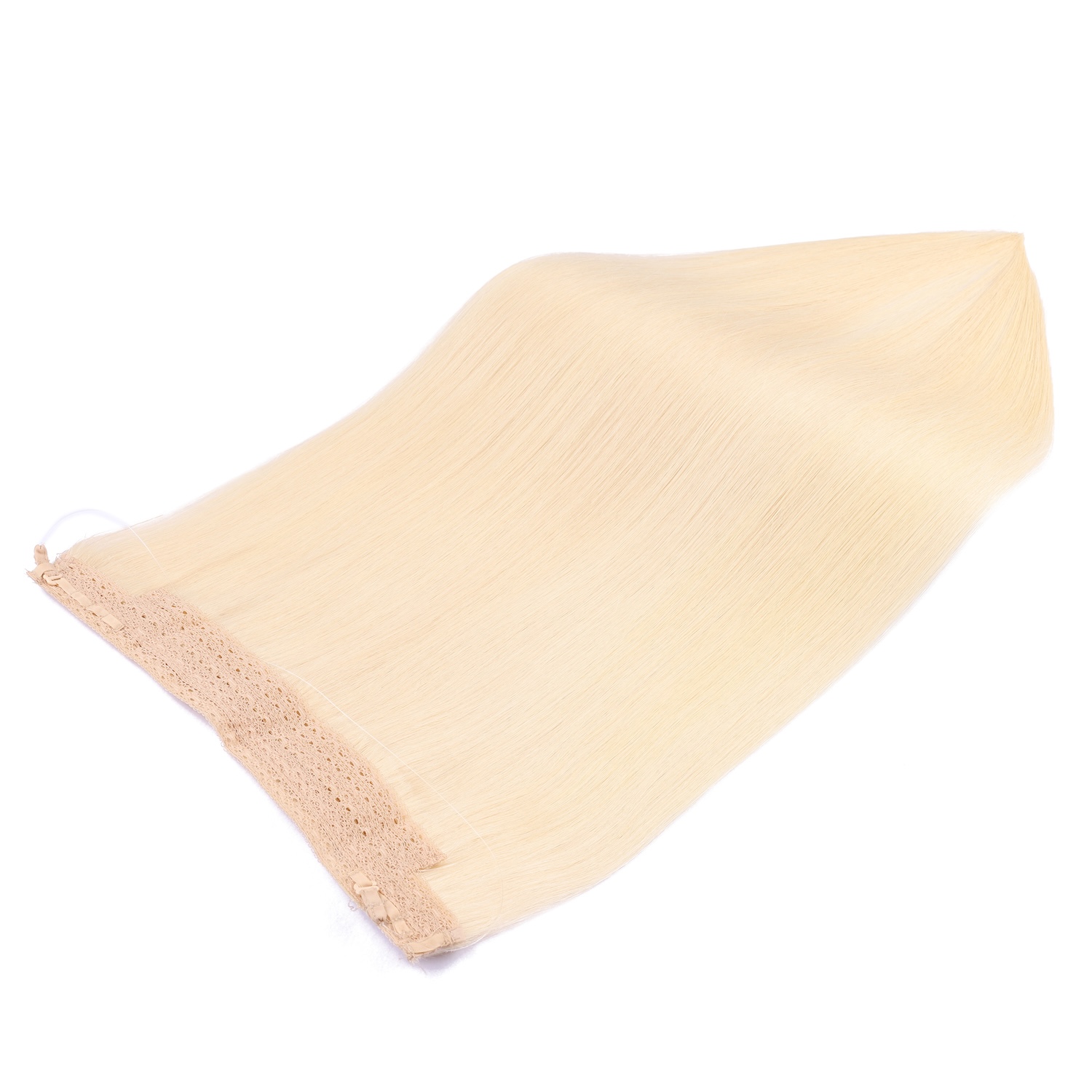
Halo extensions have become popular because they offer a relatively simple way to add length and volume without attaching multiple extension pieces directly to the natural hair. A typical halo consists of a hair weft connected to a thin, adjustable wire. The wire sits around the crown while the user’s natural hair is pulled over the top to hide the attachment.
This guide examines the real advantages and disadvantages of halo hair extensions, what customers tend to like or dislike, and what buyers should check before placing an order.
Table of Contents
1. What Are Halo Hair Extensions?
2. Halo Hair Extensions Reviews: What Do Customers Like?
3. Halo Hair Extension Reviews
4. Halo Hair Extensions Pros and Cons
5. Are Halo Hair Extensions Good for Thin Hair?
6. Human Hair vs Synthetic Halo Hair Extensions
7. Why Do Some Halo Hair Extensions Get Bad Reviews?
8. Are Halo Extensions Better Than Clip-In Extensions?
9. Halo vs Tape-In Hair Extensions
10. How to Choose Good Halo Hair Extensions
11. What Do Real Halo Hair Extension Reviews Tell Us?
12. Who Should Buy Halo Hair Extensions?
13. Are Halo Hair Extensions Worth It?
14. Final Verdict: Halo Hair Extension Reviews
15. How Long Do Halo Hair Extensions Last?
What Are Halo Hair Extensions?
Halo hair extensions are a type of temporary hair extension designed around a simple wire-based construction.
Unlike tape-in extensions, which use adhesive, or many clip-in systems, which attach several pieces directly to sections of natural hair, a halo normally uses one larger weft supported by a transparent or relatively discreet wire.
The basic installation is straightforward:
- Separate the top layer of your natural hair.
- Place the halo wire around the crown.
- Adjust the wire so it sits securely.
- Pull your natural hair over the wire and weft.
- Brush and blend the natural hair with the extension hair.
The result adds length, volume, and fullness without a complicated salon installation.
For beginners, this is one of the biggest reasons halo extensions receive positive reviews.

Halo Hair Extensions Reviews: What Do Customers Like?
Looking across current customer feedback, several themes appear repeatedly.
1. Easy to Put On
Easy installation is probably one of the biggest advantages of halo extensions.
You do not need to attach dozens of individual strands or spend significant time applying adhesive. Once you understand how to position the wire, installation can take only a few minutes.
This makes halo extensions particularly attractive to:
- First-time extension users
- People who want temporary length
- Customers who do not want salon appointments
- Brides and event customers
- People who want extensions for weekends or special occasions
Some recent customer reviews specifically praise halo extensions for being easy to install and comfortable enough for regular use.
Review takeaway
Best feature: Simple installation.
If convenience matters more than permanent wear, halo extensions have a clear advantage.
2. Natural Appearance
A good halo extension should not look like an obvious hairpiece.
The wire sits under the top layer of natural hair, while the extension hair blends with the user’s own hair.
However, the final appearance depends heavily on:
- Hair color matching
- Hair density
- Extension density
- Hair texture
- Length
- Layering
- Quality of the extension hair
Customer reviews frequently mention natural appearance when the color and texture match properly. Some verified buyers report that other people could not immediately tell they were wearing extensions.
That is important because “invisible” is not simply a property of the wire.
The wire may be invisible, but poorly matched hair can still make the extension obvious.

3. Comfort Is a Major Selling Point
Because halo extensions generally do not require multiple adhesive bonds or numerous clips attached throughout the head, some users find them more comfortable than traditional extension systems.
For people who dislike:
- Glue
- Tape
- Heavy clip systems
- Frequent salon maintenance
A halo can be a much simpler alternative.
However, comfort is not universal.
The extension still has weight, and that weight is supported around the crown. If the weft is too dense or heavy for your natural hair, you may experience pressure or discomfort.
Some customer feedback also specifically mentions weight as a potential problem.
Therefore:
Lightweight construction matters just as much as hair quality.
A premium halo should balance:
Hair volume + natural appearance + manageable weight.
4. No Glue or Tape
Another reason customers choose halo extensions is the lack of adhesive.
Traditional tape-in extensions use adhesive strips to connect extension hair to natural hair. Halo extensions generally avoid this process.
That makes them attractive to customers who want to minimize direct attachment to their natural hair.
However, it would be misleading to claim that every halo extension is completely “damage-free.”
Hair can still experience problems from:
- Excessive weight
- Incorrect positioning
- Tight adjustment
- Aggressive brushing
- Poor removal technique
- Excessive heat styling
So a more accurate statement is:
Halo extensions can reduce some of the mechanical and adhesive stresses associated with other extension methods when properly fitted and used.
That is a much more useful conclusion for buyers.

Halo Hair Extension Reviews
1. Sarah Mitchell — Salon Owner
★★★★★ 5/5 | September 2026 | Purchase Verified
We purchased halo hair extensions for our salon’s bridal and special-event clients. The hair feels soft and blends naturally with our clients’ own hair. Color matching was also quite easy, and the wire is simple to adjust. Our stylists especially like that the extensions can be fitted within a few minutes without glue or tape. The quality was consistent across the samples and bulk order, which mattered to us.
2. Emily Carter — Hair Extension Specialist
★★★★★ 5/5 | August 2026 | Purchase Verified
I ordered halo extensions for several clients who wanted extra volume without committing to permanent extensions. Installation was much easier than I expected, and the hair has natural movement after styling. The weft is neat and the wire is not noticeable once the client’s natural hair is brushed over it. We have already received repeat requests for the same style.
3. Jessica Brown — Salon Manager
★★★★☆ 4/5 | August 2026 | Purchase Verified
We bought a small batch of halo hair extensions to test before placing a larger wholesale order. Overall, the quality is very good. The hair is soft, easy to brush and reasonably easy to blend. Color matching is important, so I recommend sending hair color references before ordering. Our customers like the fact that they can put the extensions on and remove them at home.
4. Olivia Wilson — Beauty Store Buyer
★★★★★ 5/5 | July 2026 | Purchase Verified
The halo extensions performed well in our first wholesale order. Packaging was clean and the hair arrived in good condition without excessive tangling. We tested several colors before adding them to our online store. Our customers’ favorite feature is the quick installation. Compared with multi-piece clip-ins, halo extensions are much easier for beginners to understand.
5. Sophia Anderson — Hair Stylist
★★★★☆ 4/5 | July 2026 | Purchase Verified
I mainly work with clients who have fine or medium-density hair, so I always consider weight carefully. The halo extension we tested balanced volume and weight well. It blends nicely when the color is matched correctly. I would recommend choosing the density based on the client’s natural hair instead of simply choosing the thickest option available.
6. Rachel Thompson — Salon Purchasing Manager
★★★★★ 5/5 | June 2026 | Purchase Verified
We were looking for a supplier that could provide consistent halo extensions for salon use, not just individual retail pieces. The communication during sampling was helpful, especially when discussing colors, length and weight. The final products matched our approved samples well. The hair quality suits our clients, and the extensions are easy for our team to demonstrate.
7. Megan Davis — Bridal Hair Stylist
★★★★★ 5/5 | May 2026 | Purchase Verified
Halo extensions have become one of our favorite options for brides who want fuller hair without permanent extensions. They are quick to install and work particularly well for loose curls and down hairstyles. The hair holds a nice shape after styling and looks natural in photographs. We ordered several shades because brides often need very specific color matching.
8. Hannah Moore — Hair Extension Retailer
★★★★☆ 4/5 | April 2026 | Purchase Verified
We tested halo extensions as a new product category in our store. Overall quality was good, especially given how easy the product is to use. Customers liked the removable design and the fact that they don’t need professional installation every time. The main thing we learned is that we need to handle color selection carefully. Once the color is right, the blending is much better.
9. Lauren Taylor — Salon Director
★★★★★ 5/5 | March 2026 | Purchase Verified
Our salon ordered halo hair extensions for clients who wanted instant length and volume for events. The extensions were easy to fit and the hair looked natural after blending. We also appreciated being able to discuss customized requirements before production. The quality across different pieces was consistent, which matters when we recommend a product to paying salon clients.
10. Amanda Harris — Wholesale Hair Buyer
★★★☆☆ 3/5 | February 2026 | Purchase Verified
The halo extensions were generally good for the price. The hair was soft and the wire was easy to adjust, although some clients needed a little practice to position it correctly. The product works best when the density and color match the customer’s natural hair. We would consider ordering again, particularly for customers looking for a simple, temporary hair extension solution.

Halo Hair Extensions Pros and Cons
Before purchasing, it helps to look at the advantages and disadvantages side by side.
| Pros | Cons |
|---|---|
| Easy to install | May feel heavy for some users |
| No glue required | Can move if incorrectly fitted |
| No tape required | Color matching can be difficult |
| Quick transformation | Less suitable for some updos |
| Adds length quickly | Synthetic hair may have styling limitations |
| Adds volume | Very fine hair may struggle to conceal the weft |
| Reusable | Requires proper care |
| Suitable for beginners | Quality varies significantly between suppliers |
| Good for temporary wear | May not provide the same flexibility as permanent extensions |
The key point is that halo extensions are not automatically better than every other extension type.
They solve a specific problem: quick, temporary length and volume with relatively simple installation.

Are Halo Hair Extensions Good for Thin Hair?
This is one of the most important questions behind the search for halo hair extension reviews.
The answer is:
They can be, but you must choose the right construction and weight.
Fine-haired customers often like halo extensions because there are fewer attachment points to hide.
But extremely thin hair can create another problem.
The natural hair needs enough coverage to conceal the wire and extension weft.
If the natural hair is very fine, you may notice:
- The wire
- The edge of the weft
- Differences in density
- Color differences
- Uneven blending
So people with fine hair shouldn’t choose the thickest halo available.
A lighter and more naturally distributed extension can often produce a better result than an extremely dense one.

Human Hair vs Synthetic Halo Hair Extensions
This is another major purchasing decision.
Human Hair Halo Extensions
High-quality human hair generally offers greater styling flexibility.
Depending on the hair quality and manufacturer’s specifications, human hair can typically be:
- Washed
- Blow-dried
- Curled
- Straightened
- Styled with appropriate heat protection
It also tends to blend more naturally with human hair because its movement and texture are more similar to natural hair.
For customers planning to wear a halo frequently, 100% human hair is usually the better long-term choice.
Synthetic Halo Extensions
Synthetic extensions are often cheaper and can be useful for:
- Parties
- Costumes
- Occasional events
- Temporary transformations
- Customers with a limited budget
But heat styling is a major consideration.
Some synthetic fibers cannot safely tolerate conventional hair-styling temperatures. Customer feedback on low-cost synthetic halo extensions often highlights this limitation.
Quick Comparison
| Feature | Human Hair | Synthetic Hair |
|---|---|---|
| Natural appearance | Excellent | Good to fair |
| Heat styling | Usually possible* | Often limited |
| Texture | More natural | Can look less natural |
| Longevity | Generally longer | Generally shorter |
| Price | Higher | Lower |
| Styling flexibility | High | Limited |
| Best for | Regular wear | Occasional wear |
*Always follow the manufacturer’s heat-styling instructions.

Why Do Some Halo Hair Extensions Get Bad Reviews?
Not every negative review means the product itself is poor.
Negative experiences usually fall into several categories.
1. Wrong Color
This is one of the easiest ways to make a good extension look bad.
Even a high-quality extension can look unnatural if the shade is slightly wrong.
Common problems include:
- Too dark
- Too warm
- Too cool
- Incorrect balayage transition
- Wrong root color
Some customers report that their extensions were comfortable and well made but still difficult to blend because the color was not quite right.
Buying tip
Do not choose a color based only on the product name.
Compare the actual shade against your hair, preferably in natural light.
2. The Extension Feels Too Heavy
More hair does not automatically mean better hair.
A very dense halo may look impressive in product photographs but become uncomfortable during extended wear.
For fine or shorter natural hair, excessive weight can also make blending more difficult.
Therefore, buyers should consider:
Length + weight + density
rather than looking at length alone.
3. The Halo Slides
A halo that does not fit correctly may move during the day.
Sliding can be caused by:
- Incorrect wire adjustment
- Very fine or silky hair
- Insufficient natural hair covering the wire
- Excessive extension weight
- Incorrect placement
Correct fitting and styling are therefore part of the product experience.
Are Halo Extensions Better Than Clip-In Extensions?
Not necessarily.
They are designed for different priorities.
| Halo Extensions | Clip-In Extensions |
|---|---|
| One main extension piece | Multiple pieces |
| Fast installation | More sections required |
| Minimal attachment points | Clips attach directly to hair |
| Good for beginners | More styling flexibility |
| Excellent for quick length | Better for customized volume |
| Simple removal | More pieces to remove |
If speed and simplicity are your priority, halo extensions are a great option.
If you want to create highly customized hairstyles with different amounts of volume around the head, clip-ins may offer more flexibility.
Halo vs Tape-In Hair Extensions
Tape-ins suit customers looking for a more semi-permanent extension solution.
Halo extensions are better suited to temporary use.
| Feature | Halo | Tape-In |
|---|---|---|
| Installation | Minutes | Professional/experienced installation |
| Attachment | Wire | Adhesive tape |
| Daily removal | Yes | No |
| Maintenance | Low | Regular maintenance |
| Salon dependency | Low | Higher |
| Temporary use | Excellent | Less convenient |
| Long-term wear | Limited | Better suited |
This distinction is extremely important for search intent.
Someone searching “halo hair extension reviews” is often deciding whether the convenience of a temporary extension outweighs the limitations of a one-piece system.
How to Choose Good Halo Hair Extensions
If you are buying halo extensions online, don’t judge the product by photos alone.
Check these seven factors.
1. Hair Material
Look for clearly stated information:
- 100% human hair
- Remy human hair
- Virgin hair
- Synthetic fiber
Be cautious when a product simply says “real-looking hair” without explaining the material.
2. Hair Density
A thick extension is not necessarily better.
Choose density based on your own natural hair.
3. Wire Quality
The wire should be:
- Thin
- Adjustable
- Strong enough to support the weft
- Comfortable around the head
4. Color Range
More color options make it easier to achieve a natural blend.
For brands and professional suppliers, custom color matching can be a significant advantage.
5. Weft Construction
Look at how the hair is attached to the wire and whether the weft is neatly finished.
6. Styling Instructions
If the extension is human hair, check the recommended heat limit.
If it is synthetic, do not assume that it can tolerate a flat iron simply because it looks like human hair.
7. After-Sales Support
For higher-priced human hair extensions, support matters.
Useful services may include:
- Color matching
- Wire replacement
- Repair
- Product guidance
- Customization
- Warranty
Recent customer reviews for some halo brands specifically mention responsive customer service and repair support as part of the overall buying experience.
What Do Real Halo Hair Extension Reviews Tell Us?
The most useful lesson from customer reviews is that no single halo extension is universally “best halo extension.”
Positive reviews tend to focus on:
- Natural appearance
- Easy installation
- Soft hair
- Good color matching
- Comfortable wear
- Added volume
- Confidence and convenience
Negative reviews tend to focus on:
- Incorrect color
- Excessive weight
- Difficulty blending
- Sliding
- Poor-quality synthetic fibers
- Limited heat styling
- Customer service or delivery issues
For example, current review data for one dedicated halo retailer shows a strong concentration of positive ratings, but also a significant minority of one-star reviews, illustrating why buyers should examine the substance of reviews rather than relying only on an overall star rating.
This matters especially when comparing products from different manufacturers.
Who Should Buy Halo Hair Extensions?
Halo extensions are a good option if you want:
- Instant length
- More volume
- A temporary transformation
- Easy installation
- Minimal commitment
- No glue or tape
- A beginner-friendly extension system
They may be less suitable if you:
- Need permanent extensions
- Frequently wear very high ponytails
- Want complete freedom to part your hair anywhere
- Have extremely fine hair that cannot conceal the weft
- Prefer a very customized multi-piece installation
Are Halo Hair Extensions Worth It?
Yes, for the right customer.
Halo extensions are particularly appealing because they combine speed, convenience and temporary wear.
They are not designed to replace every other type of hair extension.
If you want something that can be put on quickly before work, a date, wedding, photo shoot or event, a halo can be an excellent choice.
If you want extensions that remain installed for weeks and can be worn continuously, tape-ins, hand-tied extensions or other semi-permanent systems may be more appropriate.
The biggest difference between a good and bad halo experience is usually not simply the price.
It is the combination of:
Hair quality + correct color + appropriate density + comfortable wire + proper fitting.
Final Verdict: Halo Hair Extension Reviews
Based on the advantages and recurring customer feedback, halo hair extensions are one of the more accessible options for people who want quick length and volume without a complicated installation process.
Best for:
Beginners: ★★★★★
Quick styling: ★★★★★
Temporary wear: ★★★★★
Natural appearance: ★★★★☆
Comfort: ★★★★☆
Long-term wear: ★★★☆☆
High-styling flexibility: ★★★☆☆
If you are considering buying one, don’t ask only:
“Which halo hair extension has the best reviews?”
A better question is:
“Which halo extension has the right hair quality, weight, density and color for my hair?”
That shift in how you evaluate the product can save you from the most common problems reported in halo extension reviews.
How Long Do Halo Hair Extensions Last?
Halo extensions don’t have a single lifespan. In general, a high-quality human hair halo extension can last around 6–12 months with regular use and potentially 1–2 years or longer with occasional wear and careful maintenance. Synthetic halo extensions usually have a shorter usable life, particularly when exposed to frequent brushing, washing or heat.
It depends on:
- Human vs synthetic hair
- Hair quality
- Frequency of use
- Washing frequency
- Heat styling
- Brushing habits
- Storage
- Product quality
Here is a practical estimate:
| Type of Halo Extension | Occasional Use | Regular Use | Expected Lifespan |
|---|---|---|---|
| Premium human hair | 12–24+ months | 6–12 months | Long |
| Standard human hair | 8–18 months | 4–10 months | Medium-long |
| Synthetic hair | 2–6 months | 1–4 months | Shorter |
| Low-quality synthetic hair | 1–3 months | Often shorter | Short |
These are general estimates rather than guarantees.
A high-quality human hair halo can be reused for a long time with proper maintenance.
For example, recent reviews for one halo brand include customers reporting products remaining in good condition after around two years, while other users report needing repairs or adjustments after extended use.
However, buyers should not take one customer’s experience as a guarantee of lifespan.
A better way to evaluate longevity is to ask the supplier:
What type of hair is used, how is the weft constructed, and what maintenance does the manufacturer recommend?
FAQ About Halo Hair Extensions
Are halo hair extensions good for everyday use?
Yes, high-quality halo extensions can be used regularly, provided the weight, fit and hair quality are appropriate. However, they are still removable extensions, so users should remove them when sleeping and follow the manufacturer’s care instructions.
Do halo extensions damage your hair?
Halo extensions generally avoid adhesive and multiple clip attachment points, which can reduce some types of stress on natural hair. However, excessive weight, tight fitting and rough handling can still cause discomfort or breakage.
Can you sleep with halo hair extensions?
It is generally better to remove temporary halo extensions before sleeping. Removing them reduces friction, tangling and unnecessary stress on the natural hair and extension itself.
Can you curl halo hair extensions?
If the halo is made from suitable human hair, it can generally be curled with appropriate heat protection. Synthetic hair may have strict heat limitations, so always check the manufacturer’s instructions.
How do you stop a halo extension from slipping?
Adjust the wire correctly, position it securely around the crown and make sure enough natural hair covers the wire and weft. The extension should feel secure without being excessively tight.
Are halo extensions good for fine hair?
They can be, especially when you choose a lightweight design. However, extremely fine hair may struggle to conceal a thick weft, so lighter density and a close color match are important.
How long does a halo hair extension last?
The lifespan depends on hair quality, frequency of use and maintenance. High-quality human hair can last significantly longer than low-cost synthetic alternatives when properly cared for.
What is better: halo or clip-in extensions?
Halo extensions are generally easier and faster to install, while clip-ins offer more flexibility for customizing volume and placement. The better option depends on how you plan to style and wear your hair.

Jgs is a professional with 12 years of experience in hair extensions, primarily helping importers better understand hair extensions, wigs, toupee, and other related products.