
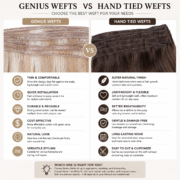
Genius Wefts vs Hand-Tied Wefts
Genius Wefts and Hand-Tied Wefts are two popular types of professional human hair extensions used in beaded-row and sew-in installations. Both are designed to add length and volume while maintaining a natural-looking result. However, their seam construction, cutting flexibility, weight distribution, and installation requirements can be quite different.
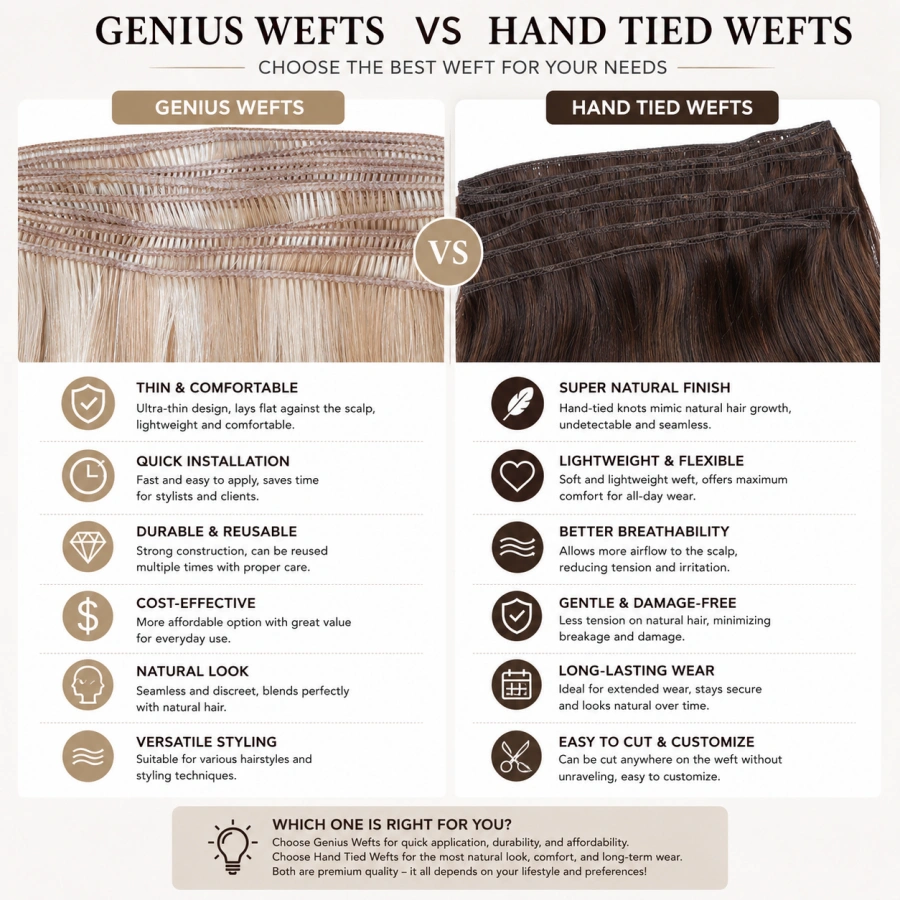
The main difference is that Genius Wefts are generally designed with a thin, customizable seam that may be cut to fit a row, while traditional Hand-Tied Wefts use a hand-tied seam that usually needs to remain intact to prevent unraveling. Genius Wefts offer more flexibility when customizing track width, whereas Hand-Tied Wefts are valued for their fine, lightweight construction.
However, one is not automatically better than the other. A well-made Hand-Tied Weft may be the better choice for a stylist who prioritizes a very fine seam and a particular installation system. A properly constructed Genius Weft may be more practical when precise row customization and cutting flexibility are important.
This guide compares Genius Wefts vs Hand-Tied Wefts by construction, thickness, weight, durability, installation, comfort, maintenance, and wholesale specifications. It also explains how salons and hair extension brands can test products before selecting a long-term manufacturing partner.
Genius Weft vs Hand-Tied Weft: Quick Comparison
Before looking at the details, here is a practical overview of the differences.
| Comparison Factor | Genius Weft | Traditional Hand-Tied Weft |
|---|---|---|
| Construction | Thin manufactured or specially bonded seam; design varies by supplier | Hair individually secured along a hand-tied seam |
| Seam profile | Generally thin and low-profile | Generally fine and flexible |
| Cutting | Many models are designed to be cut; verify manufacturer instructions | Normally should not be cut freely because the tied seam may unravel |
| Return Hair | Often designed with no or reduced return hair | May contain short folded-back or return hair |
| Width customization | Flexible when the specific model supports cutting | Usually planned around fixed widths |
| Hair density | Depends on construction and model | Depends on tying method and model |
| Installation | Commonly used in beaded rows and sew-in applications | Commonly used in beaded rows and sew-in applications |
| Stacking | Depends on seam thickness and permitted installation method | Depends on the width, folding, and installation plan |
| Main advantage | Customization and low-profile construction | Fine, flexible, lightweight seam |
| Main limitation | Specifications vary between manufacturers | Cutting restrictions and fixed-width planning |
This table describes common product characteristics, not universal manufacturing standards. Two products carrying the same name may have different seam dimensions, weights, return-hair characteristics, and cutting instructions.
For professional buyers, the actual product sample is more important than the category name.
Explore ALOVEHAIR’s Genius Weft and Micro Weft collection and Hand-Tied Extensions collection to compare the available product categories.
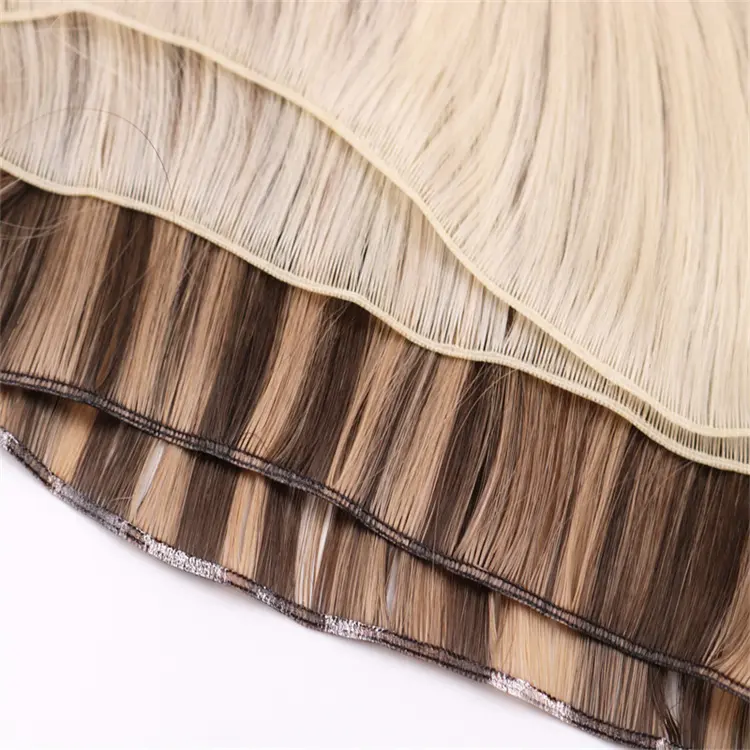
1. What Are Genius Weft Hair Extensions?
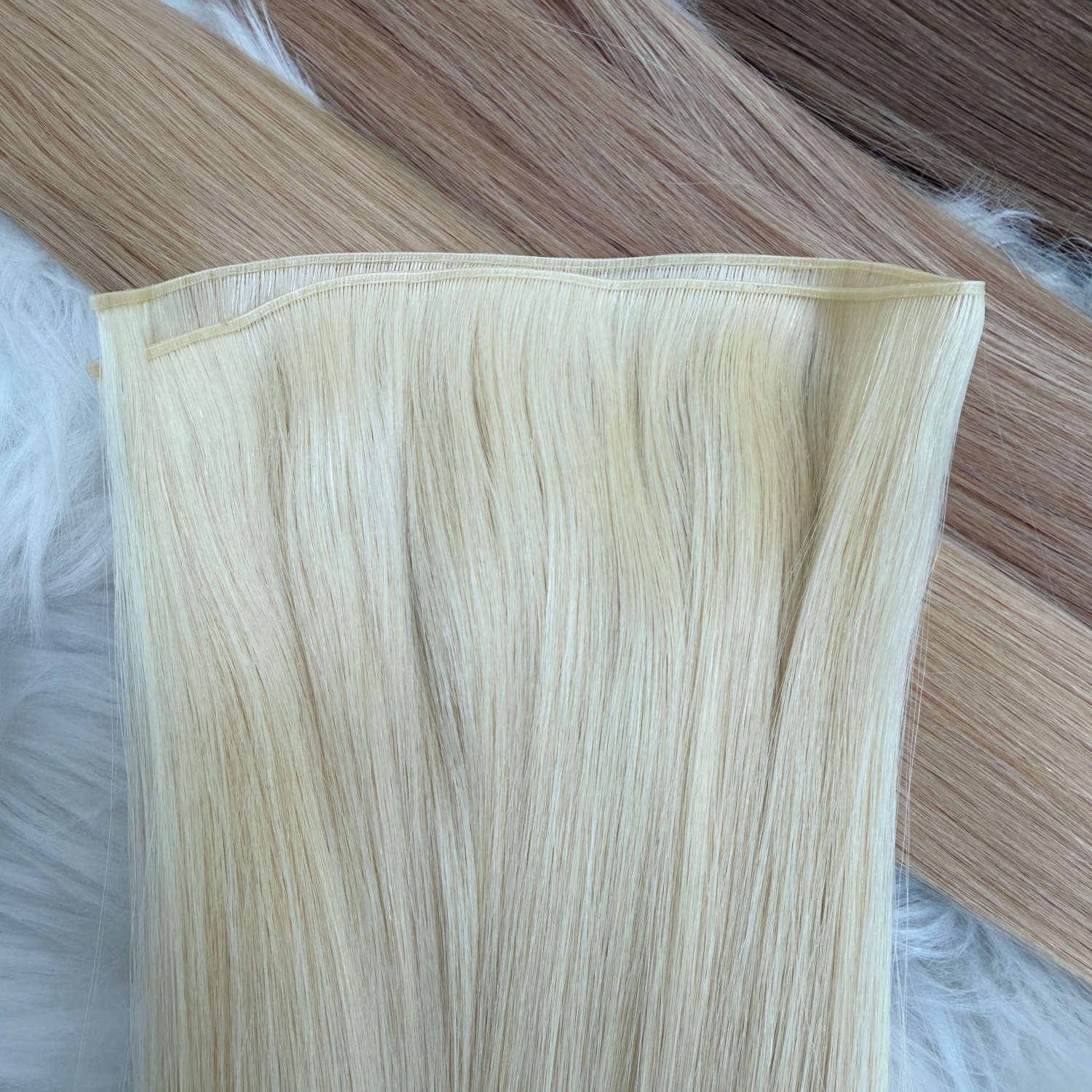
Genius Weft hair extensions are a specialized type of weft designed to combine a relatively thin seam with greater width customization.
The hair is secured along a continuous track engineered to maintain its structure under the handling and installation conditions specified by the manufacturer.
One of the main reasons stylists consider Genius Wefts is their cutability. Selected Genius Weft models can be cut at different points along the track to create sections that better match the planned row.
This can make product preparation more flexible than working with a conventional fixed-width Hand-Tied Weft.
Main Features of Genius Wefts
Thin seam construction
A thin seam can help reduce bulk where the extension sits against the natural hair. This may be especially useful when a stylist plans multiple rows or needs to stack sections.
Cut-to-size customization
On models specifically designed for cutting, the stylist can trim the weft to the required width rather than folding excess material at the end of a row.
No-return-hair or reduced-return-hair options
Some Genius Weft constructions are designed to reduce or eliminate short folded-back hairs along the upper seam. This is often marketed as no-return-hair construction.
However, buyers should confirm the actual design. The term Genius Weft does not guarantee that every manufacturer’s product has identical return-hair characteristics.
Flexible installation planning
Genius Wefts can be used in suitable beaded-row or sew-in installations. The specific application must follow the manufacturer’s construction and handling instructions.
When Are Genius Wefts a Good Choice?
Genius Wefts may suit professional stylists who:
- Need flexible row widths.
- Prefer a relatively thin seam.
- Want to reduce folding at the ends of weft sections.
- Use beaded-row or sew-in installation techniques.
- Need to build different density combinations.
- Want to stock a customizable weft product for different client requirements.
For example, ALOVEHAIR’s Professional Cut-to-Size Genius Weft is listed as a product designed for flexible width customization.
Its published product information describes a seam thickness below 1mm. This is a specification for that model, not a universal measurement for every Genius Weft available on the market.
2. What Are Hand-Tied Weft Hair Extensions?
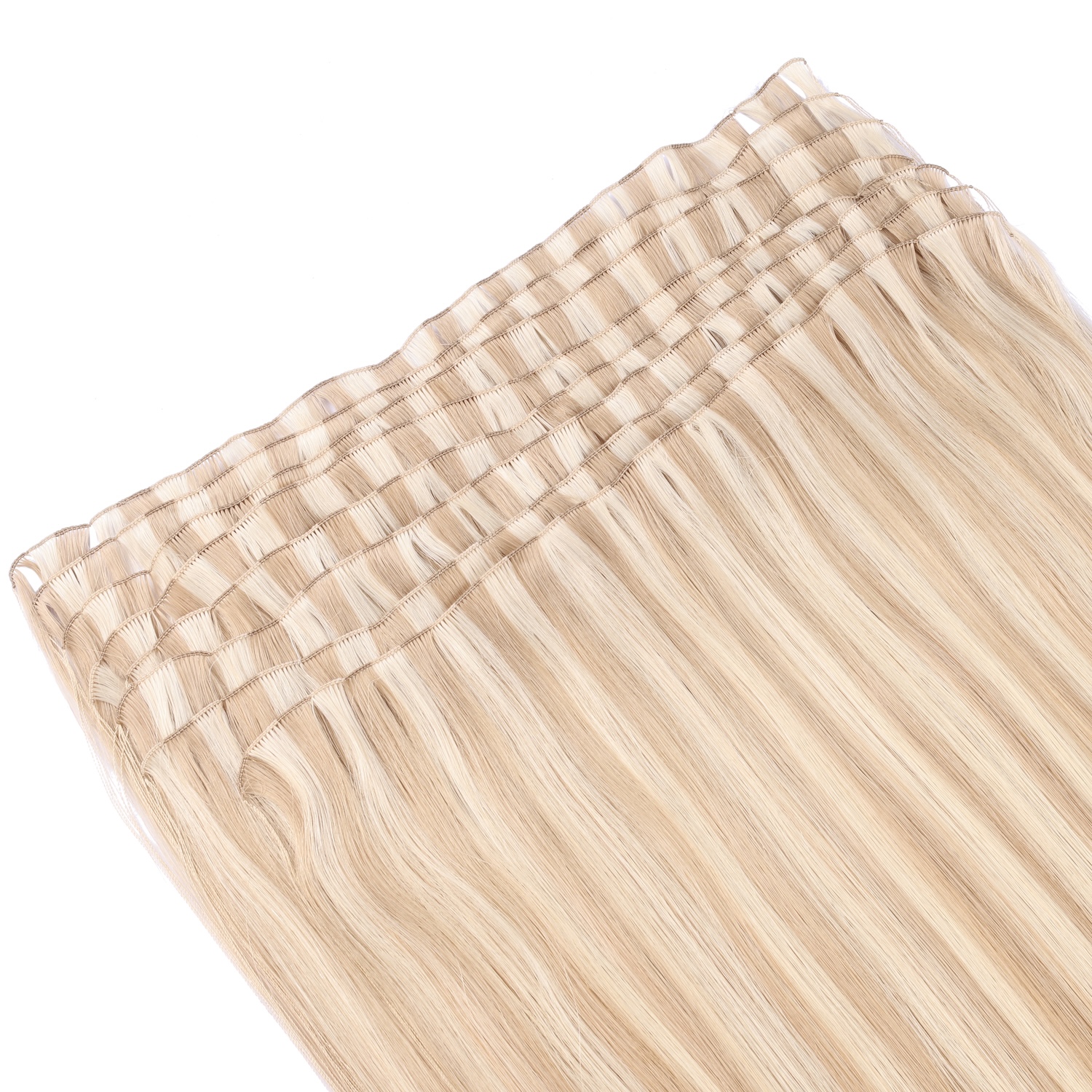
Hand-Tied Wefts are made by securing individual hair sections along a fine seam using a hand-tying process.
This construction is known for its narrow, flexible profile. Many stylists appreciate the way traditional Hand-Tied Wefts lie along a prepared row and move with the natural hair.
Unlike many cuttable Genius Weft designs, traditional Hand-Tied Wefts generally need to retain their original tied structure.
Cutting through the tied seam can release the knots and cause the weft to unravel. Some products may have manufacturer-approved edge or adjustment procedures, but buyers should never assume that an ordinary Hand-Tied Weft can be cut freely.
Main Features of Hand-Tied Wefts
Fine and flexible construction
The hand-tied seam is usually narrow and flexible, making it suitable for installation systems that require a fine weft.
Traditional craftsmanship
Each section of hair is secured through a hand-tying process. This manufacturing method requires specialized labor and production control.
Fixed-width installation planning
Because conventional Hand-Tied Wefts should not be cut arbitrarily, the stylist generally plans row placement around the supplied section widths.
Excess width may need to be managed according to the manufacturer’s approved folding or placement technique.
Lightweight feel
Many traditional Hand-Tied Wefts have a fine structure and are selected by stylists who prefer a lightweight seam. However, total product weight still depends on hair quantity, length, width, and density.
When Are Hand-Tied Wefts a Good Choice?
Hand-Tied Wefts may suit stylists and salons that:
- Prefer a very fine tied seam.
- Work with fixed-width row systems.
- Prioritize soft and flexible construction.
- Have experience planning rows around fixed weft sections.
- Want a traditional hand-tied product for their extension menu.
ALOVEHAIR offers Cuticle-Intact Hand-Tied Human Hair Extensions for professional buyers who want to evaluate this construction.
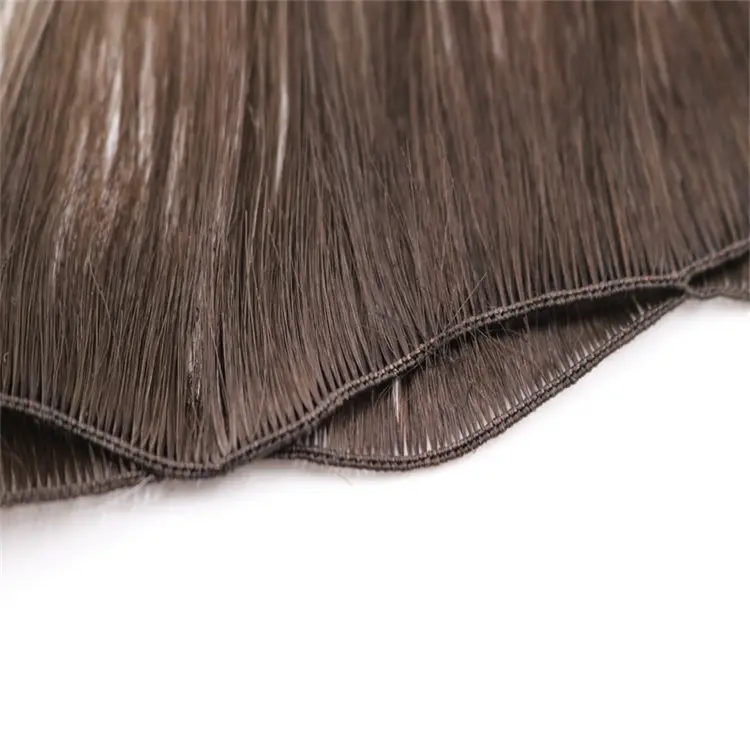
3. Genius Weft vs Hand-Tied Weft: What Is the Difference in Construction?
The most useful way to understand these two products is to examine the seam rather than relying on product names.
Genius Weft Construction
A Genius Weft generally uses a manufactured or specially secured seam designed to remain stable when handled and, on approved models, cut to the required width.
Depending on the supplier, the seam may use different materials and construction processes.
The important technical questions are:
- How is the hair secured to the seam?
- What material forms the track?
- How thick is the finished seam?
- Is there return hair?
- Can the weft be cut along the entire track?
- Does the cut edge require any finishing?
- How does the edge perform after washing and brushing?
Hand-Tied Weft Construction
A traditional Hand-Tied Weft uses individually secured sections of hair along a tied seam.
Its construction is usually designed around a specific finished width. Cutting the seam may disturb the knots and release hair.
The relevant questions include:
- How are the knots secured?
- Is return hair present?
- What is the seam height and thickness?
- Does the tied edge remain secure during normal use?
- How much does the finished weft weigh?
- What folding or installation procedures are approved?
Side-by-Side Construction Comparison
| Technical Detail | Genius Weft | Hand-Tied Weft |
|---|---|---|
| Hair attachment | Product-specific manufactured construction | Individual hand-tied attachment |
| Seam material | Varies by manufacturer | Tying thread and associated seam structure |
| Seam shape | Generally designed for a thin profile | Usually a narrow tied profile |
| Return Hair | Often reduced or absent on designated models | May be visible depending on the tying method |
| Cut edge | Designed for cutting on approved models | Cutting may release the tied structure |
| Custom row width | Often adjustable by cutting | Usually planned around the original width |
| Main inspection point | Cut-edge stability | Knot security and seam consistency |
Neither construction automatically guarantees better hair quality. The material, processing, density, and quality-control procedures should be evaluated independently.
4. Genius Weft vs Hand-Tied Weft Thickness: Which Is Thinner?
Thickness is one of the most common reasons stylists compare these two products.
A thinner seam may help the extension sit closer to the head, but seam thickness alone does not determine how natural or comfortable the finished installation will be.
The number of stacked wefts, total hair weight, bead size, row spacing, and natural hair density all affect the final profile.
Published Product Measurements
ALOVEHAIR’s Hand-Tied product comparison page gives the following approximate product-specific measurements:
| Product Type | Published Approximate Seam Thickness |
|---|---|
| Genius Weft | 0.5–0.8mm |
| Hand-Tied Weft | Approximately 1mm |
| Machine Weft | Approximately 2mm or more |
These are ALOVEHAIR’s published comparison values for its product range, not standardized industry measurements.
Other suppliers publish different figures. Bohyme, for example, lists approximately 0.37–0.42mm for selected Hand-Tied collections and approximately 0.78mm for its Genius Weft collection. That demonstrates why measurements from one supplier should not be generalized across the market.
Why Seam Thickness Is Not the Only Factor
Consider two installations:
- Installation A uses one thin weft.
- Installation B stacks three thin wefts along one row.
Even if each individual seam is thin, the total stacked profile may be substantially greater.
The stylist should therefore consider:
- Seam thickness.
- Number of layers.
- Total hair weight.
- Bead or anchor size.
- Natural hair density.
- Row placement.
- Whether the finished installation remains concealed.
For wholesale buyers, ask suppliers to measure the seam at several points rather than reporting only the thinnest section.
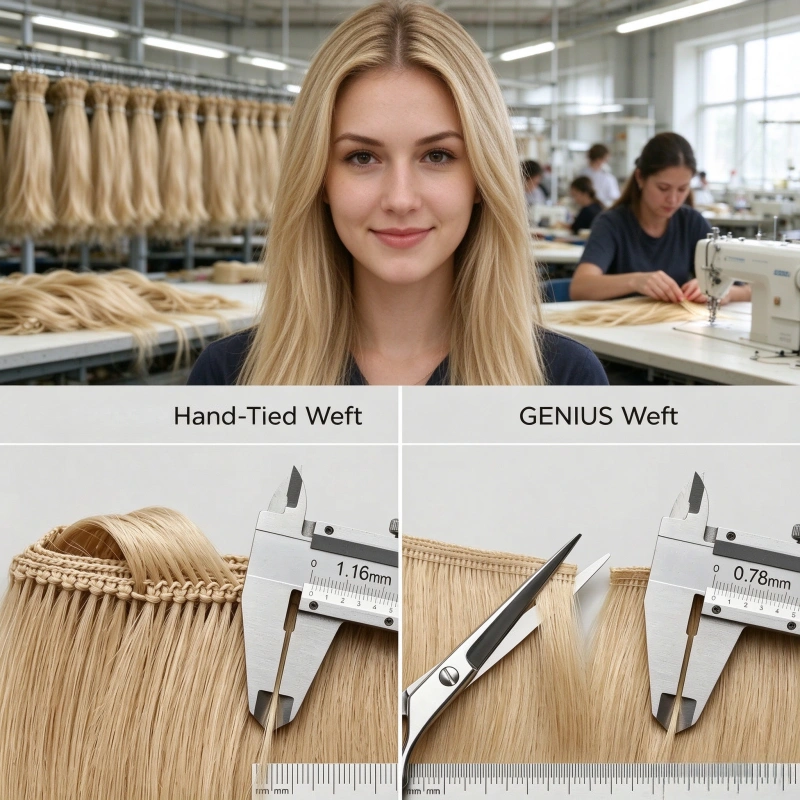
5. Genius Weft vs Hand-Tied Weft Weight: Which Provides More Hair?
Weight comparisons are often confusing because different manufacturers use different packaging configurations.
One bundle may contain 50g of hair. Another supplier may sell a single Hand-Tied Weft weighing around 16–17g. A third manufacturer may list its 18-inch Hand-Tied product at 64g.
These figures are not necessarily contradictory. The width, length, number of wefts per package, and hair density may all be different.
Real Supplier-Specific Weight Examples
Wefts + Waves publishes the following specifications for its own products:
| Product | Length | Published Weight |
|---|---|---|
| Genius / Hybrid Weft | 18 inches | 50g |
| Genius / Hybrid Weft | 22 inches | 50g |
| Genius / Hybrid Weft | 24 inches | 60g |
| Hand-Tied Weft | Product-specific section | 16.9g |
The supplier notes that one 50g Genius bundle represents approximately three of its 16.9g Hand-Tied wefts.
This is a useful comparison within that product range, not a universal conversion between all Genius and Hand-Tied products.
Newtimes Hair publishes another product-specific configuration, including a 50g Genius Weft pack and Hand-Tied products ranging from 48g at 14 inches to 100g at 26 inches.
The difference demonstrates why buyers must compare net weight and usable width, not just product names.
What Should You Compare?
| Specification | Why It Matters |
|---|---|
| Net hair weight | Shows how much hair is included |
| Length | Longer hair may need a different weight distribution |
| Weft width | Determines how much row coverage is available |
| Density | Affects the appearance from top to ends |
| Number of pieces | Clarifies whether the package contains one or multiple wefts |
| Seam weight | Helps distinguish hair weight from the finished track |
| Finished width | Important for installation planning |
A 50g Genius Weft is not automatically equivalent to three Hand-Tied Wefts from another manufacturer.
Request a specification sheet that identifies the net hair weight, length, full bundle width, individual piece width, and quantity per package.
6. Can You Cut Genius Wefts and Hand-Tied Wefts?
Cutting flexibility is one of the biggest practical differences between many Genius and traditional Hand-Tied products.
Can You Cut Genius Wefts?
Many Genius Weft models are designed for cutting.
The stylist can shorten the track to match the planned row width instead of folding excess material.
However, cuttability must be confirmed for the exact product.
A supplier should explain:
- Where cutting is permitted.
- Whether cutting is allowed anywhere along the seam.
- Whether the cut end needs sealing or reinforcement.
- Whether post-cut shedding is expected.
- Whether the cutting process affects the product warranty or replacement terms.
Can You Cut Hand-Tied Wefts?
Traditional Hand-Tied Wefts generally should not be cut through the tied seam without an approved procedure.
Because hair is individually tied along the seam, cutting can release the knots and cause unraveling.
Stylists commonly work with the original width and plan their installation around it. Depending on the product, folding or manufacturer-approved edge handling may be used to manage excess width.
Cuttability vs Cutting Stability
These are two different questions.
Cuttability means the manufacturer permits the weft to be cut.
Cutting stability means the new edge remains secure after cutting.
A supplier may describe a Genius Weft as cuttable, but professional buyers should still verify the cut edge on a sample.
A practical cut test should record:
| Test Point | What to Observe |
|---|---|
| Before cutting | Seam appearance, loose hairs, and edge condition |
| Immediately after cutting | Whether the seam opens or separates |
| After brushing | Whether hair releases from the new edge |
| After washing | Whether the edge remains stable |
| After drying | Whether the seam changes shape |
| After repeated handling | Whether shedding increases |
Only perform cutting tests on products the supplier identifies as cuttable. Traditional Hand-Tied samples should remain intact unless the manufacturer provides specific cutting instructions.
For another example of a customizable design, explore the ALOVEHAIR Cut-to-Size Genius Weft.
7. Which Weft Is More Durable: Genius Weft or Hand-Tied?
Durability is an important purchasing consideration, but it is also where many product comparison articles make claims that are too broad.
Some articles claim Genius Wefts last 6–12 months while Hand-Tied Wefts last 6–9 months. These figures are often presented as category-wide averages without clearly describing the hair quality, installation conditions, testing period, or sample size.
A weft’s actual lifespan depends on more than its construction.
Important variables include:
- Raw hair quality
- Cuticle condition and processing
- Hair length and density
- Seam construction
- Sewing and installation technique
- Washing frequency
- Heat styling
- Detangling habits
- Removal and storage
- Number of reuse cycles
A poorly manufactured Genius Weft may shed or weaken sooner than a well-made Hand-Tied Weft. Likewise, a Hand-Tied Weft can remain usable through multiple installations when handled correctly.
What Makes a Genius Weft Durable?
For a cuttable Genius Weft, buyers should examine:
- Stability of the manufactured seam
- Hair retention along the track
- Secure finishing at cut edges
- Resistance to seam separation
- Performance after brushing and washing
What Makes a Hand-Tied Weft Durable?
For a Hand-Tied Weft, focus on:
- Knot security
- Consistency of hand-tying
- Thread strength
- Edge stability
- Hair retention during removal and reuse
- Resistance to unraveling
Separate Installation Wear Time from Hair Lifespan
A row installation may need professional maintenance after several weeks as natural hair grows. This does not mean the hair itself has reached the end of its usable life.
Many salons use an approximately 6–8-week maintenance reference for beaded or sewn weft installations, but the exact schedule depends on the installation method and stylist’s protocol.
The extension hair may remain reusable after maintenance if it is still in suitable condition.
Therefore, compare two different measurements:
| Measurement | What It Means |
|---|---|
| Installation maintenance interval | How long the row can remain attached before professional adjustment |
| Hair lifespan | How long the extension hair remains suitable for reuse |
| Seam durability | How well the track withstands handling, washing, and reinstallation |
| Hair retention | How much hair remains secured after normal use |
This distinction is more useful than declaring one type of weft the winner based only on a general lifespan figure.
8. Which Weft Is More Comfortable and Natural-Looking?
Comfort depends on the entire installation, not just the thickness of the weft.
A thin seam can be helpful, but an overloaded row or excessively tight bead placement can still create discomfort.
Genius Weft Comfort
Genius Wefts may offer a smooth, low-profile seam, particularly when the stylist needs to customize a row width or combine several sections.
A no-return-hair design may also reduce short folded hairs near the top seam, depending on the product.
Hand-Tied Weft Comfort
Traditional Hand-Tied Wefts are valued for their fine construction and flexibility.
The tied seam can sit close to the head, although return hair and knot construction may affect the feel near the track.
Comfort Comparison
| Factor | Genius Weft | Hand-Tied Weft |
|---|---|---|
| Seam profile | Thin, depending on model | Fine and flexible |
| Return hair | Often absent or reduced on selected models | May be present |
| Flexibility | Depends on seam material and construction | Generally flexible |
| Stacking | Depends on seam and permitted installation | Depends on weft width and folding |
| Main comfort concern | Row weight and anchor placement | Knot feel, return hair, and row tension |
For clients with fine or fragile hair, the stylist should pay particular attention to the total weight and number of attachment points.
A lightweight product can still be unsuitable if too much hair is installed on too few natural strands.
high-quality-hand-tied-extensions
9. Which Is Better for Fine Hair: Genius Weft or Hand-Tied Weft?
There is no universal answer.
Traditional Hand-Tied Wefts are often chosen for fine hair because of their narrow, flexible seam.
Genius Wefts may also work for some clients with fine or medium-density hair, particularly when a low-profile product is installed with an appropriate weight and carefully planned rows.
The more important questions are:
- How much natural hair is available to support the extensions?
- How much weight will each row carry?
- How many beads or anchor points will be used?
- Can the seam remain concealed?
- Does the client’s hair condition support the planned installation?
- Can the client maintain the system properly?
Suggested Product Selection by Hair Type
| Client Hair Type | Product Worth Considering | Main Assessment |
|---|---|---|
| Very fine hair | Fine Hand-Tied Weft or lightweight Genius Weft | Minimum practical weight and seam visibility |
| Fine-to-medium hair | Genius or Hand-Tied | Row customization and anchor distribution |
| Medium hair | Both products | Desired density and installation preference |
| Thick hair | Genius Weft or multiple weft options | Required coverage and weight |
| Fragile or damaged hair | Professional assessment before either method | Whether extensions are suitable at all |
No extension method should be marketed as completely damage-free or suitable for everyone.
For a safer installation, the stylist must consider natural hair condition, attachment tension, maintenance frequency, and the amount of added hair.
10. Which Weft Is Better for Salon Installation?
For a stylist, the best weft is the one that matches the installation technique and client requirements while allowing consistent results.
Genius Weft for Professional Installation
Genius Weft may be useful when:
- The row width needs to be customized.
- The stylist wants to reduce folding at the row ends.
- A low-profile seam is important.
- The manufacturer permits the planned cutting technique.
- The hair needs to be distributed across multiple sections.
Hand-Tied Weft for Professional Installation
Hand-Tied Weft may be suitable when:
- The stylist prefers hand-tied construction.
- The row plan works with the supplied widths.
- A fine and flexible seam is the priority.
- The stylist is experienced in working with traditional tied tracks.
- The product can be installed without cutting the tied seam.
Installation Planning Comparison
| Installation Factor | Genius Weft | Hand-Tied Weft |
|---|---|---|
| Row width planning | Can be customized on approved models | Must account for original width |
| Cutting preparation | Follow manufacturer instructions | Generally avoid cutting through the tied seam |
| Row stacking | Confirm seam thickness and allowed method | Confirm combined seam profile |
| Installation skill | Professional row installation required | Professional hand-tied installation experience required |
| Removal | Remove thread or beads according to the installation | Remove thread or beads according to the installation |
| Reuse check | Inspect seam and hair after removal | Inspect knots and hair after removal |
A useful resource for stylists is ALOVEHAIR’s guide to applying weft hair extensions with beads.
It explains the preparation, bead placement, and professional sewing process used in beaded weft installations.
blonde-genius-wefts
11. How to Compare Genius Weft and Hand-Tied Weft Samples: A Practical Test
For a salon, distributor, or private label brand, comparing physical samples is more reliable than choosing a product based on online descriptions.
The following is a suggested in-house evaluation protocol. It is not an official industry certification or a claim that either product has passed these tests.
Step 1: Request Comparable Samples
Ask the same supplier, or multiple suppliers, for samples using the same specifications where possible:
- Same hair length
- Same color
- Same texture
- Same hair material description
- Similar net hair weight
- Clearly stated weft width
- Product-specific cutting instructions
Ideally, test at least three sample pieces of each construction to reduce the effect of one unusual sample.
Step 2: Record the Physical Measurements
Use a digital scale and a consistent measuring method.
| Measurement | Suggested Method | Why It Matters |
|---|---|---|
| Net hair weight | Weigh each sample before testing | Confirms actual material quantity |
| Weft width | Measure the usable track length | Determines row coverage |
| Seam height | Measure at several points | Identifies inconsistent construction |
| Seam thickness | Use the same caliper method | Compares bulk |
| Hair length | Measure from track to ends | Confirms usable length |
| Return hair | Photograph and record visible short hairs | Compares the area near the seam |
| Flexibility | Bend samples consistently | Evaluates track handling |
Measure seam thickness at five positions along each sample, including the center and both ends. Record the average and the range instead of reporting only the thinnest measurement.
Step 3: Test Cutting Stability
This test applies only to a product that the manufacturer identifies as cuttable.
Cut a sample section to the intended row width following the supplier’s instructions.
Record:
- Whether the cut edge opens.
- Whether hair releases immediately.
- Whether extra edge treatment is required.
- Whether the seam remains secure after brushing.
- Whether shedding increases after washing.
Do not cut a traditional Hand-Tied Weft simply to make the test appear symmetrical. The proper comparison is to follow the intended handling method of each construction.
Step 4: Conduct a Controlled Brushing Test
Use the same brush type, stroke direction, and handling method for both samples.
One possible screening protocol is 100 gentle, controlled brushing strokes from mid-length to ends, while avoiding direct pulling on the weft seam.
Record loose hair before and after the test.
This is an internal comparison method, not a universal pass/fail standard. The purpose is to identify differences between the samples under the same handling conditions.
Step 5: Conduct a Washing and Drying Check
Wash and dry both samples using the same suitable extension-hair care procedure.
For a simple screening program, evaluate them after five wash-and-dry cycles.
Record:
- Hair softness
- Tangling
- Shedding
- Color change
- Seam condition
- Cut-edge condition, where applicable
- Changes in flexibility
More extended testing may be useful for a brand developing a long-term quality specification.
Step 6: Test Installation and Removal
Ask a qualified stylist to install both samples using manufacturer-approved methods.
Evaluate:
- Preparation time
- Row customization
- Seam stacking
- Attachment security
- Finished appearance
- Client comfort
- Removal time
- Condition after removal
The test should use comparable natural hair sections and installation conditions. Otherwise, the results may reflect installation differences rather than product quality.
Sample Evaluation Record
| Evaluation Item | Genius Weft Result | Hand-Tied Weft Result |
|---|---|---|
| Sample code | Record | Record |
| Hair length | Record | Record |
| Net weight | Record | Record |
| Seam thickness | Record | Record |
| Weft width | Record | Record |
| Return hair | Record | Record |
| Cutting result | Record if approved | Follow original construction |
| Brushing result | Record | Record |
| Washing result | Record | Record |
| Installation time | Record | Record |
| Removal condition | Record | Record |
By comparing measurable features rather than product labels, professional buyers can develop a more reliable supplier selection process.
12. What Should Wholesale Buyers Look for When Choosing a Manufacturer?
For salon chains, distributors, and private label brands, the difference between Genius and Hand-Tied products affects more than appearance.
It can influence inventory planning, stylist training, installation flexibility, packaging, and repeat-order consistency.
Compare the Manufacturing Specifications
| Procurement Specification | Genius Weft | Hand-Tied Weft |
|---|---|---|
| Hair type | Confirm Remy, cuticle condition, and processing | Confirm Remy, cuticle condition, and processing |
| Hair length | Available stock or custom lengths | Available stock or custom lengths |
| Net weight | Specify weight per pack and piece | Specify weight per weft and pack |
| Seam thickness | Request exact model measurement | Request exact model measurement |
| Weft width | Confirm full bundle and usable section width | Confirm fixed supplied width |
| Return hair | Specify no-return or reduced-return requirement | Inspect and document tied construction |
| Cutting | Confirm permitted cut locations | Confirm handling and edge restrictions |
| Color | Stock shades or custom matching | Stock shades or custom matching |
| Packaging | Bulk, salon, or private label | Bulk, salon, or private label |
| MOQ | Confirm by model, color, and length | Confirm by model, color, and length |
| Lead time | Confirm for stock and custom orders | Confirm for stock and custom orders |
Why Hair Quality Must Be Evaluated Separately
A Genius Weft is not automatically better quality than a Hand-Tied Weft simply because its seam is thinner.
Hair quality is a separate part of the product specification.
For both products, ask:
- Is the hair 100% human hair?
- Is it Remy or non-Remy?
- Are the cuticles retained and aligned?
- What processing has been applied?
- What is the usable hair length?
- How is shedding checked?
- How is color consistency maintained?
- Is the same material specification available for repeat orders?
Marketing grades such as 10A or 12A are not universal independent quality certifications. A physical sample and written product specification provide better purchasing evidence.
Request a Reference Sample Before Bulk Production
Once a product is approved, keep a physical reference sample and document:
- Product model
- Hair material
- Color code
- Length
- Net weight
- Weft width
- Seam dimensions
- Return-hair requirements
- Cutting instructions
- Packaging
- Quality acceptance criteria
This will help reduce differences between sampling and bulk production.
For private label customers, an approved reference sample also makes it easier to maintain the same product specifications across future orders.
13. ALOVEHAIR Genius Weft and Hand-Tied Weft Manufacturing Options
ALOVEHAIR is a China-based human hair extension manufacturer serving professional salons, stylists, distributors, and private label businesses.
Its weft product range includes Genius Wefts, Double Genius Wefts, Hand-Tied Wefts, Machine Wefts, and Seamless/Flat Wefts.
This range allows buyers to compare different weft constructions through one manufacturing supplier.
Genius Weft Products
ALOVEHAIR’s published Genius Weft product information includes:
- Human Remy hair options
- Thin seam construction
- Multiple hair lengths
- Different weights, including 50g, 100g, and 120g configurations on listed products
- Standard and customized colors
- Sew-in and beaded-row application options
- Cut-to-size designs on specified models
One listed Genius Weft product gives a hair-length range of 14–30 inches, a weft width of approximately 36–40 inches, and customizable package weights.
These specifications belong to that product range. Buyers should confirm the actual dimensions and packaging configuration of the selected SKU before ordering.
Explore ALOVEHAIR Genius Weft and Micro Wefts or view the Professional Genius Weft product for more information.
Double Genius Wefts
For buyers developing high-density salon products, Double Genius Wefts offer another construction to evaluate.
ALOVEHAIR’s published Double Genius category describes products with different hair weights and wholesale configurations. The listed product information includes standard lengths from 14–24 inches and approximately 5–7g per piece for the specific model.
Explore ALOVEHAIR Double Genius Wefts for product and customization information.
Hand-Tied Weft Products
ALOVEHAIR also offers Hand-Tied Wefts for professional buyers who prefer traditional hand-tied construction.
The available product range includes different colors and styles, including balayage and other salon-oriented options.
Visit ALOVEHAIR Hand-Tied Wefts to compare its product selection.
Other Weft Constructions
For buyers who want to compare additional options, ALOVEHAIR also provides:
Comparing Genius, Hand-Tied, Flat, and Machine Wefts can help salons create a product range for customers with different hair densities, budgets, and installation preferences.
14. How to Care for Genius and Hand-Tied Wefts
Both product types require proper aftercare.
Human hair extensions do not receive natural scalp oils in the same way as growing hair. They therefore need careful washing, detangling, drying, and styling.
Daily Brushing
- Use a suitable extension brush.
- Detangle from the ends upward.
- Hold the hair near the row while brushing.
- Avoid pulling directly on the weft.
- Do not force a brush through knots.
Washing
Use a gentle shampoo and avoid aggressively rubbing or twisting the extensions.
Apply conditioner mainly to the mid-lengths and ends, keeping heavy products away from the attachment points.
Drying
Dry the roots and attachment areas thoroughly after washing.
Avoid sleeping with wet hair, as tangling and friction can increase when the hair remains damp.
Heat Styling
Use a heat protectant before applying hot tools.
Avoid direct heat on the seam, beads, thread, or other attachment components.
Professional Maintenance
Follow the stylist’s maintenance schedule. Check the row condition, natural hair growth, bead placement, and seam integrity at each appointment.
For more details, read the ALOVEHAIR Hair Extension Care and Maintenance Guide.
Frequently Asked Questions About Genius Wefts and Hand-Tied Wefts
Are Genius Wefts better than Hand-Tied Wefts?
Neither is universally better. Genius Wefts may be more convenient when a stylist needs a thin, customizable, cuttable track. Hand-Tied Wefts may be preferred when a fine, flexible tied seam and fixed-width installation work better for the client’s hair and the stylist’s technique.
Which is thinner, Genius Weft or Hand-Tied Weft?
It depends on the product. ALOVEHAIR’s published product comparison lists approximately 0.5–0.8mm for its Genius Weft model and approximately 1mm for its Hand-Tied Weft model. Other manufacturers publish different measurements, so compare the actual samples.
Can Hand-Tied Wefts be cut?
Traditional Hand-Tied Wefts generally should not be cut through the tied seam because the knots may unravel. Always follow the manufacturer’s approved handling instructions.
Can Genius Wefts be cut anywhere?
Many Genius Weft products are designed for cutting, but this is not universal. Confirm the approved cut locations and edge-finishing requirements for the exact product.
Which weft lasts longer?
There is no reliable universal lifespan ranking. Hair quality, seam construction, installation, washing, styling, removal, and storage all affect product life. Compare samples under the same conditions before making a durability claim.
Are Genius Wefts suitable for fine hair?
Some Genius Weft products may suit clients with fine-to-medium hair because of their low-profile seam. However, installation weight and anchor placement must be suitable for the client’s natural hair. A stylist should assess the hair before installation.
Are Hand-Tied Wefts more lightweight?
They are often selected for their fine and flexible construction, but actual weight depends on length, width, density, and the amount of hair in each weft. Compare net weight rather than relying on the category name.
Can Genius Wefts and Hand-Tied Wefts be used for beaded rows?
Yes. Both are commonly used in professional beaded-row installations, provided the specific product and installation system are compatible. The stylist must follow the manufacturer’s instructions for attachment, cutting, sewing, and row planning.
Which weft is more expensive?
Pricing varies by hair quality, construction, length, weight, labor, brand, and order quantity. Hand-Tied manufacturing involves manual work, while Genius Weft construction uses a different production process. Compare the price per gram and the finished specifications rather than assuming a fixed price ranking.
What is return hair on a weft?
Return Hair refers to shorter hair sections folded or returned near the upper seam during certain manufacturing processes. Its amount, length, and presence vary by construction. Buyers should inspect the top seam rather than assuming every Genius or Hand-Tied Weft has the same design.
What is the difference between Genius Weft and Machine Weft?
Traditional Machine Wefts generally use a thicker stitched track designed for strength and higher hair volume. Genius Wefts are commonly designed with a thinner seam and greater customization. However, actual thickness, density, and cutting requirements depend on the manufacturer’s product.
Can wholesale buyers order customized Genius and Hand-Tied Wefts?
Yes. Manufacturers may provide customization for hair length, weight, color, texture, and packaging. The available options, MOQ, and production lead time depend on the selected product and order quantity.
Does ALOVEHAIR offer both Genius and Hand-Tied Wefts?
Yes. ALOVEHAIR lists both Genius Weft and Hand-Tied Weft products for professional and wholesale buyers. It also offers Machine, Double Genius, and Seamless/Flat Weft options. Contact the company to confirm specifications and commercial terms for the chosen models.
Final Verdict: Choose the Weft by Its Construction, Not Just Its Name
Genius Wefts and Hand-Tied Wefts serve similar professional extension applications, but they offer different construction and customization characteristics.
Genius Wefts may be the better choice when the stylist needs flexible row sizing, a cuttable seam on an approved model, and a low-profile construction.
Hand-Tied Wefts may be the better choice when a stylist prefers a fine, flexible tied seam and has an installation plan designed around the supplied weft width.
Neither product is automatically more durable, more comfortable, or safer for every client. These outcomes depend on the actual hair quality, seam construction, total weight, installation, and maintenance.
For consumers, an experienced stylist should assess natural hair condition and choose an installation plan that distributes weight appropriately.
For salons, wholesalers, and private label brands, the best approach is to compare physical samples, measure the seams, document net weight, verify cutting instructions, and test product performance before committing to bulk orders.
ALOVEHAIR offers Genius Wefts, Hand-Tied Wefts, and other professional human hair weft products for wholesale and customized projects.
Explore the ALOVEHAIR Weft Hair Extensions Collection or contact the manufacturing team to discuss product specifications, samples, OEM, and private label requirements.

Alove Hair is a professional Chinese manufacturer of premium 100% Remy human hair extensions, wigs, and hair systems. Established in 2014, the company specializes in supplying global salons and distributors with high-quality, cuticle-intact hair products and offers comprehensive OEM/ODM private label services.


