
Halo Hair Extensions vs Clip Ins: Which One Is Better for You?
Choosing between halo hair extensions vs clip ins usually comes down to one question: do you want the fastest and simplest way to add length and volume, or do you want greater control over where the hair is placed?
Both halo and clip-in extensions are temporary hair extension methods. They can be removed after wearing and do not require the long-term salon maintenance associated with tape-ins, keratin bonds, or sewn-in extensions. However, their attachment systems are very different.
A halo extension normally uses one main weft attached to an adjustable wire that sits around the crown and is hidden underneath the client’s natural hair. Clip-in extensions use multiple wefts with small clips that attach directly to sections of natural hair. Current product guides commonly report halo application times of roughly 1–5 minutes, while clip-ins generally take around 5–20 minutes, depending on experience and the number of pieces.
So which one should you choose?
Halo extensions are usually better for fast application, simple volume, and clients who prefer fewer attachment points. Clip-ins are generally better for customized placement, targeted volume, shorter hair, and more elaborate hairstyles.
Site Navigation
- Halo Hair Extensions vs Clip-Ins: Quick Comparison
- What Are Halo Hair Extensions?
- What Are Clip-In Hair Extensions?
- Halo Hair Extensions vs Clip-Ins: Application Time
- Halo Hair Extensions vs Clip-Ins: Which Is More Comfortable?
- Halo vs Clip-Ins for Thin and Fine Hair
- Halo vs Clip-Ins for Volume
- Which Is Better for Adding Hair Length?
- Halo Hair Extensions vs Clip-Ins for Styling
- Which Looks More Natural?
- How Long Do Halo Hair Extensions and Clip-Ins Last?
- Maintenance and Daily Care
- Can You Wear Halo or Clip-In Extensions Every Day?
- Which Is Better for Special Events?
- Halo vs Clip-Ins: Cost and Value
- Which Is Better for a Hair Extension Business?
- What Should Wholesale Buyers Look for?
- Alove Hair: Halo and Clip-In Hair Extensions Manufacturer
- Final Verdict: Halo or Clip-Ins—Which Is Better?
Halo Hair Extensions vs Clip Ins: Quick Comparison
Before looking at each factor in detail, here is the basic difference:
| Feature | Halo Hair Extensions | Clip-In Hair Extensions |
|---|---|---|
| Attachment | Adjustable wire + one main weft | Multiple clips + separate wefts |
| Typical application | About 1–5 minutes | About 5–20 minutes |
| Number of pieces | Usually 1 main piece | Commonly 4–10 pieces |
| Placement control | Limited | High |
| Daily removal | Very easy | Very easy |
| Heat required | No | No |
| Glue required | No | No |
| Best for | Quick length and volume | Customized styling |
| Fine hair | Often a good option | Can work with lightweight pieces |
| Thick hair | May require higher-density hair | Usually highly adaptable |
| Updos | More limited | More flexible |
| Side volume | Limited | Excellent |
| Maintenance | Low | Low |
| Typical lifespan | About 6–12+ months with good care | About 6–12+ months with good care |
The exact lifespan and application time vary by hair quality, product construction, frequency of use, and maintenance. Current manufacturer and industry guides report similar ranges for temporary halo and clip-in systems.

What Are Halo Hair Extensions?
Halo hair extensions are generally made from a single hair weft connected to a thin, adjustable wire.
The wire sits around the crown of the head, and the client’s natural hair is pulled over it to conceal the attachment.
Unlike clip-ins, halo extensions usually have no clips gripping multiple sections of natural hair.
The basic structure is:
Natural hair → adjustable wire → extension weft → natural hair blended over the top
This makes the halo one of the simplest temporary extension systems available.
Some commercial halo products use approximately 80–120g of hair in standard lengths, although heavier designs can be considerably more. For example, one current specification lists 80g at 12 inches, 100g at 16–18 inches, and 120g at 20 inches.
Other manufacturers offer heavier halo systems around 140g, with additional side pieces bringing the total set weight to approximately 180g.
This shows why buyers should not compare halo extensions by the word “halo” alone. Hair weight, density, length, and construction all affect the final result.
What Are Clip-In Hair Extensions?
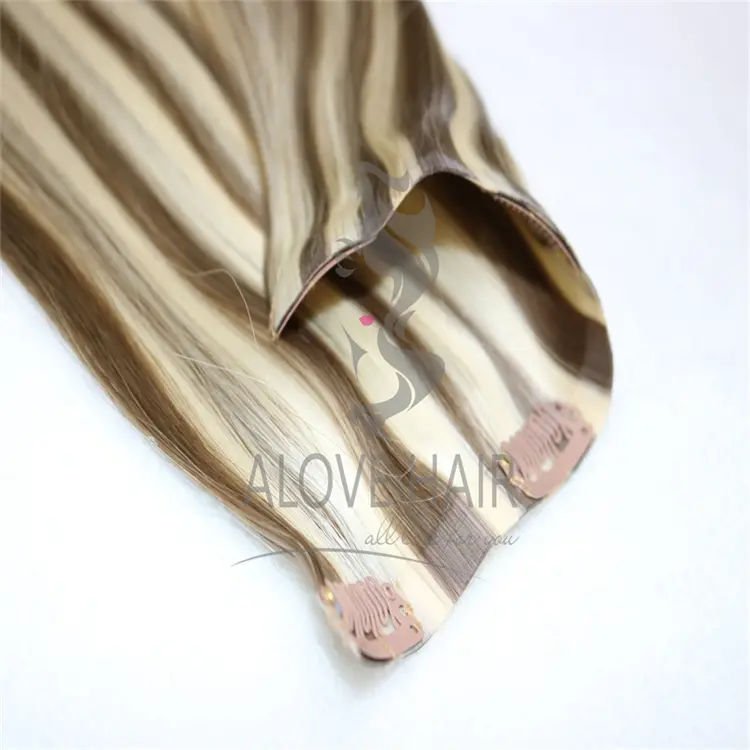
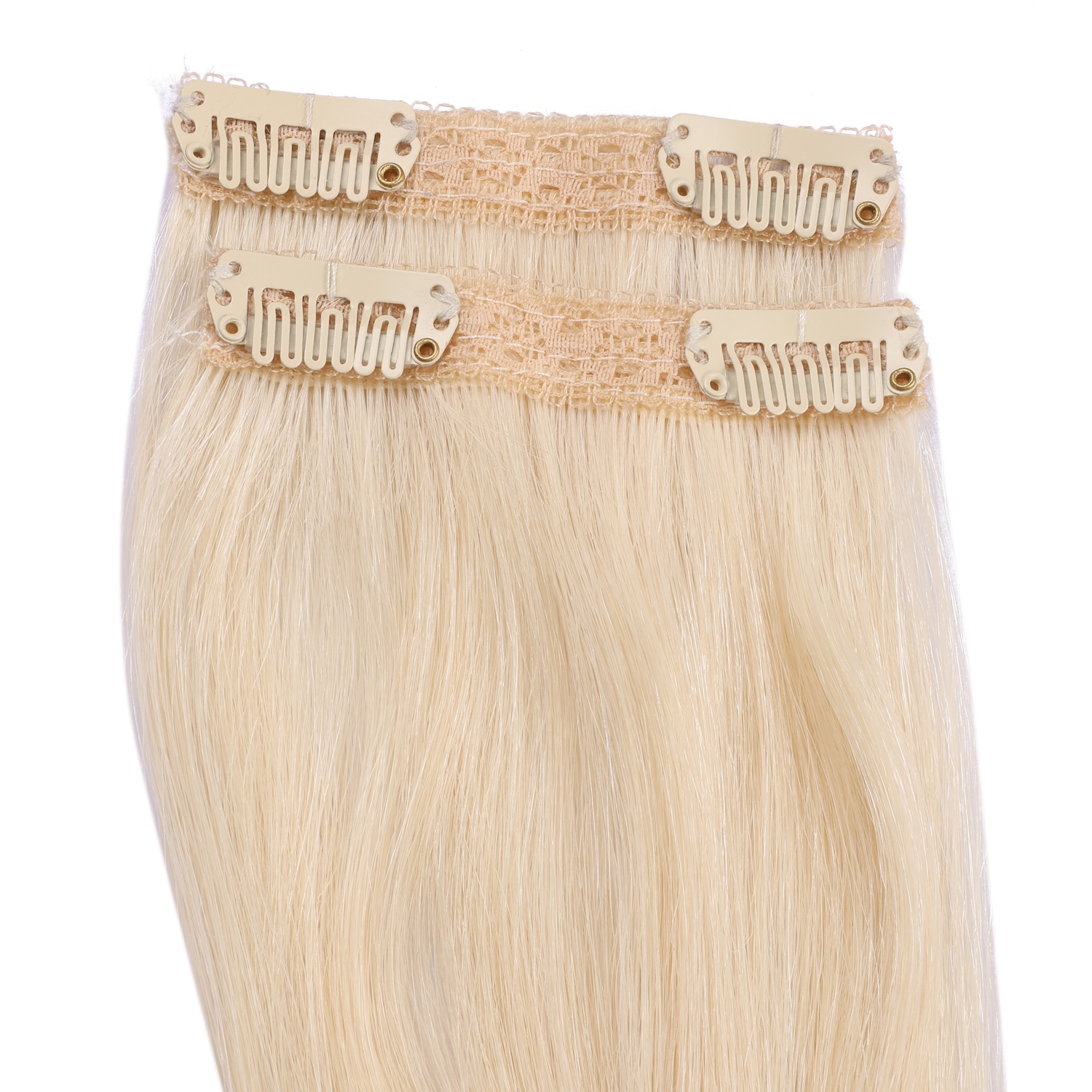
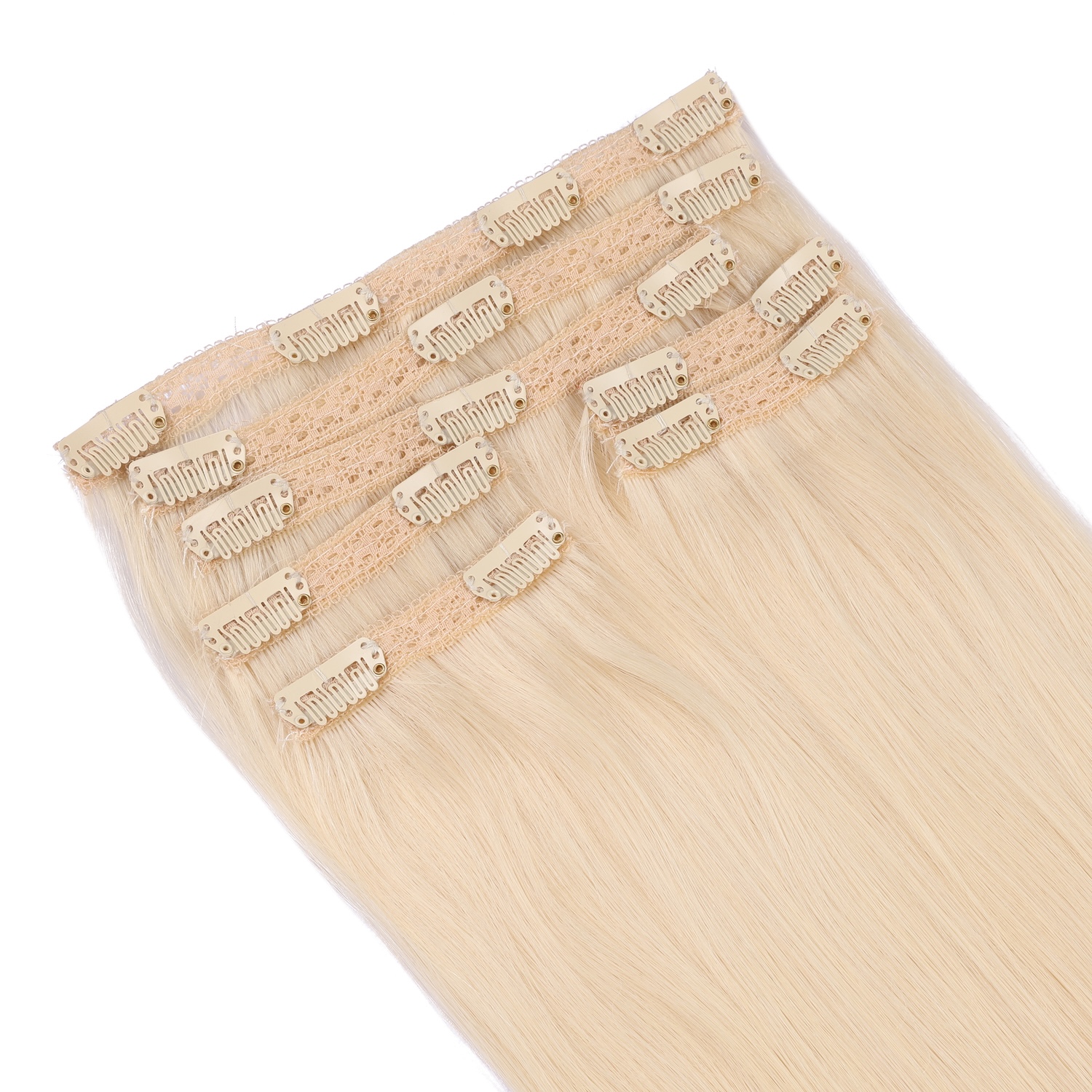
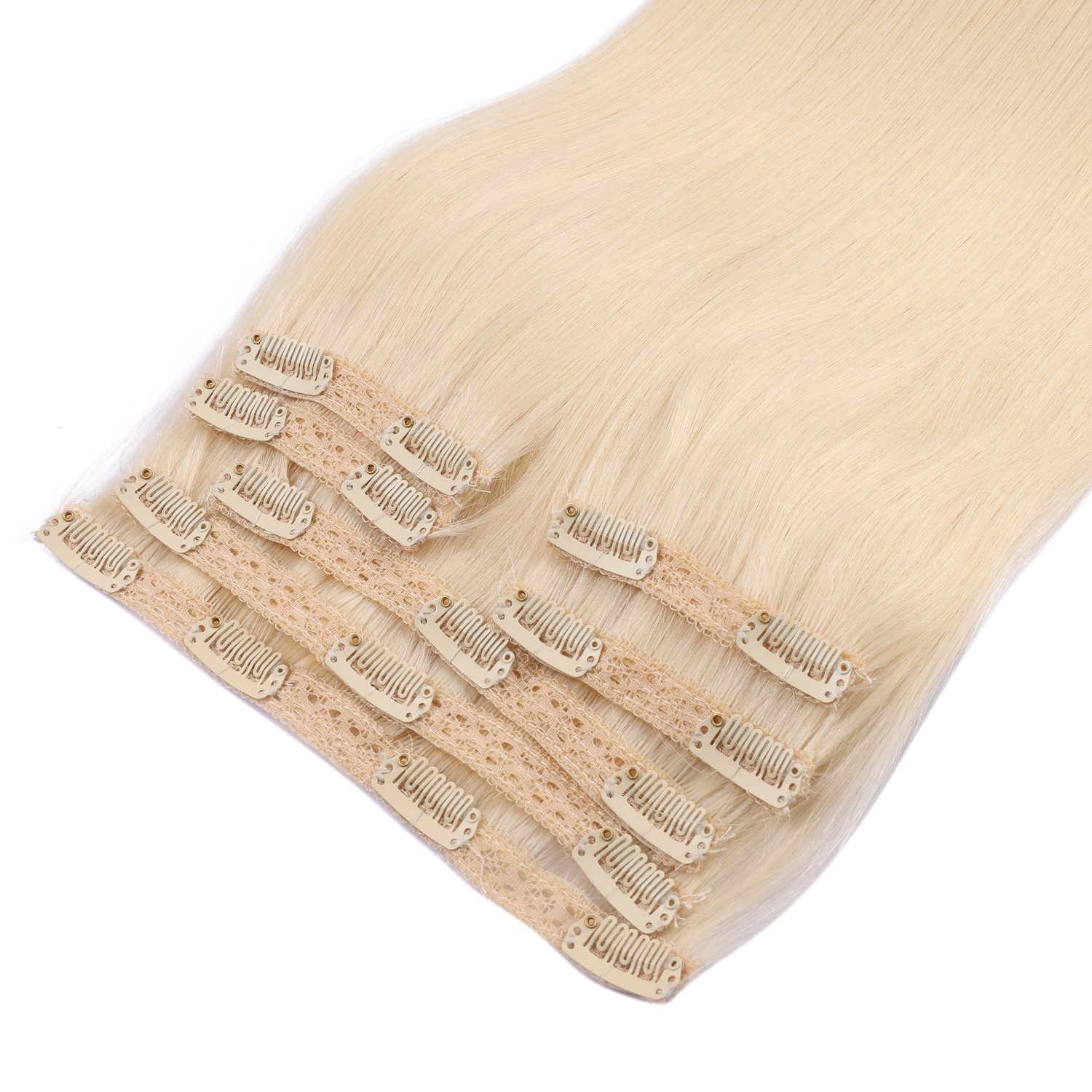
Clip-in extensions consist of several individual wefts fitted with small pressure-sensitive clips.
Instead of placing one large extension around the crown, the stylist or user sections the natural hair and attaches individual pieces at different locations.
A typical set may contain around 4–10 pieces, depending on the manufacturer and intended application.
The main advantage is placement flexibility.
You can put:
- Wider pieces at the back
- Smaller pieces around the sides
- Narrow pieces near the face
- Additional wefts where volume is needed
- Fewer pieces for a lighter look
This makes clip-ins particularly useful when the client wants to customize the shape of the finished hairstyle.

Halo Hair Extensions vs Clip-Ins: Application Time
Application time is one of the biggest differences.
Halo Extensions
You can usually position a halo, cover it with natural hair, and blend it in a few minutes.
Some manufacturers advertise application times of about 60 seconds, while other professional guides suggest 1–5 minutes, depending on the design and blending required.
The process is generally:
- Section the top layer.
- Position the wire around the crown.
- Adjust the wire.
- Release the natural hair.
- Blend the extension.
- Style if necessary.
Clip-In Extensions
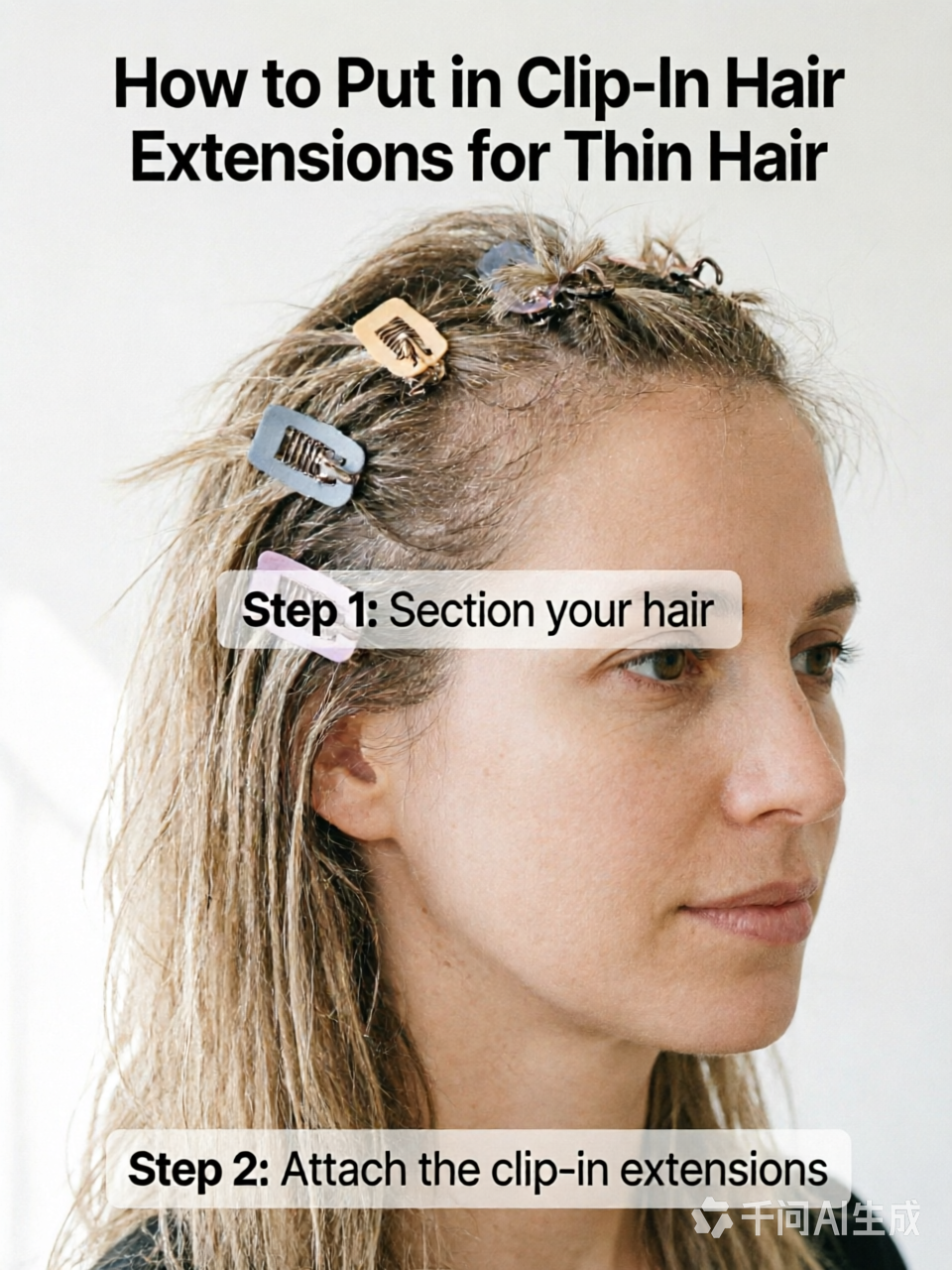
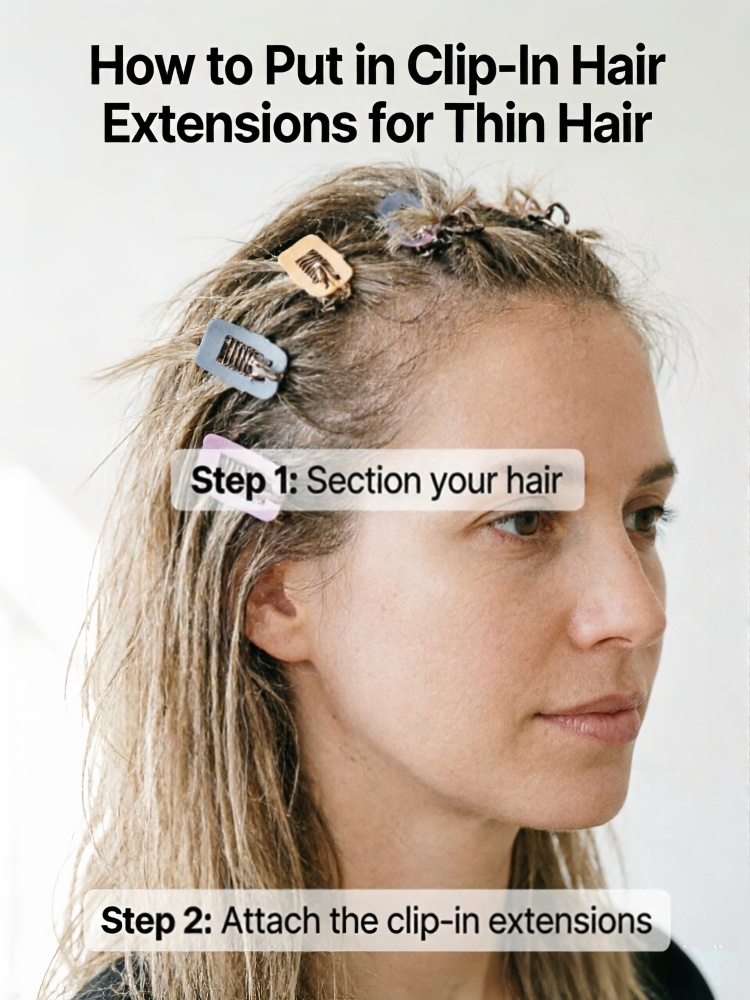
Clip-ins require more sectioning.
The user needs to:
- Divide the natural hair.
- Open the clips.
- Position each weft.
- Secure the clips.
- Release the next section.
- Repeat.
- Blend the final hairstyle.
Depending on the number of pieces, 5–20 minutes is a reasonable practical range for many users.
Winner: Halo
If speed is the priority, halo extensions clearly have the advantage.
Halo Hair Extensions vs Clip-Ins: Which Is More Comfortable?
Comfort is more complicated than simply asking which product is lighter.
Halo
The halo wire distributes the extension around the crown rather than attaching multiple clips to individual sections.
This can be attractive to clients who dislike the feeling of clips pulling on their hair.
Clip-Ins
Clip-ins place the attachment force at several individual points.
If the clips are too tight, too heavy, or installed on weak sections of hair, they can become uncomfortable.
This is particularly important for fine or fragile hair.
However, a properly fitted lightweight clip-in set can still be comfortable for many users.
Winner: Halo for Simplicity
For clients who prioritize minimal attachment points, halo generally has the advantage.

Which Is Better for Thin or Fine Hair?
This is one of the most important questions behind the search.
The answer is usually halo for very fine hair, but it depends on density and total weight.
A halo does not use multiple clips gripping sections of hair. That can make it appealing to clients with fine or fragile hair. Current comparison guides frequently position halo as a good option for fine or thinning hair, while noting that clip-ins can also work when the weight and placement are appropriate.
However, fine hair and thin hair are not exactly the same.
Fine hair means the individual strands have a smaller diameter.
Thin hair generally refers to lower overall hair density.
A person may have fine strands but plenty of hair. Another person may have relatively thick strands but very low density.
For either system, excessive weight can create problems.
A useful rule for buyers is:
Choose the extension weight according to natural hair density, not simply the desired length.
For Fine Hair
A lightweight halo around 80–120g may suit some clients, depending on natural density and desired result. Current commercial specifications for standard halo products commonly fall within this range.
For Thick Hair
A heavier halo or multiple clip-in wefts may blend better.
Clip-ins have an advantage because you can distribute additional pieces across more sections.
Halo vs Clip-Ins for Volume
If the goal is simply:
“I want my hair to look fuller.”
Halo can be an excellent choice.
The main weft creates broad volume across the back of the head.
But if the client says:
“I need more hair specifically around my sides and face.”
Clip-ins usually provide more control.
You can add smaller pieces exactly where you need more density.
Winner: Depends on the Type of Volume
Overall volume: Halo
Targeted volume: Clip-ins

Halo Hair Extensions vs Clip-Ins for Length
Both methods can add significant length.
However, the final result depends heavily on the relationship between extension length and natural hair length.
For example, a 20-inch extension may look very natural on shoulder-length hair when properly blended, but the same length can look less seamless on very short layered hair.
Halo extensions can provide a fast transformation because the main weft adds a large amount of hair at once.
Clip-ins offer more flexibility because the stylist can distribute different widths of hair throughout the head.
Winner: Tie
Choose halo for a quick overall transformation.
Choose clip-ins when you need more control over the blend.
Halo Hair Extensions vs Clip Ins for Styling
This is where clip-ins usually win.
Halo Styling
Halo extensions work especially well with:
- Loose waves
- Straight styles
- Down hairstyles
- Low ponytails
- Soft half-up styles
- Everyday volume
The limitation is the fixed position of the main weft.
Clip-In Styling
Because individual wefts can be placed around the head, clip-ins are more flexible for:
- High ponytails
- Braids
- Updos
- Side volume
- Face-framing
- Layered hairstyles
- Special-event styling
Current comparison guides consistently identify clip-ins as more customizable for updos and targeted placement, while halo extensions are more suited to simple, natural-looking styles.
Winner: Clip-Ins
If styling flexibility is your priority, clip-ins are the better choice.

Halo Hair Extensions vs Clip-Ins: Which Looks More Natural?
Both can look natural when properly matched.
The biggest factors are not simply the attachment method.
They include:
- Hair quality
- Color matching
- Density
- Length
- Texture
- Weight
- Blending
- Installation technique
A high-quality 100% human hair extension can generally provide a more natural appearance than low-quality synthetic hair.
For halo extensions, the main challenge is hiding the wire and creating a smooth transition between the natural hair and the single weft.
For clip-ins, the main challenge is hiding multiple clips and blending individual wefts.
Natural Appearance Winner: Tie
Product quality and blending technique matter more than the attachment system’s name.
Halo Hair Extensions vs Clip-Ins: Which Lasts Longer?
Both are temporary systems, so their lifespan depends heavily on how often you wear them.
Current sources give a broad range of about 6–12 months for good-quality halo and clip-in extensions, with some high-quality human hair products potentially lasting 12–18 months or longer when worn less frequently and maintained carefully.
One current comparison gives:
| Hair Quality | Halo | Clip-In |
|---|---|---|
| Standard Remy | About 4–8 months | About 6–12 months |
| Full cuticle hair | About 9–12+ months | About 12–18+ months |
These are reference ranges rather than guarantees.
Clip-ins may last longer because the hair is distributed across multiple wefts and the pieces can be removed after use.
But a halo can also last a year or longer when made from quality human hair and stored properly. Some current product specifications list 6–12 months as a typical halo lifespan.
Winner: Slight Advantage to Clip-Ins
For frequent users, clip-ins may offer a longer useful lifespan in some product designs.
For occasional users, either method can last well beyond a year with good care.

Halo Hair Extensions vs Clip-Ins: Which Requires Less Maintenance?
Both are relatively low-maintenance compared with semi-permanent extensions.
Neither requires:
- Weekly salon appointments
- Adhesive removal
- Tape replacement
- Keratin re-bonding
The main maintenance routine is:
Wear → Remove → Brush → Clean when necessary → Dry → Store
The difference is that clip-in users need to keep track of multiple pieces, while halo users mainly need to manage one primary piece.
Winner: Halo
The single-piece design makes the daily routine particularly simple.
Halo vs Clip Ins: Which Is Better for Daily Wear?
Both can be worn regularly, but the better choice depends on the client’s lifestyle.
Choose Halo if:
- You want fast application.
- You want one main piece.
- You dislike clips.
- You want simple volume.
- You have fine-to-medium hair.
- You want to remove the extension every evening.
Choose Clip-Ins if:
- You want customized placement.
- You need side volume.
- You frequently change hairstyles.
- You want more control over length and volume.
- You have medium-to-thick hair.
- You enjoy styling your hair.
For daily use, neither system is completely risk-free. Repeated tension, excessive weight, or poor placement can stress natural hair.

Halo Hair Extensions vs Clip-Ins for Special Events
For weddings, parties, photography, and other special events, clip-ins often have an advantage.
Why?
Stylists can position individual wefts to match the hairstyle.
For example:
Wedding updo → Clip-ins
Loose bridal waves → Halo or Clip-ins
Quick dinner hairstyle → Halo
High ponytail → Clip-ins
Extra side volume → Clip-ins
If the hairstyle exposes the crown or requires significant manipulation, clip-ins generally provide greater placement control.
Halo vs Clip-ins: Cost and Value
Prices vary considerably depending on:
- Hair origin
- Human hair quality
- Hair length
- Hair weight
- Brand
- Packaging
- Customization
- Retail vs wholesale pricing
Current retail examples show clip-in sets and halo extensions can overlap considerably in price. One current comparison lists clip-ins at about $155–$424 and halo extensions at $190–$255, while another retailer lists halo products at different prices depending on length and construction.
For B2B buyers, factory cost per gram is more useful than retail prices.
A better purchasing formula is:
Product cost ÷ total hair weight = approximate cost per gram
For example, if a 120g product costs $120, the simple product cost is $1.00 per gram.
This lets buyers compare products more accurately than package prices alone.
Which Is Better for a Hair Extension Business?
For salons, wholesalers, and private-label brands, the answer may actually be:
Offer both.
Halo and clip-in extensions target different customers.
Halo Customer
Usually wants:
- Easy application
- Quick transformation
- Low commitment
- Simple volume
- Beginner-friendly product
Clip-In Customer
Usually wants:
- More styling options
- Custom placement
- Different volume levels
- Multiple colors
- Event styling
- More control over the finished look
A brand offering both products can capture a broader temporary-extension market.

What Should Wholesale Buyers Look for?
If you are buying halo or clip-in extensions in bulk, don’t evaluate the products based only on product photographs.
Request samples and check:
Hair Quality
Is it 100% human hair?
Is the texture consistent?
Does it shed excessively?
Does it tangle after washing?
Hair Weight
Check the actual gram weight.
For halo products, current commercial examples commonly range from around 80g to 140g+, with heavier systems available.
Hair Length
Confirm whether the quoted length is measured when the hair is straight or naturally textured.
Construction
For halo:
- Wire strength
- Adjustability
- Weft density
- Optional clips
- Weft width
For clip-ins:
- Clip quality
- Number of pieces
- Weft width
- Stitching
- Clip attachment
Color Range
A serious B2B supplier should offer multiple colors, including:
- Natural black
- Brown
- Blonde
- Red
- Balayage
- Ombre
- Highlighted colors
- Custom colors
OEM/ODM
Private-label brands may also need:
- Custom labels
- Custom packaging
- Custom colors
- Custom lengths
- Custom weights
- Logo printing
- Product inserts
This is where working directly with a manufacturer can provide more flexibility than purchasing standard retail products.
Alove Hair: Halo and Clip-In Hair Extensions Manufacturer
Alove Hair is a professional human hair extension manufacturer and wholesale supplier in China, serving salons, wholesalers, distributors, and private-label hair brands worldwide.
For buyers comparing halo hair extensions vs. clip-ins, the right product depends on the target market.
A brand targeting first-time extension users may prioritize lightweight halo systems with simple application.
A salon-focused brand may prefer clip-in collections with multiple weft sizes and customizable placement.
Alove Hair can support B2B product development around:
- Hair lengths
- Hair weights
- Hair colors
- Hair textures
- Halo wire systems
- Clip-in wefts
- Packaging
- Private labels
- OEM/ODM specifications
Before a bulk purchase, buyers should test samples for:
| Test | What to Check |
|---|---|
| Hair Quality | Softness, shedding, tangling |
| Weight | Actual grams |
| Length | Actual finished length |
| Color | Consistency and accuracy |
| Halo Wire | Strength and adjustability |
| Clip | Grip and durability |
| Weft | Density and stitching |
| Styling | Curling and straightening performance |
| Washing | Hair condition after washing |
| Packaging | Protection during shipping |
For a private-label brand, the best supplier is not necessarily the one with the lowest unit price. Consistency between the sample and repeat bulk orders is often more important.
Frequently Asked Questions
Is halo better than clip-in hair extensions?
Halo is better for fast application, simple volume, and clients who prefer fewer attachment points. Clip-ins are better for customized placement, side volume, and complex hairstyles.
Are halo extensions easier to put on than clip-ins?
Yes. A halo is generally faster because it uses one main piece. Current guides commonly estimate about 1–5 minutes for halo application compared with approximately 5–20 minutes for clip-ins.
Are halo extensions better for thin hair?
They can be. Halo extensions do not use multiple clips attached directly to individual sections of hair, which can make them attractive for fine hair. However, total weight still needs to be appropriate.
Do clip-ins damage hair more than halo extensions?
Not necessarily. Both can be worn safely when properly fitted and removed. However, repeated tension from clips or excessive extension weight can stress natural hair.
Which lasts longer, halo or clip-in extensions?
Both can last approximately 6–12 months or longer with proper care. Some high-quality human hair systems can last 12–18 months or more depending on how often they are worn.
Can you sleep with halo or clip-in extensions?
Both halo and clip-in extensions are generally designed to be removed before sleeping. Removing them reduces friction and unnecessary stress and makes it easier to store the hair properly.
Which is better for a high ponytail?
Clip-ins generally provide greater flexibility for high ponytails because individual pieces can be positioned around the head. Halo extensions can be more limited because the main weft and wire are relatively fixed.
Which is better for beginners?
Halo extensions are generally easier for first-time users because you can position the main piece quickly. Clip-ins are also beginner-friendly but require more sectioning and blending.
Can halo and clip-in extensions be curled or straightened?
If they are made from suitable human hair, they can generally be heat-styled. However, frequent high-temperature styling can shorten the lifespan of the hair, so heat protection and moderate temperatures are recommended.
Can I buy halo and clip-in extensions wholesale?
Yes. Professional hair extension manufacturers can provide halo and clip-in systems for salons, distributors, wholesalers, and private-label brands. Buyers should request samples and confirm hair quality, weight, MOQ, packaging, and customization before placing a bulk order.
Final Verdict: Halo Hair Extensions vs Clip Ins
There is no universal winner in the halo hair extensions vs clip-ins comparison.
The better choice depends on what the customer values most.
Choose Halo Hair Extensions if you want:
- Fast application
- Simple daily use
- Fewer attachment points
- Easy removal
- Natural everyday volume
- A beginner-friendly product
- A good option for many fine-to-medium hair types
Choose Clip-In Extensions if you want:
- Maximum placement control
- Targeted volume
- More styling flexibility
- Better support for elaborate hairstyles
- Side and face-framing volume
- More customization
In simple terms:
Halo wins on speed and simplicity. Clip-ins win on flexibility and customization.
For hair extension brands and wholesale buyers, however, you don’t need to choose only one. Halo extensions and clip-ins solve different customer problems and can complement each other within the same product range.
The most important factors remain human hair quality, appropriate weight, accurate color matching, durable construction, and consistent manufacturing. A well-made extension that matches the customer’s hair and lifestyle will usually outperform a product chosen simply because one attachment method is considered universally “better.”
For manufacturers such as Alove Hair, offering both halo and clip-in human hair extensions also creates an opportunity to serve different customer segments—from first-time buyers looking for a 2-minute transformation to professional stylists who need complete control over placement and styling.

Jgs is a professional with 12 years of experience in hair extensions, primarily helping importers better understand hair extensions, wigs, toupee, and other related products.