
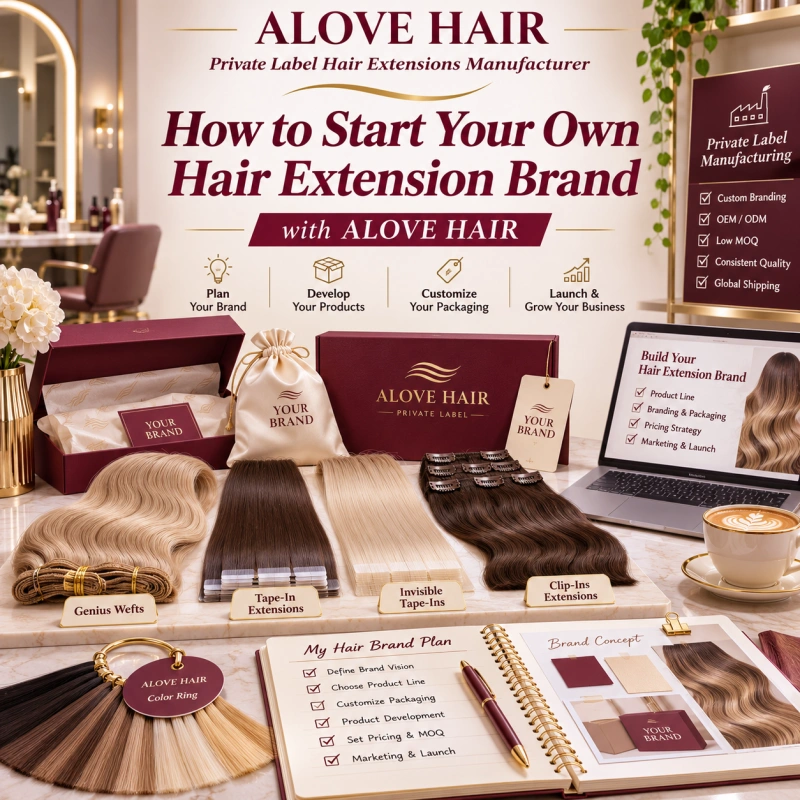
How to Start Your Own Hair Extension Brand: 12 Steps
Learning how to start your own hair extension brand involves more than finding a hair vendor, designing a logo, and launching an online store. A successful hair extension business requires a clearly defined target market, reliable product quality, competitive pricing, manageable inventory, and a manufacturing partner that can support repeat orders.
Whether you are a professional hairstylist, salon owner, beauty entrepreneur, distributor, or online retailer, developing your own brand gives you greater control over product quality, customer experience, pricing, and long-term business development.
At ALOVE HAIR, we specialize in manufacturing premium human hair extensions and providing wholesale, OEM, ODM, and private label solutions for professional hair businesses worldwide.
This guide explains how to develop your first hair extension collection, calculate startup costs, evaluate manufacturers, establish profitable pricing, and build a sustainable brand.
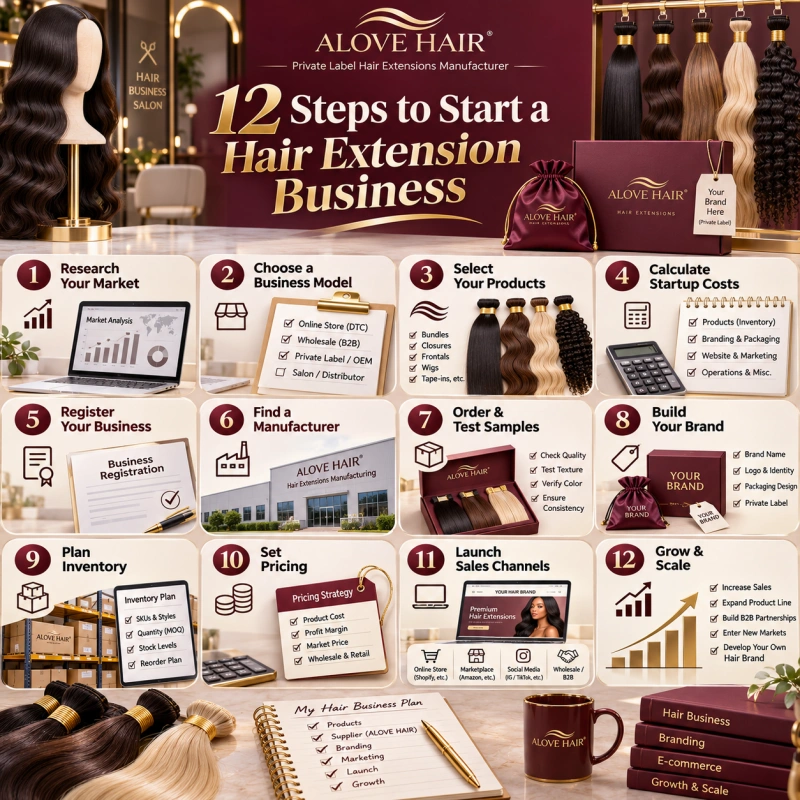
How to Start Your Own Hair Extension Brand in 12 Steps
Here is a practical roadmap for launching a hair extension business.
| Step | Main Task | Expected Outcome |
|---|---|---|
| 1 | Research your target market | Identify potential customers |
| 2 | Choose a business model | Define your revenue strategy |
| 3 | Select your first products | Create a focused product collection |
| 4 | Calculate startup costs | Establish a realistic budget |
| 5 | Register your business | Prepare your legal business structure |
| 6 | Find a reliable manufacturer | Establish your supply chain |
| 7 | Order and test samples | Approve product quality |
| 8 | Develop your brand identity | Create recognizable branding |
| 9 | Plan inventory and packaging | Reduce initial financial risk |
| 10 | Establish pricing | Calculate margins and break-even volume |
| 11 | Launch your sales channels | Generate your first orders |
| 12 | Monitor performance and expand | Build a sustainable business |
You do not need to offer every type of hair extension immediately. Starting with a smaller, well-tested collection is often more manageable than launching hundreds of products without proven customer demand.
1. Identify Your Target Hair Extension Market
Before contacting manufacturers, determine who will purchase your products and why they should choose your brand.
The hair extension market includes professional salons, independent stylists, beauty retailers, online consumers, wholesalers, and distributors. Each customer group has different purchasing requirements.
Choose a Profitable Customer Segment
| Target Customer | Main Purchasing Requirements | Suitable Products |
|---|---|---|
| Professional salons | Consistent quality and reliable replenishment | Genius Wefts, Tape-Ins, K-Tips |
| Independent hairstylists | Flexible quantities and accurate color matching | Hand-Tied Wefts, Invisible Tape-Ins |
| Online consumers | Easy application and clear color guidance | Clip-Ins, Halo Extensions |
| Premium beauty brands | Product differentiation and customization | Cuticle-intact Remy extensions |
| Wholesale distributors | Competitive pricing and stable bulk supply | Multiple professional extension methods |
| Hair extension academies | Standardized training products and tools | Wefts, Tape-Ins, K-Tips |
| Beauty supply stores | Attractive packaging and manageable inventory | Clip-Ins, Tape-Ins, Ponytails |
A brand targeting luxury American salons will require a different product range from an online store selling removable hair extensions to first-time users.
Explore our professional human hair extensions collection to understand the product formats available for different business models.
Conduct Customer Research Before Purchasing Inventory
As a practical starting point, interview 10–20 potential customers or professional stylists.
Ask them:
- Which extension methods do they purchase most frequently?
- Which lengths and colors sell consistently?
- What problems do they experience with existing suppliers?
- How often do they reorder hair extensions?
- What price range is acceptable for their target customers?
- Would they consider switching to a new brand?
Record their answers before developing your first collection.
The objective is to identify a customer problem worth solving rather than simply choosing products that look attractive in a supplier’s catalog.
2. Choose the Right Hair Extension Business Model
There are several ways to establish your own hair extension brand.
Your business model determines how much capital you need, how you manage inventory, and how you acquire customers.
| Business Model | Initial Investment | Inventory Requirements | Main Advantage |
|---|---|---|---|
| Salon private label brand | Low to medium | Limited to service demand | Existing customer relationships |
| Direct-to-consumer online brand | Medium | Depends on product range | Control over retail pricing |
| Wholesale salon supplier | Medium to high | Professional product inventory | Potential recurring orders |
| Hair extension distributor | High | Larger stock requirements | Higher-volume sales opportunities |
| Dropshipping brand | Relatively low | Minimal owned inventory | Lower initial inventory exposure |
| Custom OEM brand | Medium to high | Project-dependent | Greater product differentiation |
Salon Private Label Business
Salon owners already have direct access to customers who use hair extensions.
Instead of purchasing products exclusively from established brands, salons can develop their own signature collections and build customer loyalty around their services.
Online Hair Extension Brand
Online brands can reach customers across different geographic markets.
However, they must invest in product photography, color matching guidance, website development, customer acquisition, fulfillment, and returns management.
Wholesale Hair Extension Business
Wholesale businesses supply products to professional salons, hairstylists, beauty stores, and regional distributors.
Although wholesale selling prices are generally lower than direct retail prices, repeat orders can support more predictable inventory planning.
Dropshipping vs Factory-Direct Private Label
Dropshipping can reduce the amount of money invested in inventory, but it may provide less control over product construction, packaging, stock availability, and fulfillment.
Factory-direct private labeling usually requires more planning and inventory investment but offers greater opportunities to establish your own product specifications and brand identity.
3. Choose the Best Hair Extensions to Sell Under Your Brand
One of the most important decisions when starting a hair extension company is selecting the right products.
Not every extension method is suitable for every customer or sales channel.
Genius Weft Hair Extensions
Genius Wefts are popular among professional stylists because of their relatively thin, flexible attachment construction and suitability for various weft installation methods.
They are particularly relevant for brands targeting premium salon services.
Our Genius Weft and Micro Weft Hair Extensions can serve as the foundation of a professional salon-focused product collection.
Best for: Premium extension brands, salon chains, independent stylists, and professional distributors.
Hand-Tied Weft Hair Extensions
Hand-tied extensions feature a delicate handcrafted weft structure designed to provide lightweight, low-profile installation.
Our Hand-Tied Hair Extensions are suitable for businesses targeting professional weft specialists and luxury salons.
Best for: Premium salons and specialist extension studios.
Invisible Tape-In Hair Extensions
Invisible tape-ins use a discreet attachment structure designed to imitate natural hair growth and conceal the bonding area.
For brands serving customers who prioritize discreet attachment points, Invisible Tape-In Hair Extensions offer an opportunity to develop a premium collection.
Best for: Professional salons, fine-hair extension specialists, and premium beauty brands.
K-Tip Hair Extensions
K-Tips are individual pre-bonded extensions used in professional keratin fusion installations.
They allow stylists to customize the distribution of hair strands according to the client’s natural hair and desired result.
Our K-Tip Hair Extensions are designed for professional extension businesses offering strand-by-strand installation services.
Best for: Luxury salons, fusion extension specialists, and professional wholesalers.
Clip-In Hair Extensions
Clip-ins are removable extensions that customers can generally apply and remove without a permanent attachment method.
Because they do not require the same level of professional installation as bonded extensions, our Clip-In Hair Extensions are particularly relevant to consumer-facing online brands.
Best for: E-commerce stores, beauty retailers, bridal businesses, and direct-to-consumer brands.
Halo Hair Extensions
Halo extensions use an adjustable wire system to add temporary length and volume.
Our Halo Hair Extensions provide another option for brands targeting consumers seeking removable hair products.
Best for: Online retailers and brands specializing in temporary hair transformations.
Product Selection Comparison for New Hair Brands
| Product | Recommended Sales Channel | Installation Skill | Initial Product Complexity |
|---|---|---|---|
| Genius Weft | Professional salons | Professional | Medium |
| Hand-Tied Weft | Luxury salons | Professional | Medium |
| Invisible Tape-In | Salons and specialist brands | Professional | Medium |
| K-Tip | Professional salons | Professional | Medium to high |
| Clip-In | Online and retail | Relatively low | Medium |
| Halo | Online and retail | Relatively low | Low to medium |
For a new brand, we recommend selecting one main attachment method and developing a clear competitive advantage before expanding into additional product categories.
4. How Much Does It Cost to Start a Hair Extension Brand?
The cost of launching a hair extension brand depends on your product quality, inventory quantity, business model, packaging, marketing strategy, and location.
An established salon launching a small private label collection may need significantly less capital than a distributor developing a nationwide professional supply business.
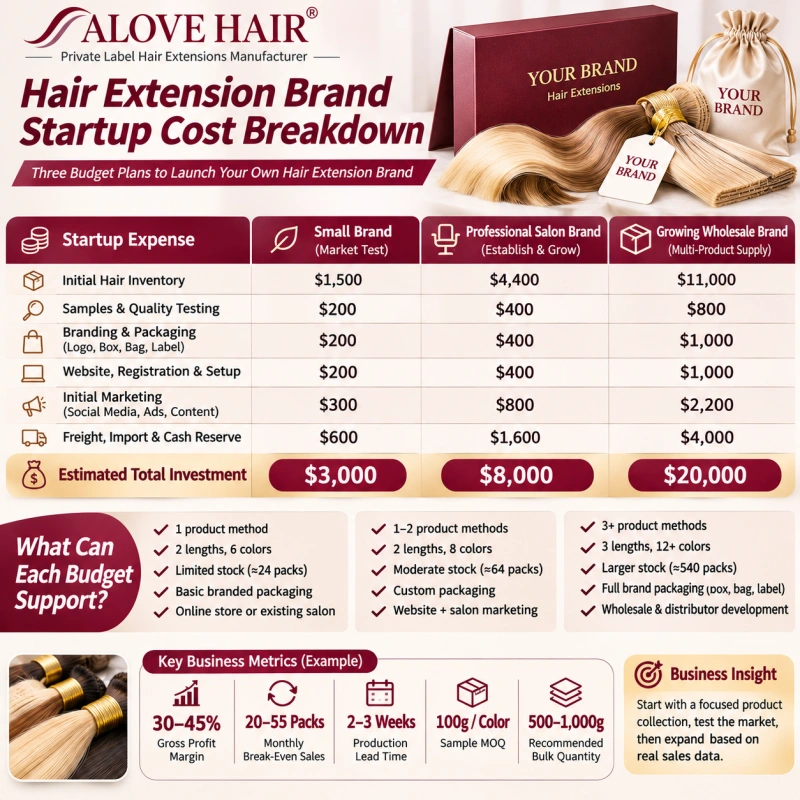
Hair Extension Business Startup Cost Breakdown
The following budgets are illustrative planning scenarios in US dollars, not current factory quotations or guaranteed startup requirements.
| Startup Expense | Small Brand | Professional Salon Brand | Growing Wholesale Brand |
|---|---|---|---|
| Initial hair inventory | $1,500 | $4,400 | $11,000 |
| Product samples and testing | $200 | $400 | $800 |
| Branding and packaging | $200 | $400 | $1,000 |
| Website, registration and setup | $200 | $400 | $1,000 |
| Initial marketing | $300 | $800 | $2,200 |
| Freight, import costs and cash reserves | $600 | $1,600 | $4,000 |
| Estimated total | $3,000 | $8,000 | $20,000 |
These examples assume that the founder does not need to lease a new salon, hire a full-time team, or establish a dedicated warehouse.
Actual startup expenses can be higher or lower depending on the business structure.
The U.S. Small Business Administration recommends estimating startup expenses and ongoing operating costs before launching a business.
What Can a $3,000 Startup Budget Support?
A small startup might focus on:
- One main product method
- Two lengths
- Six colors
- Limited stock per product variation
- Simple branded packaging
- A basic online store or existing salon sales channel
- Representative product samples
For example, 24 packs at an assumed purchase price of $60 each would require $1,440 in initial product inventory.
However, this small quantity may not meet a manufacturer’s custom production minimums. A startup may need to use available standard products, reduce its assortment, or arrange preorders before investing in a fully customized collection.
What Can an $8,000 Budget Support?
A professional salon brand could consider a broader color assortment, more representative product testing, improved packaging, and additional working capital.
The advantage of a salon-based launch is that existing service customers can help validate product demand before the brand invests heavily in external marketing.
What Can a $20,000 Budget Support?
A growing wholesale business may develop multiple product lengths and colors, professional sample kits, more substantial inventory, salon account development, and a larger replenishment reserve.
Even with a larger budget, we recommend expanding based on customer demand rather than buying every available product variation.
5. Register Your Hair Extension Business and Protect Your Brand
Before investing in custom packaging, confirm that your proposed brand name is available and that your business meets applicable local requirements.
Depending on your country and business model, you may need to:
- Register a legal business entity.
- Register your business or trading name.
- Obtain applicable tax registrations.
- Arrange relevant business insurance.
- Open a business bank account.
- Establish payment processing.
- Confirm import and product labeling requirements.
- Develop shipping, refund, and warranty policies.
- Check applicable trademark requirements.
For businesses launching in the United States, the United States Patent and Trademark Office provides trademark search resources that can help identify potentially conflicting brand names.
Selling hair extensions and providing professional installation services may also be subject to different licensing requirements.
Confirm the rules in your operating jurisdiction before opening a salon or offering installation services.
6. Find a Reliable Hair Extension Manufacturer
The quality of your supplier will influence nearly every aspect of your brand, including customer satisfaction, repeat purchases, product returns, and profitability.
There are three common sourcing options.
| Supplier Type | Main Advantages | Potential Limitations |
|---|---|---|
| Local wholesale supplier | Faster access to available inventory | Limited manufacturing control |
| Trading company | Convenient sourcing across multiple factories | Actual production source may be less transparent |
| Direct manufacturer | Greater customization and production communication | Requires more detailed purchasing and import planning |
You can use our hair extension manufacturers comparison guide as an initial reference when researching potential suppliers.
Questions to Ask a Hair Extension Manufacturer
Before placing a wholesale order, ask the manufacturer the following questions.
| Evaluation Area | Questions to Ask |
|---|---|
| Business identity | Are you a manufacturer, trading company, or distributor? |
| Hair material | What hair material and cuticle condition can you document? |
| Sourcing | Can you provide relevant material sourcing information? |
| Production | Which manufacturing processes are completed in-house? |
| Customization | Can you customize lengths, weights, shades, and attachment structures? |
| MOQ | What is the minimum quantity per color, length, and product type? |
| Samples | Can I purchase representative samples before bulk production? |
| Quality control | How do you test hair quality and finished products? |
| Packaging | What are the minimum quantities for custom packaging? |
| Lead time | How long do samples and repeat orders take? |
| After-sales | How are verified product quality problems handled? |
At Qingdao ALOVEHAIR Products Co., Ltd., we developed our ALOVE HAIR brand in 2014 and focus on professional human hair manufacturing for salons, hairstylists, distributors, and private label businesses.
Our product development approach emphasizes cuticle-intact Remy human hair, color consistency, and professional attachment construction.
Manufacturing Insight: Compare Specifications, Not Hair Grade Names
Suppliers often describe their products as 8A, 10A, 12A, luxury grade, or premium grade.
These labels do not represent a single universally standardized hair grading system.
A 12A product from one supplier may not be equivalent to a 12A product from another.
We recommend comparing approved physical samples, hair weight, length distribution, cuticle condition, color quality, attachment construction, and performance after washing.
A written product specification is more useful than a grade name alone.
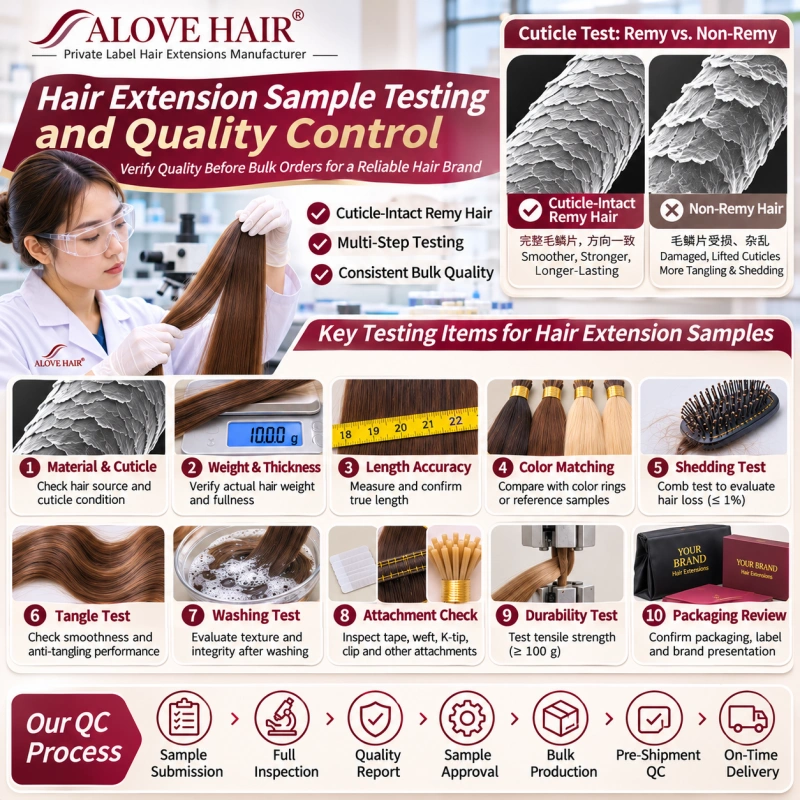
7. Order Hair Extension Samples and Test Product Quality
Never approve a large manufacturing order based solely on supplier photographs or promotional videos.
A product sample should represent the actual specifications you intend to purchase.
Recommended Hair Extension Sample Testing Process
| Testing Area | What to Evaluate |
|---|---|
| Hair material | Appearance and agreed material specification |
| Cuticle condition | Alignment and surface condition |
| Weight | Actual hair and attachment weight |
| Length | Agreed measurement method |
| End fullness | Distribution of shorter and longer hair fibers |
| Color accuracy | Comparison with physical reference samples |
| Washing performance | Texture and manageability after washing |
| Shedding | Hair loss under comparable test conditions |
| Tangling | Ease of brushing and detangling |
| Weft quality | Seam thickness, stitching and flexibility |
| Tape quality | Attachment integrity and adhesive performance |
| Keratin quality | Bond size and consistency |
We recommend testing more than one color, particularly if you plan to launch a collection containing dark shades, platinum blonde, balayage, and rooted colors.
Blonde hair may require different processing from darker hair, so a satisfactory dark sample does not automatically establish the performance of every lighter shade.
Example of a Clear Product Specification
Our Cuticle Intact Invisible Tape-In Extensions have a published configuration of:
| Product Parameter | Specification |
|---|---|
| Hair material | Luxury Remy human hair |
| Pack weight | 100g |
| Pieces per pack | 40 |
| Nominal average piece weight | 2.5g |
| Attachment size | 1 × 4 cm |
| Customizable options | Selected colors and lengths |
This level of product detail helps a new brand establish its product descriptions, purchasing specifications, installation planning, and inventory records.
Final approved specifications should also identify the measurement method and acceptable production tolerances.
Manufacturing Insight: Keep a Reference Sample
Once you approve a sample, retain it as a reference for subsequent deliveries.
Record the supplier, product code, color number, length, weight, approval date, and attachment dimensions.
A reference sample makes it easier to investigate quality differences between future production batches.
8. Develop Your Hair Extension Brand Identity and Packaging
Your brand should communicate who your products are designed for and why customers should purchase them.
For example:
- A luxury weft brand may emphasize discreet attachment construction and premium salon results.
- A clip-in brand may emphasize convenience and accurate color matching.
- A wholesale salon supplier may emphasize consistent specifications and dependable replenishment.
Essential Brand Development Elements
| Branding Element | Purpose |
|---|---|
| Brand name | Customer recognition |
| Logo | Visual identity |
| Brand colors | Consistent presentation |
| Product names | Clear collection organization |
| Product photography | Demonstrate texture, color and construction |
| Color chart | Improve product selection |
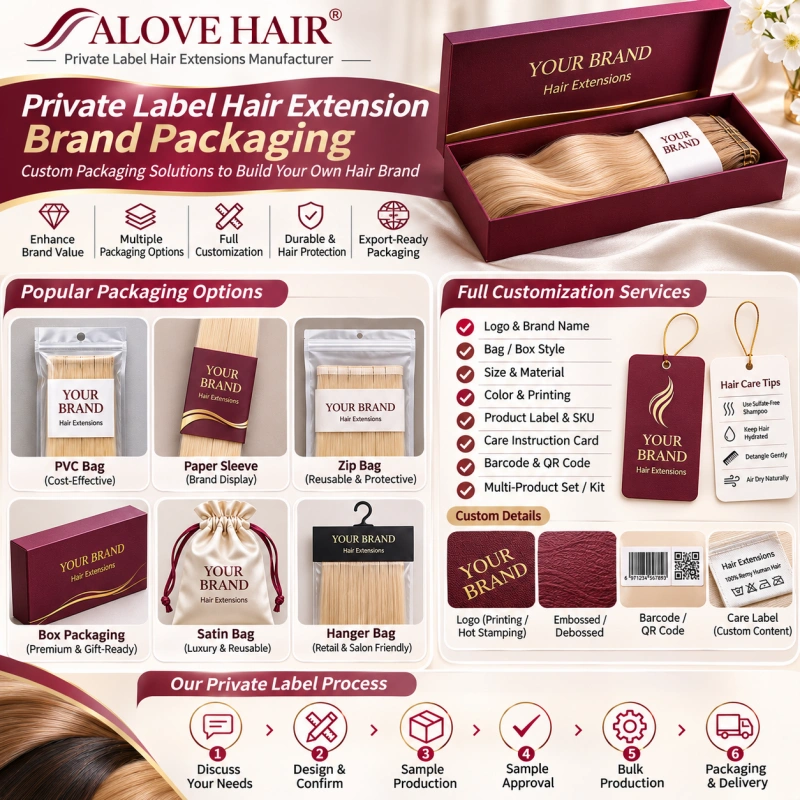
| Custom packaging | Communicate brand positioning |
| Care instructions | Improve customer education |
| SKU labels | Reduce ordering and inventory errors |
A professional brand does not necessarily require expensive luxury packaging at launch.
For a small business, standardized protective bags with custom branded labels may be more practical than ordering several hundred fully customized boxes.
As sales increase, you can introduce printed sleeves, premium retail boxes, branded storage bags, or complete professional salon kits.
Private Label Packaging vs Custom OEM Products
Private label services allow you to sell approved products under your own branding.
OEM manufacturing provides additional opportunities to specify product weights, attachment dimensions, colors, textures, and other manufacturing details.
Through our China hair extension factory, ALOVE HAIR supports businesses seeking direct manufacturing cooperation and customized hair extension solutions.
New brands can begin with simpler private label arrangements and gradually introduce more advanced product customization as demand develops.
9. Plan Your First Hair Extension Inventory
Inventory planning is one of the most overlooked aspects of starting a hair extension business.
Every combination of length, color, attachment method, and package weight creates a separate stock-keeping unit, or SKU.
Hair Extension SKU Calculation
Number of SKUs = Product methods × Lengths × Colors × Pack configurations
Imagine a new brand offering:
- 3 extension methods
- 4 lengths
- 15 colors
- 2 pack weights
This creates 360 SKUs.
Buying just three packs of each SKU would require 1,080 packs.
At an assumed purchase price of $70 per pack, the initial product investment would be $75,600, before shipping, packaging, and other business costs.
A large catalog can therefore create a significant financial burden before a brand has established reliable sales.
Recommended Inventory Models for New Brands
| Launch Model | Methods | Lengths | Colors | Packs per SKU | Total Packs |
|---|---|---|---|---|---|
| Small market test | 1 | 2 | 6 | 2 | 24 |
| Professional salon launch | 1 | 2 | 8 | 4 | 64 |
| Growing brand | 2 | 2 | 9 | 4 | 144 |
| Established distributor | 3 | 3 | 12 | 5 | 540 |
These examples assume one pack configuration. They illustrate inventory exposure rather than guaranteed factory order quantities.
ALOVE HAIR’s general published MOQ and production guidelines are:
| Order Type | General Guideline |
|---|---|
| Samples | From 100g per color |
| Recommended bulk quantity | 500–1,000g per color |
| Typical sample production | 1–2 weeks |
| Typical bulk production | 2–3 weeks |
| Custom packaging MOQ | Confirmed according to project |
| International delivery | Depends on destination and shipping method |
The recommended bulk quantity is equivalent to five to ten 100g packs by weight.
A buyer should confirm whether minimums apply to the total color quantity, each individual length-and-color combination, or another production unit.
Use an ABC Inventory Strategy
After launching your brand, group products according to actual sales performance.
| Inventory Group | Product Characteristics | Purchasing Strategy |
|---|---|---|
| A products | Frequently purchased colors and lengths | Prioritize stock availability |
| B products | Moderate or seasonal demand | Maintain controlled quantities |
| C products | Infrequent demand or specialty shades | Use smaller orders or preorders |
Do not classify products as high-demand solely because a competitor sells them.
Your own customer base should determine which products receive the largest inventory investment.
10. Calculate Hair Extension Prices and Profit Margins
A profitable hair extension business requires more than adding a markup to the manufacturer’s price.
You must consider the complete cost of acquiring, storing, marketing, selling, and delivering each product.
Calculate Your Landed Cost
The landed cost of hair extensions may include:
- Manufacturing price
- Custom packaging
- International freight
- Import duties and applicable taxes
- Customs clearance
- Inspection expenses
- Other inbound handling costs
Example: Landed Cost per Pack
| Cost Component | Illustrative Cost |
|---|---|
| Hair extensions | $75 |
| Custom packaging | $3 |
| International freight allocation | $6 |
| Import and handling allocation | $6 |
| Total landed cost | $90 |
These are hypothetical costs, not current factory prices or customs duty rates.
Retail vs Wholesale Hair Extension Profitability
The following example compares the same $90 landed-cost product under two selling models.
| Cost or Revenue | Direct Retail | Wholesale |
|---|---|---|
| Selling price | $199 | $135 |
| Landed product cost | $90 | $90 |
| Outbound shipping and fulfillment | $10 | $5 |
| Payment processing | $6 | $4 |
| Returns and warranty allowance | $8 | $6 |
| Customer acquisition or sales cost | $25 | $8 |
| Contribution profit per pack | $60 | $22 |
| Contribution margin | 30.2% | 16.3% |
Retail sales may generate higher contribution profit per unit, while wholesale relationships may offer larger orders and repeat purchasing opportunities.
These margins exclude fixed business expenses and income taxes.
Actual profitability depends on your selling price, negotiated purchasing costs, marketing efficiency, order size, and return rates.
How Many Hair Extensions Do You Need to Sell to Break Even?
According to the SBA break-even analysis method, break-even sales volume is calculated by dividing fixed costs by the contribution per unit.
Break-even units = Monthly fixed costs ÷ Contribution per pack
Assuming monthly fixed operating costs of $1,200:
| Business Model | Contribution per Pack | Monthly Break-Even Sales |
|---|---|---|
| Direct retail | $60 | 20 packs |
| Wholesale | $22 | 55 packs |
The calculation shows why a lower-margin wholesale business needs higher sales volume to cover the same operating expenses.
Business Insight: Revenue Is Not the Same as Available Cash
A business may appear profitable while experiencing cash-flow problems.
For example, you may need to pay for your next manufacturing order before selling all the products from your previous shipment.
Maintain a cash reserve for production deposits, shipping, marketing, warranty claims, and unexpected expenses.
Avoid spending your entire startup budget on the first inventory order.
11. Build Your Hair Extension Website and Marketing Strategy
Once your products, branding, and prices are approved, establish a reliable sales channel.
Build Product Pages That Answer Customer Questions
Every hair extension product page should include:
- Hair material and quality description
- Product attachment method
- Available lengths
- Color options
- Pack weight
- Number of pieces
- Close-up attachment photographs
- Installation requirements
- Care instructions
- Shipping and return policies
For professional salon products, include detailed specifications that help stylists estimate the quantity required for different services.
Clear product information can also reduce unnecessary customer service inquiries and prevent ordering mistakes.
Use Google SEO to Generate Long-Term Traffic
Hair extension brands should target keywords at different stages of the purchasing journey.
| Content Category | Example Keyword | Customer Intent |
|---|---|---|
| Product education | What are Genius Weft extensions? | Informational |
| Product comparison | Tape-In vs K-Tip extensions | Commercial investigation |
| Product selection | Best extensions for fine hair | Commercial investigation |
| Pricing | How much do hair extensions cost? | Purchase research |
| Product specification | Hair extension length chart | Product research |
| Professional purchasing | Wholesale hair extensions | Transactional |
| Brand purchasing | Private label hair extensions | B2B sourcing |
Each article should direct interested visitors toward a relevant product, collection, consultation, or wholesale purchasing page.
Create Instagram and TikTok Content
Hair extensions are visual products.
Useful social media content may include:
- Before-and-after transformations
- Color matching demonstrations
- Professional installation videos
- Hair texture comparisons
- Product unboxing
- Washing and maintenance demonstrations
- Customer education
- Stylist interviews
Use genuine product demonstrations and obtain permission before publishing customer photographs or videos.
Develop Professional Salon Accounts
For a B2B hair extension brand, direct relationships with professional stylists may be more valuable than a large but unqualified social media following.
Start with a focused prospect list.
An example monthly salon outreach plan could include:
| Sales Activity | Example Monthly Target |
|---|---|
| Research qualified salons | 100 |
| Send personalized introductions | 60 |
| Conduct product consultations | 15 |
| Provide professional sample kits | 8 |
| Develop trial wholesale accounts | 3–5 |
These are suggested activity targets, not guaranteed conversion results.
Track each prospect’s product preferences, purchasing requirements, and follow-up schedule.
Increase Customer Lifetime Value
Hair extension brands can create additional revenue through compatible maintenance and installation products.
For example, brands selling tape-in extensions may also offer replacement tapes for professional extensions.
A complete professional supply system can include color rings, application tools, beads, needles, and other hair extension accessories.
The objective is to become a dependable supply partner rather than a one-time product vendor.
12. Establish a Reliable Reordering and Quality Management System
A successful first order is only the beginning of a hair extension business.
Your long-term reputation depends on whether customers receive consistent products when they reorder.
Calculate Your Inventory Reorder Point
Reorder point = Average weekly demand × Total replenishment lead time + Safety stock
Consider a product selling five packs per week.
Assume:
- Production, shipping and receiving lead time: 4 weeks
- Safety stock: 10 packs
Reorder point = 5 × 4 + 10 = 30 packs
Under these assumptions, the brand should initiate replenishment when its inventory position reaches approximately 30 packs.
Actual lead times must include production, transportation, customs clearance, and receiving rather than factory production time alone.
Track Essential Hair Extension Business Metrics
| Metric | Why It Matters |
|---|---|
| Sales by SKU | Identifies the most commercially successful products |
| Gross product margin | Evaluates product-level profitability |
| Contribution margin | Accounts for variable selling expenses |
| Customer acquisition cost | Measures marketing efficiency |
| Return rate | Identifies product or purchasing problems |
| Repeat purchase rate | Measures customer loyalty |
| Inventory sell-through | Helps control excess stock |
| Stockout frequency | Identifies replenishment problems |
| Supplier on-time delivery | Evaluates supply chain reliability |
| Quality complaint rate | Supports manufacturing improvements |
Review these metrics regularly before introducing new colors, lengths, or attachment systems.
A 90-Day Hair Extension Brand Launch Plan
A structured launch schedule helps coordinate business registration, product development, inventory planning, and marketing.
| Period | Main Activities |
|---|---|
| Days 1–15 | Market research, customer interviews and business model selection |
| Days 16–30 | Supplier evaluation, sample requests and brand development |
| Days 31–45 | Sample testing, pricing calculations and initial marketing preparation |
| Days 46–60 | Final product approval, packaging approval and production order |
| Days 61–75 | Production, website development and salon outreach |
| Days 76–90 | Receiving, inspection, initial sales and customer feedback |
This schedule is a planning example rather than a guaranteed production or delivery timeline.
Complex custom colors, extended wear testing, international shipping, or additional packaging development may require more time. Product quality should take priority over an arbitrary launch date.
Example Case Study: Launching a $8,000 Professional Hair Extension Brand
Consider a hypothetical US salon owner who wants to develop a private label Genius Weft collection.
Instead of launching several different attachment methods, the founder begins with one professional product family.
Initial Product Collection
| Product Specification | Example Configuration |
|---|---|
| Target customers | Professional salons and stylists |
| Product | Genius Weft extensions |
| Hair material | Cuticle-intact Remy human hair |
| Lengths | 18 and 22 inches |
| Color range | 8 selected shades |
| Number of SKUs | 16 |
| Packs per SKU | 4 |
| Pack weight | 100g |
| Total inventory | 64 packs |
| Total hair weight | 6.4kg |
The proposed quantities would need to be confirmed against the manufacturer’s applicable production minimums.
Initial Product Investment
Assuming a negotiated purchase price of $65 per pack:
64 packs × $65 = $4,160
The remaining $3,840 of the $8,000 budget can support sample testing, branding, packaging, shipping, website development, initial marketing, and cash reserves.
First Sales Scenario
Assume the brand achieves an average landed cost of $80 per pack and a wholesale selling price of $135.
| Sales Scenario | Example Result |
|---|---|
| Initial inventory | 64 packs |
| Packs sold | 40 |
| Sales revenue | $5,400 |
| Landed cost of products sold | $3,200 |
| Gross product profit | $2,200 |
| Gross product margin | 40.7% |
| Remaining inventory | 24 packs |
| Remaining inventory at landed cost | $1,920 |
The $2,200 gross product profit does not include marketing expenses, payment fees, outbound fulfillment, fixed overhead, or taxes.
The remaining 24 packs also represent inventory capital that has not yet been recovered through sales.
This hypothetical case demonstrates how a focused collection can help a founder monitor demand and plan replenishment without immediately committing to hundreds of product variations.
It does not represent an actual ALOVE HAIR customer transaction or guaranteed business performance.
10 Common Mistakes When Starting a Hair Extension Brand
| Common Mistake | Recommended Solution |
|---|---|
| Launching too many products | Start with one main attachment method |
| Choosing a supplier based only on price | Compare samples and written specifications |
| Skipping sample testing | Conduct representative product evaluations |
| Using unverified hair grade claims | Establish measurable quality criteria |
| Buying too many slow-selling shades | Use customer research and sales data |
| Overspending on luxury packaging | Increase packaging investment gradually |
| Ignoring import and shipping costs | Calculate complete landed cost |
| Setting prices without margin analysis | Include all relevant variable expenses |
| Depending on one marketing channel | Combine SEO, social media and direct sales |
| Spending all available startup capital | Maintain working capital and replenishment reserves |
A successful brand is built through controlled product development and consistent customer experience, not simply through the size of its initial catalog.
Why Choose ALOVE HAIR as Your Hair Extension Manufacturing Partner?
ALOVE HAIR supports professional hair businesses looking to develop their own branded extension collections.
Our manufacturing and wholesale solutions include:
| Service | Business Benefit |
|---|---|
| Cuticle-intact Remy human hair | Supports premium product positioning |
| Multiple extension methods | Enables product collection development |
| Custom colors | Supports brand differentiation |
| Custom lengths and weights | Adapts products to customer requirements |
| OEM/ODM development | Provides additional manufacturing customization |
| Private label packaging | Helps businesses establish their own identity |
| Sample orders | Supports product evaluation before production |
| Wholesale purchasing | Enables recurring professional supply |
| Pre-shipment inspection | Helps identify product quality issues before delivery |
| International shipping arrangements | Supports overseas customers |
Whether you are a first-time entrepreneur, an established salon owner, or a wholesale distributor, we recommend starting with a clearly defined product brief and representative samples.
This allows both the buyer and manufacturer to agree on realistic specifications, pricing, minimum quantities, and production requirements.
Frequently Asked Questions
Is starting a hair extension brand profitable?
A hair extension business can be profitable when product quality, pricing, customer acquisition costs, inventory turnover, and operating expenses are managed effectively.
Profitability varies considerably between businesses and is not guaranteed.
How much money do I need to start my own hair extension brand?
The required investment depends on the business model.
A small market-test collection might be planned around $3,000, while a professional salon brand or wholesale business might require $8,000–$20,000 or more.
These are illustrative budgets rather than universal startup requirements.
What are the best hair extensions to sell as a new brand?
For professional salon customers, Genius Wefts, Invisible Tape-Ins, Hand-Tied Wefts, and K-Tips are relevant options.
For consumer-facing online stores, Clip-Ins and Halo Extensions may be more appropriate because they are removable products.
Can I start a hair extension brand without owning a factory?
Yes. You can work with an OEM or private label manufacturer to produce hair extensions under your own brand.
This avoids the need to establish your own hair processing and manufacturing facilities.
Can I start a hair extension business with no inventory?
Dropshipping and carefully managed preorder arrangements may reduce initial inventory requirements.
However, you still need to evaluate product quality, fulfillment reliability, customer acquisition costs, and applicable consumer protection requirements.
What is the minimum order quantity for private label hair extensions?
MOQ depends on product type, color, length, packaging, and customization requirements.
ALOVE HAIR’s general published sample MOQ is 100g per color, with 500–1,000g per color recommended for larger orders.
Final production minimums should be confirmed individually.
How do I find trustworthy hair extension vendors?
Verify business identity, manufacturing capabilities, product specifications, sample performance, pricing transparency, quality control, delivery terms, and after-sales policies.
Do not rely exclusively on photographs, social media followers, or hair grade descriptions.
How long does it take to launch a hair extension brand?
A straightforward launch may be planned over approximately 90 days.
The actual timeline depends on business registration, sample development, product testing, packaging, manufacturing, shipping, and marketing preparation.
How can I sell my own hair extension brand to salons?
Develop professional product samples, a color chart, wholesale price information, a clear ordering process, and reliable replenishment support.
Contact salons that already provide extension services and demonstrate how your products meet their specific purchasing requirements.
Can ALOVE HAIR manufacture hair extensions with my own logo?
Yes. ALOVE HAIR provides private label packaging and customized manufacturing solutions for eligible projects.
The exact product and packaging requirements should be confirmed before production.
Start Your Own Hair Extension Brand With ALOVE HAIR
Building a successful hair extension brand begins with choosing the right products, developing a focused business strategy, and establishing a dependable manufacturing relationship.
You do not need to launch the largest product collection in your market.
You need products that meet customer expectations, a pricing model that supports sustainable profitability, and a supply chain capable of delivering consistent quality as your business grows.
At ALOVE HAIR, we help professional salons, hairstylists, beauty entrepreneurs, distributors, and established brands develop customized human hair extension collections.
To receive a relevant wholesale or private label quotation, prepare the following information.
| Project Information | Your Requirements |
|---|---|
| Target market | Country and customer group |
| Business model | Salon, online retail, wholesale or distribution |
| Extension type | Genius Weft, Tape-In, K-Tip or others |
| Preferred lengths | Inches or centimeters |
| Color selection | Color codes or physical samples |
| Pack weight | Required grams per pack |
| Initial order quantity | Estimated packs or kilograms |
| Packaging | Standard or customized |
| Target budget | Estimated purchasing investment |
| Launch date | Preferred delivery schedule |
Contact ALOVE HAIR to discuss your business plan, request professional hair extension samples, obtain factory-direct wholesale pricing, and develop your own private label hair extension collection.

Jgs is a professional with 12 years of experience in hair extensions, primarily helping importers better understand hair extensions, wigs, toupee, and other related products.


Leave a Reply
Want to join the discussion?Feel free to contribute!