
Private Label Hair Extensions Manufacturer: Custom OEM Solutions for Hair Brands
Are you looking for a reliable private label hair extensions manufacturer to develop your own professional hair extension collection, expand your salon business, or establish a competitive beauty brand?
At ALOVE HAIR, we specialize in manufacturing premium cuticle-intact Remy human hair extensions and providing customized OEM, ODM, wholesale, and private label solutions for hair brands, professional salons, distributors, and beauty retailers worldwide.
From Genius Wefts and Hand-Tied Wefts to Invisible Tape-In Extensions, K-Tips, Clip-Ins, and Halo Extensions, we help businesses develop products that reflect their brand identity, target customers, and commercial requirements.
Unlike purchasing standardized products from a conventional hair extension vendor, working directly with a manufacturer gives your business greater control over hair quality, attachment construction, color development, product weight, packaging, and repeat production.
As a professional human hair extensions manufacturer in China, our goal is to help you build a sustainable hair extension business, not simply supply your next order.
Your Brand. Your Specifications. Our Manufacturing Expertise.
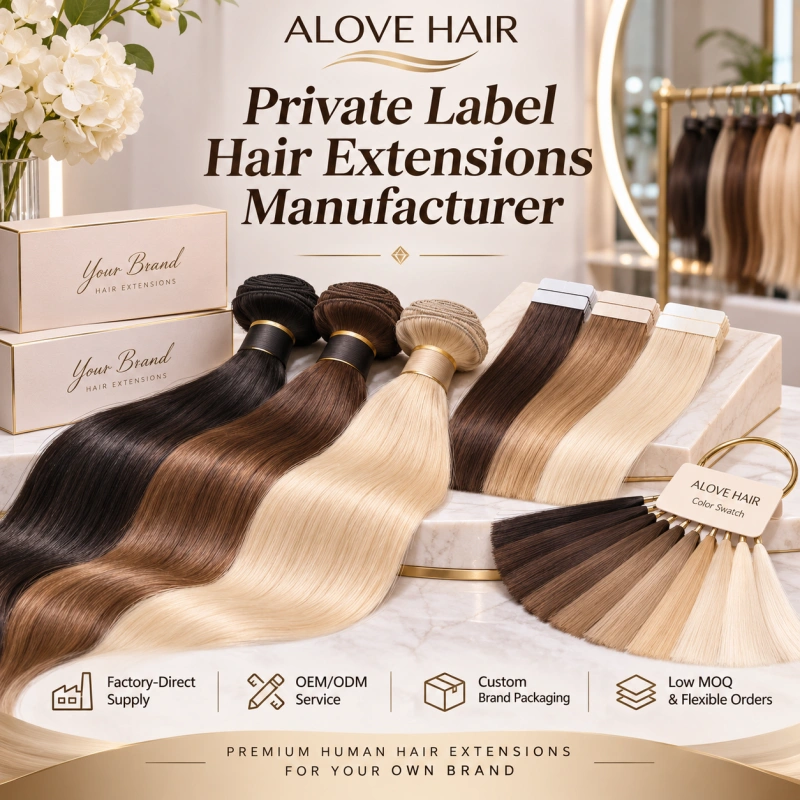
ALOVE HAIR: Your Private Label Hair Extensions Manufacturing Partner
Qingdao ALOVEHAIR Products Co., Ltd. developed its ALOVE HAIR brand in 2014, building on extensive experience in raw hair sourcing, processing, and human hair manufacturing.
Today, we support professional hair extension businesses seeking premium products, flexible customization, and factory-direct purchasing.
Our manufacturing approach focuses on material selection, cuticle protection, color development, attachment construction, and finished product quality.
Our Manufacturing and Private Label Capabilities
| Manufacturing Capability | Details |
|---|---|
| Brand established | 2014 |
| Manufacturing location | Qingdao, China |
| Hair material | Cuticle-intact Remy human hair |
| Raw material classification | 24 grades under our internal grading system |
| Manufacturing procedures | 56 processes under our published production system |
| Business model | OEM, ODM, private label and wholesale |
| Standard sample MOQ | 100g per color |
| Suggested bulk order quantity | 500–1,000g per color |
| Typical sample production time | 1–2 weeks |
| Typical bulk production time | 2–3 weeks |
| Custom colors and textures | Available for approved projects |
| Custom packaging | Available |
| Target customers | Hair brands, salons, distributors and retailers |
| Quality inspection | Hair shedding, tangling and color checks before shipment |
These figures are based on our published company information and general ordering policies. Final minimum quantities, specifications, packaging requirements, and production schedules depend on the individual project.
Through our hair extension manufacturing company, buyers can source multiple professional product categories while developing a consistent brand and quality standard.
What Are Private Label Hair Extensions?
Private label hair extensions are manufactured by a supplier and sold under the purchasing company’s own brand name.
Instead of creating your own hair processing factory, purchasing manufacturing equipment, and recruiting specialized production workers, you can cooperate with an established manufacturer to develop a collection tailored to your customers.
Your business manages the brand, marketing, customer relationships, and distribution, while the manufacturing partner supports product development and production.
A professional private label program may include:
- Customized human hair extensions
- Product specification development
- Hair length and weight customization
- Custom color matching
- Attachment structure development
- Branded retail packaging
- Logo printing and labels
- Professional color rings
- Sample development
- Bulk production and inspection
- Repeat-order supply
Private labeling is particularly valuable for businesses that want to build customer loyalty around their own products rather than resell another company’s established brand.
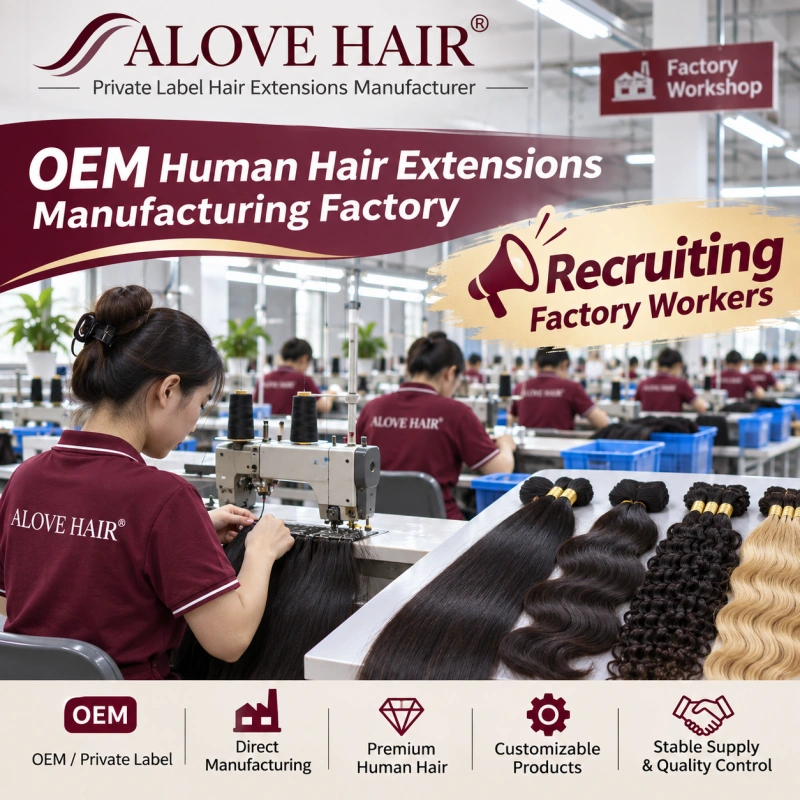
Private Label vs OEM vs ODM Hair Extensions
Although these terms are frequently used together, they describe different levels of product development and customization.
Understanding the differences helps buyers choose an appropriate manufacturing solution.
| Feature | White Label | Private Label | OEM | ODM |
|---|---|---|---|---|
| Product design | Existing product | Existing or customized product | Buyer-defined specification | Joint or manufacturer-led development |
| Brand name | Buyer’s brand | Buyer’s brand | Buyer’s brand | Buyer’s brand |
| Packaging customization | Basic | Available | Extensive | Extensive |
| Product customization | Limited | Moderate to extensive | Extensive | Extensive |
| Development investment | Generally lower | Depends on specifications | Generally higher | Depends on development complexity |
| MOQ | Often lower | Project-dependent | Project-dependent | Project-dependent |
| Product differentiation | Limited | Moderate to high | High | Potentially high |
| Best for | Startups testing demand | Salons and growing brands | Established hair brands | Innovative product development |
Private Label Hair Extensions
Private labeling is suitable for businesses that want to sell established extension constructions using their own branding, packaging, and selected product specifications.
This is often a practical starting point for salon owners launching their first extension collection.
OEM Hair Extensions
OEM manufacturing is appropriate when you already know your desired product specifications.
For example, you may require a specific Genius Weft seam thickness, a customized 50g tape-in pack, a unique rooted blonde shade, or a particular keratin bond size.
ODM Hair Extensions
ODM projects involve more extensive product development, potentially including new attachment structures, product configurations, textures, or packaging concepts.
For such projects, development costs, intellectual property ownership, exclusivity, and minimum production quantities should be agreed in writing.
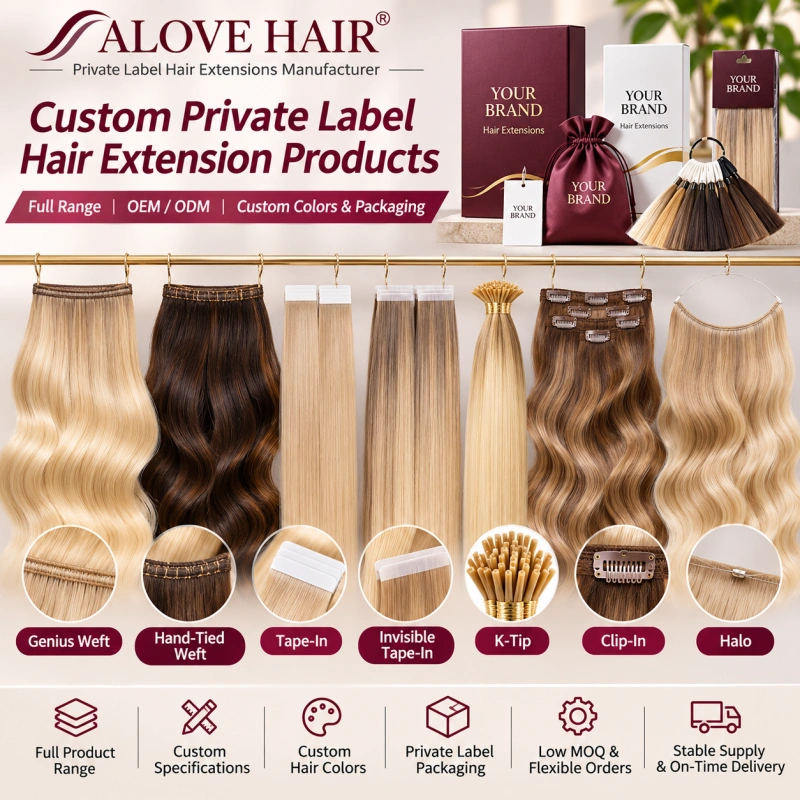
Private Label Hair Extension Products We Manufacture
Choosing the right product portfolio is one of the most important decisions when building a hair extension brand.
We recommend starting with the installation methods that your customers already understand, then expanding the collection based on actual sales and stylist feedback.
Our professional human hair extension collection covers multiple attachment systems for salon services, wholesale distribution, and beauty retail.
Private Label Genius Weft Hair Extensions
Genius Wefts are a core product category for premium professional hair extension brands.
Their relatively thin, flexible attachment construction makes them attractive to stylists who require discreet installation and flexible weft placement.
Customization requirements may include:
- Hair length
- Weft width and thickness
- Weight per weft
- Hair density
- Double-drawn finish
- Standard and custom colors
- Rooted and balayage shades
- Branded packaging
Explore our Genius Wefts and Micro Wefts to develop a professional weft collection suited to your target market.
Best for: Premium hair brands, extension specialists, salon chains, and professional weft distributors.
Private Label Hand-Tied Hair Extensions
Hand-tied wefts are designed for professional installations requiring a lightweight and discreet attachment structure.
Their handcrafted construction is particularly relevant to premium salon services where flexibility and natural movement are important.
Our Hand-Tied Weft Hair Extensions provide a foundation for customized collections targeting experienced extension stylists.
Best for: Luxury salons, specialist extension studios, and premium professional brands.
Private Label Tape-In Hair Extensions
Tape-ins remain an important product category for salons seeking efficient installation services and repeat maintenance appointments.
Our Tape-In Hair Extensions can be developed around different lengths, shades, pack weights, and attachment configurations.
Buyers should confirm adhesive compatibility, tab dimensions, individual piece weight, and replacement tape specifications before bulk production.
Best for: Professional salons, distributors, beauty supply businesses, and established extension brands.
Private Label Invisible Tape-In Hair Extensions
Invisible tape-ins feature a discreet attachment structure designed to reduce the visibility of the bonding area.
Our Cuticle Intact Invisible Tape-In Extensions include a published configuration of 100g per pack, 40 individual pieces, and a 1 × 4 cm attachment size.
This corresponds to a nominal average weight of 2.5g per piece.
Private label buyers can discuss alternative product configurations, shades, lengths, and packaging according to their project requirements.
Best for: Premium salon brands, discreet extension collections, and professional volume-enhancement services.
Private Label K-Tip Hair Extensions
K-Tip extensions are individual pre-bonded hair strands used in professional keratin fusion installations.
When developing a branded collection, buyers should evaluate the strand weight, bond dimensions, bonding material, and consistency of the attachment structure.
Our K-Tip Hair Extensions can support professional product development for salons specializing in strand-by-strand extension methods.
Best for: Luxury salons, professional fusion extension specialists, and distributors.
Private Label Clip-In Hair Extensions
Clip-in extensions are removable hair products suitable for beauty retailers, online sellers, and consumer-facing hair brands.
A customized collection can be developed around set weight, number of pieces, weft width, clip placement, hair length, and packaging.
Our Clip-In Hair Extensions offer an additional product category for businesses targeting customers who prefer removable extensions.
Best for: E-commerce brands, beauty retailers, bridal businesses, and direct-to-consumer companies.
Private Label Halo Hair Extensions
Halo extensions provide an alternative removable extension format that does not require permanent attachment.
When developing a halo collection, buyers should confirm hair weight, weft width, wire specifications, adjustability, and accessory compatibility.
Explore our Halo Hair Extensions for customized retail and professional product opportunities.
Best for: Online hair extension brands, beauty retailers, and businesses specializing in removable hair products.
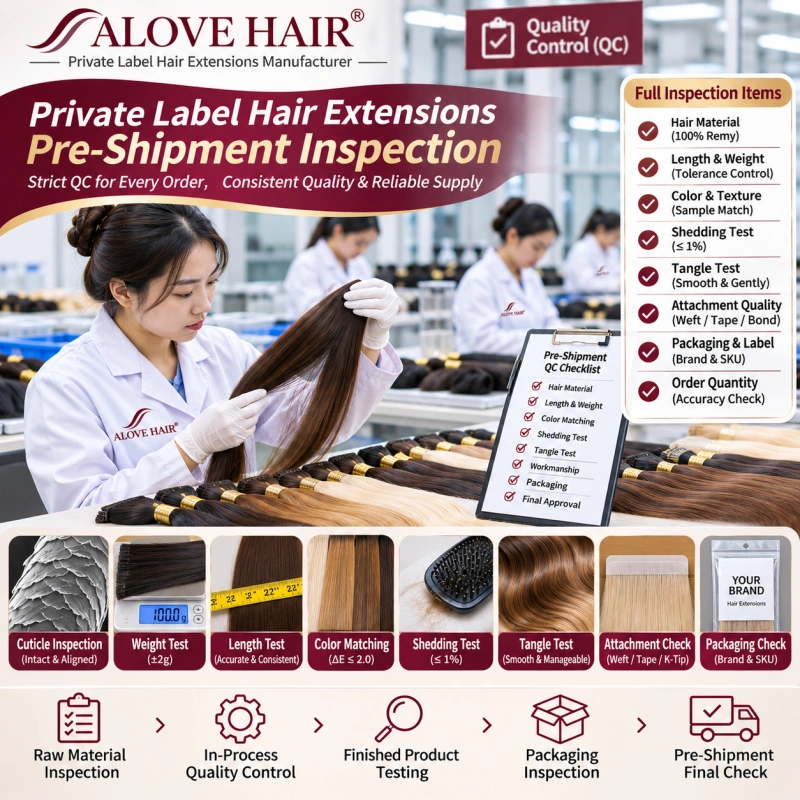
Private Label Hair Extension Product Specifications
The following table provides recommended starting configurations for product development.
These are proposed purchasing specifications, not universal stock availability or fixed manufacturing commitments.
| Product | Suggested Length | Example Pack Weight | Key Customization |
|---|---|---|---|
| Genius Weft | 16–26 inches | 50–100g | Seam dimensions and density |
| Hand-Tied Weft | 16–24 inches | 50–100g | Weft width and piece count |
| Double Genius Weft | 18–26 inches | 50–100g | Density and thickness |
| Regular Tape-In | 14–26 inches | 50–100g | Tab dimensions and adhesive |
| Invisible Tape-In | 14–26 inches | 50–100g | Hair coverage and tab weight |
| K-Tip | 16–26 inches | 50–100g | Bond size and strand weight |
| Clip-In | 14–24 inches | 100–200g | Set structure and clip layout |
| Halo | 14–24 inches | 80–150g | Weft width and wire structure |
The final specification should be approved for each product before production begins.
What Can You Customize With Our OEM Hair Extensions Service?
Successful private labeling goes beyond placing a logo on a standard hair extension package.
The most competitive brands establish a product identity that customers recognize through appearance, performance, packaging, and consistency.
1. Custom Hair Material and Drawn Finish
Hair quality is the foundation of a premium extension brand.
At ALOVE HAIR, our core professional collection focuses on cuticle-intact Remy human hair, with customization options developed around the intended product application.
Buyers should consider:
- Cuticle condition and alignment
- Hair processing history
- Hair diameter and texture
- Length distribution
- Hair softness and movement
- End fullness
- Shedding and tangling performance
- Color-processing requirements
Single-drawn and double-drawn products contain different distributions of hair lengths. Double-drawn hair generally provides a fuller appearance toward the ends.
However, double-drawn hair and double-weft construction are different specifications.
For brands targeting higher-volume salon services, our Double Genius Wefts offer an additional construction option for product development.
2. Custom Hair Extension Length and Weight
Two extension packs with identical lengths and packaging can contain significantly different quantities of hair.
A clear private label specification should identify both the total net hair weight and the number of individual pieces.
| Example Product Configuration | Pack Weight | Piece Count | Average Piece Weight |
|---|---|---|---|
| Tape-In A | 50g | 20 | 2.5g |
| Tape-In B | 100g | 40 | 2.5g |
| K-Tip A | 50g | 50 | 1.0g |
| K-Tip B | 50g | 100 | 0.5g |
| Genius Weft A | 50g | 1 | 50g |
| Genius Weft B | 100g | 2 | 50g |
These examples demonstrate how the same attachment method can be configured for different service requirements.
For accurate quotations, buyers should also specify whether the stated weight includes tapes, clips, threads, bonds, or other attachment materials.
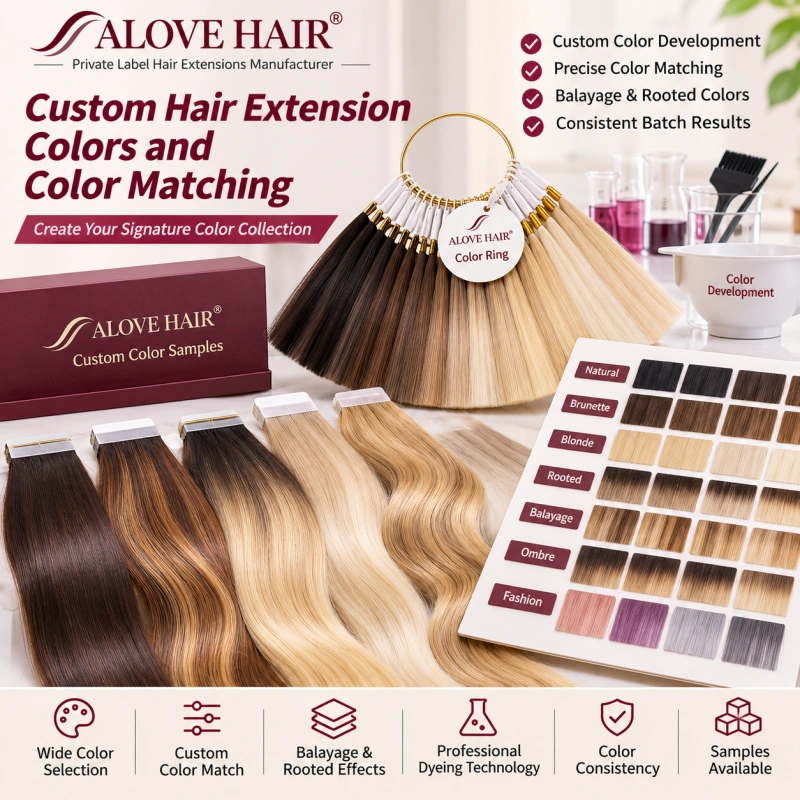
3. Custom Hair Colors
Color development is one of the most effective ways to differentiate a professional hair extension collection.
A branded color range may include:
| Color Family | Product Development Options |
|---|---|
| Natural dark shades | Natural black, dark brown |
| Brunette shades | Chocolate, chestnut and ash brown |
| Blonde shades | Beige, ash, golden and platinum blonde |
| Rooted shades | Dark root with blended lighter lengths |
| Balayage shades | Multi-tonal highlights and blended color transitions |
| Ombre shades | Gradual transitions between selected colors |
| Fashion colors | Selected custom shades subject to processing feasibility |
We recommend approving physical color swatches rather than relying entirely on digital images.
Screen brightness, photography lighting, and camera settings can make the same hair sample appear different online.
For rooted and balayage products, the approved specification should also record the root length, color proportions, and transition pattern.
4. Custom Texture
Different markets require different textures and styling results.
Possible product development options include straight, natural wave, body wave, and selected curly textures.
Before approving a custom texture, buyers should test the product after washing and natural drying.
A texture that looks attractive immediately after unpacking may behave differently after repeated maintenance.
5. Custom Attachment Structures
Attachment quality has a direct influence on the usability of professional hair extensions.
| Product | Attachment Details to Approve |
|---|---|
| Genius Weft | Seam thickness, height, width and flexibility |
| Hand-Tied Weft | Stitching consistency and return hair |
| Tape-In | Tab width, adhesive and backing material |
| Invisible Tape-In | Hair coverage, attachment thickness and flexibility |
| K-Tip | Bond dimensions and individual strand weight |
| Clip-In | Clip type, positioning and stitching |
| Halo | Wire strength, fit and adjustment mechanism |
As a manufacturer, we encourage buyers to evaluate the complete extension system rather than focusing only on hair softness.
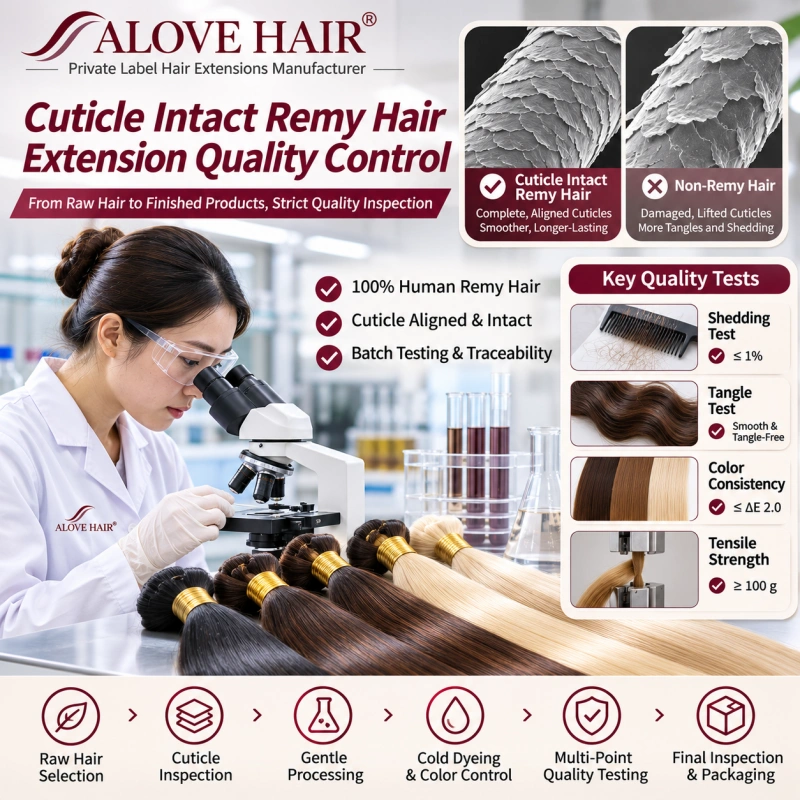
Our Cold Dyeing Technology for Premium Hair Extensions
Achieving clean blonde shades without excessive deterioration of the hair fiber is a significant manufacturing challenge.
Highly processed hair may initially appear smooth and attractive but become more difficult to manage after repeated washing, brushing, and styling.
ALOVE HAIR uses specialized color-processing methods designed to protect the hair structure while achieving natural-looking shades.
Our cold bleaching and dyeing technology is particularly relevant to premium blonde, ash, rooted, and balayage collections.
Potential benefits of carefully controlled color processing include:
- Better preservation of the hair’s natural structure
- More controlled color development
- Improved consistency between approved color samples
- Reduced risk of excessive processing
- More natural-looking color transitions
Actual hair performance depends on the original material, processing requirements, maintenance conditions, and individual product specification.
Manufacturing Insight: Blonde Hair Requires Separate Approval
A practical mistake in hair extension sourcing is approving one dark-colored sample and assuming every light shade will perform in the same way.
Light blonde hair generally requires more intensive color processing than darker shades.
For a premium private label collection, we recommend evaluating at least one representative shade from each major color family, including the most heavily processed blonde shade in your intended range.
This provides a more useful basis for product approval than testing only the easiest color to manufacture.
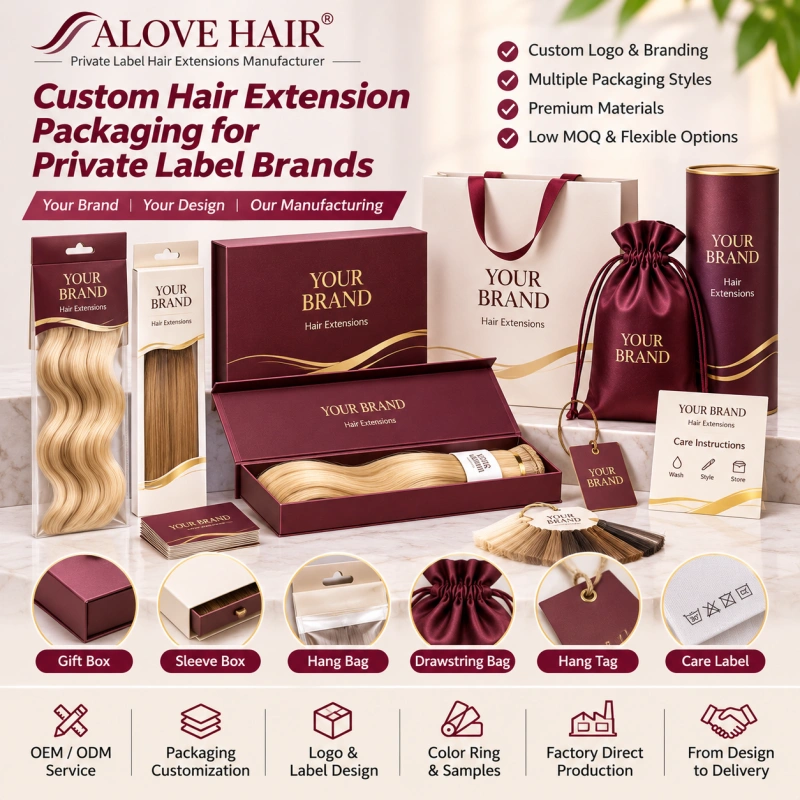
Custom Hair Extension Packaging for Your Brand
Packaging influences how customers perceive the quality and value of your hair extension products.
However, attractive packaging must also serve practical purposes, including product protection, identification, storage, and inventory management.
ALOVE HAIR supports customized packaging projects for professional hair extension businesses.
Private Label Packaging Options
| Packaging Type | Suitable Application |
|---|---|
| Branded plastic or protective bags | Economical wholesale collections |
| Custom paper sleeves | Retail and professional salon products |
| Printed hang tags | Product identification and branding |
| Drawstring bags | Premium extension storage |
| Custom retail boxes | E-commerce and beauty retail |
| Magnetic gift boxes | Luxury collections |
| Care instruction cards | Customer education |
| Barcode labels | Warehouse and retail inventory |
| Color rings | Professional color consultation |
| Customized accessory kits | Salon and stylist collections |
Specific packaging materials, printing methods, artwork requirements, and minimum quantities should be confirmed before ordering.
Recommended Information on Hair Extension Packaging
Professional packaging should communicate more than your brand name.
Consider including:
- Brand name and logo
- Product collection name
- Extension type
- Color code
- Hair length
- Net hair weight
- Number of pieces
- Hair material description
- SKU or barcode
- Care instructions
- Country-of-origin information where required
- Production or batch reference, where supported
Clear labeling reduces inventory mistakes and helps customers reorder the correct product.
Packaging Insight: Separate Product MOQ From Packaging MOQ
Hair manufacturing and packaging production often involve different minimum order quantities.
For example, a buyer may need only 100 packs of hair for an initial launch but receive a quotation requiring 500 printed boxes.
In this situation, using standardized packaging with custom labels may be more economical than committing to a large quantity of fully customized boxes.
As sales increase, the brand can transition to more sophisticated packaging.
The objective is to invest in packaging that supports sales rather than creating unnecessary inventory costs.
How Much Inventory Do You Need to Start a Private Label Hair Extension Brand?
One of the biggest challenges for new hair extension brands is managing the number of stock-keeping units, commonly known as SKUs.
Every combination of product type, color, length, and weight creates a separate inventory requirement.
How to Calculate Hair Extension SKUs
Total SKUs = Product methods × Lengths × Colors × Pack configurations
Consider a brand offering:
- 2 extension methods
- 3 lengths
- 12 colors
- 2 pack configurations
This produces 144 individual SKUs.
If the company purchases five packs per SKU, it must purchase 720 packs before making its first sale.
For a new business, that may represent unnecessary financial exposure.
Three Example Private Label Launch Models
| Launch Model | Methods | Lengths | Colors | Packs per SKU | Total Packs | Hair Weight at 100g/Pack |
|---|---|---|---|---|---|---|
| Startup test collection | 1 | 2 | 6 | 5 | 60 | 6kg |
| Professional salon brand | 2 | 2 | 10 | 5 | 200 | 20kg |
| Established distributor | 3 | 3 | 12 | 5 | 540 | 54kg |
These models assume one pack configuration and equal quantities across all SKUs.
They are inventory planning examples rather than fixed ALOVE HAIR order requirements.
Our Recommendation for New Hair Brands
Start with one main product family, a manageable selection of lengths, and a core group of colors.
Collect information about actual customer demand before expanding.
A business with six consistently selling shades may be more profitable than a business carrying 30 shades that rarely sell.
Private Label Hair Extensions MOQ and Lead Time
Minimum order quantities depend on the attachment method, hair material, color complexity, package configuration, and degree of customization.
Our general published order guidelines are:
| Order Stage | General ALOVE HAIR Guideline |
|---|---|
| Product sampling | From 100g per color |
| Suggested bulk quantity | 500–1,000g per color |
| Standard sample production | Usually 1–2 weeks |
| Bulk production | Usually 2–3 weeks |
| New custom color development | Confirmed by project |
| Custom packaging MOQ | Confirmed by packaging type |
| Complex OEM/ODM development | Individually evaluated |
| International shipping | Quoted according to destination and service |
At 100g per pack, a bulk quantity of 500–1,000g corresponds to five to ten packs by weight.
However, this does not automatically establish the MOQ for every individual length, color, or custom packaging combination.
Buyers should request an itemized quotation covering each SKU.
Working directly with our China hair extension factory allows you to discuss the manufacturing requirements before committing to a large inventory investment.
How Much Do Private Label Hair Extensions Cost?
Private label hair extension prices vary according to the quality of the human hair, product construction, length, weight, color processing, customization, and order quantity.
For professional buyers, we recommend evaluating the total landed cost rather than comparing factory quotations alone.
Main Private Label Cost Components
| Cost Component | What It Includes |
|---|---|
| Hair material | Human hair quality and raw material selection |
| Manufacturing | Processing, wefting, bonding or attachment |
| Custom color | Special shade development and processing |
| Packaging | Bags, boxes, labels and printed materials |
| Sampling | Product development and approval samples |
| Inspection | Internal or third-party quality verification |
| International freight | Transportation and handling |
| Import costs | Applicable duties, taxes and clearance fees |
Example: Private Label Hair Extension Cost Calculation
The following scenario illustrates the potential cost of an initial 100-pack order. These are hypothetical planning figures, not current ALOVE HAIR quotations.
| Cost Component | Example Cost |
|---|---|
| 100 packs of hair at $95 | $9,500 |
| Custom packaging at $2 per pack | $200 |
| Sample development | $150 |
| Quality inspection | $100 |
| International shipping | $350 |
| Assumed import and clearance costs | $400 |
| Total estimated landed cost | $10,700 |
| Average landed cost per pack | $107 |
If the brand sells each pack for $199, its potential gross product profit is $92 per pack.
The illustrative gross margin is approximately 46.2%, before payment processing, advertising, warehousing, returns, taxes, and general business expenses.
Actual product quotations depend on the approved specifications.
Import duties and taxes must be calculated using the current requirements of the destination country.
How We Develop Your Private Label Hair Extension Collection
A professional OEM project should follow a structured process that reduces misunderstandings between the buyer and the manufacturer.
Step 1: Define Your Target Market
Tell us whether your products are intended for:
- Professional hair salons
- Independent extension stylists
- Wholesale distributors
- Beauty supply stores
- Online hair extension retailers
- Luxury private label brands
- Hair extension training academies
Your target market helps determine product quality, packaging, product range, and commercial positioning.
Step 2: Confirm Product Specifications
Select your preferred hair extension method, hair material, lengths, colors, texture, weight, and attachment structure.
A reference sample from your current collection can also help communicate your expectations.
Step 3: Develop and Review Samples
Samples allow you to evaluate hair quality, color accuracy, attachment construction, weight, and potential installation performance.
We recommend testing representative products before approving an entire collection.
Step 4: Approve Packaging and Branding
Provide your logo, packaging artwork, brand colors, labeling requirements, and preferred retail presentation.
Approve the packaging proof before mass production.
Step 5: Confirm the Production Order
Agree on product specifications, quantities, prices, packaging requirements, lead time, payment terms, and inspection criteria.
These details should be documented in the final order confirmation.
Step 6: Manufacturing and Quality Inspection
Production proceeds according to the approved order specification.
Before shipment, products should be inspected against the agreed quality and packaging requirements.
Step 7: International Delivery
Shipping arrangements are confirmed according to the destination country, delivery schedule, shipment weight, and agreed trade terms.
Step 8: Repeat Orders and Collection Expansion
Retain the approved specifications, color references, packaging artwork, and order records for future purchases.
As your brand grows, the collection can be expanded based on proven customer demand.
Hair Extension Quality Control: From Sample Approval to Bulk Production
Consistent product quality is more important to a private label brand than a single impressive sample.
A reliable purchasing program requires clear acceptance criteria for both the initial sample and every subsequent bulk order.
Recommended Quality Control Checklist
| Inspection Item | What Buyers Should Verify |
|---|---|
| Hair material | Approved human hair specification |
| Cuticle alignment | Consistency with the agreed quality grade |
| Hair length | Agreed measurement method and tolerance |
| Net weight | Approved weight per pack |
| Drawn finish | Length distribution and end fullness |
| Color | Comparison with approved physical swatches |
| Texture | Appearance after washing and drying |
| Tangling | Performance during controlled brushing and washing |
| Shedding | Hair loss under an agreed test procedure |
| Weft construction | Seam dimensions, flexibility and integrity |
| Adhesive | Tape adhesion and removal performance |
| Keratin bond | Bond dimensions and structural consistency |
| Packaging | Artwork, labels and pack configuration |
| Quantity | SKU-level count and order accuracy |
Example Product Acceptance Specification
The following is an example of a buyer-defined quality specification for a 100g invisible tape-in product.
| Specification | Example Acceptance Requirement |
|---|---|
| Nominal pack weight | 100g |
| Example weight tolerance | ±2g |
| Piece count | 40 pieces |
| Nominal tab size | 1 × 4 cm |
| Example tab dimension tolerance | ±1mm |
| Color | Match approved physical color reference |
| Hair texture | Match approved sample |
| Attachment appearance | No significant exposed or damaged attachment area |
| Packaging | Correct artwork, color code and SKU |
The proposed tolerances are illustrative purchasing criteria. They are not universal industry standards or automatically guaranteed factory tolerances.
The buyer and manufacturer should agree on achievable measurement methods and acceptance limits before production.
How to Evaluate a Private Label Hair Extensions Manufacturer
Before choosing a long-term manufacturing partner, evaluate more than product photographs, price lists, and marketing claims.
A structured supplier assessment helps compare potential manufacturers objectively.
100-Point Hair Extension Manufacturer Evaluation System
| Evaluation Area | Maximum Score |
|---|---|
| Raw hair quality and processing | 20 |
| Sample performance | 15 |
| Batch and color consistency | 15 |
| Attachment manufacturing quality | 10 |
| OEM/ODM customization capability | 10 |
| Manufacturing transparency and sourcing documentation | 10 |
| MOQ and pricing transparency | 5 |
| Packaging capability | 5 |
| Delivery reliability | 5 |
| After-sales support | 5 |
| Total | 100 |
Suggested evaluation:
- 90–100: Consider long-term cooperation following successful trial orders.
- 80–89: Suitable for further evaluation.
- 70–79: Require improvements or additional testing.
- Below 70: Consider other sourcing options.
This is a proposed purchasing assessment model, not an independent certification system.
We recommend requesting factory information, physical samples, sourcing documentation where applicable, product specifications, and clear commercial terms before making a final decision.
Changing Your Existing Hair Extension Manufacturer
Established hair brands may face a different challenge from new businesses.
Rather than launching an entirely new collection, they may need to replace a current supplier without creating noticeable changes for their existing customers.
A manufacturer transition can create risks involving color consistency, hair texture, attachment dimensions, packaging, and inventory availability.
Recommended Supplier Transition Process
| Stage | Recommended Action |
|---|---|
| Product benchmarking | Submit samples from your current collection |
| Specification comparison | Record hair weight, length, color and attachment dimensions |
| New sample development | Compare new samples against existing products |
| Performance evaluation | Conduct comparable washing and professional wear tests |
| Packaging approval | Check artwork, barcodes and product labels |
| Pilot production | Test a limited quantity before switching suppliers |
| Inventory overlap | Maintain sufficient existing stock during the transition |
| Repeat-order approval | Confirm consistency before expanding production |
Manufacturing Insight: Do Not Change Everything at Once
If you are changing suppliers, avoid simultaneously changing the hair grade, color numbering system, attachment construction, packaging, and product weight.
When too many specifications change together, it becomes difficult to determine the cause of customer complaints or installation problems.
A controlled transition allows your team to evaluate changes systematically and protect the reputation of your existing brand.
Private Label Solutions for Different Hair Extension Businesses
For New Hair Extension Brands
A new brand should focus on a commercially manageable product assortment, representative sample testing, and packaging that fits its initial budget.
We recommend starting with fewer products and expanding once customer preferences become clearer.
For Professional Hair Salons
Salons can develop signature extension collections that reflect their preferred installation techniques and client requirements.
A salon brand may also combine hair extensions with professional hair extension accessories, including application tools and maintenance supplies.
For Wholesale Distributors
Distributors generally require larger inventories, accurate SKU identification, predictable production schedules, and consistent specifications across repeat orders.
Packaging efficiency and replenishment planning are particularly important.
For Established Hair Extension Brands
Established brands may require custom product development, additional color collections, alternative attachment structures, and improvements to existing products.
Manufacturing projects can be reviewed according to the brand’s existing specifications and commercial requirements.
For Hair Extension Training Academies
Training organizations may need coordinated student kits, practice products, color rings, tools, and standardized extension specifications.
Consistent training materials help instructors demonstrate techniques more effectively across different groups of students.
Example Private Label Project: Launching a Professional Genius Weft Brand
Consider a hypothetical hair extension business preparing to launch a premium Genius Weft collection for professional salons in the United States.
The brand wants to control its initial investment while offering several commercially relevant lengths and colors.
Initial Product Development Plan
| Project Item | Example Configuration |
|---|---|
| Target customers | Professional US salons |
| Product | Premium Genius Weft |
| Lengths | 18 and 22 inches |
| Color selection | 8 shades |
| Pack weight | 100g |
| Number of SKUs | 16 |
| Packs per SKU | 5 |
| Total packs | 80 |
| Total hair weight | 8kg |
| Packaging | Custom branded sleeve and care card |
| Color references | Approved physical swatches |
The proposed collection includes natural dark shades, brunette tones, selected blondes, and rooted or balayage options.
Instead of immediately purchasing 30 shades in several lengths, the brand begins with a focused product range.
After collecting sales and stylist feedback, it can increase quantities of frequently purchased shades and gradually introduce additional products.
This hypothetical case demonstrates how a private label launch can be planned around controlled inventory investment and measurable product demand.
It is not a representation of an actual ALOVE HAIR customer transaction.
Frequently Asked Questions
What is a private label hair extensions manufacturer?
A private label hair extensions manufacturer produces hair extensions that another company sells under its own brand name.
The manufacturer may support customized product specifications, colors, packaging, labeling, sample development, and bulk production.
Can I start a hair extension brand with a small order?
Yes. Starting with samples and a focused trial collection can reduce initial inventory investment.
ALOVE HAIR’s general published sample MOQ starts from 100g per color. Bulk and packaging minimums depend on the project.
Can you customize my hair extension colors?
Yes. We support custom color development based on approved physical samples and production requirements.
We recommend providing a physical swatch or reference product whenever possible.
Can I put my own logo on hair extension packaging?
Yes. Private label packaging may include branded bags, boxes, hang tags, sleeves, care cards, and selected labeling solutions.
Minimum quantities and production costs depend on the packaging format and printing requirements.
What types of private label hair extensions can you manufacture?
Our product portfolio includes Genius Wefts, Hand-Tied Wefts, Machine Wefts, Double Genius Wefts, Tape-Ins, Invisible Tape-Ins, K-Tips, I-Tips, U-Tips, Clip-Ins, Halo Extensions, and other selected products.
How long does private label hair extension production take?
Our general sample production time is approximately one to two weeks, and bulk production usually takes two to three weeks.
Complex customization, packaging development, material availability, and order size may affect the final schedule.
Do you supply cuticle-intact Remy human hair?
Yes. Cuticle-intact Remy human hair is a core focus of our professional hair extension collection.
The exact material and processing specification should be confirmed for your selected products.
Can you reproduce products from my current hair extension supplier?
We can review reference samples and discuss comparable specifications, including color, weight, length, texture, and attachment construction.
Exact reproduction depends on material availability, manufacturing feasibility, and any applicable intellectual property restrictions.
Can you guarantee the same hair color in future orders?
Hair is a natural material, and minor variations can occur between production batches.
Retaining approved physical color references and agreeing on acceptable color tolerances can help improve repeat-order consistency.
Do you provide exclusive OEM hair extension products?
Product exclusivity, custom design ownership, and commercial restrictions can be discussed for eligible projects.
Such arrangements should be confirmed in a separate written agreement.
Do you supply private label hair extensions to the USA and Europe?
Yes. ALOVE HAIR serves international professional buyers, including hair extension businesses targeting North America, Europe, and other markets.
Product labeling, import responsibilities, shipping costs, and applicable compliance requirements should be reviewed for each destination.
How can I get a wholesale quotation?
Provide your desired product types, lengths, colors, hair weight, estimated quantities, packaging requirements, destination country, and intended launch date.
This information allows us to prepare a more relevant manufacturing quotation.
Request Your Private Label Hair Extension Samples and OEM Quotation
Building a successful hair extension brand requires dependable products, clear specifications, effective quality management, and a manufacturing partner capable of supporting long-term growth.
At ALOVE HAIR, we combine human hair manufacturing expertise with flexible product development, private label services, and factory-direct wholesale solutions.
Whether you are launching your first hair extension collection, developing a signature salon brand, expanding your distribution business, or looking for a new manufacturing partner, we can help you evaluate a suitable production solution.
Send Us Your Project Requirements
| Information | Your Requirements |
|---|---|
| Company or brand name | |
| Destination country | |
| Hair extension type | |
| Preferred lengths | |
| Colors or reference samples | |
| Weight per pack | |
| Estimated order quantity | |
| Packaging requirements | |
| Target launch date | |
| Additional customization |
Start with a sample, approve your product specifications, and develop your collection with a manufacturing partner that understands professional hair extension businesses.
Contact ALOVE HAIR today to request private label samples, OEM/ODM solutions, factory-direct wholesale pricing, custom color development, and branded packaging options.
Build Your Brand With ALOVE HAIR — Your Professional Private Label Hair Extensions Manufacturer.


